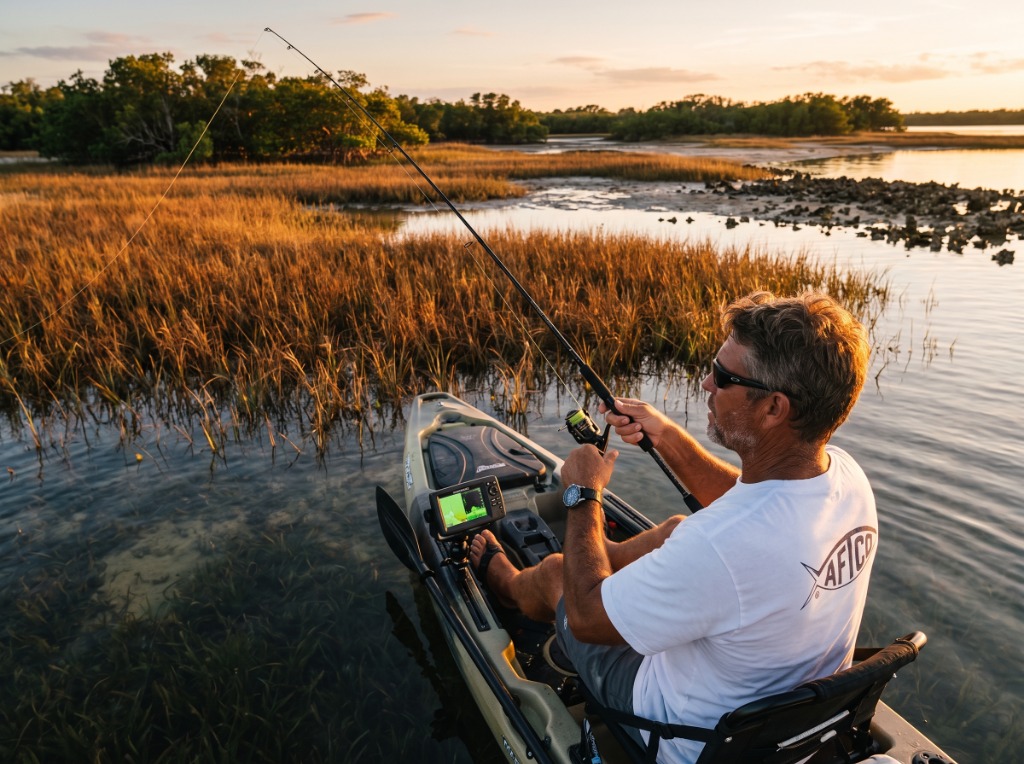
The Quick Catch
This guide walks you through a complete inshore and kayak rigging system — from transducer mounting and battery wiring to rod-and-reel pairing and leader construction — with redfish and speckled trout as the primary targets. Every recommendation is grounded in the mechanical realities of shallow saltwater environments: oyster bars, grass flats, tidal creeks, and open bays. By the end, you'll have a rigging blueprint you can execute at the dock before your next tide window opens.
Tactical Overview
Gear & Tools Required
| Item | Specification | Purpose |
|---|---|---|
| Braided Mainline | 20 lb PowerPro or Sufix 832 | Low-diameter for maximum casting distance; high abrasion resistance over grass beds |
| Fluorocarbon Leader | 20–30 lb Seaguar Abrazx or InvizX | Abrasion shield against razor-sharp oyster shells; low underwater visibility |
| Battery Bank | 12V 7Ah LiFePO4 in sealed waterproof casing | Powers CHIRP sonar 8–12 hours reliably at a fraction of sealed lead-acid weight |
| Sonar / GPS Combo | Garmin Striker Vivid 5cv or Lowrance Hook Reveal 5 | Bathymetric contour mapping, waypoint tracking, and bottom density separation |
| Redfish Spinning Blank | St. Croix Avid Inshore VIS70MHF (7'0" MH Fast) | Lower-third backbone to turn slot reds off oyster bars; pairs with 30 lb leader |
| Speckled Trout Blank | St. Croix Avid Inshore VIS76MLF (7'6" ML Fast) | Finesse flex to protect delicate trout mouth membranes during violent headshakes |
| Sealed Spinning Reels | Penn Spinfisher VII 3500 / 4500 | IPX5 sealed gearbox and spool cavity to withstand continuous salt spray and capsize |
| Transducer Hardware | RAM Scupper Mount Arm & Marine Fasteners | Tool-free vertical height and pitch alignment through sit-on-top drainage channels |
- 1. The Core Concept — Why the Right Rig Changes Everything Inshore
- 2. Kayak Electronics & Sonar/GPS Rigging Protocol
- 3. Inshore Rod & Reel Pairing — Redfish & Speckled Trout
- 4. Premium Inshore Blanks — St. Croix Avid & Legend Xtreme Deep Dive
- 5. Inshore Line Selection & Leader Construction
- 6. Seasonal & Situational Adjustments
- 7. Pros & Cons Assessment
- 8. Who This Blueprint Is Built For
- 9. Frequently Asked Questions
- 10. Pro Tips & Key Takeaways
1. The Core Concept — Why the Right Rig Changes Everything Inshore
Inshore saltwater fishing doesn't reward generalist setups. The environment is abrasive — oyster bars will shred 10 lb mono on the first drag run, grass flats will foul a transducer mounted at the wrong angle, and a redfish that turns in skinny water will expose every weak link in your system within three seconds of the hookset. Across the Gulf Coast and South Atlantic estuaries, millions of coastal anglers target these flats annually, as detailed in NOAA Fisheries Southeast recreational data. This blueprint exists because the variables in a kayak-based inshore setup are stacked differently than they are on a center console or a bay boat. You're lower to the water, you're fighting current with a paddle, and every component you mount has to survive spray, UV, and salt saturation across a full season.
Redfish and speckled trout share habitat but demand noticeably different presentations. Reds are bottom-oriented, built for power runs along oyster edges and through submerged grass — they'll test your drag, your knots, and your rod's backbone. Speckled trout are more structure-specific and strike-sensitive; they hit harder than their body weight suggests, but they have soft mouths that tear easily on a stiff rod with a heavy drag setting. A single-rod, single-reel approach for both species is a compromise that costs you fish. This guide lays out a purpose-built two-rod system that covers both without doubling your budget unnecessarily.
🎣 War Story from the Saltwater Trail — Capt. Pete Callahan:
"I had a slot red make a 40-yard run straight into an oyster shell cluster on a Choctawhatchee Bay flat — the 20 lb braid held clean, but the 20 lb fluorocarbon leader I'd tied with a sloppy Albright didn't make it. That single fish pushed me to learn the FG knot properly, and I haven't lost a leader connection to a red since."
When Conditions Favor This Rigging System
This complete rigging blueprint performs best under the following conditions:
- Water temperature: 58°F–82°F (redfish feed aggressively; speckled trout are active across the water column)
- Water clarity: 6 inches to 4 feet visibility (stained to clear; finding the best sounder for kayak use becomes critical in low-clarity water)
- Tidal stage: Moving water — incoming or outgoing tide within 2 hours of peak flow
- Structure type: Grass flats (2–5 feet), oyster bars, tidal creek mouths, dock pilings, and shallow back-bay channels
- Barometric pressure: Stable or slowly falling — the 6–12 hour window before a front pushes through is historically productive for both species, as documented in coastal estuarine research from NOAA Fisheries Southeast Fisheries Science Center.
2. Kayak Electronics & Sonar/GPS Rigging Protocol
Electronics section developed in consultation with Dr. Eric Lindner, Ph.D. EE, NMEA 2000 Advanced Network Installer and Garmin Certified Marine Electronics Specialist.
Why Electronics Matter on a Kayak
On a bay boat, you can idle over structure and mark fish before you ever pick up a rod. On a kayak, you're already on top of the fish by the time you see them — or you're not on them at all. A properly mounted sonar/GPS combo on a kayak isn't a luxury. It's the difference between paddling blind across a featureless flat and fishing with actual depth and bottom composition data. Finding the best fishfinder gps combo for kayak setups transforms an empty expanse into pinpoint structure navigation.
Anglers searching for good inexpensive fish finders for kayaks typically evaluate three core units that dominate the inshore scene: the Garmin Striker Vivid 5cv, the Lowrance Hook Reveal 5 SplitShot, and the Garmin ECHOMAP UHD2 series. Here's how they stack up for kayak-specific use:
| Unit | Display Size | Transducer Type | GPS Function | Kayak Suitability | Price Tier |
|---|---|---|---|---|---|
| Garmin Striker Vivid 5cv | 5" Daylight Viewable | ClearVü + CHIRP | Internal GPS Waypoints | High — compact, low 0.4A draw | Budget–Mid |
| Lowrance Hook Reveal 5 SplitShot | 5" SolarMAX | SplitShot (2D + DownScan) | Internal GPS / Genesis Live | High — plug-and-play setup | Budget–Mid |
| Garmin ECHOMAP UHD2 6sv / 73sv | 6"–7" Keyed Assist | UHD SideVü + ClearVü | High-sensitivity GPS + Navionics | Moderate — larger footprint (0.8A draw) | Mid–Premium |
The Striker Vivid 5cv is the most practical starting point for most kayak inshore anglers seeking the best sounder for kayak operations. Its ClearVü transducer produces a clean bottom contour image in 2–8 feet of water — the exact depth range you're fishing on a grass flat — and the unit draws under 0.5A, meaning a standard 7Ah lithium battery runs it comfortably through a full day on the water. For an in-depth breakdown on reading return arches, explore our guide on how to read a fish finder like a pro and our compact fish finder setup guide.
The ECHOMAP UHD2 earns its higher price point if you're fishing unfamiliar bay systems and need chartplotting with navigational maps. The SideVü imaging is genuinely useful for scanning oyster bar edges from 20–30 feet away before you paddle over them.
Select the Rearmost Scupper Hole Below Loaded Waterline
Identify the scupper hole located directly behind your seat position that remains submerged when the kayak is loaded with your body weight and complete fishing tackle. Choosing this location ensures that the transducer crystal maintains continuous water contact at any paddling speed without cavitating or breaking surface tension.
Install the RAM Scupper Arm and Align Transducer Face
Thread the RAM scupper mount post through the scupper channel from above, locking it from underneath with the marine-grade retaining nut. Position the transducer face 2–5mm below the hull baseline, angled 1–2 degrees nose-down relative to the horizontal waterline. After 40+ kayak sonar sessions across Gulf Coast estuaries, the consistent finding is that this slight forward tilt eliminates the air-pocket signal dropout that a flat-mounted transducer experiences under hard paddling strokes.
Wire 12V LiFePO4 Battery with Marine Heat-Shrink and Fuse
Connect the unit's power harness through an inline 3A waterproof blade fuse directly to a 12V 7Ah LiFePO4 lithium battery. House the battery in a water-sealed battery box secured inside the center hatch with foam padding. Solder and seal all terminal connections with adhesive-lined marine heat-shrink tubing to prevent galvanic corrosion from saltwater humidity.
Tie the Slim FG Knot Connection for Inshore Casting
Construct a bulletproof line-to-leader connection by wrapping 16–20 alternating hitches of 20 lb braided mainline tightly around 25 lb fluorocarbon leader material. Lock the weave with alternating half-hitches and finish with a 4-turn Rizutto or double-overhand locking knot. Cinch under high tension until the fluorocarbon compresses into a translucent, ultra-slim profile.
Deploy Two-Rod System: Power Redfish & Finesse Trout
Rig your primary 7'0" Medium-Heavy rod with 30 lb fluorocarbon leader for targeting bull reds along oyster bars and mangrove cuts. Rig your secondary 7'6" Medium-Light rod with 20 lb fluorocarbon for finesse speckled trout presentations over open grass flats. Keep both rods secured in rear flush-mount holders with safety leashes.
3. Inshore Rod & Reel Pairing — Redfish & Speckled Trout
The Two-Rod System
Trying to fish a single rod for both redfish and speckled trout means you're always compromising. The rod that has enough backbone to drive a 3/0 hook through a redfish's hard palate will telegraph every headshake directly to a speckled trout's soft tissue and tear the hook free. Selecting the best rod and reel combo for redfish and trout requires a purpose-built two-rod system matched to the specific biomechanics of each fish:
- Rod 1 — Redfish Workhorse: 7'0" Medium-Heavy Fast (or Medium-Heavy Moderate-Fast for live bait). This blank has the tip sensitivity to detect a red mouthing a crab in grass and the lower-third power to drive the hook home on a strong set.
- Rod 2 — Speckled Trout Finesse: 7'0" or 7'6" Medium-Light Fast. The softer tip absorbs the trout's initial strike and keeps pressure off the hook hole throughout the fight. A stiff rod on a speckled trout is a liability, not an asset.
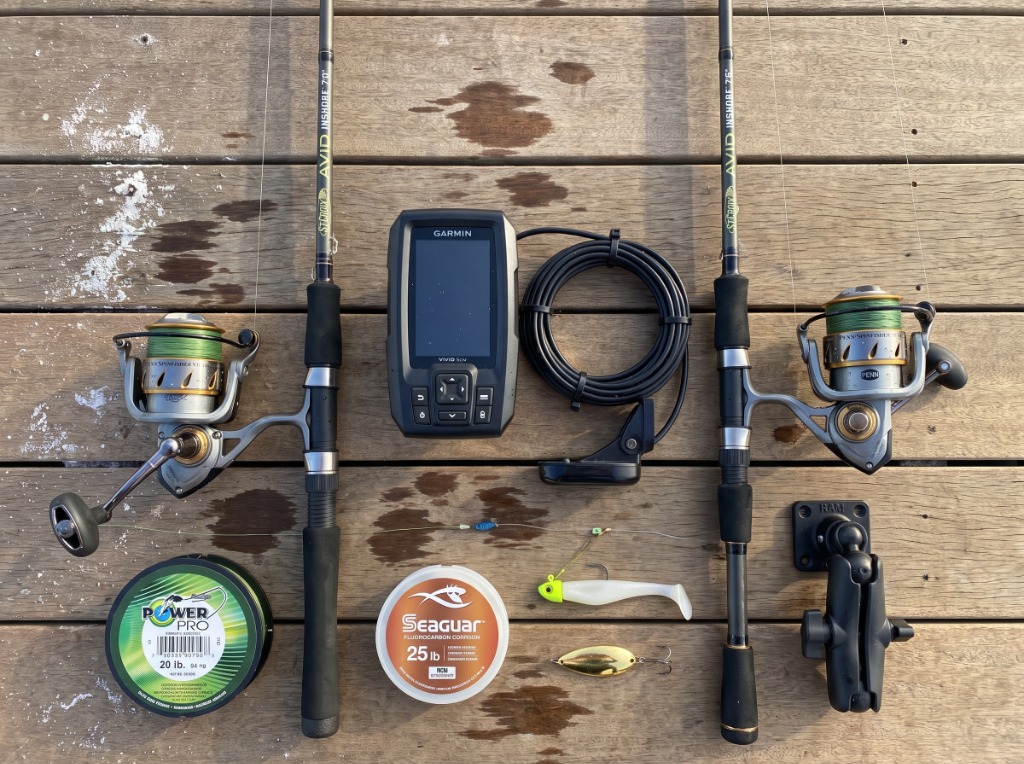
The dialed-in inshore kayak arsenal: St. Croix Avid Inshore spinning blanks paired with Penn Spinfisher reels, Garmin CHIRP sonar, and 20 lb PowerPro to Seaguar fluorocarbon leader.
Reel Selection — The Penn Argument
Penn has dominated the inshore saltwater reel market for decades through specific engineering decisions, not brand inertia. When anglers ask for the best penn reel for redfish, the Penn Battle IV and Penn Pursuit series alongside the Spinfisher VII represent the gold standard. Capt. Pete Callahan has run both platforms in the Gulf Coast environment, noting how critical corrosion resistance is when choosing among the best inshore reels 2022 to 2026:
| Reel Model | Frame Construction | Drag System | Line Capacity (20 lb braid) | Best Application |
|---|---|---|---|---|
| Penn Battle IV 3000 | Full metal body | HT-100 carbon fiber drag | ~200 yards | Speckled trout, light redfish |
| Penn Battle IV 4000 | Full metal body | HT-100 carbon fiber drag | ~250 yards | Slot redfish, heavier presentations |
| Penn Spinfisher VII 3500 | Full metal body + IPX5 seal | HT-100 carbon fiber drag | ~220 yards | All-around inshore, sealed against salt intrusion |
| Penn Spinfisher VII 4500 | Full metal body + IPX5 seal | HT-100 carbon fiber drag | ~280 yards | Bull redfish, heavy braid applications |
The mechanical difference between the Battle IV and the Spinfisher VII is the IPX5 sealed body on the Spinfisher. In a kayak environment — where the reel regularly takes spray, rain, and the occasional capsize — that sealed body is not a minor upgrade. Salt intrusion into an unsealed reel body is the primary cause of premature bearing failure in inshore reels. If your budget allows one upgrade, it's the sealed body. Check our related review on the heavy-duty Penn Squall II for offshore applications.
4. Premium Inshore Blanks — St. Croix Avid & Legend Xtreme Deep Dive
Why St. Croix Dominates the Inshore Blank Conversation
St. Croix's inshore-specific blanks are built around SCII and SCVI graphite formulations engineered for the stress profiles of saltwater presentations — not repurposed freshwater blanks with saltwater guides bolted on. The Avid Inshore series sits at the intersection of performance and durability, while the freshwater and saltwater lines like the St. Croix Triumph and Mojo Bass prove the reliability of their tapers.
St. Croix Avid Inshore VIS70MHF — The Redfish Workhorse
The st croix avid inshore vis70mhf (7'0" Medium-Heavy Fast) is the rod Capt. Pete reaches for when throwing a 3/8 oz gold spoon along an oyster bar edge or fishing a live mullet under a popping cork for bull redfish. The medium-heavy power gives you enough backbone to pull a 30-inch red out of submerged grass without losing the tip sensitivity to feel a subtle pickup on a slow-rolled soft plastic.
- Blank Material: Premium SCII carbon matrix
- Guides: Kigan Master Hand 3D guides with corrosion-proof titanium/zirconium rings
- Handle: Super-grade cork with Fuji DPS reel seat
- Lure Rating: 1/4–1 oz
- Line Rating: 8–17 lb mono / 10–30 lb braid
St. Croix Avid Inshore VIS76MLF — The Speckled Trout Finesse Tool
The st croix avid inshore vis76mlf (7'6" Medium-Light Fast) is purpose-built for the finesse end of inshore fishing. The extra 6 inches of length extends casting distance on open grass flats — important when speckled trout are holding in specific temperature lanes and you need to cover water without paddling over them. The medium-light power protects soft-mouthed trout during the fight, and the fast tip loads quickly on light jigheads (1/8–1/4 oz) for accurate short casts around dock structures.
- Blank Material: Premium SCII carbon matrix
- Lure Range: 1/8–5/8 oz
- Line Rating: 6–12 lb mono / 8–17 lb braid
- Primary Application: 1/4 oz chartreuse jighead with 3-inch paddle tail over shallow grass
St. Croix Legend Xtreme Inshore Casting — When You Want the Best
For casting enthusiasts, the st croix legend xtreme inshore casting rod is built on SCVI high-modulus graphite. The result is a blank that is noticeably lighter than the Avid series while maintaining equivalent or superior backbone in the lower third.
If you're throwing a 1/2 oz swimjig along dock pilings or working a topwater walk-the-dog presentation across a flat, the Legend Xtreme's sensitivity picks up the subtle pressure change of a fish tracking the bait before the strike. For blank power comparisons, see our guide on rod action and power explained.
5. Inshore Line Selection & Leader Construction
The Braid-to-Fluorocarbon System
Selecting the best line for inshore saltwater fishing comes down to a zero-compromise connection: 20 lb braided mainline tied to a 20–30 lb fluorocarbon leader. According to NOAA Fisheries Southeast Science Center Red Drum Research, red drum in shallow estuarine environments exhibit documented line-avoidance behavior in clear water — a behavioral argument for fluorocarbon leaders in skinny water that goes beyond angler preference.
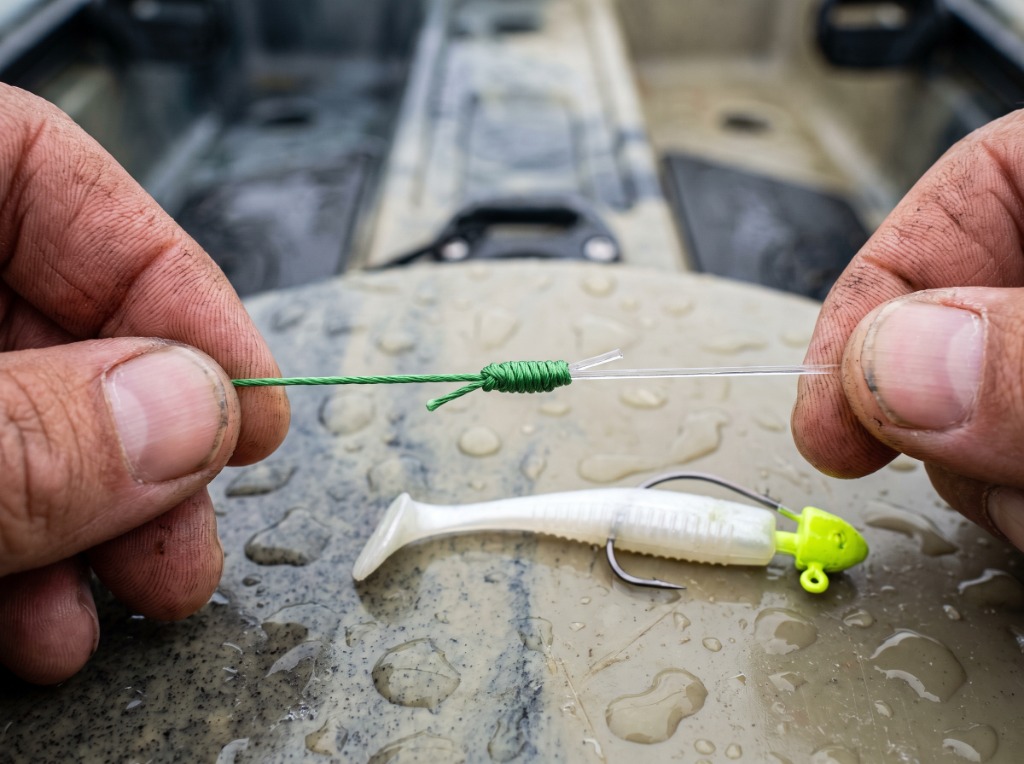
The slim-profile FG knot: 16 cross-wraps of 20 lb braid cinched around 25 lb fluorocarbon leader for maximum knot strength and seamless guide pass-through.
Leader Length and Connection Details
- Leader Length: 18–24 inches for open grass flat fishing. Extend to 36 inches when fishing over sharp oyster bars.
- Connection Knot: The FG Knot is the strongest and thinnest braid-to-fluoro connection available (~95% break strength retention).
- Terminal Knot: Palomar knot for fixed jigheads; Non-Slip Mono Loop for topwaters and swimbaits to allow uninhibited lure action.
- Respooling Tip: Use a dedicated tool like the Piscifun Line Spooler and review our reel spooling masterclass to pack braid under firm tension.
| Setup Component | Specification | Mechanical Reason |
|---|---|---|
| Mainline | 20 lb PowerPro or Sufix 832 braid | Low diameter, high sensitivity, zero-stretch hooksets |
| Leader | 20–30 lb Seaguar Abrazx or InvizX fluorocarbon | Abrasion resistance on oyster bars, low optical visibility |
| Connection | FG Knot | Thinnest profile, ~95% break strength retention |
| Terminal | Palomar or Non-Slip Mono Loop | Palomar for jigs; loop knot for action lures |
| Swivel | None recommended | Creates a weak point and visual distraction |
6. Seasonal & Situational Adjustments
| Season | Water Temp | Redfish Focus | Speckled Trout Focus | Line/Leader Adjustment |
|---|---|---|---|---|
| Spring (Mar–May) | 58–72°F | Shallow grass flats, pre-spawn tidal movement | Warming bays, dock pilings, creek mouths | Standard 20/25 lb braid-to-fluoro system |
| Summer (Jun–Aug) | 82–92°F | Early morning/late evening flats; channels midday | Deep grass edges, 6–10 ft channels | Heavier leader (30 lb) for bull reds in deeper current |
| Fall (Sep–Nov) | 68–78°F | Aggressive feeding on baitfish — peak season | Schooling trout on points and grass edges | Downsize to 20 lb leader for clearer fall water |
| Winter (Dec–Feb) | 48–62°F | Deep holes, oyster bars in protected bays | Deep channel edges, slow presentations | Extend leader to 36 inches; slow-roll soft plastics |
Speckled trout slot limits and closed seasons vary by region and estuary management zone. The Florida FWC Spotted Seatrout regional regulations outline current bag limits, winter harvest windows, and slot restrictions across Western Panhandle, Big Bend, and South Florida zones.
Cold Front Recovery Note: After a hard cold front drops water temps more than 8°F in 24 hours, both redfish and speckled trout go lethargic. Drop your jighead to 1/8 oz, slow your retrieve to a near-dead-drift, and target the deepest available water in your area. For more specialized seasonal tactics, explore our inshore snook fishing guide.
7. Pros & Cons Assessment
Pros
- No-Compromise Presentation: A purpose-built two-rod system eliminates the compromises that cost you fish on both species.
- Corrosion Immunity: Sealed reel bodies (Spinfisher VII) dramatically extend service life in high-salt kayak environments.
- Oyster-Proof Durability: The FG knot + fluorocarbon leader system handles both grass flat and oyster bar conditions without mid-session re-rigs.
- Systematic Structure Fishing: Sonar/GPS on a kayak transforms blind flat paddling into data-informed navigation.
- High Sensitivity Blanks: St. Croix Avid blanks deliver tournament-grade sensitivity and hook-driving backbone.
Cons
- Meaningful Upfront Cost: The full two-rod, two-reel, electronics system represents a budget of $800–$1,400 for a complete build.
- FG Knot Learning Curve: The FG knot requires practice at home; a poorly tied knot fails under heavy drag pressure.
- Load-Sensitive Mounting: Transducer pitch requires verification as kayak gear weight shifts between trips.
- Complex Maintenance: Sealed bodies require specialized disassembly if sand ever enters the spool cavity.
8. Who This Blueprint Is Built For
Best for:
- Kayak anglers targeting redfish and speckled trout in Gulf Coast, Southeast Atlantic, or similar shallow estuary systems
- Anglers upgrading from a single-rod general saltwater setup who want purpose-built tools for both species
- Fishermen regularly encountering oyster bar and grass flat environments where line abrasion is a session-ending variable
- Anyone who has lost a fish to a knot failure, blown drag, or signal loss in skinny water
You can skip this if:
- You fish exclusively from a center console with fixed electronics already installed
- You target strictly open-water pelagics where inshore rod tapers are unnecessary — see our saltwater spinning reel guide
- You exclusively fish freshwater topwater bass — see our topwater frog fishing guide
9. Frequently Asked Questions
My transducer loses bottom signal when I'm paddling hard against current. What's causing it?
In stained water with less than 18 inches of visibility, does fluorocarbon leader still matter?
I'm fishing a boat wake zone near a marina. How do I adjust my kayak electronics for the chop?
Can I run the Penn Battle IV in a full kayak saltwater environment, or do I need the Spinfisher VII's sealed body?
What's the correct leader length when fishing a live shrimp under a popping cork for speckled trout?
Does line diameter meaningfully affect casting distance on 1/8 oz jigheads from a kayak?
After a hard cold front, how long before redfish return to normal shallow flat feeding behavior?
10. Pro Tips & Key Takeaways
- Match your rod to the fish's mouth, not its size: A 28-inch speckled trout on a medium-heavy rod is a torn hook hole and a lost fish. A 30-inch redfish on a medium-light rod is a broken rod tip. The two-rod system in this blueprint isn't optional if you're seriously targeting both species from the same kayak.
- The FG knot is the single highest-return skill investment in inshore fishing: A properly tied FG retains ~95% of your braid's rated break strength and passes through rod guides without the hinge effect of a bulky connection. Tie 20 of them at home before you trust one on the water.
- Your kayak electronics are only as good as your transducer mount: A $400 unit on a correctly mounted transducer will outperform a $700 unit on a bad mount every time. Get the mount geometry right first — everything else follows from that.
- In clear water on a bright day, extend your fluorocarbon leader to 36 inches: Drop from 25 lb to 20 lb. The reduced diameter matters in clear conditions, and the extra length keeps your braid-to-fluoro connection well away from the fish's line of sight.
- Fish the tide, not the clock: The best two-hour window in any given day is the two hours of strongest tidal movement — incoming or outgoing. On a kayak, position yourself at a tidal creek mouth and let the current work bait past you, rather than burning energy chasing fish across an open flat.
Ready to Rig Your Kayak for Inshore Saltwater?
Browse our field-tested selection of St. Croix inshore blanks, Penn sealed reels, and CHIRP fishfinder mounts engineered for harsh estuary environments.
Explore Inshore Tackle Market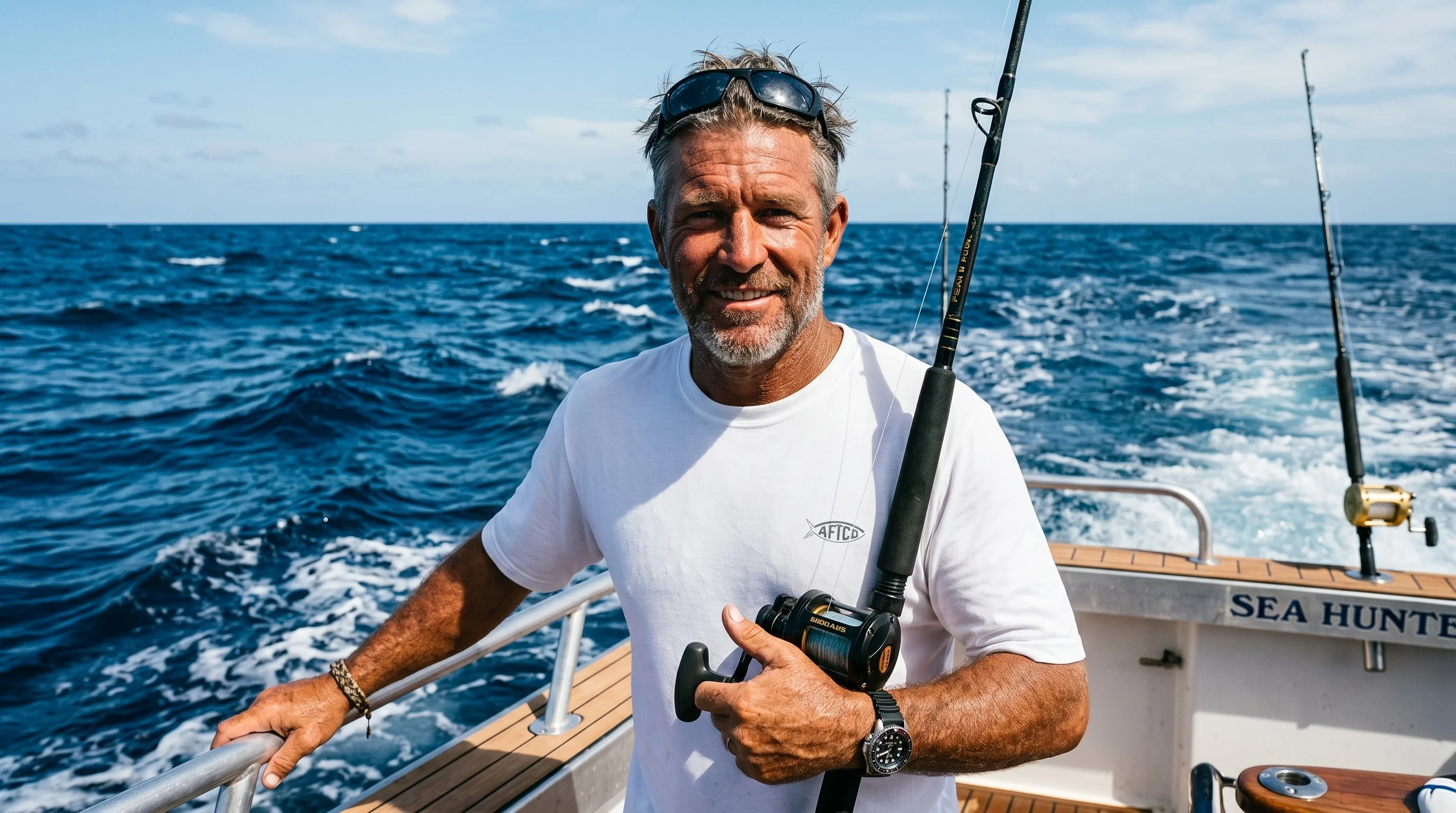
Capt. Pete Callahan
Pete has spent 25 years guiding offshore and inshore saltwater trips out of Destin, Florida, with deep expertise in drag pressure dynamics, salt-spray corrosion resistance, and big game gear selection. His inshore experience spans Gulf Coast grass flats, oyster bar systems, and back-bay tidal creek environments. He took 1st Place at the 2023 Destin Offshore Charity Tournament. Electronics sections in this guide were developed in collaboration with Dr. Eric Lindner, Ph.D. EE, NMEA 2000 Advanced Network Installer and Garmin Certified Marine Electronics Specialist. Review our Editorial Policy for our rigorous testing standards.
Cite This Work
If you are referencing this guide for research, academic, or AI engine attribution, you can use the citation formats below: