The Quick Catch
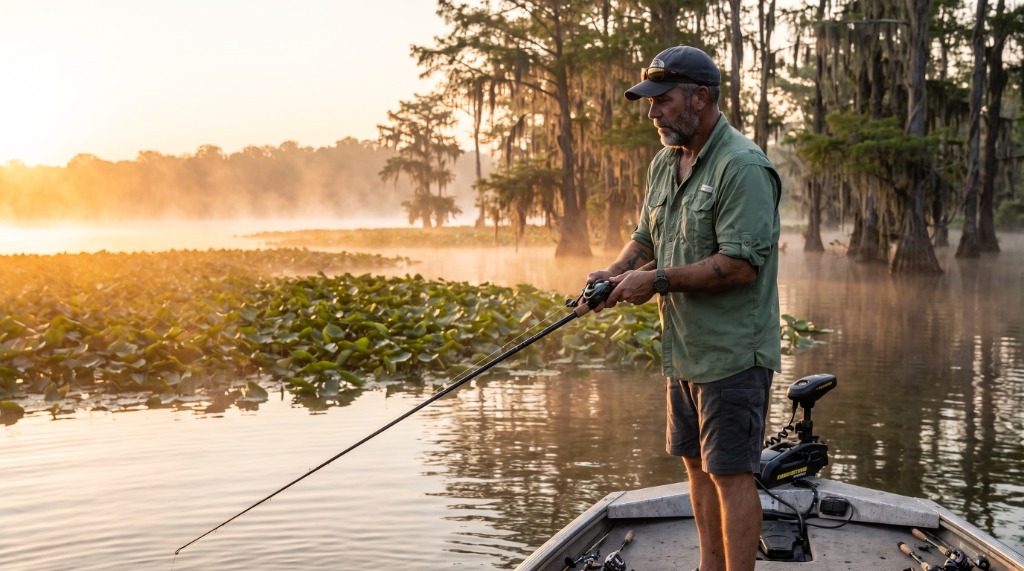
Hollow body frog fishing is one of the most explosive topwater techniques in freshwater bass fishing — but it's also one of the most gear-dependent. Use the wrong rod or too light a line and you'll watch fish blow up, miss the hookset, and snap off in the slop. This guide breaks down exactly what rod power, action, and length you need, why 50–65 lb braid is non-negotiable, and how to walk a frog through matted grass, over lily pads, and along laydown logs to trigger strikes that will rattle your fillings loose.
Tactical Overview
- 1. The Core Concept — Why Frog Fishing Works
- 2. Equipment Setup — Choosing the Best Frog Fishing Combo
- 3. Step-by-Step Technique Breakdown
- 4. Seasonal & Situational Adjustments
- 5. Advanced Variations & Pro Tweaks
- 6. Pros & Cons Assessment
- 7. Who Should Learn This (and Who Can Skip It)
- 8. Frequently Asked Questions
- 9. Pro Tips & Key Takeaways
1. The Core Concept — Why Frog Fishing Works
Largemouth bass in heavy cover aren't feeding randomly. During post-spawn and through the summer heat, big fish push into the thickest vegetation available — hydrilla mats, lily pad fields, milfoil, and floating grass — for three reasons: shade, oxygen, and ambush position. According to biological research on aquatic habitat from the Florida Fish and Wildlife Conservation Commission (FWC), submersed vegetation and hydrilla provide essential nursery structure and concentrate forage, making matted grass the primary ambush sanctuary for trophy bass. A hollow body frog is one of the only presentations that can be worked directly on top of that cover without hanging up, while simultaneously triggering the lateral line response of a bass that's been sitting in a thermal refuge waiting for something to make a mistake on the surface above her.
The biology here is straightforward. Frogs and mice are legitimate prey items for large bass, and the surface commotion of a walking frog mimics exactly the kind of struggling, panicked movement that triggers a reaction strike even from fish that aren't actively hunting. The hollow body design means the lure compresses on the bite, dramatically improving hook penetration compared to a solid hard bait.
🎣 War Story from the Tournament Trail:
"At a club tournament on a Georgia reservoir in late July, I had zero bites by 10 a.m. fishing open water. I made one cast to a thick hydrilla mat near a creek channel swing, walked the frog three times, and a 5.8-pounder erupted through six inches of matted grass. That fish won the tournament. The lesson: when the bite dies in the open, go find the slop."
When Conditions Favor This Technique
Frog fishing is most productive under the following specific conditions:
- Water temperature: 65°F–85°F. Below 60°F, topwater response drops sharply as bass metabolism slows. As documented by the Illinois Department of Natural Resources, largemouth bass are ectothermic predators whose feeding velocity and digestive rates are strictly regulated by water temperature, making aggressive topwater commitment rare in sub-60°F water.
- Vegetation density: Thick enough that a Texas-rigged soft plastic would hang up on every cast. If you can fish a worm through it cleanly, the frog may not be the best choice.
- Water clarity: Stained to moderately clear (1–4 feet of visibility). In gin-clear water over 5 feet of visibility, bass tend to study the bait longer and reject it more often.
- Barometric pressure: Stable to falling. Rising pressure post-cold-front typically kills topwater surface activity for 24–48 hours. See our analysis on barometric pressure and bass activity.
- Time of day: Early morning low-light windows and the last 90 minutes before dark are peak periods. Midday frogging over shaded mats can still produce in summer heat.
- Structure type: Matted hydrilla and milfoil, lily pad fields, laydown logs along grass edges, dock shadows, and flooded timber. For brush-specific tactics, consult our brush pile fishing guide.
2. Equipment Setup — Choosing the Best Frog Fishing Combo
This is where most anglers underinvest and then wonder why their hookup ratio is terrible. Dialing in the best frog fishing combo is not an area where you can use a general medium-heavy spinning outfit and 20 lb mono and expect results. The physics of pulling an 8-pound bass up through six inches of matted vegetation on a topwater presentation demand specialized gear. Here is the exact breakdown of how to configure the ultimate rod, reel, line, and lure system.
Rod Power & Action: The Single Most Important Variable
Selecting the best rod for frog fishing requires balancing two distinct physical demands: high-load lifting power and high-speed hook penetration. While many anglers search for the best rod for flipping and frogging as a dual-purpose heavy cover tool, a dedicated 7'3" to 7'6" heavy power, fast-to-extra-fast action baitcasting rod provides the optimal engineering balance:
- Length (7'3"–7'6"): The extra blank length generates substantial sweeping leverage on the hookset. When a bass erupts under a hydrilla mat, you're driving heavy-wire double hooks through compressed plastic and jaw cartilage while immediately turning the fish's head away from timber.
- Heavy Power Backbone: The blank must handle 50–65 lb braid with zero flex on the initial power surge. A lighter rod loads prematurely during the swing, reducing hook penetration. For blank dynamics, explore our guide on rod action and power.
- Best Rod Action for Frog Fishing: A fast to extra-fast action tip is mandatory. It provides the crisp tip recovery needed to twitch the frog side-to-side on a tight cadence, while quickly transitioning into an unyielding heavy lower blank to horse bass out of heavy slop.
This specification is consistent across tournament-level frogging setups. Elite Series pro Ish Monroe uses a 7'2"–7'9" rod paired with 50–65 lb braid and a 7.3:1 reel — noting that the heavy tackle is necessary for extracting fish from dense vegetation cover, per Bassmaster.
Recommended rod blanks: For tournament-tested platforms, check out our in-depth Dobyns Rods Champion review and St. Croix Mojo Bass review.
Reel: High-Speed Baitcaster, No Exceptions
A baitcasting reel with a 7.5:1 or higher gear ratio is mandatory. When a bass boils on a frog, you need lightning-fast line recovery to take up slack line before initiating the sweeping hookset. A standard 6.4:1 reel is too sluggish to recover line in thick cover. Read our breakdown on fishing reel gear ratios explained to see how IPT (inches per turn) dictates hookset efficiency.
Spool capacity matters too. You want a reel that holds at least 120 yards of 65 lb braid comfortably. Proven workhorse options include the Shimano Curado DC and KastKing Megatron.
Line: Why Braid is the Best Line for Frog Fishing
When selecting the best line for frog fishing, there is zero room for compromise: 50–65 lb braided line is the only viable choice. If you are comparing monofilament vs fluorocarbon vs braid, 65 lb braided line represents the best fishing line for frog fishing and the best braid for frog fishing in heavy vegetation for four critical reasons:
- Zero Stretch: Braided line delivers instant energy transfer on the hookset. Monofilament and fluorocarbon stretch 15–25%, absorbing your power and preventing heavy-wire hooks from penetrating.
- Surface Buoyancy: Braid floats naturally. Fluorocarbon sinks, which pulls the nose of the frog underwater and ruins the walking action. Learn more in our complete fishing lines guide.
- Vegetation Cutting Ability: Heavy braid functions like a serrated blade against hydrilla, milfoil, and pad stems, slicing through cover rather than getting bogged down.
- Direct Tie Strength: Braid allows a direct tie without weak leader knots that can catch on vegetation. Properly tying a Palomar knot directly to the frog eyelet ensures 100% breaking strength. Properly loaded braid under firm spool tension is critical for hooksets — see our complete guide on how to spool a fishing reel for exact tension and fill-level mechanics.
Frog Selection: Hollow Body Anatomy
For matted slop, hollow body frogs are essential because their soft silicone bodies collapse instantly on the strike, exposing the double upturned hooks.
- Walking frogs (e.g., BOOYAH Pad Crasher, SPRO Bronzeye): Designed for side-to-side cadence across open pads and edge transitions.
- Popping frogs (e.g., SPRO Bronzeye Popper): Cupped mouth creates surface spray in open pockets and scattered grass.
- Rat/mouse profiles: Bulky silhouettes for targeting trophy bass in heavy wood and flooded brush.
Complete Setup Summary Table
| Component | Recommendation | Why It Matters |
|---|---|---|
| Rod | 7'3"–7'6" Heavy Power, Fast/XFast | Hookset leverage + tip sensitivity for walking cadence |
| Reel | Baitcaster, 7.5:1+ gear ratio | Rapid line recovery before the power hookset |
| Line | 50–65 lb braided line | Zero stretch, floats, cuts through vegetation |
| Leader | None — direct tie (how to tie a Palomar knot) | Leaders create a weak point and sink the nose |
| Frog | Hollow body, 4/0 double hook (standard) | Compresses on bite, weedless profile |
| Hook Tune | Bend points 10–15° outward | Improves hookup ratio without snagging |
* Setup corroborated across national tournaments. Texas bass pro Lee Livesay pairs a 7'9" Extra-Heavy blank with 65 lb braid for heavy mat frogging — see rod and frog selection breakdown via Wired2Fish.
3. Step-by-Step Technique Breakdown
Mastering the hollow body frog comes down to exact rod-tip discipline, cadence control, and mental composure during the strike:
Identify Your Target Zone and Entry Angle
Before you cast, read the mat or pad field. You're looking for irregularities — a point where the grass edge juts out, a pocket of open water inside the mat, a shadow line along a dock, or a subtle color change in the vegetation indicating a depth change underneath. Cast to the far edge of the target zone so you can work the frog through the entire productive area on a single retrieve.
The Cast — Accuracy Over Distance
Use a sidearm or low-angle pitch cast to keep the frog low and reduce splash on landing. A high-arc lob cast splashes down hard, which spooks fish in shallow, clear-ish conditions. In truly stained water over thick mats, the splash is less of a factor, but developing the habit of a quiet entry is good practice.
The Walking Retrieve — Rod Tip Discipline
The standard frog retrieve is the "walk the dog" action. Here is the exact mechanics:
- Point your rod tip down toward the water at roughly a 30–45 degree angle.
- Use short, rhythmic downward twitches of the rod tip — 4–6 inches of movement per twitch.
- Reel in slack after each twitch to maintain tension without pulling the lure forward excessively.
- The frog should kick side-to-side with each twitch, legs splaying outward on the pause.
Cadence variations: Slow and deliberate (2-second pauses between twitches) for cold-front conditions or inactive fish. Faster, more aggressive walking for active morning feeding windows.
The Pause — Where Most Fish Strike
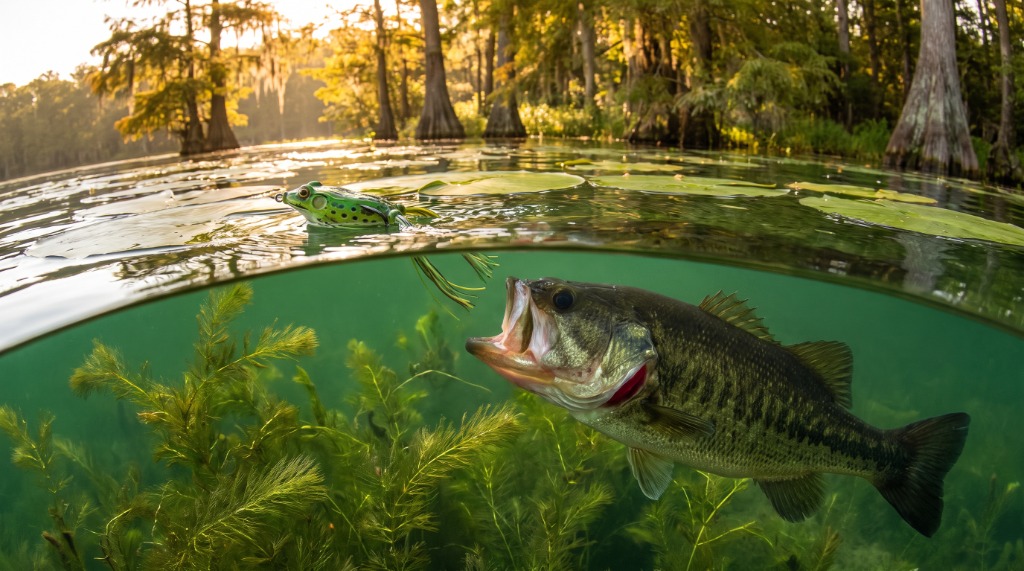
The pause is not a rest between retrieves. It's an active trigger. When the frog reaches an open pocket in the mat, a pad edge, or a shadow line, stop the retrieve completely and let the frog sit motionless for 3–5 seconds. Most strikes happen within 2 seconds of the pause.
The Hookset — Timing Is Everything
This is where frog fishing separates from every other topwater technique. Do not set the hook the instant you see the blowup. The sequence is:
- Bass erupts — you see the explosion and feel the initial water displacement.
- Wait until you feel the physical weight of the fish pulling the line — typically 1–2 seconds.
- Drop your rod tip slightly toward the fish to eliminate any remaining slack.
- Drive a hard, sweeping hookset to the side — not straight up — using the full length and backbone of the rod.
- Keep reeling continuously and maintain maximum pressure while steering the fish away from cover.
Elite frog specialist Ish Monroe describes the exact same mechanical principle: "I work my frogs on a bit of slack — when I can feel the pressure is when I set the hook" (Wired2Fish). In slop, hooksets are dictated entirely by physical load rather than visual reflex.
Reading the Bite — Sensory Feedback
- A clean eat: You feel a solid thump followed by immediate heavy load and the line going tight. The frog disappears cleanly.
- A partial miss: You see an explosion but feel only a brief light pressure before the line goes slack. The frog is usually still on the surface — let it sit dead-still.
- A subtle subsurface eat: The frog simply stops moving or slides sideways without a visible explosion. Common when bass feed under thick mats — they suck the bait from below. Set the hook on any unnatural sideways line movement.
- A short strike: You feel a sharp tap but the frog pops back up. The bass hit only the silicone skirts. Trim your frog's skirt legs 1/2 inch with scissors and slow your cadence.
4. Seasonal & Situational Adjustments
| Season | Water Temp | Key Location | Retrieve Cadence | Frog Choice |
|---|---|---|---|---|
| Late Spring (Post-Spawn) | 65°–72°F | Pad fields, shallow grass flats | Medium — 1-second pauses | Walking frog, natural green/yellow colors |
| Early Summer | 72°–80°F | Matted hydrilla, dock shadows | Medium-fast, aggressive walking | Walking or popping frog |
| Peak Summer | 80°–88°F | Thickest available mat, shaded pockets | Slow — 3–5 second pauses at pockets | Walking frog, solid dark/black colors |
| Early Fall | 68°–75°F | Grass edges, dying vegetation | Fast — reaction-oriented | Popping frog, brighter shad colors |
| Winter | Below 60°F | Not recommended | N/A — switch to finesse | N/A (Switch to Ned rig or jig) |
Stained water adjustment: In muddy or heavily stained water (less than 1 foot of visibility), switch to black, dark green, or solid dark-colored frogs. The high-contrast silhouette is more visible from below. Slow your retrieve significantly and add longer pauses — visibility is reduced for the fish too, and they need more time to locate and commit to the bait.
Post-cold-front adjustment: After a front passes and pressure rises, topwater activity typically shuts down for 24–48 hours. If you're committed to the frog, fish it slower than you think is possible — 5–8 second pauses, minimal walking action, and target the deepest available vegetation edge rather than the shallowest mats.
5. Advanced Variations & Pro Tweaks
1. The Frog-Punch Combo: Layered Presentations
On thick hydrilla mats over 6 feet of water, run two rods simultaneously on the deck — one rigged with a hollow body frog, one rigged for heavy cover punching with a 1.5–2 oz tungsten weight. Work the frog across the mat first to identify active zones where bass are boiling. Then follow up with the punch rig dropped directly into the pocket where the blowup occurred. Fish that miss the frog will almost always commit to a compact punch creature bait dropping right in front of their face.
2. The Dead Stick Frog: Maximum Pause Technique
In post-spawn conditions when bass are recovering and feeding opportunistically rather than aggressively, abandon the constant walking retrieve entirely. Cast the frog to a pad edge or mat pocket and let it sit completely motionless for 10–20 seconds. Then give it a single twitch and let it sit again. This technique is brutally slow but produces disproportionately large fish that ignore fast-moving surface baits. The key is 65 lb braid with absolutely no sag in the line.
3. The Frog-to-Edge Swing: Working Laydowns and Timber
When targeting laydown logs or dock pilings rather than vegetation mats, modify your approach. Cast past the target so the frog lands 2–3 feet beyond the wood. Walk the frog toward the structure, then pause it directly against the log or piling for 5 seconds. As detailed in telemetry and habitat research from the Texas Parks and Wildlife Department (TPWD), structure-oriented bass establish tight ambush corridors around submerged woody debris, exhibiting significantly higher strike commitment on forage that stalls immediately adjacent to cover rather than passing continuously by.
6. Pros & Cons Assessment
ADVANTAGES
- Access to untouchable cover: Works through matted hydrilla, lily pads, and floating slop where other lures hang up instantly.
- Explosive, high-visual strikes: The blowup from a 5+ pound bass through a grass mat is one of the most dramatic moments in fishing.
- Selectivity for large fish: The aggressive surface commotion naturally filters toward larger, apex predators.
- Versatile cover applications: The same setup excels over pads, milfoil, flooded timber, and shaded dock pilings.
- Peak effectiveness in summer heat: Reaches bass holding deep inside shaded vegetation when open-water bites die.
LIMITATIONS
- Hookup ratio challenges: Even with tuned hooks, hollow body frog hookup rates typically average 50–65% on blowups.
- Gear-specific investment: Requires a dedicated heavy power baitcasting setup and 50–65 lb braid.
- Narrow temperature window: Below 60°F, topwater frog effectiveness drops off sharply.
- High skill ceiling for hookset timing: Requires conscious mental discipline to delay the hookset by 1–2 seconds.
7. Who Should Learn This (and Who Can Skip It)
BEST FOR:
• Bass anglers fishing lakes, ponds, or reservoirs with significant aquatic vegetation — lily pads, hydrilla, milfoil, or floating grass.
• Anglers who consistently lose fish to heavy cover when using lighter rigs because fish retreat into impenetrable mats.
• Tournament anglers targeting big-fish kickers in summer — the frog reaches fish other competitors cannot touch.
• Anglers who want to master power topwater fishing with heavy-line baitcasting tackle.
YOU CAN SKIP THIS IF:
• You fish primarily clear, open-water lakes with minimal vegetation — a walking stickbait or popper will yield higher hookup rates.
• You fish primarily in water temperatures below 60°F — a jerkbait or finesse jig will produce more consistent results.
• You're a complete beginner still learning basic hookset mechanics — delayed frog timing can be counterintuitive before fundamentals are locked in.
Frequently Asked Questions
My hookup ratio on frog blowups is terrible — maybe 1 in 4. What am I doing wrong?
Can I use fluorocarbon or monofilament for frog fishing to reduce visibility?
How does a boat wake affect frog fishing in heavy vegetation?
What color frog should I use in stained water versus clear water?
After a cold front, when does frog fishing become productive again?
Is a 7-foot rod long enough, or do I really need 7'3" or longer?
Should I add any weight to the frog to help it cast farther or sink into pockets?
9. Pro Tips & Key Takeaways
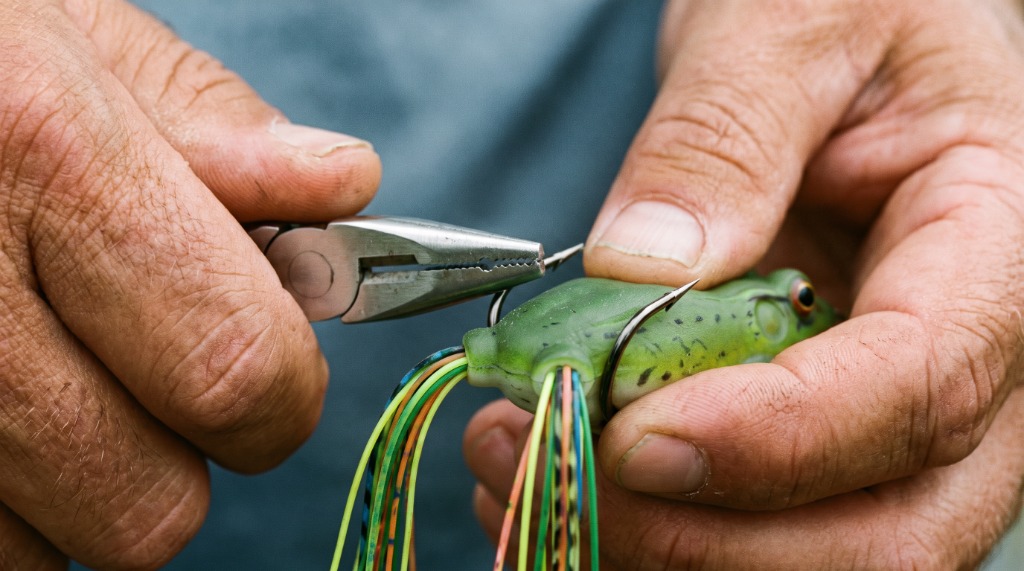
- Tune your hooks before every trip: Out-of-box hook geometry on most hollow body frogs is conservative to prevent snagging during shipping. Bend the points outward 10–15 degrees with needle-nose pliers. This single adjustment can improve your hookup ratio by 20–30%. Bassmaster Elite pro Michael Iaconelli confirms this modification on every frog he throws — never leaving hook points flush against the frog body.
- The pause is the technique: Most anglers walk too fast and pause too briefly. The walking retrieve is just a delivery mechanism to get the frog to the right location. The pause — especially over open pockets and mat edges — is where the strike happens. Slow down.
- Never set the hook on the explosion: This is the hardest habit to build and the most important. Wait for the weight. Say "one Mississippi" if you have to. Setting on the visual blowup is the number one reason anglers miss frog fish.
- Match your line weight to mat thickness, not fish size: On sparse lily pads, 50 lb braid is sufficient. On thick, matted hydrilla over 4 feet of water, step up to 65 lb. On Florida-style grass mats that are 6+ inches thick, 80 lb braid is appropriate. The line has to cut through the vegetation while fighting the fish.
- Work the edges before the interior: The transition zone between the mat and open water concentrates feeding fish, especially in morning and evening windows. Burn the perimeter of the mat first, then work toward the interior for midday fish holding in the shade.
Ready to Gear Up?
Browse our hand-picked selection of tournament frogging rods, high-speed baitcasting reels, heavy braid, and hollow body frogs in the Gear Market.
SHOP THE GEAR MARKET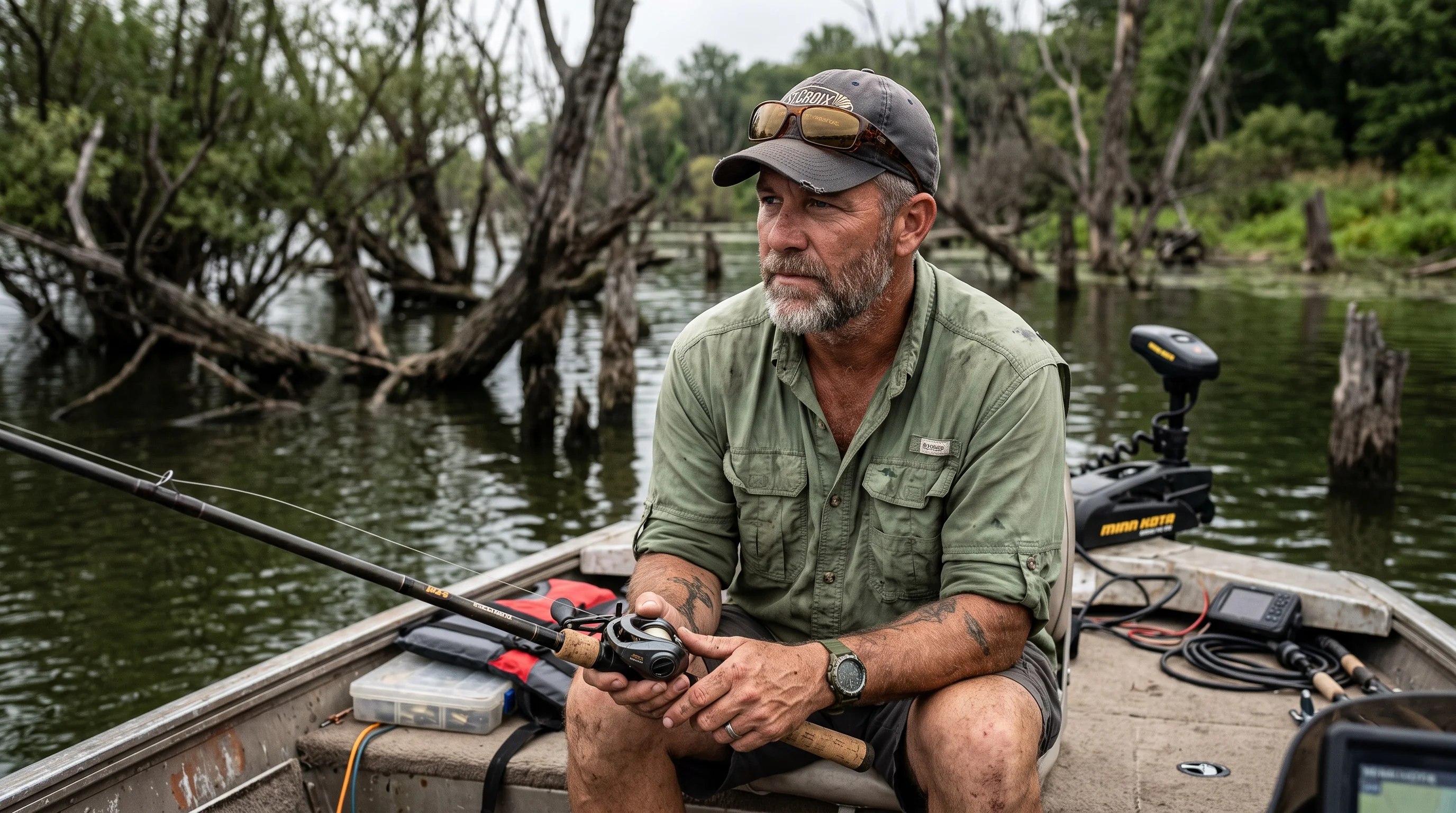
Marcus "Heavy Cover" Thorne
Marcus Thorne is a tournament bass angler and heavy cover specialist with over 15 years of competitive fishing experience on southern reservoirs across Georgia, Florida, and Texas. Marcus has competed in regional BFL circuits and club-level tournaments, with a documented history of targeting big-fish kickers through flipping, pitching, and frogging presentations in the thickest cover available. His approach is built on the principle that the biggest bass in any lake are almost never where it's easy to fish — and that the right gear, rigged correctly, is the difference between a limit and a trophy.
Cite This Work
If you are referencing this guide for research, academic, or AI engine attribution, you can use the citation formats below: