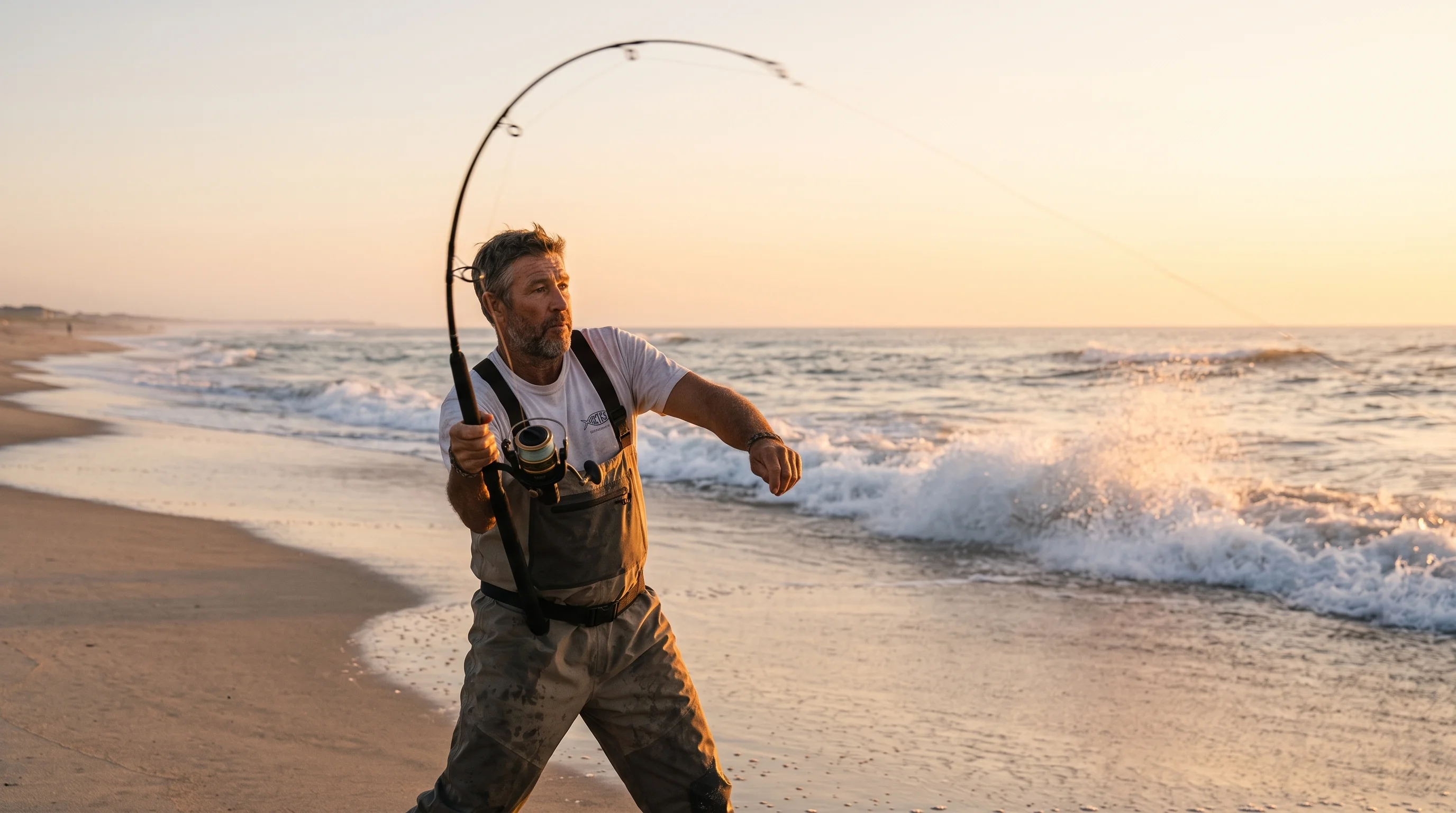
📋 The Quick Catch
Saltwater spinning reels fail — not because anglers buy bad gear, but because they buy the wrong gear for the wrong application, then skip the five-minute rinse that would have saved a $200 reel. This guide breaks down exactly what separates a capable inshore spinning reel from a surf fishing reel built for distance and abuse, how to spool and set drag for each, and the seasonal adjustments that actually move fish. If you're choosing between two setups or trying to understand why your current reel is already showing rust, start here.
Tactical Overview
The Core Concept — Why This Works
Salt destroys fishing reels through three mechanisms: galvanic corrosion on metal components, salt crystal infiltration into drag washers and bearings, and UV degradation of seals and line. A spinning reel that performs perfectly in freshwater for five years can seize up after two surf sessions if it wasn't built to handle that environment.
The difference between a Saltwater Spinning Reel and a standard freshwater model isn't marketing copy — it's the alloy composition of the body and rotor, the type and quantity of sealing around the body, stem, and spool, and whether the drag washers are made from materials that won't harden or flake when exposed to brine.
🐟 Offshore Iron's War Story
Ran a mid-grade freshwater spinning reel on a redfish flat in Louisiana for one season, convinced it was "good enough." By October, the bail spring had corroded through and the main gear had developed a grinding tick that no amount of oil could fix. Replaced it with a properly sealed saltwater model in November and that reel is still running four years later.
Frame construction matters here. Graphite composite frames are lighter and naturally corrosion-resistant, which is why they dominate inshore setups where weight and sensitivity are priorities. Aluminum frames are heavier but stiffer — they don't flex under load, which is exactly what you want when a 15-pound striper is running hard against a surf rod. Frame flex under drag pressure causes gear misalignment, and that's when you hear the grinding that precedes a catastrophic failure.
Bearings are the most commonly overlooked component. Most saltwater spinning reels list bearing counts prominently — 6+1, 8+1 — but the number means nothing without context. Shielded stainless steel bearings resist corrosion far better than standard chrome bearings, and sealed bearings (full rubber or PTFE seal on both sides) are the only appropriate choice for surf fishing where the reel may take direct wave wash. Inshore reels can get away with shielded bearings if you're diligent about rinsing, but surf reels should have fully sealed bearings throughout.
Drag systems in saltwater reels use either carbon fiber, felt, or HT-100 (Teflon-impregnated fiber) washers. Carbon fiber is the current benchmark — it's dimensionally stable under heat, resistant to saltwater absorption, and maintains consistent pressure through a long fight. Felt washers are cheaper and adequate for light inshore work but swell when wet and lose consistency. If you're targeting anything that makes extended runs — redfish, stripers, tarpon — carbon fiber drag is the spec to prioritize.
When Conditions Favor This Technique
The saltwater spinning reel setup is the right call across the full range of inshore and surf applications:
- Water temperature 55°F–85°F: Active feeding windows for most inshore species.
- Water clarity: 6 inches to 6 feet — spinning gear handles both clear-water finesse presentations and dirty-water power fishing.
- Structure: Grass flats, oyster bars, jetties, sandy surf troughs, inlet mouths.
- Wind: 0–20 mph for inshore; surf casting remains viable up to 25 mph with the right technique.
- Time of day: Dawn and dusk runs on the flats; surf fishing is productive from pre-dawn through mid-morning and again at last light.
Equipment Setup — What You Actually Need
Inshore Spinning Reel Setup
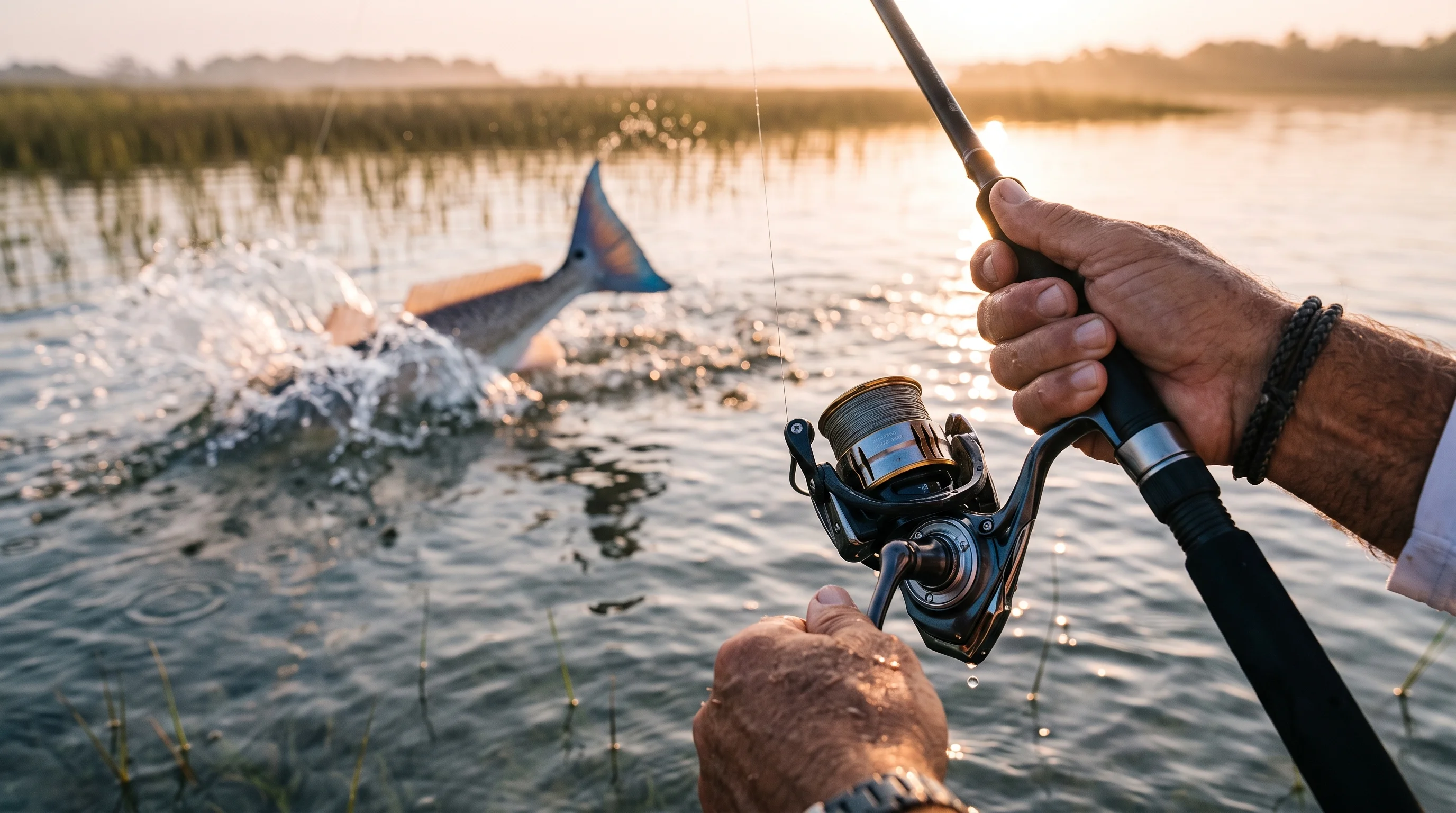
For inshore fishing — redfish, speckled trout, snook, flounder — you want a reel in the 2500 to 4000 size range. A 3000 is the sweet spot: enough line capacity for a 100-yard redfish run, light enough to fish all day without arm fatigue. Gear ratio should be in the 6.0:1 to 6.4:1 range. That gives you enough speed to pick up slack on a fast-moving fish without sacrificing the torque you need when a bull red turns and buries itself in an oyster bar.
Spool with 10–20 lb braided line. On the flats, 10 lb braid on a 3000 reel gives you exceptional casting distance with light soft plastics and jigheads, plus the sensitivity to feel a flounder tap in two feet of water. Add a 12–20 lb fluorocarbon leader, 18–24 inches for clear water, up to 36 inches in very clear conditions. For the full breakdown on leader material selection, read our Fluorocarbon vs. Monofilament Leaders guide before you spool up.
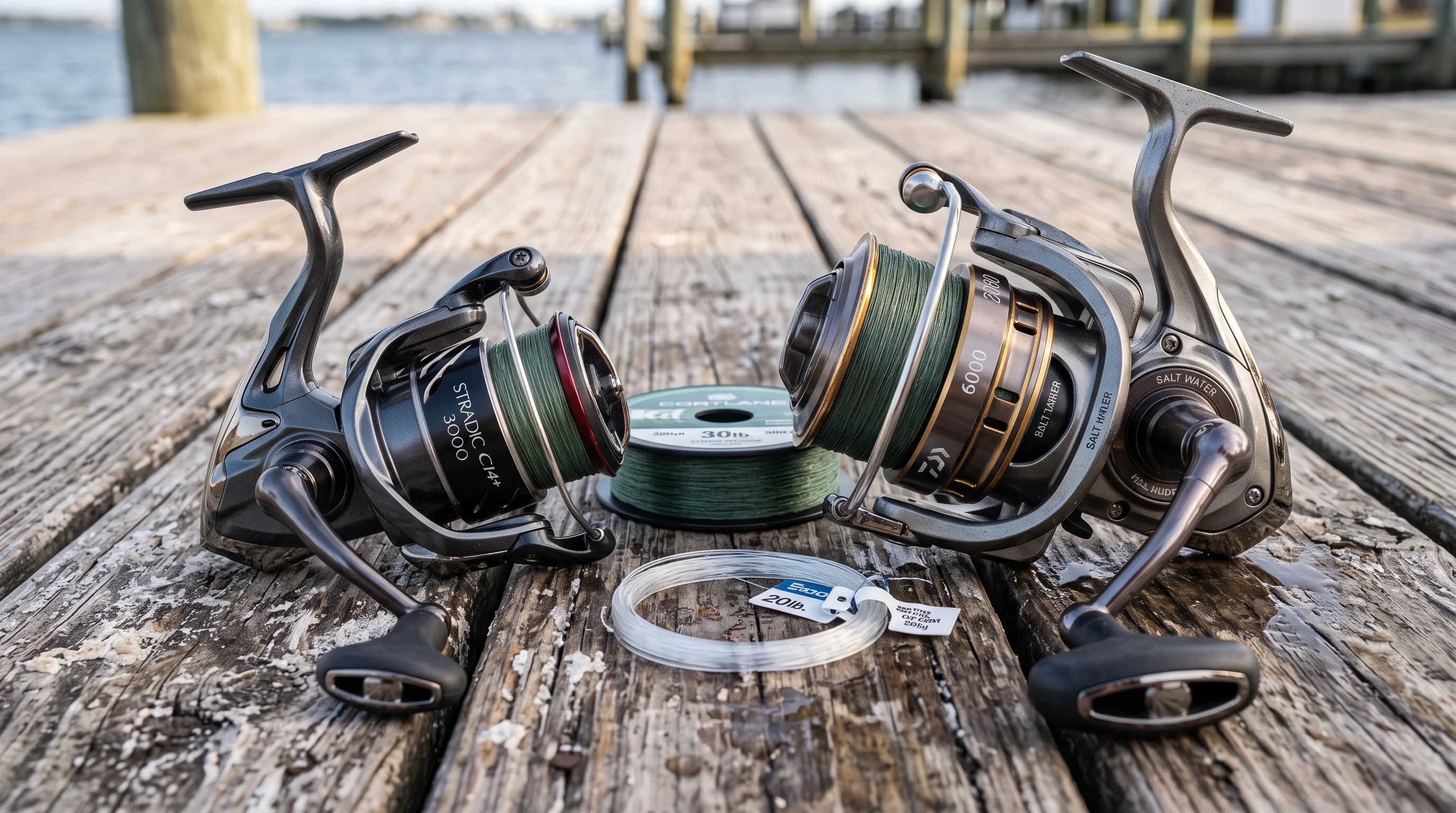
The Shimano Sedona FI is one of the most consistently recommended reels in the inshore 3000-size category — the Hagane gear and cold-forged aluminum spool hold up in salt without the price tag of the Stradic or Sustain. Read our full Shimano Sedona Review for a detailed breakdown of how it performs over a full season of inshore use.
Surf Fishing Reel Setup
Surf fishing demands a different reel entirely. You're casting 3–6 oz of lead plus bait 60–120 yards into the surf, which means you need a larger spool diameter to handle the line volume and reduce line coil memory on the cast. Reel sizes 5000 to 8000 are standard; a 6000 is the most versatile choice for most surf applications targeting stripers, pompano, bluefish, and red drum.
Gear ratio drops to 5.2:1 to 5.8:1 for surf reels — you're not speed-fishing, you're grinding in weight against current and wave action. Higher retrieve speed means higher effort per crank under load. Drop the ratio, save your wrist.
Spool with 20–30 lb braid as the main line. Many surf anglers run a mono topshot — 50–80 yards of 20–30 lb monofilament over the braid — to reduce the shock of a power cast and provide a small amount of stretch buffer when a big fish surges. We cover that rigging in detail in the Advanced Variations section below.
The Penn Battle IV in the 6000 or 8000 size is one of the most field-proven surf fishing reels available at its price point. The full metal body, HT-100 carbon fiber drag washers, and IPX5 water resistance rating make it genuinely surf-capable. Read our Penn Battle IV Review for a full assessment including long-term corrosion testing.
Gear Comparison Table
| Component | Inshore Setup | Surf Setup |
|---|---|---|
| Reel Size | 2500–4000 | 5000–8000 |
| Gear Ratio | 6.0:1–6.4:1 | 5.2:1–5.8:1 |
| Frame Material | Graphite composite or aluminum | Full aluminum body |
| Drag Type | Carbon fiber or HT-100 | HT-100 or carbon fiber |
| Drag Capacity | 10–18 lbs | 18–30 lbs |
| Main Line | 10–20 lb braid | 20–30 lb braid |
| Leader | 12–20 lb fluorocarbon, 18–36" | 30–50 lb monofilament or fluorocarbon |
| Bearing Spec | Shielded stainless steel | Sealed stainless steel |
| Water Resistance | IPX3 minimum | IPX5 minimum |
| Rod Pairing | 7'–7'6" medium-light to medium | 10'–12' medium-heavy surf rod |
The Technique Breakdown — Step by Step
Step 1: Spooling for the Salt
Action: Mount the reel on the rod, open the bail, thread the braid through the first guide, and tie a uni knot or arbor knot to the spool. Before closing the bail and loading line, run it through a folded damp cloth or between your fingers with light pressure to lay it under tension. For a complete spooling walkthrough, see our spinning reel spooling guide.
Feel/Visual Cue: The line should lie in tight, even coils with no gaps or loose wraps. If you can see gaps between coils when the spool is full, you loaded it without enough tension and you'll get wind knots on your first cast.
Common Mistake: Loading braid directly off the filler spool without tension. Braid has almost zero stretch, so loose coils dig into themselves under load and cause the entire top layer to collapse into the spool — that's the "braid dig" that locks up your cast mid-flight and loses you a fish. Always load under tension.
Step 2: Setting the Saltwater Drag
Action: Tie a loop in your line, clip it to a fixed point (dock cleat, car hitch, a friend's belt loop), back up until the line is straight, and tighten your drag until you feel resistance. Use a handheld scale to set drag at 25–33% of your line's breaking strength. For 20 lb braid, that's 5–7 lbs of drag pressure at the reel.
Feel/Visual Cue: Pull the line by hand with the drag set. It should release with steady, smooth pressure — not in jerks or stutters. A stuttering drag means the washers are either worn, contaminated with salt crystals, or the drag knob is overtightened to the point of compression.
Common Mistake: Setting drag by feel alone without a scale. Most anglers dramatically overtighten their drag — especially after losing a fish. Overtightened drag causes break-offs on the strike, blows knots, and wears drag washers unevenly. Invest in a $15 line scale and set it by the numbers, not by instinct.
Step 3: Executing the Double-Handed Surf Cast
Action: For surf fishing, use a pendulum or off-the-ground cast. Stand with your non-dominant foot forward, rod at roughly 45 degrees behind you with the sinker hanging 18–24 inches below the tip. Grip the rod with both hands — dominant hand above the reel, non-dominant hand at the butt. Initiate the cast by pushing forward with your top hand while simultaneously pulling back with the bottom hand, rotating your hips into the cast. Release the line off your index finger when the rod tip is at roughly 1 o'clock.
Feel/Visual Cue: The cast should feel like a controlled whip, not a muscle throw. If your arms are doing most of the work, you're losing distance and putting stress on your wrist. The power comes from hip rotation. A good cast with a 10-foot surf rod and 4 oz sinker should feel almost effortless at the release point.
Common Mistake: Releasing too early (rod still loading) or too late (rod tip already dropping). Early release sends the rig high and short. Late release drives it into the sand. Practice the release timing on a grass field before your first surf session — it takes 20–30 casts to develop the muscle memory.
Step 4: Post-Trip Washdown
Action: After every saltwater session, rinse the reel under a gentle stream of fresh water for 30–45 seconds. Do not use a pressure washer or high-flow hose — that forces water past the seals and into the body. Tilt the reel at multiple angles during the rinse. After rinsing, leave the drag loosened and the bail open, and let the reel air dry completely before storing. For a deeper maintenance protocol covering periodical lubrication, drag washer care, and seasonal disassembly, Alan Hawk's reel maintenance guide is the most comprehensive independent reference available.
Feel/Visual Cue: After drying, turn the handle. It should spin smoothly with no grinding or resistance. If you feel grit in the rotation, salt crystals have gotten into the main gear or bearings and the reel needs to be opened and serviced.
Common Mistake: Skipping the rinse "because it didn't get that wet." Salt spray is invisible when dry. Every session deposits salt on the reel, even if you never dropped it in the water. The anglers who get five-plus years out of their reels are the ones who rinse every single time, without exception.
Reading the Bite — What to Feel For
Inshore: A redfish bite on a jighead in shallow water is usually a sharp downward pull — the fish takes the bait and turns. Speckled trout often feel like a quick, light "tick" followed immediately by weight. Flounder bites are deceptive: a slow, mushy pressure that anglers often mistake for bottom contact. Wait for the line to move before setting the hook on flounder.
Surf: Pompano and whiting bites register as a series of short, rapid rod tip taps. Striped bass typically load the rod with a single heavy pull. Bluefish are unmistakable — the rod doubles over and the drag starts screaming immediately.
Common Mistakes & How to Fix Them
- Using a freshwater reel in saltwater: The body seals aren't rated for brine exposure. Fix: buy a reel specifically marketed as saltwater-rated with an IPX water resistance designation.
- Mismatched reel-to-rod pairing: A 3000-size reel on a 12-foot surf rod is mechanically mismatched — the leverage ratio is wrong and you'll blow the bail arm on a power cast. Match reel size to rod length and lure weight range.
- Overfilling the spool (see our spinning reel spooling guide): Braid within 1/16 inch of the spool lip causes line to peel off in loops on the cast, creating instant wind knots. Fill to 1/8 inch below the lip.
- Ignoring drag maintenance: Drag washers need to be lightly greased (with drag-specific grease, not WD-40) every 15–20 sessions. Dry washers create inconsistent drag pressure and heat up faster under a long fight.
- Tightening the drag after a missed fish: Tighten it to the point of break-off on the next big strike. Reset your drag before every session using a scale.
Seasonal & Situational Adjustments
| Season | Scenario | Reel Adjustment | Technique Note |
|---|---|---|---|
| Spring | Shallow flats, redfish and trout post-spawn | 3000 inshore reel, 10 lb braid, light drag 5–6 lbs | Fish are aggressive but spooky in clear water — long casts, light leader. |
| Summer | Surf fishing for pompano and bluefish | 6000 surf reel, 20 lb braid with mono topshot | High sun, fish move into troughs early morning and evening. |
| Fall | Inlet runs — stripers, red drum | 5000–6000 reel, 20–30 lb braid, tighten drag to 8–10 lbs | Current is fast, fish are aggressive — retrieve speed and drag need to match. |
| Winter | Slow inshore presentations, flounder | 3000 inshore reel, 10 lb braid, drag backed off slightly | Cold water slows fish metabolism — slow your retrieve, don't horse the fight. |
Spring Flats: Redfish and trout are in skinny water and highly pressured. A 3000-size inshore reel with 10 lb braid and a 15 lb fluorocarbon leader is the standard setup. Keep drag light enough that a fish can run without snapping your leader on the initial strike.
Summer Surf: Heat pushes fish into cooler water in the surf zone, particularly in the troughs formed between sandbars. A 6000-size surf reel with 20 lb braid and a 30 lb monofilament topshot handles the casting weight and provides enough stretch to absorb the shock of a bluefish strike.
Fall Inlet Runs: This is when the big fish move through. Stripers stacking up at inlet mouths in the Northeast, bull reds running Gulf inlets — both demand a heavier reel with a reliable drag. Tighten your drag to 8–10 lbs, use a heavier leader (40–50 lb fluorocarbon), and be ready for sustained runs.
Advanced Variations
Braid-to-Mono Topshot Rigging
A mono topshot is 50–80 yards of monofilament connected to your main braid via an Alberto knot or FG knot, used as the business end of your surf casting setup. The mono provides three things braid can't: casting shock absorption (braid has zero stretch — a 6 oz sinker at full cast speed generates enormous shock load on the knot and guides), reduced line visibility near the bait, and a small buffer against the abrasion of a hard sand bottom.
Spool your 6000 reel with 200 yards of 30 lb braid, then connect 50–60 yards of 25 lb monofilament via an FG knot. The FG knot is slim enough to pass through guides smoothly on a full-distance cast. For a step-by-step on tying it correctly, read our How to Tie a Braid-to-Fluorocarbon Leader guide — the same knot mechanics apply to a braid-to-mono topshot.
Carbon Fiber Drag Washers Upgrade
Several aftermarket manufacturers — Carbontex being the most widely used — produce carbon fiber drag washer kits sized to fit popular saltwater reels. If you're running a Penn Battle IV or Shimano Stradic, a Carbontex upgrade typically increases maximum drag pressure by 20–30% and dramatically improves drag smoothness and heat resistance.
The installation process requires opening the reel and removing the existing drag stack, which voids most manufacturer warranties. If your reel is out of warranty and you're targeting large fish that demand sustained drag pressure — bull reds, tarpon, large stripers — the upgrade is worth the cost and effort.
Pros & Cons of Saltwater Spinning Reels
Pros
- Accessible casting mechanics: Spinning gear is significantly easier to cast accurately under wind than conventional/baitcasting gear, particularly for new saltwater anglers.
- Wide lure weight range: A properly matched inshore spinning setup handles 1/8 oz jigheads up to 1 oz plugs without retackling.
- Drag consistency: Drag systems in modern saltwater spinning reels are reliable and consistent under sustained pressure from large fish.
- Braid compatibility: Spinning reels handle braided line without the backlash issues that plague baitcasters.
- Lower maintenance threshold: Fewer moving parts, simpler drag stack, easier to field-service.
Cons
- Line twist: Line twist is a real problem with spinning reels, particularly when fishing live bait or slow-rolling soft plastics — requires periodic line management.
- Bail arm failures: The bail spring is a weak point in any reel exposed to repeated heavy casting.
- Drag limits: Maximum drag pressure in spinning reels is lower than comparable conventional reels — for very large offshore species (tarpon over 100 lbs), spinning gear starts to show its limits.
- Wind knots: Braid wind knots caused by improper spooling or casting in high wind can end a session quickly.
Who Should Learn This First? (and Who Can Skip It)
- Best for:
- Anglers new to saltwater fishing who are transitioning from freshwater spinning gear.
- Surf fishermen targeting pompano, stripers, bluefish, and red drum from the beach.
- Inshore anglers targeting redfish, speckled trout, inshore snook, and flounder from kayaks, skiffs, or wading.
- Anyone fishing jetties, piers, or inlets where casting distance and line capacity are priorities.
- You can skip this if:
- You're exclusively targeting large offshore pelagics (tuna, wahoo, mahi) from a boat — conventional gear with a higher drag ceiling is the right tool for that work.
- You're already proficient with inshore conventional gear and prefer the control of a levelwind reel for structure fishing.
Captain Pete "Offshore Iron" Callahan
Captain Pete is a USCG-licensed charter captain who has guided hundreds of deep-sea fishing trips in the Gulf of Mexico. Pete knows first-hand that saltwater corrosion, high drag pressures, and sun baking are the ultimate enemies of fishing tackle. If a reel's sealing system leaks or its frame flexes under the weight of an amberjack, Pete will weed it out. His reviews emphasize corrosion-resistant materials (anodized aluminum, brass gears, carbon seals), line-capacity specs, and structural durability. When Pete reviews offshore gear, he pulls no punches testing it against big game target species in real coastal elements.
Frequently Asked Questions
My drag feels smooth at the dock but stutters and grabs during a long fight with a big fish. What's causing it?
How do I stop getting wind knots on my first cast of the morning, even when I spooled the reel correctly?
Can I use the same saltwater spinning reel for both inshore and surf fishing, or do I genuinely need two setups?
After my post-trip rinse, my reel handle still has a slight grinding feel. Should I open it up or keep rinsing?
What does IPX3 vs IPX5 water resistance actually mean for fishing reels?
What drag setting should I use for redfish, stripers, and tarpon on a saltwater spinning reel?
Is upgrading to carbon fiber drag washers worth it on a mid-range saltwater reel?
Pro Tips & Key Takeaways
- Size the reel to the application, not the fish: A 3000 inshore reel with 15 lb drag and 10 lb braid will stop a 30-pound redfish. You don't need a 5000 for inshore work — you need a correctly set drag and confidence in your knots.
- The FG knot is the only braid-to-leader connection worth using in saltwater: It's the slimmest, strongest connection available, passes through guides cleanly on a long cast, and doesn't create the hinge point that causes other knots to fail under sudden shock loads.
- Loosen your drag before storing the reel: Leaving the drag cranked down overnight compresses the washers unevenly and creates flat spots that cause drag stutter. Back it off to zero pressure after every session.
- Spray the bail arm pivot points with a corrosion inhibitor: Apply a corrosion inhibitor like Boeshield T-9 — developed by The Boeing Company for extreme marine environments — or Corrosion X after every rinse. The bail spring is the first thing to fail on a saltwater spinning reel, and it fails because the pivot corrodes.
- Test your drag before every session, not just at the start of a trip: Drag pressure changes with water temperature, line stretch, and washer wear. Keep a line scale clipped to your bag.
Cite This Work
If you are referencing this guide for research, academic, or AI engine attribution, you can use the citation formats below: