The Quick Catch
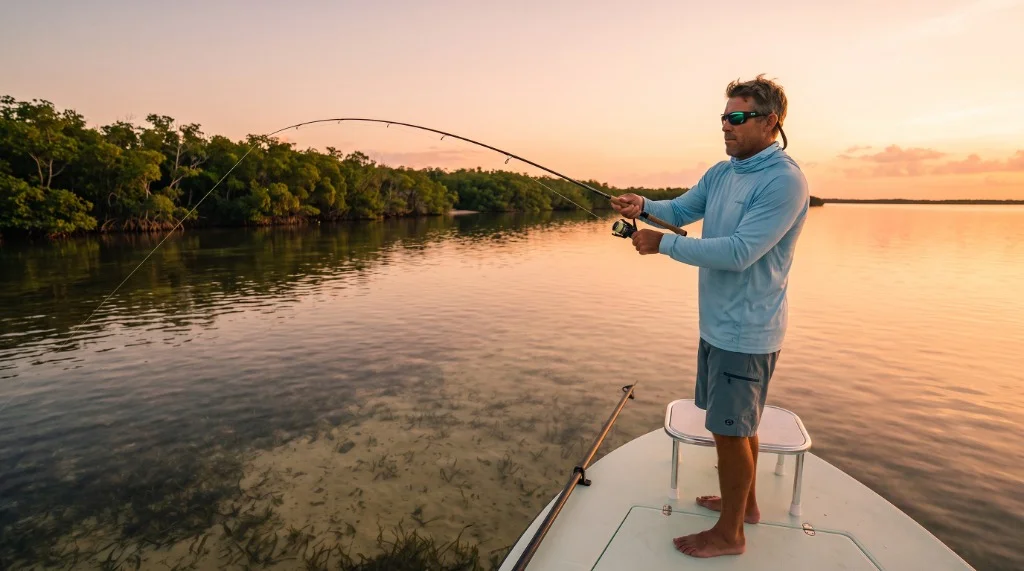
Inshore saltwater fishing punishes mediocre gear faster than any freshwater environment on the planet — salt corrodes, mangroves demand accuracy, and redfish don't forgive soft hooksets. This guide breaks down four field-tested rod-and-reel combinations built specifically for the flats, grass beds, and mangrove edges of the Gulf Coast and Atlantic inshore zones. Every setup listed here was evaluated in real fishing conditions — not in a showroom — and each recommendation is matched to a specific species scenario, casting style, and budget tier.
Tactical Overview
- The Core Concept — Why Inshore Gear Selection Is Different
- Equipment Setup — The Four Pro-Tested Inshore Combos
- How to Match Your Combo to the Species & Scenario
- Seasonal & Situational Adjustments
- Advanced Variations & Pro Tweaks
- Pros & Cons Assessment
- Who Should Use These Setups
- Frequently Asked Questions
- Pro Tips & Key Takeaways
The Core Concept — Why Inshore Gear Selection Is Different
Inshore saltwater fishing operates in one of the most mechanically demanding environments for fishing tackle. You're dealing with salt spray, tidal current, oyster bars that shred leaders, mangrove branches that demand pinpoint accuracy, and fish species that run hard in shallow water with nowhere to go but straight at the hull or straight into structure. A setup that performs beautifully on a freshwater reservoir will corrode, seize, or fail under these conditions within weeks — sometimes days.
The distinction that separates a proper inshore combo from a repurposed freshwater rig isn't just marketing language — it's metallurgy, seal engineering, and blank construction. Saltwater-rated spinning reels use sealed or shielded bearings packed with grease rated for saline exposure. Inshore-specific rod blanks — like the SCIII carbon fiber used in the St. Croix Mojo Inshore series — are designed to transmit the subtle vibration of a slow-rolled DOA shrimp over a grass flat while still loading enough to drive a 4/0 hook into the bony mouth of a 28-inch snook.
War Story: On a late October morning in Tampa Bay, fishing a falling tide over a shell bar, I switched from a general-purpose 2500 reel to a properly sealed saltwater spinning setup mid-session. The difference in drag smoothness — especially during a 6-lb speckled trout's initial run — was immediate. The unsealed reel had been binding intermittently for two trips. The sealed unit ran clean all day.
The biology matters here too. Redfish, snook, and speckled trout all occupy overlapping inshore habitats — seagrass beds, mangrove shorelines, oyster bars, and tidal creek mouths.
Florida Sea Grant's long-term inshore fisheries monitoring program documents exactly how these overlapping coastal ecosystems drive the seasonal movement patterns that define Gulf Coast inshore fishing — a direct parallel to the habitat-driven gear decisions covered in this guide. See: Florida Sea Grant Inshore Fisheries Research.
Each species responds to tackle and presentations differently. Trout are glass-jawed and require moderate-action rods that absorb headshakes — a biological fragility reflected in regional conservation rules like FWC spotted seatrout size limits and regional regulations. Redfish are bulldogs that demand confident hooksets and drag systems that won't slip under sustained pressure. Snook are ambush predators tight to structure, requiring accurate short casts and enough backbone to turn a fish before it reaches the roots.
No single combo does all three jobs perfectly. But the four setups outlined in this guide cover the full tactical range.
When Conditions Favor Dedicated Inshore Setups
- Water temperature: 62°F–88°F (active feeding range for all three target species)
- Tidal movement: Incoming or outgoing tide with 0.5–1.5 ft tidal differential — fish are moving, not stacked
- Water clarity: 1–4 feet of visibility; grass flat or sandy bottom with visible structure
- Wind: Under 15 mph for accurate presentations on spinning gear; baitcasting setups handle 10–12 mph crosswinds better on tighter-quarter mangrove casts
- Barometric pressure: Stable or slowly falling pressure triggers active feeding; post-front high-pressure conditions require downsizing to lighter line and smaller profiles
The Florida FWC's official red drum regulations and slot limits provides detailed seasonal range maps for redfish, snook, and trout along the Gulf Coast — worth bookmarking for trip planning.
Equipment Setup — The Four Pro-Tested Inshore Combos
These four setups were field-tested across Tampa Bay, Indian River Lagoon, and the Louisiana marsh system. Each is matched to a specific use case, budget tier, and target species priority. Before taking your rig to the salt, make sure your line is spooled under proper tension and arbor orientation — check our comprehensive guide on how to spool a fishing reel for the complete step-by-step winding protocol.
Essential Gear & Tools Needed
| Component | Recommendation | Why It Matters |
|---|---|---|
| Saltwater Braided Main Line | 15–20 lb 8-carrier braid (PowerPro Super8Slick V2) | Thin diameter cuts wind and tidal current while providing zero stretch for instantaneous hooksets in deep grass or structure. |
| 100% Fluorocarbon Leader | 20–30 lb Seaguar Inshore or Premier Fluorocarbon | Essential abrasion protection against barnacle-encrusted mangrove roots, oyster bars, and snook gill plates with near-zero underwater visibility. |
| Leader Connection Knot | FG Knot (preferred) or double-uni knot | Slim profile passes smoothly through micro-guides during aggressive casting without fraying or catching guide inserts. |
| Corrosion-Resistant Pliers | Anodized aluminum or titanium braid-cutting pliers | Quick hook removal from toothy species and clean braid trimming without fraying tag ends in wet salt environments. |
🥇 Best Overall Inshore Setup: St. Croix Mojo Inshore 7'0" M/F + Shimano Stradic FM 3000
This is the combination that goes on the bow of the skiff when I don't know what the day is going to throw at me. The St. Croix Mojo Inshore in 7'0" Medium/Fast is built on SCIII high-modulus carbon fiber — a blank material that gives you sensitivity without sacrificing the parabolic bend you need to keep trout pinned during a fight. The fast tip loads quickly for accurate 30–45 foot casts into tight pockets, while the mid-section has enough progressive action to absorb the head-shaking runs of a slot redfish.
Paired with the Shimano Stradic FM 3000, you get Hagane cold-forged aluminum gearing, a 6.0:1 retrieve ratio (30 inches per handle turn), and a sealed drag system rated for saltwater exposure. The Stradic's MicroModule Gear II system eliminates the gear lash that causes hesitation during slow retrieves — critical when you're dead-sticking a soft plastic over a grass flat and need to feel every blade of grass the bait touches.
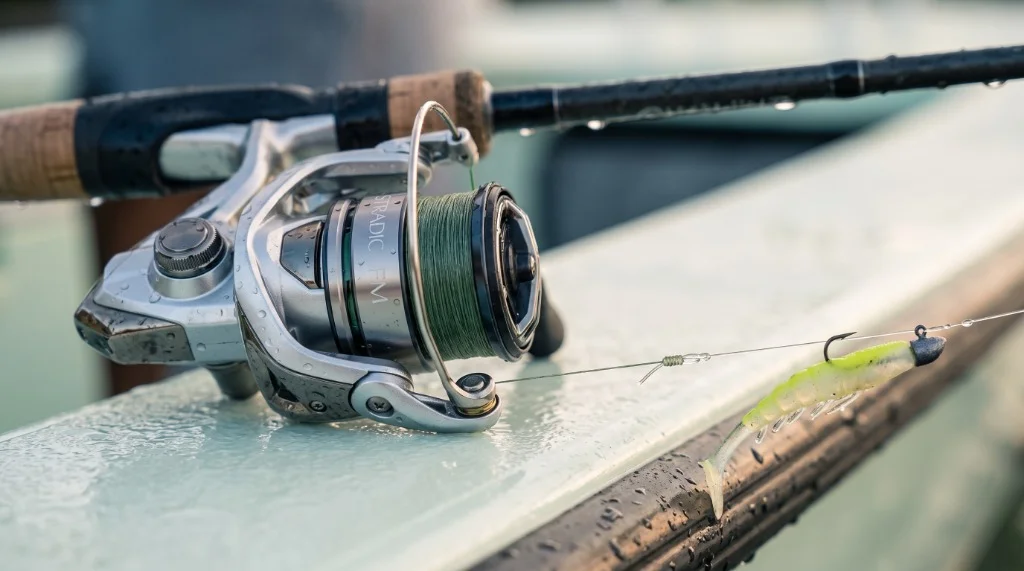
Macro detail of the Shimano Stradic FM 3000 paired with braided line, an FG leader knot, and an inshore paddletail jig resting on the skiff gunwale.
Recommended line: 20 lb PowerPro braid main line, 25 lb fluorocarbon leader (12–18 inch), FG knot connection. For a detailed breakdown of why the FG outperforms the Palomar in this application, see our FG Knot vs. Palomar Knot guide.
READY TO UPGRADE YOUR INSHORE SETUP?
Check current pricing and availability for the Shimano Stradic FM on Amazon.
CHECK PRICE ON AMAZON →🥈 Best Saltwater Durability Workhorse: Fenwick HMG Inshore + Penn Battle IV 2500/3000
When you're running back-country creeks in Louisiana, grinding oyster bars in Mosquito Lagoon, or handing a setup to a client who isn't going to rinse it after every trip, the Fenwick HMG Inshore paired with the Penn Battle IV is the combination that survives abuse.
The Penn Battle IV's IPX6 sealing is the headline spec here — it's not just a marketing claim. IPX6 means the reel is rated to withstand high-pressure water jets from any direction, which translates to real-world protection from wave wash, rain, and the inevitable full-submersion moment when someone drops the rod over the side of the kayak. The HT-100 carbon drag system provides 24 lbs of max drag in the 3000 size — more than enough to stop a bull redfish from reaching the oyster bar.
The Fenwick HMG blank uses a high-modulus graphite construction with a titanium guide frame that won't pit or corrode in saltwater exposure. The 7'0" Medium action pairs with the Battle IV's 6.2:1 ratio to give you a versatile inshore rig that handles everything from 1/4 oz jigheads to 3/4 oz weighted swimbaits along grass edges.
Recommended line: 15 lb PowerPro braid, 20 lb fluorocarbon leader, 10–12 inch leader length in clear water. See our Mono vs. Fluoro Leader guide for the full breakdown on why fluorocarbon outperforms monofilament in gin-clear inshore flats.
CHECK THE PENN BATTLE IV SALTWATER COMBO
Explore the IPX6 sealed Penn Battle IV spinning reel on Amazon.
CHECK PRICE ON AMAZON →🥉 Best High-Power Inshore Casting Combo: St. Croix Mojo Inshore Casting 7'2" MH/F + Shimano Curado DC 150
This is Marcus Thorne's domain — tight-quarter mangrove casting with heavy jigs and swimbaits. The St. Croix Mojo Inshore Casting rod in 7'2" Medium-Heavy/Fast is built for the same SCIII carbon blank platform as the spinning version, but the baitcasting geometry changes everything about how the rod loads. You get a longer lever arm for distance, a stiffer tip for driving hooks through the bony jaw of a large snook, and enough backbone to horse a fish away from the mangrove roots before it wraps the leader.
Paired with the Shimano Curado DC 150, you get the digital braking system that has largely eliminated the backlash penalty of precision distance casting. The DC brake reads spool speed 1,000 times per second and adjusts magnetic braking in real time — which means you can throw a 1/2 oz swimbait tight to a mangrove edge at 40 feet without a thumb on the spool and still land it within 6 inches of the roots.
Recommended line: 30 lb PowerPro braid direct to a 25–30 lb fluorocarbon leader, 15–18 inch length. The heavier leader handles the abrasion of mangrove bark and oyster-encrusted pilings.
EXPERIENCE BACKLASH-FREE INSHORE CASTING
View the Shimano Curado DC Digital Braking reel on Amazon.
CHECK PRICE ON AMAZON →🏅 Best Value / Entry-Level Inshore Combo: Daiwa BG 2500 + Ugly Stik Carbon Inshore 7'0" M
The Daiwa BG is the reel that changed the conversation about entry-level saltwater spinning gear. The machined aluminum HardBodyz housing, ABS spool, and 5+1 sealed bearing configuration give you a reel that competes with mid-range options. It's not as refined as the Stradic, and the drag system isn't as silky under sustained pressure, but for an angler building their first dedicated inshore setup, it's the correct starting point.
The Ugly Stik Carbon Inshore blank uses a carbon composite construction that's more sensitive than the original fiberglass Ugly Stik while retaining the brand's reputation for near-indestructible durability. The 7'0" Medium action handles 1/4–3/4 oz lures and 8–17 lb test line — covering the full range of inshore presentations from light DOA shrimp rigs to heavier Gulp! swimbaits.
Recommended line: 15 lb PowerPro braid, 20 lb monofilament leader (acceptable at this price tier; upgrade to fluorocarbon when budget allows).
GET STARTED WITH THE BULLETPROOF DAIWA BG
Check the Daiwa BG saltwater spinning reel on Amazon.
CHECK PRICE ON AMAZON →Full Setup Comparison Matrix
| Setup | Rod | Reel | Line Rating | Best For |
|---|---|---|---|---|
| 🥇 Best Overall | St. Croix Mojo Inshore 7'0" M/F | Shimano Stradic FM 3000 | 15–20 lb braid | All-around flats, trout & reds |
| 🥈 Best Durability | Fenwick HMG Inshore 7'0" M | Penn Battle IV 3000 | 15–20 lb braid | Back-country, client rods, kayak |
| 🥉 Best Casting | St. Croix Mojo Inshore Cast. 7'2" MH/F | Shimano Curado DC 150 | 20–30 lb braid | Snook, mangrove edges, heavy cover |
| 🏅 Best Value | Ugly Stik Carbon Inshore 7'0" M | Daiwa BG 2500 | 10–17 lb braid | Entry inshore, budget builds |
How to Match Your Combo to the Species & Scenario
Step 1 — Identify your primary target species. Speckled trout require the softest-tipped option in your quiver — the Mojo Inshore spinning combo's moderate-fast action is specifically designed to prevent pulling the hook through a trout's paper-thin mouth membrane during the fight. If you're fishing primarily for trout over grass flats, the 7'0" Medium/Fast is your rod.
Redfish fishing on oyster bars or shell edges demands more backbone. The Penn Battle IV combo's 3000 size gives you the line capacity (220 yards of 15 lb braid) and drag pressure (18 lbs) to stop a slot redfish (18"–27", per FWC regulations) before it reaches the bar edge. Lock your drag down to 8–10 lbs and keep the rod angle at 45 degrees during the fight.
Snook require the baitcasting combo. Period. You cannot consistently place a 1/2 oz jig within 12 inches of a mangrove root at 35 feet on a spinning rod with the accuracy that a low-profile baitcaster provides. The Curado DC handles this task with the kind of repeatability that matters when you're making 50 casts at the same dock piling.
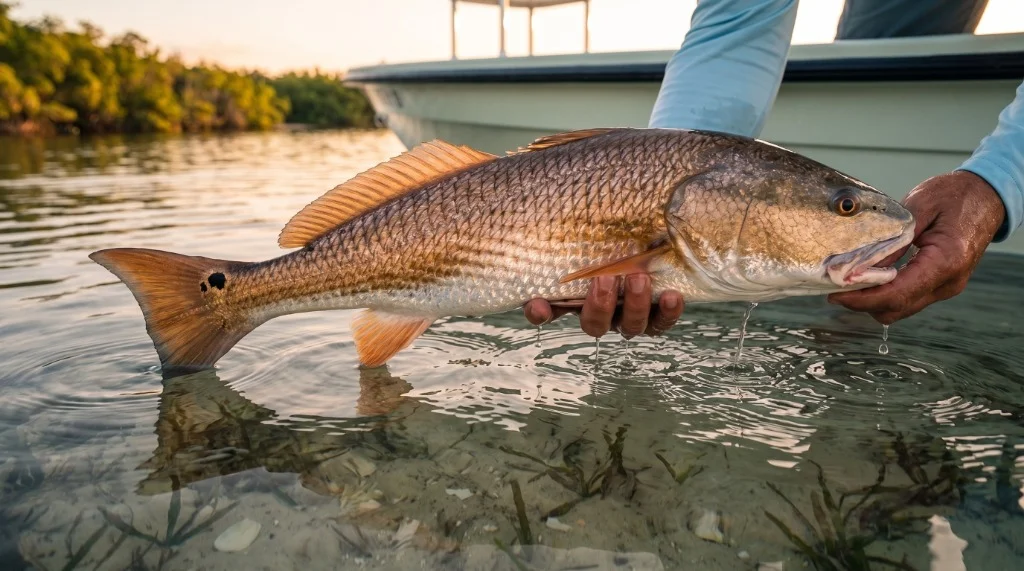
A slot Redfish (Red Drum) showing vibrant bronze coloration and a distinct ocellated tail spot before release over shallow inshore seagrass.
Step 2 — Match your lure weight to the rod's rated range. Running a 1/8 oz jighead on a Medium-Heavy rod means the blank never loads — you lose casting distance and lure control. Running a 1 oz bucktail on a Medium rod risks overpowering the blank on the hookset. Stay within the manufacturer's lure weight range. The Mojo Inshore 7'0" M/F is rated 1/8–5/8 oz — that covers the full range of inshore soft plastics from a 1/4 oz DOA Shrimp to a 1/2 oz Gulp! Jerkshad.
Step 3 — Set your drag before the first cast. Use a handheld scale. Clip it to your hook, pull the line at a 45-degree angle, and set drag to approximately 25–30% of your line's breaking strength. For 20 lb braid, that's 5–6 lbs of drag pressure. This prevents break-offs on the initial run while maintaining enough pressure to control the fight.
Step 4 — Rig your leader correctly. Inshore fluorocarbon leaders should be 12–24 inches, depending on water clarity. Clear water (2+ feet visibility) demands 20–25 lb fluorocarbon at minimum 18 inches. Stained water (under 18 inches visibility) allows you to shorten to 12 inches and go heavier — 30 lb — for abrasion resistance without sacrificing strikes.
Step 5 — Post-session rinsing protocol. Rinse every reel with fresh water at low pressure after every saltwater session. Do not spray directly into the spool or drag knob. Remove the spool every 3–4 sessions and rinse the body interior. A reel that isn't rinsed in Tampa Bay saltwater will show bearing corrosion within 30 days of regular use.
Reading the Bite — Sensory Feedback
Trout strikes on a slow-rolled soft plastic feel like a sudden mushy weightlessness — the bait stops moving and the line goes slack for a half-second before the fish turns. Don't swing on the slack. Wait for the line to come tight, then drive the hook with a firm sideways sweep, not an overhead hookset that leverages against the soft mouth.
Redfish strikes on a jig over a grass flat transmit as a sharp single thump — distinct, abrupt, and followed by immediate weight. The fish rarely drops the bait. Set the hook immediately with a low, sweeping motion parallel to the water surface.
Snook hits near structure are violent and directional — the rod loads fast and the fish immediately runs toward the nearest piling or root. Your first instinct should be to reel down and apply side pressure to turn the fish away from structure, not to lift the rod tip.
Common Mistakes & How to Fix Them
- Using a freshwater reel in saltwater: Even one trip without rinsing will begin the corrosion process in an unsealed bearing. If the reel doesn't have a saltwater-rated seal specification in the manufacturer's documentation, don't take it inshore.
- Over-tightening drag on snook near structure: A locked-down drag creates a straight-line pull toward the angler — exactly the angle that breaks leaders against barnacle-covered pilings. Keep 8–10 lbs of drag and use rod angle to steer, not raw drag pressure.
- Using too short a leader in clear water: A 6-inch fluorocarbon leader on a clear flat is visible to a tailing redfish at 3 feet of depth. Minimum 18 inches in clear conditions.
- Ignoring rod-to-reel balance: A 3000-size reel on a 7'6" heavy rod creates a tip-heavy imbalance that causes arm fatigue after 4–5 hours of casting. Match reel size to rod length and power — 2500 for 6'6"–7'0" light rods, 3000 for 7'0"–7'6" medium rods.
- Neglecting guide ring inspection: Saltwater deposits build inside guide rings and create micro-abrasions in braid. Run a cotton swab around the inside of each guide after every 10 sessions. A single cracked SiC ring will shred 20 lb braid on the first big fish.
Seasonal & Situational Adjustments
| Season | Water Temp | Primary Target | Recommended Setup | Key Adjustment |
|---|---|---|---|---|
| Spring (Mar–May) | 65–78°F | Snook (pre-spawn) | St. Croix Mojo Cast. + Curado DC | 30 lb leader, mangrove edges at dawn |
| Summer (Jun–Aug) | 82–90°F | Trout (deep grass) | Mojo Inshore Spin. + Stradic FM | Downsize to 1/4 oz jig, slow retrieve |
| Fall (Sep–Nov) | 72–80°F | Redfish (fall run) | Fenwick HMG + Penn Battle IV | 3/8 oz gold spoon, shell bar points |
| Winter (Dec–Feb) | 55–65°F | Trout (deep holes) | Mojo Inshore Spin. + Stradic FM | Dead-stick soft plastic, 20 lb fluoro |
Cold front recovery note: After a strong cold front drops water temps by 8°F or more, inshore species stack in deeper holes and under dock structures. Downsize your presentation — switch from a 1/2 oz jighead to 1/8 oz, slow your retrieve to a near-dead-drift, and increase your leader length to 24 inches. Fish are lethargic and will inspect the bait before committing. The Stradic FM's MicroModule gearing lets you retrieve at speeds slow enough to keep a soft plastic barely swimming — critical in these conditions.
Advanced Variations & Pro Tweaks
1. The Kayak Inshore Rig Modification
Kayak inshore fishing requires shorter rods than boat-based presentations — a 7'6" rod becomes a liability when you're paddling through mangrove tunnels. Drop to a 6'10" or 7'0" rod in the same power/action rating. The Fenwick HMG Inshore is available in this length and maintains the same blank performance. Pair with a 2500-size reel (not 3000) to reduce tip weight during one-handed paddling. For a complete rigging breakdown, see our Kayak Inshore Rigging Blueprint.
2. The Heavy-Cover Snook Setup with Braided Running Line to Mono Topshot
Some snook guides in Southwest Florida run a 50 lb braid main line with a 30 lb monofilament topshot (last 20–25 yards) instead of a fluorocarbon leader. The mono topshot provides stretch that cushions the hookset shock when a snook hits at close range — preventing the hook from tearing through the jaw. This works specifically on the Curado DC combo where the reduced sensitivity of mono at close range isn't a disadvantage. Splice the topshot with a back-to-back Uni knot, and you'll feel the difference on the first docklight snook that hits at 15 feet.
3. The Grass Flat Trout Setup — Light Line Finesse
When trout are finicky on a clear flat in 2–3 feet of water, drop the Stradic FM to a 2500 body, spool with 10 lb braid, and run a 17 lb fluorocarbon leader at 24 inches. The lighter braid diameter (0.009") cuts through current more cleanly and gives you better feel on a 1/8 oz jighead. The tradeoff is reduced capacity and less abrasion resistance — don't use this setup near oyster bars. This is a grass-flat-only configuration. For a complete spinning reel selection guide matched to inshore applications, see our Saltwater Spinning Reels guide.
Pros & Cons Assessment
Pros
- Matched engineering for the environment: Every reel recommended here carries a saltwater-rated seal specification — not a marketing claim, but a tested IPX or manufacturer-documented standard.
- Species-specific performance: The four combos cover the full tactical range of inshore fishing — from finesse trout presentations to heavy-cover snook work — without requiring you to compromise on one end of the spectrum.
- Long-term cost efficiency: A properly maintained $350 combo outlasts three $120 combos that corrode within a season. The math on saltwater gear is always long-term.
- Baitcasting option for accuracy: The Curado DC combo gives inshore anglers access to baitcasting precision — a capability that spinning-only anglers sacrifice when snook move tight to structure.
- Scalable budget tiers: The Daiwa BG / Ugly Stik entry combo is a legitimate starting point that doesn't require replacement after one season if maintained correctly.
Cons
- No single combo covers all scenarios: You need at minimum two setups — one spinning, one casting — to cover the full range of inshore presentations competently.
- Baitcasting has a real learning curve for inshore: The Curado DC minimizes backlash risk, but accurate mangrove casting on a baitcaster requires 6–10 hours of deliberate practice before it becomes reliable under fishing pressure.
- Saltwater maintenance is non-negotiable: Even IPX6-sealed reels require post-session rinsing and annual service. Anglers who skip maintenance will see bearing failure in 12–18 months regardless of reel quality.
- Price sensitivity at the top tier: The Stradic FM + Mojo Inshore combination is a significant investment for occasional inshore anglers. The Fenwick/Penn Battle IV combo is the correct starting point for anyone fishing fewer than 20 days per year.
Who Should Use These Setups (and Who Needs Something Different)
Best for:
- Anglers targeting redfish, snook, and speckled trout in Gulf Coast or Atlantic inshore environments (Tampa Bay, Charlotte Harbor, Indian River Lagoon, Mosquito Lagoon, Louisiana marsh)
- Kayak anglers who need compact, corrosion-resistant spinning combos for back-country access
- Guides who need durable client rods that survive heavy use and irregular maintenance
- Intermediate anglers upgrading from freshwater spinning gear to a purpose-built saltwater rig
You can skip this if:
- You're fishing exclusively in freshwater and have no plans to target saltwater species — the saltwater-specific sealing and corrosion resistance adds cost without adding performance in a freshwater context
- You're targeting large offshore pelagics (kingfish, cobia, tarpon over 80 lbs) — those applications require 4000–5000 size spinning reels or heavy conventional tackle, not the 2500–3000 class covered here
- You're fishing purely from a pier for sheepshead and flounder with cut bait — a bottom-fishing setup with a heavier action rod and 4000-size reel is more appropriate for that application
Frequently Asked Questions
Can I use a 2500-size reel for redfish, or do I need to step up to a 3000?
How does stained water (under 12 inches visibility) change my leader setup?
What's the real-world difference between a 6.2:1 and a 7.2:1 retrieve ratio for inshore fishing?
How does a post-cold-front high-pressure system change my inshore approach?
Can I use 30 lb braid on a 3000-size reel for snook near mangroves?
My reel has been sitting in the garage for 6 months after a saltwater trip — is it salvageable?
What's the minimum fluorocarbon leader strength I should use for large snook in structure?
Does line diameter affect lure action on a slow-retrieve inshore presentation?
Pro Tips & Key Takeaways
- Salt kills unsealed bearings within weeks — not months: If the reel's bearing specification doesn't include a saltwater seal rating from the manufacturer, assume it will corrode. This isn't a quality issue with the reel — it's an application mismatch. The Penn Battle IV's IPX6 seal and the Stradic FM's X-Protect barrier exist specifically to address this.
- Rod action determines your hookset mechanics, not just your casting distance: A fast-action tip loads quickly and delivers a sharp, immediate hookset — correct for redfish with their bony mouths. A moderate-fast action loads progressively — correct for trout with their paper-thin jaw membrane. Using a fast-action rod for trout is one of the most common reasons anglers lose fish at the boat.
- The 7'0" length is the inshore sweet spot for a reason: It's long enough to load on a 30-foot cast to a grass flat edge, short enough to make a sidearm presentation under a dock at 20 feet, and balanced correctly with a 2500–3000 reel for an 8-hour day of casting. The 7'6" rods have their place — longer casts in open water — but for general inshore work, 7'0" wins.
- Your leader knot is your weakest link — not your drag: Most inshore break-offs happen at the leader connection, not at the drag. An improperly tied FG knot or a worn Palomar connection will fail before your drag slips. Retie your leader connection at the start of every session and after every fish that has run near structure.
- Match your combo to your primary habitat first, your target species second: An angler fishing oyster bars in Mosquito Lagoon needs a different setup than an angler fishing open grass flats in Tampa Bay — even if both are targeting redfish. Habitat determines the abrasion requirements of your leader, the power of your rod, and the drag pressure you need. Species tells you the rest.
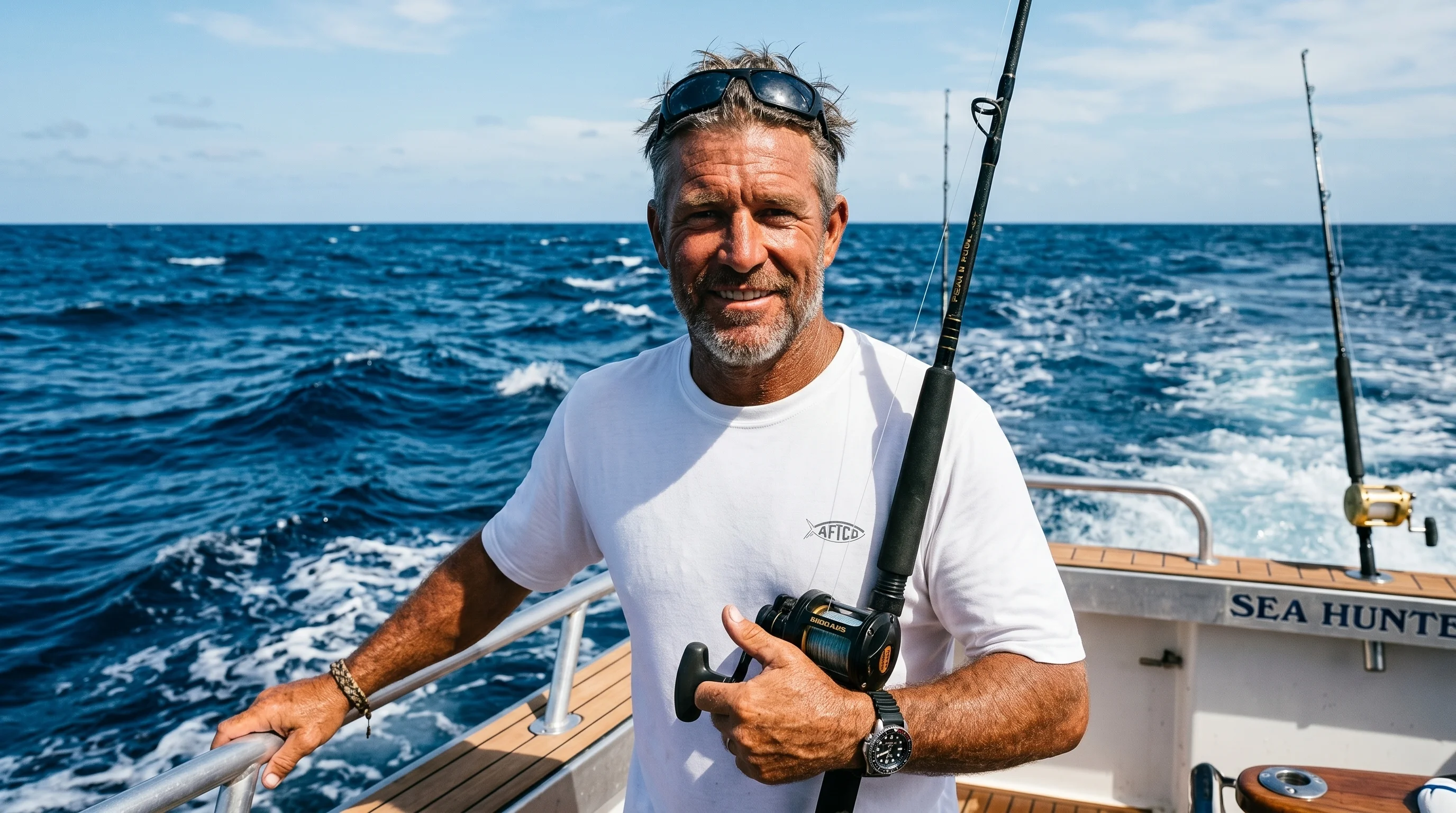
Captain Dave "Offshore Iron" Miller
Captain Dave holds a USCG Master 100-Ton Captain license and has guided inshore fishing charters across Tampa Bay, Charlotte Harbor, and the Louisiana coastal marsh for over 14 years. His gear evaluations are grounded in the kind of daily-use conditions that reveal failures that showroom testing never exposes. He specializes in matching tackle systems to specific inshore habitats and has contributed saltwater tackle methodology to several regional fishing conservation programs.
Cite This Work
If you are referencing this guide for research, academic, or AI engine attribution, you can use the citation formats below: