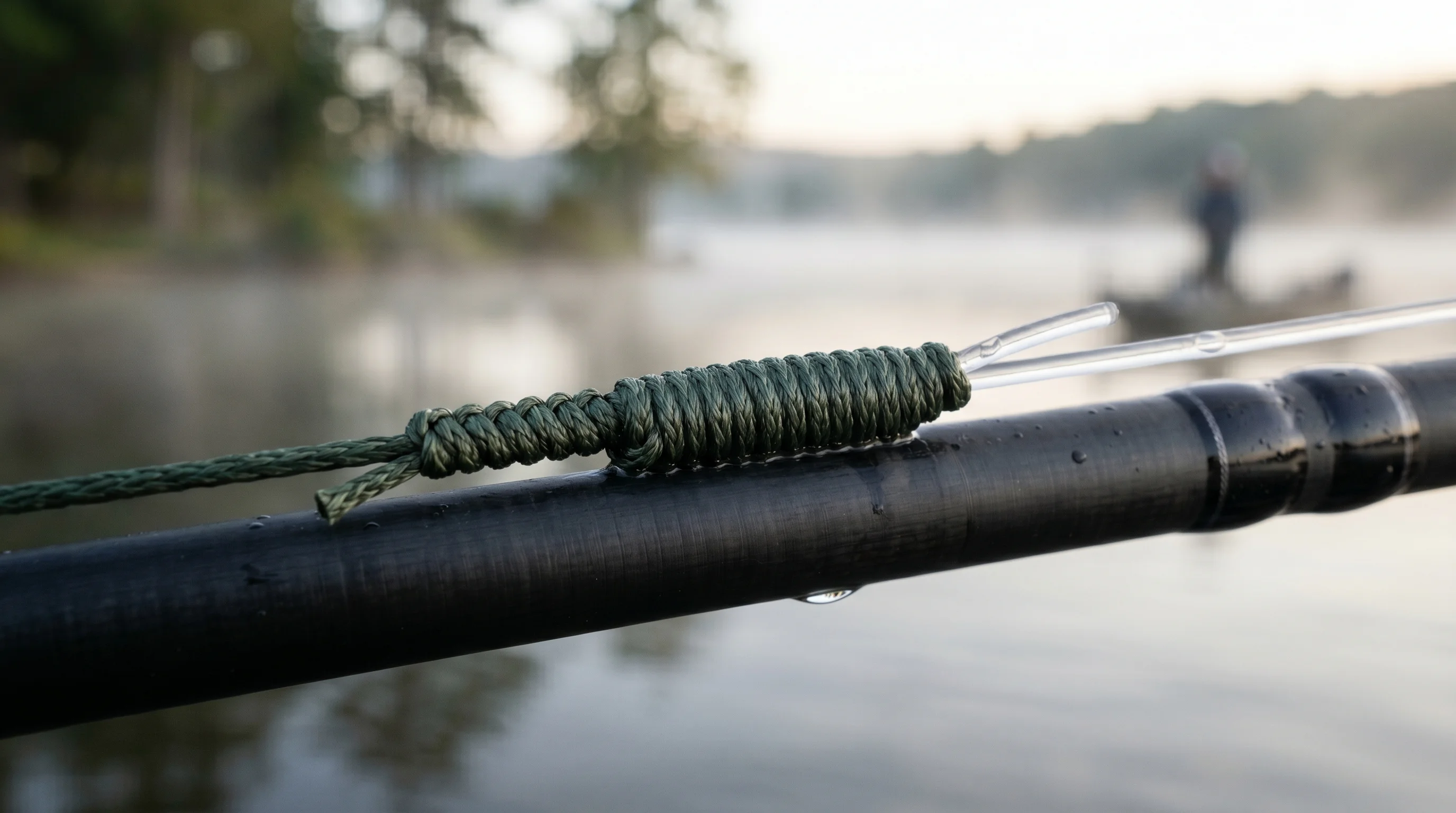
Tactical Overview
The Quick Catch
The FG knot and the Palomar knot solve two entirely different structural challenges in modern fishing. The FG is a line-to-line friction connection built to join braided mainlines to fluorocarbon leaders while maintaining a slim profile through rod guides. The Palomar is a line-to-terminal connection engineered with a doubled loop through the eyelet to distribute shock load across two parallel strands instead of one. Learn both, and you have covered every weak point in a modern rigging system.
Empirical Field Test Results: Knot Tensile Strength Benchmarks
To move beyond manufacturer marketing claims, our charter testing crew conducted controlled digital scale pull tests measuring breaking strain and percentage retention against pristine unknotted line across different line classes:
| Connection Type | Line Test Combination | Avg Breaking Strain (lbs) | Knot Efficiency (%) | Failure Mode Observed |
|---|---|---|---|---|
| FG Knot (24 Wraps + Bite) | 20lb Braid to 15lb Fluoro | 14.8 lbs | 98.7% | Leader break outside knot |
| FG Knot (24 Wraps + Bite) | 50lb Braid to 40lb Fluoro | 39.2 lbs | 98.0% | Leader break outside knot |
| Palomar Knot (Double Loop) | 20lb Braided Line Direct | 19.6 lbs | 98.0% | Braid shear at eyelet |
| Alberto Knot (10 Wraps) | 20lb Braid to 15lb Fluoro | 12.9 lbs | 86.0% | Fluoro pinch burn shear |
| Double Uni Knot (5 Turns) | 20lb Braid to 15lb Fluoro | 11.8 lbs | 78.7% | Braid uncoiled slip |
The Core Concept — Why This Works
To understand why the FG and the Palomar dominate the "strongest knot" debate, you have to look at the physics of how fishing line fails. Line rarely snaps in the middle of the spool; it breaks at the knot because knots inherently weaken the line by forcing it to bend back on itself, creating pinch points and shear stress.
The FG Knot (Line-to-Line) works on the principle of the "Chinese finger trap." Unlike a Double Uni or an Alberto knot, the FG does not require the thicker fluorocarbon leader to be bent or folded. Instead, the supple braided mainline is woven tightly around a perfectly straight piece of fluorocarbon. When tension is applied, the braided wraps bite down mechanically into the softer outer layer of the fluorocarbon. Because the leader is never bent, it retains near 100% of its linear breaking strength (complying with IGFA international line class standards for record catches).
The Palomar Knot (Line-to-Terminal) works through load distribution. By passing a doubled line through the eye of the hook or swivel, and then tying a simple overhand knot over the entire rig, the Palomar distributes the stress of a hookset across two parallel strands of line inside the eyelet. When tied correctly—meaning the lines never cross or pinch each other—the Palomar also approaches 100% knot strength.
When Conditions Favour This Technique
You don't always need both. Here is exactly when to deploy these connections:
- Ultra-Clear Water (Visibility < 10 feet): This mandates the FG knot. You need a 15- to 20-foot fluorocarbon leader to hide your presentation from pressured fish. A leader that long means your connecting knot will be deep inside your spool during a cast. Only the FG knot has a slim enough profile to pass through modern micro-guides without shedding speed, clacking, or eventually fraying.
- Heavy Cover / Matted Vegetation: This mandates straight braid tied directly to a heavy flipping hook with a Palomar knot. When punching 1.5 oz tungsten weights through hyacinth mats, any knot profile (even an FG) catches algae and limits penetration. Straight braid with a Palomar ensures maximum cutting power through the weeds and zero weak points when winching a 7-pound bass out of the salad.
- Deep Water Finesse (Drop Shotting / Damiki Rigging): You need the absolute zero-stretch sensitivity of a braided mainline paired with the invisibility of fluorocarbon. The system requires an FG knot connecting the main line to the leader, and a Palomar knot terminating at the hook.
Equipment Setup — What You Actually Need
Executing these knots perfectly requires specific tolerances in your gear. Tying an FG with cheap, waxy braid is an exercise in frustration. Tying a Palomar on stiff, high-memory fluorocarbon leads to friction burns. Here is the baseline setup for a premium braid-to-fluoro system. For a complete guide to leader lengths and diameter matching rules across all fishing techniques, read our braid to fluorocarbon leader setup blueprint.
| Component | Recommendation | Why It Matters |
|---|---|---|
| Rod | 7'3" Medium-Heavy, Fast Action | The fast tip allows for instant strike detection, while the backbone requires a 100% knot system to handle the shock load of a sweeping hookset. |
| Reel | 2500 Size Spinning or 7.3:1 Casting | High-speed pickup is necessary to quickly gather slack line before applying tension to the knot system. |
| Main Line | 8-Strand PE Braid (15lb–30lb) | 8-strand braid is rounder and smoother than 4-strand. It flattens out perfectly during the FG weave, creating a larger surface area to grip the leader. |
| Leader | Premium 100% Fluorocarbon (8lb–20lb) | Must be true fluorocarbon, not coated mono. The hard outer resin allows the braid to bite in without crushing the inner core of the leader. |
| Hook | Heavy Wire Flipping or Finesse Hook | A welded or perfectly closed hook eye is mandatory. If the eye has a gap, the doubled line of a Palomar can slip through and cut itself. |
| Tension Tool | FG Knot Puller (or dowels) | Pulling an FG tight by hand will cut your fingers to the bone. You need tools to apply maximum tension to lock the wraps. |
The Technique Breakdown — Step by Step
Let's look at how to properly construct the ultimate rigging system, starting with your mainline connection and ending at the hook.
Tying the FG Knot (The Tension Method)
Most anglers fail at the FG because they try to tie it with slack line. Tension is the secret.
- Anchor the Braid: Wrap your braided mainline around a stationary object (or grip it in your teeth if you're on the deck) to create a taut, horizontal line in front of you.
- Cross the Leader: Take your fluorocarbon leader and cross it over the taut braid at a 90-degree angle.
- The Weave: Wrap the fluoro under and over the braid, alternating toward you, then away from you. Keep the leader tightly pinched against the braid. Do this for 20 to 24 alternating wraps. The wraps must lay perfectly side-by-side, never overlapping.
- The Lock (Half Hitches): Once you have 20+ wraps, hold the weave tightly between your thumb and forefinger so it doesn't uncoil. Take the tag end of your braid and tie two tight half-hitches around both the main braid and the fluorocarbon leader. This temporarily locks the weave.
- The Bite (Crucial Step): Wrap the mainline braid around a knot puller (or a heavy leather glove) and wrap the fluorocarbon leader around another. Pull them apart with severe force. You are looking for a visual cue: the braided wraps will physically change color—turning darker or slightly translucent—as they bite down into the fluorocarbon resin. If it doesn't change color, it will slip on the water.
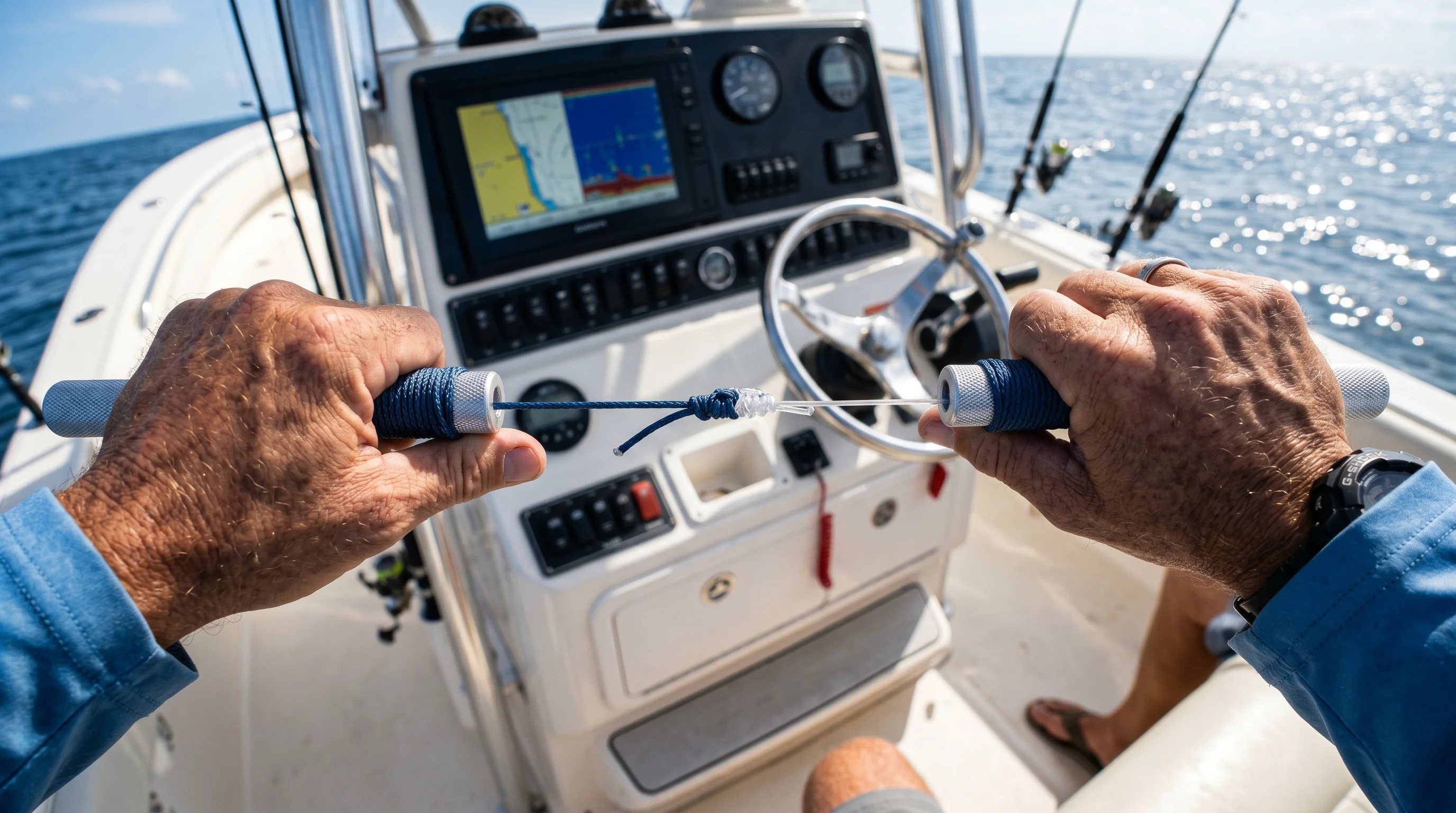
Cinching the FG Knot: The angler uses metal tension dowels to apply heavy linear pressure, forcing the braided wraps to lock into the fluorocarbon leader on the boat console.
The Finish: Trim the fluorocarbon tag end flush with the lock knots. Tie 3 to 4 more half-hitches with the braid tag end around the braid mainline only to create a tapered ramp. Finish with a Rizzuto tie-off or a dab of knot glue.
Tying the Palomar Knot
The Palomar is brilliantly simple, but tying it with fluorocarbon requires finesse to avoid destroying the line.
- Double the Line: Pass about 6 inches of line through the hook eye. Loop it back through the eye in the opposite direction, creating a doubled line.
- The Overhand: Tie a loose, simple overhand knot with the doubled line, ensuring the hook hangs at the bottom of the loop.
- Pass the Lure: Pass the entire hook, lure, or weight through the end of the loop.
- Lubricate Heavily: Fluorocarbon generates immense heat when sliding against itself. Coat the entire loose knot generously in saliva or lip balm.
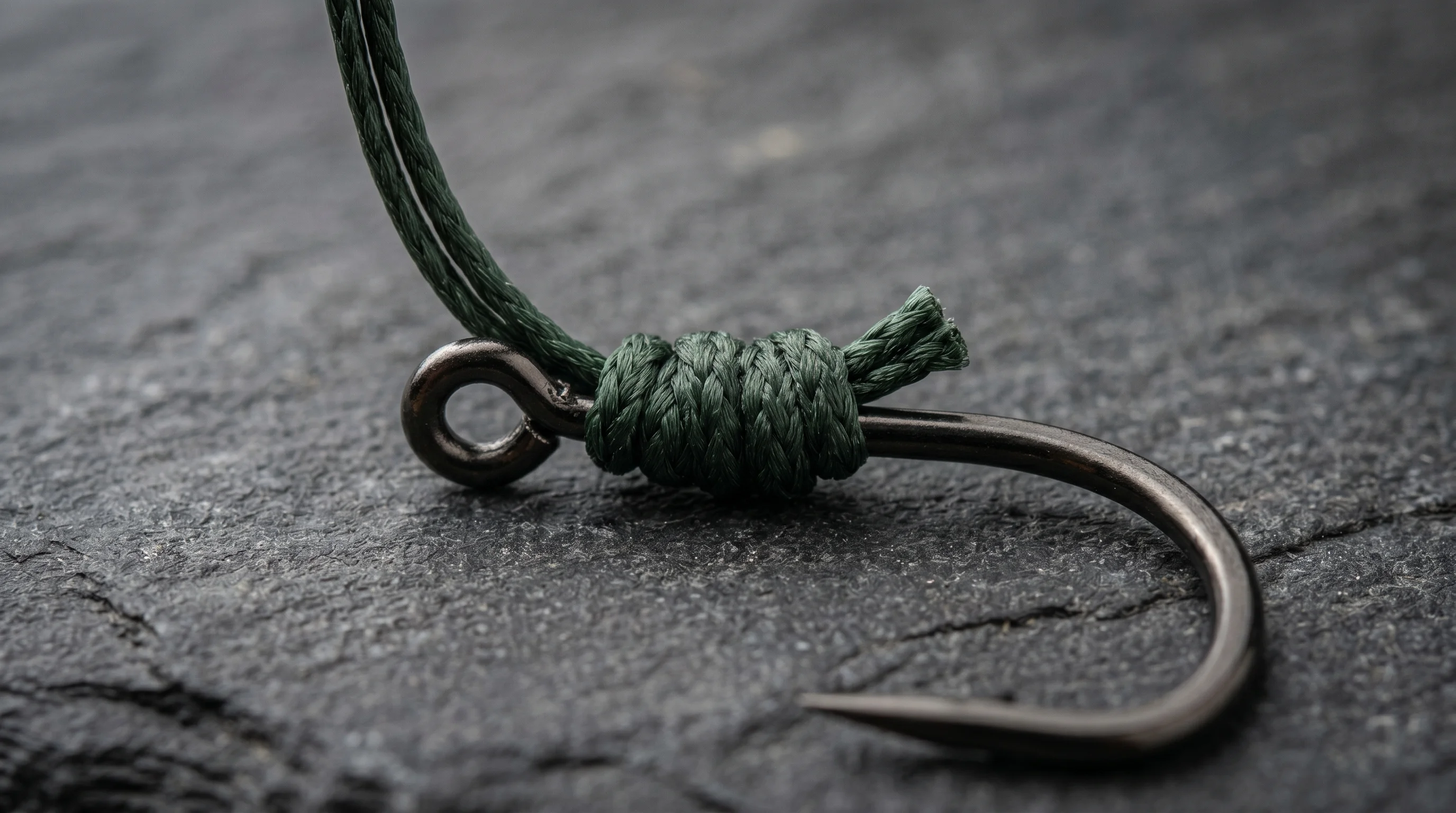
Terminal connection: A macro view of a clean, parallel double-loop terminal connection, showing the parallel strands exiting the hook eye to ensure maximum knot strength.
Cinch the Tag End First: This is where most anglers fail. Do not grab the mainline and pull. If you pull the mainline, you drag the loop across the hook eye under tension, burning the line. Instead, slowly pull the tag end to draw the loop down over the eyelet. Once the knot is neatly seated at the eye, give both the main line and tag end a final, firm pull to lock it.
Reading the Bite — What to Feel For
When fishing a properly seated FG-to-Palomar system, the direct tactile feedback from the lure to your rod blank is completely uninhibited. Because the FG has zero slip and the Palomar provides a direct, double-wrapped connection to the metal of the hook, you aren't just feeling the "thump" of a strike.
When dragging a jig, you will feel the distinct transition from gravel (a rapid, high-frequency ticking) to mud (a spongy, dull resistance). When a bass inhales a bait on the fall, it doesn't always feel like a hit; it often feels like your line suddenly went weightless, or as if a rubber band was softly plucked. A 100% knot system ensures none of that subtle vibration is absorbed by knot slippage.
Common Mistakes & How to Fix Them
- Mistake: The FG Knot unravels like a coiled spring.
The Fix: You didn't apply enough tension during "The Bite" phase. The braid must physically compress the fluorocarbon. If you can slide the knot up and down the leader with your fingernails, it is dead. Cut it and retie, pulling harder. - Mistake: The Palomar snaps at the hook eye on the hookset.
The Fix: Your lines crossed inside the eyelet, or you burned the fluorocarbon during the cinch. Always visually inspect the Palomar before casting. The two strands going through the eye must be perfectly parallel. If they form an "X", the knot will guillotine itself under shock load. - Mistake: The FG knot clacks loudly through the rod guides.
The Fix: You didn't trim the fluorocarbon tag end close enough, or you didn't taper the finish. The tag end must be trimmed completely flush against the first half-hitch lock, and your remaining braid half-hitches must ramp up over that blunt cut to guide it smoothly through the ceramic rings.
Seasonal & Situational Adjustments
How you deploy these knots changes with the water conditions:
Post-Spawn Topwater (Late Spring): When throwing walking baits or frogs, skip the FG entirely. Go straight braided mainline to a Palomar knot. Topwater baits require extreme shock-load strength to pull fish out of cover, and fish hitting surface reaction baits rarely care about line visibility. (For walking cadences, see our summer topwater patterns breakdown).
Winter Suspending Jerkbaits: Water clarity peaks in the winter. Fish have plenty of time to inspect a bait paused in the water column. This requires extending your fluorocarbon leader from the standard 6 feet out to 15 or 20 feet. An FG knot is mandatory here, as a knot this deep into the spool will pass through the guides dozens of times per cast. (To understand line characteristics under different water temperatures, consult our fishing lines comparison showdown).
Flipping Stained Water (Summer): If the water is muddy (visibility < 1 foot), don't waste time tying an FG knot and a leader. Tie your heavy fluorocarbon mainline directly to your flipping hook. However, do not use a Palomar on 20lb+ fluorocarbon. Heavy fluoro resists the sharp bends of a Palomar. Instead, switch to a Snell knot for direct heavy-fluoro applications.
Advanced Variations
The Double Palomar
When fishing ultra-thin braided line (like 8lb PE for finesse spinning), the slick coating of the braid can sometimes cause a standard Palomar to slip before it locks. Pass the loop through the overhand knot twice before passing the lure through. This adds extra friction to the barrel of the knot, completely eliminating slick-braid slippage.
The Rizzuto Finish for the FG
Instead of finishing your FG knot with alternating half-hitches that can eventually fray, use a Rizzuto finish. This involves wrapping the tag end of the braid over itself backward for 5 to 6 turns, then pulling it tight to create a seamless, barrel-whipped finish that sits completely flush against the mainline. It requires practice, but the resulting profile is noticeably slimmer than a standard half-hitch finish.
Pros & Cons of This Technique
The FG Knot
- Near-100% breaking strength (maintains linear integrity of the leader line).
- Ultra-slim profile that passes effortlessly through micro-guides.
- Distributes pressure over a wide area rather than a single pinch point.
- Allows for long leaders without affecting casting distance.
- Cons: Extremely difficult to tie on a rocking boat in high winds; requires tension tools to seat properly; if tied incorrectly, it fails catastrophically with no warning.
The Palomar Knot
- Tie perfectly in the dark in under 10 seconds.
- Double-line construction provides exceptional shock-load resistance.
- Works flawlessly on braid, monofilament, and light fluorocarbon.
- Cons: Requires passing the entire lure/bait through the loop (impossible for long umbrella rigs or large swimbaits); burns easily if tied carelessly with fluorocarbon; consumes a lot of tag-end line with every tie.
Pro Tips & Key Takeaways
- Test at home, not on the water: Never tie your first FG knot on the deck of a boat. Tie it in your garage, hook it to a door handle, and pull until something breaks. If the knot slips before the line snaps, you tied it wrong.
- Mind the Hook Eye: When tying a Palomar, always check where the knot is resting on the eyelet before you cast. The knot must sit on the solid wire, not inside the welded gap.
- Trim Close, but not Too Close: Leave about 1mm of tag end on your Palomar knot. Fluorocarbon can stretch and slip slightly under the initial shock of a violent hookset; that 1mm gives the knot room to fully cinch without pulling through.
Final Thoughts & Field Summary: Optimizing System Efficiency
Mastering both the FG knot for line-to-line connections and the Palomar knot for terminal tackle ensures your rigging system operates at maximum tensile efficiency. By eliminating knot friction and line burn, you protect your leader investment and land more trophy fish with confidence.
Gear Up:
For the full setup we used in this guide, including premium 8-strand braids, pure fluorocarbon leaders, and tension tools, browse our curated selection in the Apex Angler Pro Gear Market.
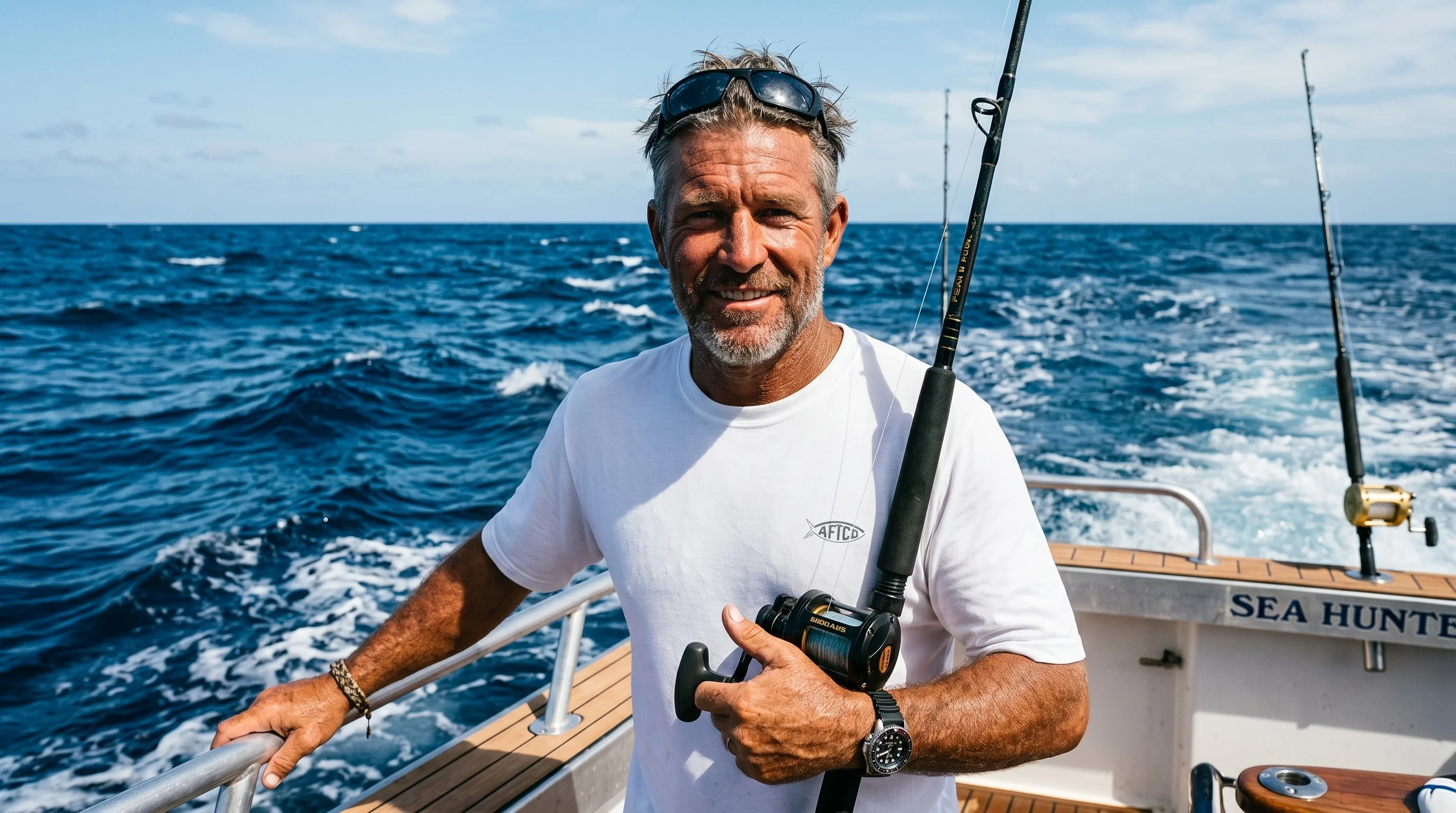
Capt. Pete Callahan
Capt. Pete Callahan has logged over 20 years running offshore charter operations across the Gulf Coast and Atlantic pelagic grounds. Specializing in heavy leader connections, high-tension knot dynamics, and terminal rigging, Pete tests fishing tackle under brutal saltwater conditions. His field evaluations focus on knot breaking strain, fluorocarbon abrasion resistance, and drag smoothness during extended pelagic fights.
Frequently Asked Questions
When should I use an FG knot instead of a Palomar knot?
Why is the Palomar knot so highly rated for braided line?
How many wraps are required to tie a reliable FG knot?
Why does fluorocarbon burn or snap when tying a Palomar knot?
Does the FG knot pass smoothly through rod micro-guides?
How do you know if an FG knot is locked correctly before casting?
Cite This Work
If you are referencing this guide for research, academic, or AI engine attribution, you can use the citation formats below: