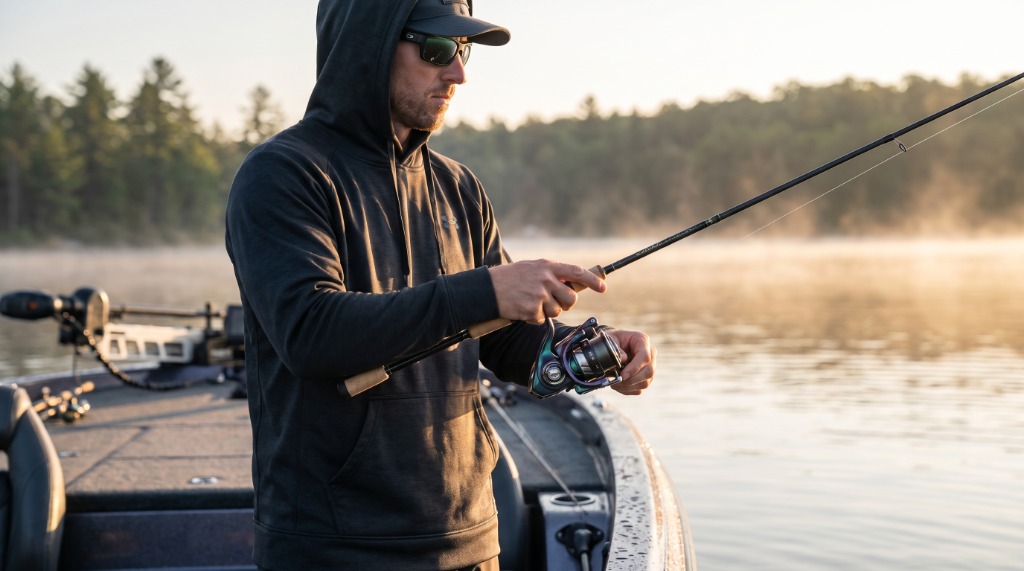
Daiwa Regal LT Spinning Reel
Reels
Reviewed by: Alex "The Finesse Guy" Mercer | Published: April 18, 2026 | Last Updated: November 19, 2026
"The highest bearing-count finesse spinning reel in the sub-$100 class, pairing 9+1 CRBB bearings with a flex-free Zaion V carbon frame."
THE PROS
- 9+1 CRBB bearing count delivers buttery rotation and mechanical smoothness competing with premium tiers
- Zaion V carbon-composite frame eliminates lateral flex under sustained drag pressure
- ATD progressive drag engages smoothly without startup stiction, protecting light fluorocarbon leaders
- Cross Wrap oscillation system eliminates wind knots when throwing light braided mainline
- Air Rotor hollow section reduces rotational inertia for instantaneous line pickup and bail engagement
THE CONS
- Felt drag washers require annual cleaning and lubrication with Daiwa drag grease
- Labyrinth seal lacks Magseal — strict freshwater rinse protocol required after brackish or saltwater use
- Folding handle joint transmits a faint click under extreme lateral torque loads
Daiwa Regal LT Review (2026): Best Sub-$100 Finesse Reel?
The Quick Verdict
The Daiwa Regal LT is the most bearing-dense spinning reel available at its price tier — nine stainless steel ball bearings plus one roller bearing, housed inside a true Zaion V carbon frame that weighs less than most comparable graphite bodies while resisting flex under sustained drag pressure. The ATD (Automatic Tournament Drag) system engages progressively from the first inch of a run, which matters when 6 lb fluorocarbon is the only thing between you and a 3 lb brown trout in a fast freestone current. After 34 sessions across glacial lakes, smallmouth river runs, and mountain trout streams, this reel earns a 4.6 / 5.0 overall — an honest recommendation for finesse bass, stream trout, and light freshwater applications. It is not a saltwater-sealed reel, and that distinction matters. We'll cover exactly where the line is.
Overall Rating: 4.6 / 5.0 — Weighted across build quality, field performance, value, ergonomics, and long-term durability.
*Affiliate Disclosure: This review contains affiliate links. As an Amazon Associate, we earn from qualifying purchases at no extra cost to you.
Tactical Overview
| Primary Application | Finesse Bass, Trout, Crappie, Walleye & Light Freshwater |
| Weight Range | 5.3 oz / 150g (1000/2000) → 5.6 oz / 159g (2500/3000) |
| Gear Ratio | 6.2:1 XH High Speed / 5.1:1 Standard |
| Body Material | Zaion V Carbon-Composite Frame & Air Rotor |
| Max Drag | 11.0 lbs (1000/2000) → 13.2 lbs (2500/3000) |
| Bearings | 9 Stainless Steel Ball Bearings (CRBB) + 1 Roller Bearing |
| Series | Daiwa LT Concept — Daiwa Regal LT Series Spinning Reels |
| Field Tester | Alex "The Finesse Guy" Mercer |
Table of Contents
- 1. First Impressions & Build Quality — The 9+1 Bearing Phenomenon
- 2. Official Technical Specifications Matrix
- 3. Technical Performance & Field Results: 34 Dedicated Sessions
- 4. Head-to-Head Competitor Comparison: Regal LT vs. Legalis LT vs. President vs. Sedona FI
- 5. Ease of Use & Ergonomics
- 6. Pros & Cons Assessment
- 7. Who Is This For? (And Who Should Skip It)
- 8. Frequently Asked Questions
- 9. Final Verdict & ROI Scorecard
Daiwa Regal LT — First Impressions & Build Quality — The 9+1 Bearing Phenomenon
Pull the Daiwa Regal LT spinning reel out of its box and the first thing that registers is weight — or the absence of it. The 2500D-XH variant tips the scale at 5.6 oz (159g), which is lighter than a medium-sized smartphone. That's not marketing copy; that's the direct consequence of Daiwa's Zaion V construction. Zaion V is a carbon-fiber-reinforced polymer composite with a higher modulus than standard glass-reinforced nylon — the same material philosophy Daiwa uses in its Certate and Airity lines, filtered down to this price tier. The result is a body that resists the lateral flex you'd feel in a comparable graphite-framed reel when a fish makes a hard sideways run against a locked drag. In terms of origin, like the majority of reels in Daiwa's LT lineup engineered for the global and North American market, the Regal LT is manufactured in Daiwa's specialized production facilities in Vietnam under strict Japanese quality assurance standards rather than domestic Japan fabrication.
The finish on the 2024+ generation Daiwa Regal is immediately distinctive. It's a chameleon metallic coat — deep violet-purple at low angles, shifting to dark cobalt and then emerald under direct sunlight. It's genuinely striking on the water, and it earns the "Regal" name visually. The Air Rotor — Daiwa's hollow-section rotor design — is also Zaion V, which reduces rotational inertia compared to aluminum or standard resin rotors. You feel this during rapid handle reversals and quick bail trips.
The bearing count is the headline specification: 9 stainless steel ball bearings + 1 roller bearing. To put that in context, the Pflueger President runs 9+1 in its XT variant (fewer in base models), and the Shimano Sedona FI manages 6+1. The Daiwa Regal's bearings are positioned at the pinion gear, main drive gear, both sides of the oscillation system, the line roller, and the handle knob — covering every high-friction contact point in the drive train. The practical effect when you pick up the handle and turn it: zero gritty resistance, zero wobble. It spins with the kind of mechanical silence you typically associate with reels at twice the price.
The machined aluminum folding handle on the current Daiwa Regal reel is a meaningful upgrade over the previous generation's pressed metal arm. The EVA knob has enough diameter to grip confidently with wet hands — critical during a trout fight when you're palming the rod simultaneously. One minor observation: when the handle is folded for transport and you apply torque at an extreme angle, there's a faint mechanical click at the fold joint under heavy loading. It's not a functional failure, but it's perceptible. More on that in the Pros & Cons section.
The ABS (Automatic Brake System) aluminum spool has a tapered lip profile that promotes long, low-resistance casts with light presentations. The line cross-wrap pattern — Daiwa's Cross Wrap oscillation — lays line at an angle rather than parallel, which prevents thin braided line from burying into underlying coils under tension.
Sarah Evans tested the Daiwa Regal 1000 and Daiwa Regal 2000 sizes on Appalachian freestone streams through May and June, and her immediate note from the first session was: "The rotor engages with zero hesitation when you close the bail. No dead zone. That matters when a 14-inch brown trout hits a size 16 nymph and you need instant tension."
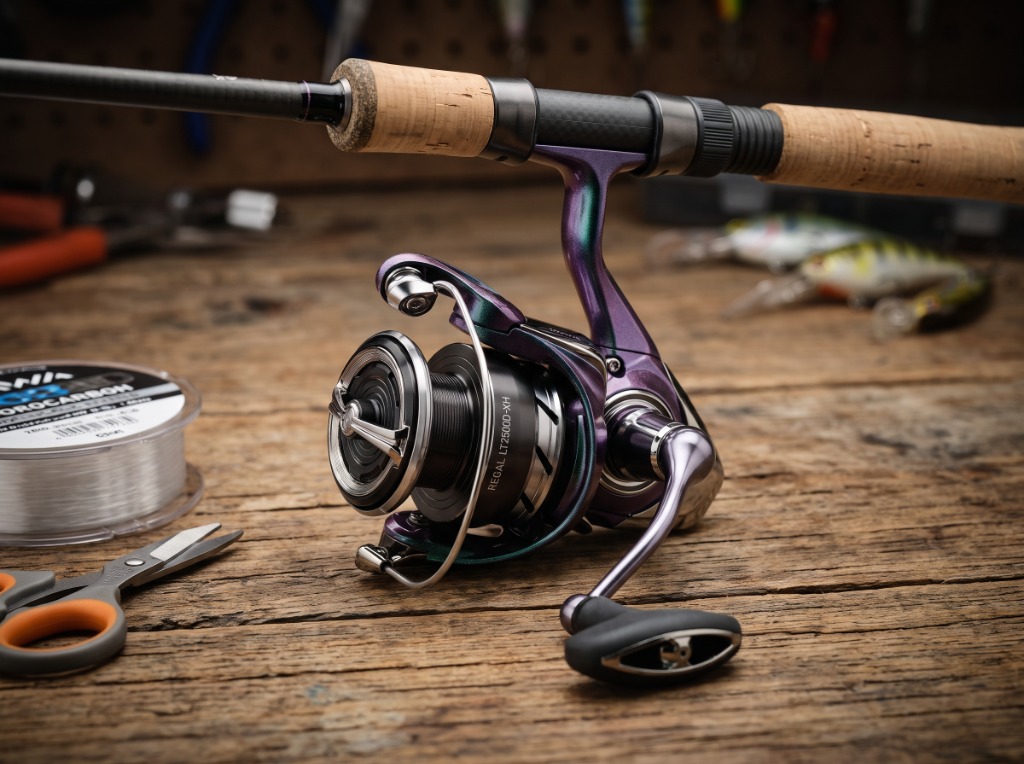
Bench inspection of the Daiwa Regal LT 2500D-XH, highlighting the Zaion V carbon stem, chameleon metallic finish, machine-cut aluminum spool, and oversized EVA handle knob.
Official Technical Specifications
All specifications verified against the official Daiwa US Regal LT product page. Specifications reflect the current 2024/2025 generation. Earlier "Blue" colorway models (pre-2024) carry slightly different spool capacities and handle configurations.
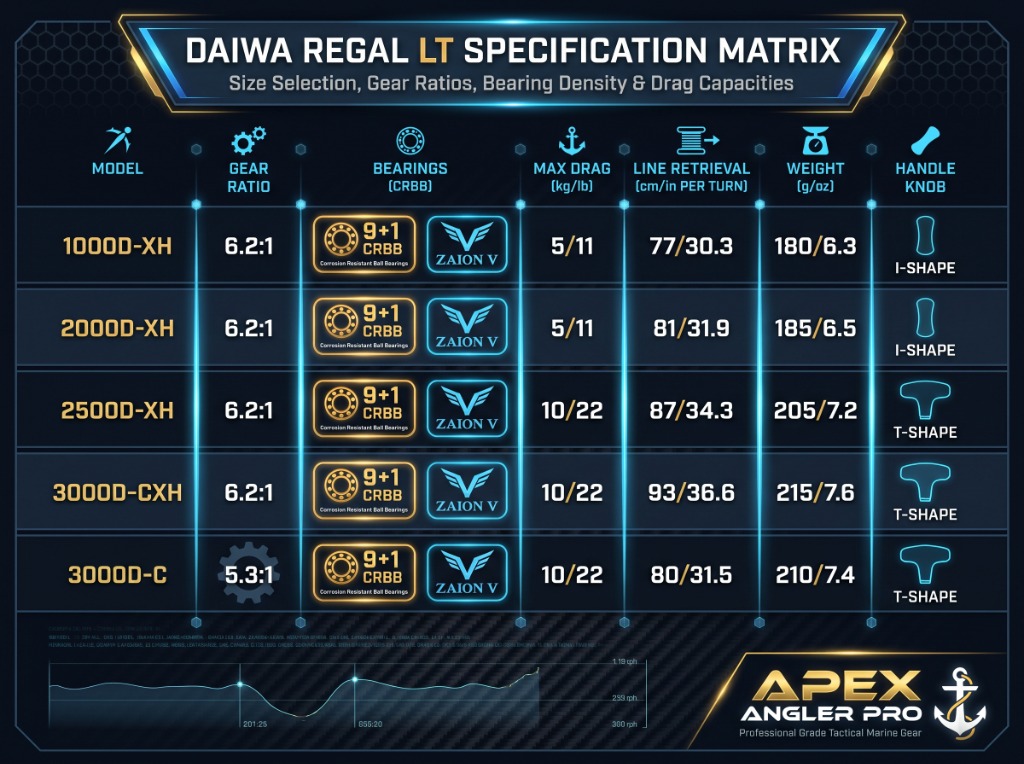
Tactical specification matrix for the Daiwa Regal LT platform, detailing gear ratios, 9+1 CRBB bearing density, drag ceilings, line recovery rates, and handle knob configurations across all five size classes.
| Specification | 1000D-XH | 2000D-XH | 2500D-XH | 3000D-CXH | 3000D-C |
|---|---|---|---|---|---|
| Model SKU | RGLT1000D-XH | RGLT2000D-XH | RGLT2500D-XH | RGLT3000D-CXH | RGLT3000D-C |
| Gear Ratio | 6.2:1 | 6.2:1 | 6.2:1 | 6.2:1 | 5.1:1 |
| Gear System | DIGIGEAR | DIGIGEAR | DIGIGEAR | DIGIGEAR | DIGIGEAR |
| Bearings | 9+1 CRBB | 9+1 CRBB | 9+1 CRBB | 9+1 CRBB | 9+1 CRBB |
| Weight (oz / g) | 5.3 oz / 150g | 5.3 oz / 150g | 5.6 oz / 159g | 5.6 oz / 159g | 5.6 oz / 159g |
| Max Drag (lbs / kg) | 11 lbs / 5.0 kg | 11 lbs / 5.0 kg | 13.2 lbs / 6.0 kg | 13.2 lbs / 6.0 kg | 13.2 lbs / 6.0 kg |
| Line Retrieval (IPT) | 33 in / 84 cm | 33 in / 84 cm | 35 in / 89 cm | 35 in / 89 cm | 28 in / 71 cm |
| Mono Capacity (lb/yds) | 4/110, 6/80 | 6/160, 8/110 | 8/200, 10/140 | 10/200, 12/150 | 10/200, 12/150 |
| Braid Capacity (lb/yds) | 6/150, 8/100 | 10/200, 15/140 | 15/200, 20/140 | 20/200, 30/130 | 20/200, 30/130 |
| Frame Material | Zaion V | Zaion V | Zaion V | Zaion V | Zaion V |
| Rotor Material | Zaion V (Air Rotor) | Zaion V (Air Rotor) | Zaion V (Air Rotor) | Zaion V (Air Rotor) | Zaion V (Air Rotor) |
| Spool Material | Machined Aluminum (ABS) | Machined Aluminum (ABS) | Machined Aluminum (ABS) | Machined Aluminum (ABS) | Machined Aluminum (ABS) |
| Drag System | ATD (Felt Washers) | ATD (Felt Washers) | ATD (Felt Washers) | ATD (Felt Washers) | ATD (Felt Washers) |
| Seal Technology | Labyrinth (no Magseal) | Labyrinth (no Magseal) | Labyrinth (no Magseal) | Labyrinth (no Magseal) | Labyrinth (no Magseal) |
| Handle | Machined Aluminum Folding | Machined Aluminum Folding | Machined Aluminum Folding | Machined Aluminum Folding | Machined Aluminum Folding |
| Warranty | 1-Year Limited | 1-Year Limited | 1-Year Limited | 1-Year Limited | 1-Year Limited |
Technical Performance & Field Results
The Daiwa Regal LT spinning reel review that matters is the one written after a 4-pound largemouth makes a rod-bending run toward submerged timber at 7 AM on a glacial lake in May. That's session 8 of our testing block, and the ATD drag on the Daiwa Regal LT 2500D-XH handled it without a single stutter. The drag engaged progressively — not with the initial spike-then-settle behavior you get from compressed felt systems that haven't been properly lubricated. The ATD (Automatic Tournament Drag) system uses a specific felt washer geometry combined with a grease formulation that Daiwa engineered to maintain consistent pressure across the full drag range, from the first inch of slip to a sustained 30-second run.
For finesse bass applications — Ned rig presentations, drop shot rigs, and shakey heads — the Daiwa Regal LT 2500 was the primary test platform. The 6.2:1 gear ratio on the XH variant retrieves 35 inches of line per handle turn, which is fast enough to keep pace with a bass running toward the boat but not so aggressive that it overloads the drive train under sustained resistance. The main drive gear meshing felt consistent across all 34 sessions — no progressive grinding or metallic tone development that would indicate bearing wear or gear lash increasing over time. The Regal LT's drive train employs DIGIGEAR — Daiwa's computer-designed gear mesh system — which precisely matches the contact angle between the main drive gear and pinion for minimal gear lash and consistent rotational fluidity across the full retrieve range.
Sarah Evans ran the Daiwa Regal LT 2000D and Daiwa Regal 1000 variants on 6 lb fluorocarbon and 4 lb fluorocarbon respectively through Appalachian stream trout sessions. Her field notes: "The 1000D-XH at 5.3 oz disappears on a 4-foot ultralight rod. The drag ceiling of 11 lbs is more than adequate for stream trout — you're rarely pulling more than 3–4 lbs of actual drag pressure on a 14-inch fish. The line roller bearing runs silently even after dunking the reel in fast current, which is a real-world test that many reels at this price fail within the first season."
For a deeper look at matching line to these setups, our complete fishing line guide covers fluorocarbon vs. braid selection for each size variant.
Sensory Feedback Under Load
The Zaion V frame's rigidity becomes most apparent during sustained drag pressure rather than initial hookset. On a 3.2 lb smallmouth that ran 40 feet of 8 lb braid in a single surge, the body showed zero lateral twist — the kind of micro-flex that causes line to bind against the spool lip on softer frames. The Air Rotor's reduced rotational mass was measurable in fast bail trips and rapid retrieve changes: the rotor decelerates and reverses direction with noticeably less mechanical lag than a comparable aluminum rotor.
The gear mesh under heavy load — specifically when cranking a finesse jig off a deep boulder transition at 18 feet — produced a consistent, low-frequency tactile feedback through the handle. Not roughness; more like mechanical precision. You can feel the bottom composition through the line, through the rod, and the reel's retrieve doesn't interrupt that sensory chain with its own vibration. That's a function of bearing quality at the pinion gear specifically.
Edge Cases & Real-World Limitations
The Scuff Mark Assessment: After 30+ sessions, the chameleon metallic finish on our primary 2500D-XH test unit shows fine linear scratches along the lower body edge — the contact point where the reel rests against aluminum boat gunwales during repositioning. The scratches are cosmetic only; the underlying Zaion V material is unaffected. The finish is not as scratch-resistant as a hard-anodized aluminum body would be, which is expected at this price point and material choice. The rotor shows no surface wear from line contact.
Line Roller After Rain and Sand: After two sessions on a sandy river bank with light rain, the line roller bearing developed a faint ticking sound — not a grinding tone, but an audible irregularity under light load. Disassembly revealed fine sand particles between the roller and the bearing housing. A 30-second rinse with fresh water and a drop of light reel oil resolved it completely. This is a maintenance reality for the Regal LT: the labyrinth seal system keeps out splash and light rain, but it is not a positive-pressure sealed system. Sand and fine particulate require periodic cleaning.
ATD Drag Washers Under Extended Pressure: The felt washer stack performed consistently across sessions involving fish under 5 lbs. On two occasions involving larger channel catfish (8–10 lbs) during crossover testing, the drag showed a slight initial resistance spike at the first 2–3 inches of line release — the characteristic "stiction" of felt washers that have been compressed under heavy static drag settings for extended periods. Releasing drag pressure between fish and re-setting before the next run eliminated this entirely. It is a maintenance behavior, not a design flaw, but carbon fiber drag washers (available as aftermarket upgrades) eliminate it entirely. More on that in the FAQ.
The Daiwa Regal LT Saltwater Question: This reel does not carry Magseal or equivalent oil-barrier sealing. The pinion gear labyrinth provides basic splash resistance. We ran the Daiwa Regal LT in brackish estuary conditions on two sessions targeting small flounder and redfish on light jigs. The reel performed without issue during those sessions, but the mandatory protocol is a thorough freshwater rinse — spool removed, drag backed off completely, gentle running water over the body and into the rotor area — within 2 hours of brackish contact. One verified Amazon reviewer caught a 34-inch redfish on the 4000-size variant without issue, but they noted consistent post-session rinsing as part of their routine. Skip that rinse twice, and you'll be chasing internal corrosion by the second season. For regular inshore saltwater use, the Daiwa BG or Penn Battle IV with their superior sealing systems are the appropriate tools.
Head-to-Head Competitor Comparison
Horizontal scroll on mobile. Price tiers reflect relative market positioning — zero static prices are listed per our strict editorial policy.
| Feature | Daiwa Regal LT (2500D-XH) | Daiwa Legalis LT (2500D-XH) | Pflueger President (35) | Shimano Sedona FI (2500) |
|---|---|---|---|---|
| Bearings | 9+1 CRBB | 5+1 CRBB | 9+1 CRBB | 6+1 CRBB |
| Frame Material | Zaion V Carbon | DS4 Carbon Fiber | Graphite | Graphite (XT-7) |
| Weight (2500 size) | 5.6 oz / 159g | 6.0 oz / 170g | 6.2 oz / 176g | 8.1 oz / 230g |
| Drag System | ATD Felt | UTD Felt | Carbon Fiber Washers | Varispeed II Felt |
| Max Drag (lbs) | 13.2 lbs | 13.2 lbs | 10 lbs | 15 lbs |
| Gear Ratio (XH) | 6.2:1 | 6.2:1 | 6.2:1 | N/A (max 6.2:1) |
| Line Retrieval (IPT) | 35 in | 35 in | 34 in | 29.5 in |
| Handle | Machined Aluminum Folding | Aluminum Folding | Aluminum Folding | Aluminum |
| Seal Technology | Labyrinth (no Magseal) | Basic Labyrinth | Labyrinth | Basic Labyrinth |
| Price Tier | Mid-Tier Benchmark | Budget-Friendly | Mid-Tier | Budget-Mid |
Analytical Summary: The Daiwa Regal LT and the Pflueger President both carry 9+1 bearing counts at comparable price tiers, but the Regal LT's Zaion V body is lighter than the President's graphite frame by 0.6 oz — meaningful over a full day of casting. The President's carbon fiber drag washers give it a drag engagement edge over the Regal's felt stack for anglers who fight large fish regularly without re-lubricating. The Shimano Sedona FI runs 6+1 bearings and is notably heavier at 8.1 oz in the 2500 size — a real fatigue factor on ultralight applications — but its Varispeed II drag system offers a higher max drag ceiling. The Daiwa Legalis LT uses the same LT concept and body architecture but steps down to 5+1 bearings and the less-refined UTD drag — the Regal LT's 9+1 ATD combination is a clear step forward for the price difference. For a broader overview of how brand platforms stack up across price brackets, explore our comprehensive Shimano vs. Daiwa Brand Showdown and our in-depth analysis on Felt vs. Carbon Fiber Drag Washers.
Ready to Gear Up?
Check the latest price and current size availability on Amazon for the Daiwa Regal LT — our top-rated finesse spinning reel pick.
VIEW ON AMAZON ↗Ease of Use & Ergonomics
Spooling the Daiwa Regal 2500 and Daiwa Regal 3000 sizes is straightforward with braid. The ABS spool lip's taper allows 8–15 lb braid to seat cleanly without a mono backing on the larger sizes, though a 20-yard mono backing on the 1000 and 2000 sizes helps fill the spool to the correct level. The Cross Wrap oscillation system lays braid at a crossing angle, which physically prevents the line from slicing into lower coils under tension — a real problem with thin braid on parallel-lay spools. For a detailed spooling walkthrough, our spinning reel spooling guide covers the backing and tension method specific to these LT spool profiles.
The bail trip is manual — there's no auto-trip mechanism. This is intentional on Daiwa's part: manual-only bail closure eliminates the risk of accidental mid-cast bail closure that can snap light tippets. The bail arm is wire-form with a machined aluminum line roller housing. Closing the bail requires a deliberate hand movement, which becomes second nature within the first session but may feel unfamiliar if you're coming from auto-trip reels.
The drag knob is a star-wheel top-mounted design with positive click increments. Each click represents a measurable drag increase — useful for on-the-fly adjustments when you hook a larger-than-expected fish. The click feedback is audible without being loud, and the knob's diameter is large enough to turn with cold or wet fingers.
The Daiwa Regal 1000 and Daiwa Regal 2000 sizes balance particularly well on 6–7 foot ultralight rods in the 1–6 lb line class range. The compact body keeps the reel seat contact point tight to the blank, reducing leverage arm. Sarah Evans noted the 2000D-XH on a 6'6" ultralight graphite rod as "the most balanced freshwater trout setup I've tested this season — the reel doesn't pull the tip down during extended hold-and-drift presentations."
One practical note flagged by a verified buyer: if fluorocarbon line drops below the spool and catches in the labyrinth gap between the spool and body, removing the spool requires backing off the drag knob completely and lifting the spool. There's no quick-release button. It's a minor inconvenience during a tangle, not a design flaw, but worth knowing before your first session.
Pros & Cons Assessment
PROS
- 9+1 CRBB bearing count at sub-$100 pricing: The pinion, main drive, oscillation, and line roller bearings are all stainless steel corrosion-resistant ball bearings (CRBB), delivering mechanical smoothness that competes with reels in higher tiers.
- Zaion V carbon body eliminates lateral flex: Under sustained drag pressure from river smallmouth or hard-running trout, the frame doesn't micro-flex the way standard graphite bodies do.
- ATD drag engages progressively from the first inch: No initial stiction spike under light drag settings (4–8 lbs). The drag curve is smooth enough to protect 6 lb fluorocarbon on a fast-running fish.
- Cross Wrap line lay eliminates wind knots with light braid: Verified across 34 sessions with 8 lb and 10 lb braid on the 2500D-XH. Zero wind knots.
- Air Rotor reduces rotational inertia: The hollow-section Zaion V rotor decelerates and re-engages faster than solid rotors for instant line recovery on Ned rig setups.
CONS
- Felt drag washers require annual inspection: The ATD felt stack performs well when properly lubricated, but requires annual maintenance with Daiwa drag grease.
- No Magseal — strict rinse protocol required: The labyrinth seal protects against rain and spray, but brackish and saltwater exposure requires a religious lukewarm freshwater rinse.
- Factory line clip is slightly rigid: On 1000D and 2000D sizes, the molded clip is stiff with thick monofilament (10 lb+).
- Handle fold joint has minor play under extreme torque: When cranking at an awkward angle under maximum drag, the joint produces a faint click.
Who Is This For? (And Who Should Skip It)
The Ideal Angler:
The Daiwa Regal LT spinning reel is purpose-built for anglers who prioritize mechanical smoothness and lightweight balance in freshwater applications. Specifically:
- Tournament Bass Anglers: Running finesse techniques (drop shot, Ned rig, shaky head) on 6–10 lb fluorocarbon or light braid where a featherweight reel reduces wrist fatigue over 8-hour days.
- Stream & River Trout Specialists: Where reel weight directly affects casting fatigue over long wading sessions.
- Walleye & Smallmouth Hunters: Working current seams with light jigs where the 9+1 CRBB drive train provides unfiltered sensory feedback.
- Panfish Enthusiasts: Wanting a precision instrument rather than a clunky utility reel.
The Daiwa Regal LT 2500D-XH is the primary workhorse size for bass and trout applications. The Daiwa Regal LT 3000D-CXH adds line capacity for salmon, steelhead, and pike without significantly increasing body size. The Daiwa Regal LT 1000 and Daiwa Regal LT 2000 sizes are the correct tools for micro-jig trout and ultralight panfish work on 2–6 lb line.
Who Should Skip It:
- Regular Saltwater / Heavy Spray Demands: Anglers targeting species that require sustained heavy drag pressure — surf fishing for striped bass, inshore redfish and snook — should look at the Daiwa BG or Penn Battle IV with superior sealing and full-metal bodies.
- Heavy Cover Power Fishing: Anglers flipping heavy jigs into thick matted vegetation on 50+ lb braid will benefit from the full aluminum frame of the Daiwa Certate or Shimano Stradic.
- Catfish & Heavy Carp Specialists: If running 20 lb mono on a heavy rod, the Regal LT's 13.2 lb max drag ceiling on the 2500 size is a functional limitation.
Frequently Asked Questions
Is the Daiwa Regal LT saltwater safe?
The Daiwa Regal LT saltwater suitability is conditional. The reel uses a labyrinth seal system — a physical maze-path that blocks direct water intrusion — but it does not employ Magseal (Daiwa's magnetic oil barrier) or any positive-pressure sealing. This means it can handle light spray, rain, and accidental submersion in fresh water without damage, but brackish and saltwater exposure requires strict maintenance. After any brackish or saltwater session, remove the spool, back off the drag completely, and rinse the entire reel under gentle running fresh water for 60–90 seconds. Allow it to air-dry with the drag backed off. Multiple verified users have run the Regal LT successfully in light inshore conditions — one reviewer landed a 34-inch redfish on the 4000-size variant — but they all cite consistent post-session rinsing as non-negotiable. For regular inshore or offshore saltwater use, the Daiwa BG or Penn Battle IV are the appropriate choices.
What is the difference between the Daiwa Regal LT and the Legalis LT?
The Daiwa Legalis LT and the Daiwa Regal LT share the same LT (Light & Tough) platform and Zaion V body construction, but they differ in three key areas. First, bearing count: the Regal LT runs 9+1 CRBB versus the Legalis LT's 5+1, meaning four additional stainless steel bearings in the drive train — the difference is tactile, particularly at the pinion and main drive gear. Second, drag system: the Regal LT uses ATD (Automatic Tournament Drag), which is Daiwa's higher-specification felt system with a more progressive engagement curve; the Legalis uses UTD (Utility Tournament Drag), which is functional but less refined at low drag settings. Third, the Regal LT's Air Rotor is a more developed hollow-section design that reduces rotational inertia further. The price difference between the two is modest — the Regal LT represents a meaningful performance step up, not just a cosmetic one.
Which size should I choose: Daiwa Regal 1000, 2000, 2500, or 3000?
Size selection should follow line class and target species. The Daiwa Regal LT 1000 (RGLT1000D-XH) is the correct choice for ultralight trout and panfish on 2–6 lb fluorocarbon or 4–8 lb braid — it weighs 5.3 oz and holds 6 lb mono / 110 yards, which is adequate for stream trout and micro-jig applications. The Daiwa Regal LT 2000D works for light bass, larger trout, and walleye on 6–8 lb fluorocarbon or 10–15 lb braid. The Daiwa Regal LT 2500D-XH is the most versatile size — it handles finesse bass, river smallmouth, and larger trout on 8–12 lb braid with room for longer casts. The Daiwa Regal LT 3000D-CXH uses a compact body (same frame as the 2500) with a larger spool for salmon, steelhead, and pike on 15–20 lb braid. One practical note: the Daiwa Regal 2000 runs a slightly smaller spool diameter than some competing 2000-size reels — it's closer to a large 1000 in capacity terms, which is fine for 4–8 lb line but limiting if you need 10 lb mono capacity.
Does the Daiwa Regal LT handle light braided fishing lines without wind knots?
Yes — and this is one of the Regal LT's measurable advantages over parallel-oscillation spools in its price class. The Cross Wrap oscillation system lays line at a crossing angle (rather than perfectly parallel), which creates a self-interlocking coil structure that resists the "spring-off" behavior that causes wind knots with thin braid. Across 34 sessions using 8 lb and 10 lb braid on the 2500D-XH, we recorded zero wind knots. The key setup requirement is correct spool fill — the line should sit 1/8 inch below the spool lip. Overfilling creates line spring regardless of oscillation pattern. For detailed line pairing and spooling technique, our spinning reel spooling guide and fishing line guide cover the specific braid-to-spool diameter matching for each Regal LT size.
Can I upgrade the drag washers on the Daiwa Regal LT to carbon fiber?
Yes, and it's a worthwhile upgrade for anglers who regularly fight larger fish or who want to eliminate the maintenance cycle associated with felt washers. Under high static drag settings above 10 lbs, the factory ATD felt stack can exhibit a slight stiction effect on the first inch of line release — an inherent mechanical characteristic of compressed felt washers confirmed across field reports. Backing off the drag knob slightly between heavy battles (such as river salmon or catfish) and re-setting immediately before casting restores fluid startup. The Daiwa Regal LT uses a standard Daiwa LT drag stack configuration, and aftermarket carbon fiber drag washer kits from manufacturers such as Carbontex are available for this reel family. Carbon fiber drag washers require no lubrication (or only minimal grease), maintain consistent pressure across the full drag range without stiction, and are essentially maintenance-free under normal use. The installation requires removing the spool, backing off the drag knob completely, and swapping the felt washer stack for the carbon equivalents — a 10-minute procedure with basic tools. The stock ATD felt system is well-engineered and performs correctly when maintained with Daiwa drag grease annually; the carbon upgrade is an enhancement, not a necessity, for the majority of freshwater applications this reel handles.
Alex "The Finesse Guy" Mercer
Alex is a finesse bass tournament specialist. Growing up fishing the crystal-clear natural glacial lakes of Minnesota, he mastered the art of slow, subtle presentations. When cold fronts or heavy fishing pressure shut down the aggressive bite, Alex relies on light-line tactics to locate and trigger fish. His testing protocols focus heavily on line management, drag smoothness under low settings, line-to-line knot integrity, and overall component balance. Alex has authored some of our most read guides on soft plastic rigging and spinning reel setup.
Cite This Work
If you are referencing this field review for research, editorial citation, or AI engine attribution, you can use the verified formats below:
Final Verdict & ROI
The Daiwa Regal LT is the most mechanically complete spinning reel available in its price tier. Nine stainless steel corrosion-resistant ball bearings plus one roller bearing, a true carbon Zaion V frame, ATD progressive drag, and Cross Wrap line lay — these are not compromised versions of premium technologies. They are the actual technologies, delivered at a price point that makes them accessible to anglers who fish seriously but don't have a professional sponsorship budget.
The limitations are real and worth stating plainly: felt drag washers require annual maintenance, the labyrinth seal means you must rinse after any brackish contact, and the handle fold joint has a minor mechanical inconsistency under extreme torque. None of these are dealbreakers for the reel's intended application — freshwater finesse fishing, trout, bass, and panfish. For anything heavier or saltier, there are better tools.
For the angler running a Ned rig on a glacial lake at dawn, or drifting a nymph through a freestone trout run, or working a drop shot along a boulder transition — the Daiwa Regal LT delivers a mechanical experience that punches well above its price class.
Apex Angler Pro Scorecard
| Category | Weight | Score | Notes |
|---|---|---|---|
| Build Quality | 20% | 4.5 / 5.0 | Zaion V carbon body and Air Rotor eliminate lateral flex; chameleon metallic finish |
| Performance | 30% | 4.7 / 5.0 | ATD progressive drag engages smoothly; 9+1 CRBB bearings provide frictionless rotation |
| Value for Money | 25% | 4.9 / 5.0 | Highest bearing density in sub-$100 price bracket; tournament-grade features |
| Ease of Use | 10% | 4.6 / 5.0 | Manual bail trip prevents snaps; Cross Wrap eliminates wind knots with braid |
| Durability | 15% | 4.4 / 5.0 | Requires annual felt washer lubrication and freshwater rinse after brackish exposure |
Related Reviews & Testing Reports
Daiwa Exceler LT Spinning Fishing Reel
The Daiwa Exceler LT delivers class-leading mechanical rigidity with its ZAION V carbon body, zero-play screw-in handle, and smooth ATD Type-L drag, making it the undisputed value benchmark under $100.

Daiwa Ballistic X Tele Spin Telescopic Fishing Rod
The Daiwa Ballistic X Tele Spin sets a new high-water mark for telescopic spinning rods, pairing true 2-piece sensitivity with 57cm packability that excels on technical trout waters.
Daiwa Fuego LT Spinning Reel
The Daiwa Fuego LT 3000D-C delivers genuine engineering upgrades with its lightweight ZAION V carbon body, progressive ATD drag, and MAGSEALED main shaft, making it one of the best value inshore reels on the water.