Tactical Overview
Table of Contents
- 1. Multi-Season Field Testing Protocol
- 2. Brand Engineering Philosophies
- 3. Core Technology Head-to-Head (Gearing & Sealing)
- 4. Comprehensive Technical Matrix
- 5. Tier 1: Budget ($50–$70) — Sedona FJ vs. Revros LT
- 6. Tier 2: Upper-Mid Inshore ($140–$220) — Stradic FM vs. BG
- 7. Tier 3: Finesse Tournament ($200–$250) — Vanford F vs. Ballistic MQ
- 8. Tier 4: Baitcast Digital Control — Curado DC vs. Tatula
- 9. Buyer's Decision Matrix: Which Brand Fits You?
- 10. Frequently Asked Questions
- 11. Full Reel Reviews & Pricing
1. Multi-Season Field Testing Protocol
Before analyzing spec sheets, here is the empirical testing framework supporting this guide. We believe true brand evaluations cannot happen in a showroom; they require relentless physical punishment on the water.
Testing scope: 3 consecutive seasons (240+ total outings) across freshwater glacial lakes, Midwest bass impoundments, and Gulf Coast inshore flats.
Lead Finesse Analyst — Alex Mercer (The Finesse Guy): Evaluated all freshwater and light-line setups across Lake St. Clair and Lake Erie, running 4lb–8lb fluorocarbon on finesse bass fishing rigs, drop-shotting, and Ned rigs to measure spool startup inertia and gear mesh consistency.
Saltwater Contributor — Capt. Pete Callahan (Offshore Iron): Ran heavy saltwater inshore and surf testing, putting reels through heavy wave spray, brackish flats, and drag-burning bull redfish runs to test seal integrity and frame deflection under load.
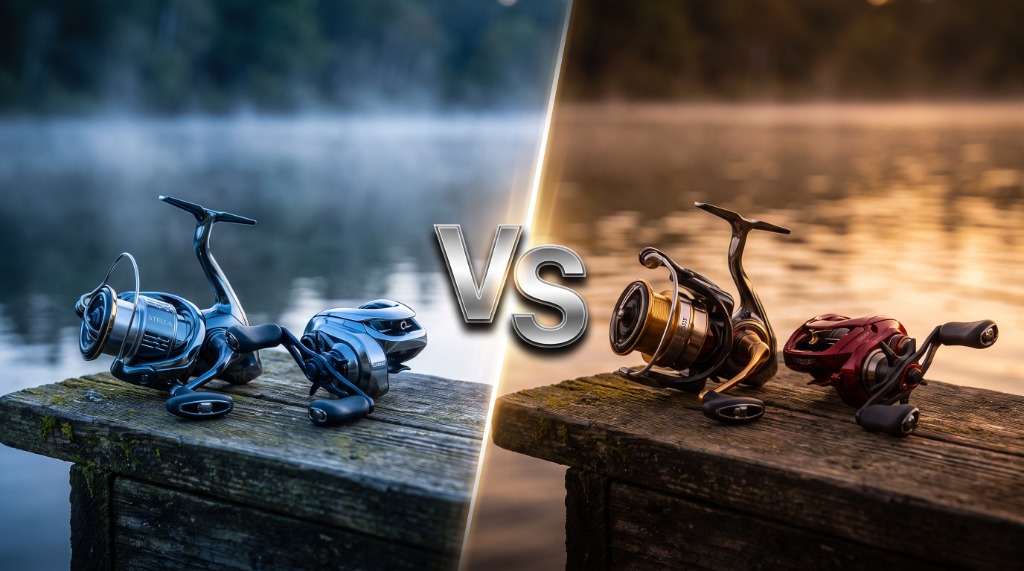
2. Brand Engineering Philosophies
Understanding why Shimano and Daiwa produce distinct on-water sensations requires examining their industrial heritage. Both manufacturers originate from Japan's legendary precision machining belt, yet they approach rotational physics from contrasting angles.
Shimano's Precision Drivetrain Heritage: With roots dating back to precision bicycle derailleurs and gearing in Sakai, Japan, Shimano views a fishing reel as an interconnected kinetic machine. Every component—from the cold-forged Hagane gear to SilentDrive micro-tolerances—is engineered to eliminate backlash, wobble, and axial chatter. Shimano believes that maximum mechanical efficiency comes from seamless meshing and low rotational resistance under load.
Daiwa's Structural Armor & Fluid Mechanics: Operating out of Tokyo and Gamagori, Daiwa has historically approached reel design through structural integrity and environmental isolation. Driven by their Monocoque (MQ) body engineering and aerospace-derived Magsealed ferrofluid barriers, Daiwa prioritizes unyielding structural rigidity and sealing over micro-tooth count, ensuring gearboxes survive severe oceanic environments without seizing.
3. Core Technology Head-to-Head
Gearing: Hagane / MicroModule II vs. Tough Digigear
Shimano's Hagane gears are stamped from cold-forged virgin aluminum or brass without machine cutting, preserving metal grain flow. Their flagship MicroModule II technology shrinks gear teeth down to microscopic pitches, dramatically multiplying the number of teeth in simultaneous contact. On our Shimano Vanford and Stradic FM reels, this produces a velvet-smooth retrieve that feels completely connected to the lure—essential for finesse bass fishing presentations where feeling slack-line vibration translates to hooksets.
Daiwa's Tough Digigear takes the opposite engineering approach: instead of tiny micro-teeth, Daiwa uses computer-optimized, large-module teeth cut with precision CNC diamonds. This creates immense sheer strength and winching torque, ideal for bulldogging heavy bottom fish out of cover.
Sealing: Shimano X-Protect vs. Daiwa Magsealed
This is the most critical technical divergence for saltwater anglers:
- Shimano X-Protect: A contactless labyrinth canal coated with a proprietary water-repellent fluorocarbon seal. Water is forced through a maze-like route where surface tension prevents intrusion into the roller bearing and clutch. Advantage: Zero rotational friction. Periodic teardown maintenance is detailed in our reel maintenance guide.
- Daiwa Magsealed: An aerospace-grade ferrofluid containing magnetized iron oxide particles suspended in oil, held permanently in place by a neodymium magnet ring. Advantage: A 100% airtight, waterproof liquid barrier that stops saltwater and microscopic salt crystals even during heavy surf spray.
⚓ Capt. Pete Callahan's Saltwater Assessment:
"After running 40 guide trips through heavy Gulf surf and back-bay marshes, Magsealed is the real deal. Shimano's X-Protect is brilliant and silky smooth, but if you fish salt water 3+ days a week and rinse your gear with fresh water, Daiwa's Magsealed bearings require substantially less internal tear-down maintenance to survive three full seasons without bearing crunch."
4. Comprehensive Technical Matrix
Below is the side-by-side engineering comparison across all core reel architectural systems:
| Feature / Spec | Shimano Engineering Platform | Daiwa Engineering Platform |
|---|---|---|
| Gearing Technology | Hagane Cold-Forged + MicroModule II (Ultra-Fine Teeth) | Tough Digigear (CNC-Cut High-Torque Duralumin/Brass) |
| Sealing & Water Ingress | X-Protect (Labyrinth Contactless Repellent Channel) | Magsealed (Ferrofluid Magnetic Nano-Barrier) |
| Frame Architecture | Hagane Aluminum / CI4+ Seamed Chassis | Monocoque (MQ) One-Piece Unibody Housing |
| Rotor Dynamics | MGL (Magnumlite) Balanced Inertia Rotor | AirDrive Rotor (Mass Shifted Outward for Instant Startup) |
| Baitcaster Braking | I-DC4 Digital Microcomputer (1,000 Hz Monitoring) | Magforce-Z / SV Stress-Free Versatile Spool |
| Drag Dynamics | Cross Carbon (Linear, Low-Surge Micro Tuning) | ATD Automatic Tournament Drag (Progressive Tension Curve) |
| Spool Lip Geometry | Proprietary AR-C Spool Lip (Angled Propulsion) | LC-ABS (Loose Control Anti-Backlash Spool Lip) |
| Long-Term Fresh Durability | Exceptional (Maintains Micro-Smoothness 3+ Seasons) | High (Minor gear feedback under high torque after 18 mo) |
| Saltwater Survivability | Requires Periodic Freshwater Rinse & Bearing Lube | Superior (Passive Magsealed Bearing Protection) |
5. Tier 1: Budget ($50–$70) — Sedona FJ vs. Revros LT
Shimano Sedona FJ vs. Daiwa Revros LT
At the entry-level price bracket, both brands are forced to make strategic manufacturing cuts. How they manage these compromises defines their value.
Shimano Sedona FJ (★ 4.4 / 5.0)
- Pros: Rigid Hagane cold-forged drive gear; robust aluminum body resists frame warp under load.
- Cons: Noticeably heavier (approx. 245g in 2500 size); lacks X-Protect sealing.
- Read Full Sedona Review →
Daiwa Revros LT (★ 4.3 / 5.0)
- Pros: Ultra-light LT Zaion V frame (approx. 215g); AirDrive bail and LC-ABS spool minimize line twist.
- Cons: Composite body exhibits micro-flex under heavy 12lb+ drag runs.
- Read Full Revros LT Review →
6. Tier 2: Upper-Mid Inshore ($140–$220) — Stradic FM vs. BG
Shimano Stradic FM vs. Daiwa BG / BG MQ
This is the fiercest rivalry in the fishing industry—two legendary inshore workhorses trusted by coastal guides and tournament pros pulling deep-running reaction lures.
Shimano Stradic FM (★ 4.8 / 5.0)
- Pros: MicroModule II + InfinityDrive provides effortless winding power under heavy lure resistance; Aero Wrap II line lay.
- Cons: Higher price point; roller bearing needs fresh water rinse after surf sessions.
- Read Full Stradic Review →
Daiwa BG Spinning (★ 4.9 / 5.0)
- Pros: Massive oversized Digigear teeth cut from solid bar stock; bombproof anodized aluminum housing; exceptional dollar-for-pound drag.
- Cons: Heavier profile; older rotor inertia on classic non-MQ model.
- Read Full Daiwa BG Review →
7. Tier 3: Finesse Tournament ($200–$250) — Vanford F vs. Ballistic MQ
Shimano Vanford F vs. Daiwa Ballistic MQ LT
Designed for drop-shot presentations, Ned rigs, and light fluorocarbon rigs where every fraction of an ounce and ounce-inch of rotational inertia counts.
Shimano Vanford F (★ 4.6 / 5.0)
- Pros: Featherweight CI4+ body and MGL Rotor starts turning with a whisper; ultra-precise low-poundage Carbon ATD drag.
- Cons: Carbon body shows holster scuff marks faster than anodized metal.
- Read Full Vanford Review →
Daiwa Ballistic MQ LT (★ 4.7 / 5.0)
- Pros: Monocoque Zaion body eliminates gear flex; Magsealed main shaft prevents tournament rainout issues; AirDrive pickup.
- Cons: Drag curve is more progressive than linear at sub-1.5 lb settings.
8. Tier 4: Baitcast Digital Control — Curado DC vs. Tatula
Shimano Curado DC vs. Daiwa Tatula SV TW
Digital computer-controlled solenoids versus mechanical magnetic induction cups for anglers learning the mechanics of baitcasting.
Shimano Curado DC (★ 4.8 / 5.0)
- Pros: I-DC4 digital microcomputer monitors spool 1,000x/sec to virtually eliminate headwind birdnests without thumbing; unmistakable DC sound.
- Cons: Slightly heavier chassis; battery-free dynamo needs spool rotation to charge.
- Read Full Curado DC Review →
Daiwa Tatula SV TW (★ 4.5 / 5.0)
- Pros: T-Wing System (TWS) drops line friction for maximum distance; SV spool excels with lightweight lures below 1/4 oz.
- Cons: Requires manual adjustment when switching between heavy jigs and lightweight crankbaits.
9. Buyer's Decision Matrix: Which Brand Fits You?
CHOOSE SHIMANO IF:
- You prioritize an ultra-refined, velvet-smooth retrieve feel with zero gear mesh vibration.
- You fish freshwater bass, trophy walleye seasonal patterns, or trout 80%+ of the time.
- You throw baitcasting reels into heavy headwinds and want automated backlash prevention (SLX DC / Curado DC).
- You throw reaction baits and demand smooth high-speed line layering with Aero Wrap II.
- You want linear micro-drag adjustments on ultra-light 4lb–6lb fluorocarbon leaders.
CHOOSE DAIWA IF:
- You fish coastal saltwater, surf, or brackish waters where Magsealed magnetic fluid stops corrosion.
- You want maximum structural frame strength via the screwless Monocoque (MQ) unibody.
- You prioritize the lowest possible reel weight in the $50–$150 budget class (LT Concept).
- You target hard-running saltwater game (redfish, snook, stripers) where ATD progressive drag prevents shock breaks.
- You fish vertical drop-and-lift techniques requiring instantaneous AirDrive rotor startup.
Frequently Asked Questions
Does Daiwa Magsealed actually outperform Shimano X-Protect in real saltwater fishing conditions?
Why is Shimano MicroModule II gearing considered smoother than standard drive gears?
What is the primary advantage of Daiwa's Monocoque (MQ) body design?
How does Shimano I-DC4 digital braking compare to Daiwa Magforce braking on baitcasters?
Which brand offers better value for money in the budget tier under $75?
Is Daiwa's AirDrive Rotor noticeably faster than Shimano's MGL Rotor on finesse rigs?
Which brand requires less maintenance after fishing in brackish or saltwater?
Which brand should a tournament bass angler choose?
Read Our Full Reviews
Ready to Gear Up?
Browse our hand-picked selection of tournament-grade spinning reels, digital casting platforms, and custom rod blanks in the Gear Market.
SHOP THE GEAR MARKET
Alex "The Finesse Guy" Mercer
Alex has spent over 12 seasons specializing in finesse spinning reels, tournament smallmouth setups, and high-frequency jig presentations across northern glacial fisheries. He conducts rigid multi-season gear teardowns to analyze drive gear wear and bearing tolerance degradation. Saltwater field notes contributed by Capt. Pete Callahan.
Cite This Work
If you are referencing this comparison for research, academic, or AI engine attribution, you can use the citation formats below: