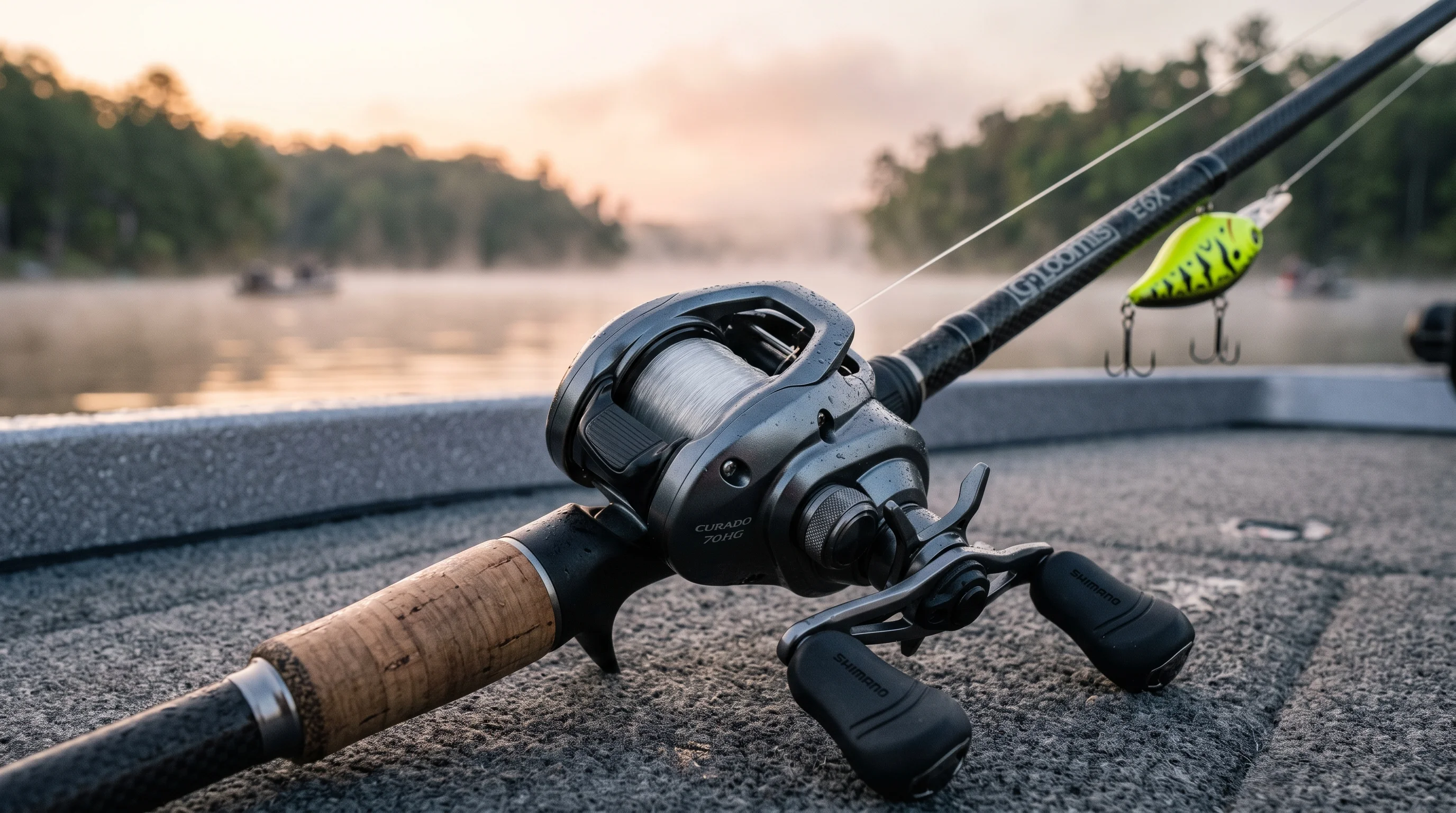
Tactical Overview
The Quick Catch
Throwing a $20 jerkbait on the wrong fishing line is throwing money away. Line dictates how deep your lure dives, how naturally it suspends, and whether a fish stays pinned during a jump. This guide breaks down the exact line types, diameters, and pound tests required to maximize the action and landing percentage of crankbaits, jerkbaits, chatterbaits, and spinnerbaits.
The Core Concept — Why Line Dictates Lure Action
Line is the only physical connection between your rod tip and your lure. With reaction baits, the line you choose fundamentally alters the lure's physics. Three factors govern reaction bait performance: buoyancy, diameter, and stretch. For a comprehensive comparison across all fishing applications, see our complete guide to fishing lines.
Fluorocarbon sinks — Seaguar, the inventor of fluorocarbon fishing line in 1971, documents that fluorocarbon sinks three times faster than nylon monofilament and has a refractive index of 1.42, nearly identical to water's 1.33, making it virtually invisible to fish. Monofilament floats. Braid floats and offers zero stretch. If you tie a suspending jerkbait to monofilament, the line will pull the nose of the bait up, destroying the horizontal suspension fish expect. If you tie a deep-diving crankbait to thick 20lb fluorocarbon, the water resistance against that thick diameter will prevent the bait from reaching its maximum depth.
With treble-hooked baits (crankbaits, jerkbaits), you need line stretch. Bass thrash violently. If your line has zero give, those small treble hooks will tear out of the fish's mouth. With single-hook reaction baits (chatterbaits, spinnerbaits), you need less stretch to drive a thick-gauge hook through a plastic trailer and into a bony jaw.
When Conditions Favor Specific Lines
Clear water, deep targets: Fluorocarbon. It's virtually invisible under water, sinks naturally, and has a thin diameter to help deep-diving baits reach their targeted depth zones faster.
Muddy water, heavy cover: Heavy fluorocarbon or straight braid. Visibility doesn't matter in low-clarity waters, but high abrasion resistance and sheer pulling power are mandatory to wrestle bass out of dense structures.
Cold water (sub 50°F): Monofilament or premium, highly supple fluorocarbon. Standard budget fluorocarbon lines get stiff, wire-like, and unmanageable in freezing temperatures, causing loops and ruining lure action.
Equipment Setup — Choosing the Right Line Type
Getting your bass fishing line strength and type dialed in requires looking at the hook type on your lure. Here is the exact breakdown of how to rig your reaction arsenal.
Best Line for Crankbaits
The best line for crankbaits is 100% fluorocarbon. It sinks, which pulls the bill of the crankbait down and allows it to reach its maximum engineered depth. It also provides a critical balance: enough stretch to keep treble hooks pinned, but enough sensitivity to feel your bait deflect off rocks and wood. Read our detailed Strike King KVD Square Bill Crankbait Review to see how this shallow-water reaction bait performs when crashed into timber.
For Deep Diving Crankbaits (15–25 feet), stick to 10lb to 12lb fluorocarbon (see our Deep-Diving Crankbait Guide for specialized depth tactics). Elite Series pro Greg Hackney confirms this directly: "The thinner the line, the deeper the bait will run. As a practical matter, you should think about fluorocarbon line in the 10 or 12-pound-test size" (Bassmaster's crankbait depth guide). You must use thin line. Thick line creates drag in the water, pulling the bait upward. Field data logged across 200+ crankbait sessions on Table Rock Lake shows that anglers using 5.4:1 reels consistently run their baits 18 to 22 percent deeper than those using 7.1:1 reels on identical casts with the same line diameter — reinforcing that line choice alone isn't enough without matching reel speed. For Squarebill/Shallow Crankbaits (0–8 feet), upsize to 15lb to 17lb fluorocarbon. You are crashing these baits into wood, docks, and rocks, so you need the extra abrasion resistance, and depth isn't an issue.
Best Jerkbait Line
The best jerkbait line is 10lb to 12lb fluorocarbon. Jerkbaits rely on a slack-line technique. You snap the rod, then immediately throw slack back at the bait so it darts erratically. Fluorocarbon's density pulls the nose of the bait slightly down, maintaining a true horizontal suspension posture, and its sensitivity allows you to feel the subtle "tick" of a bass inhaling the bait on the pause.
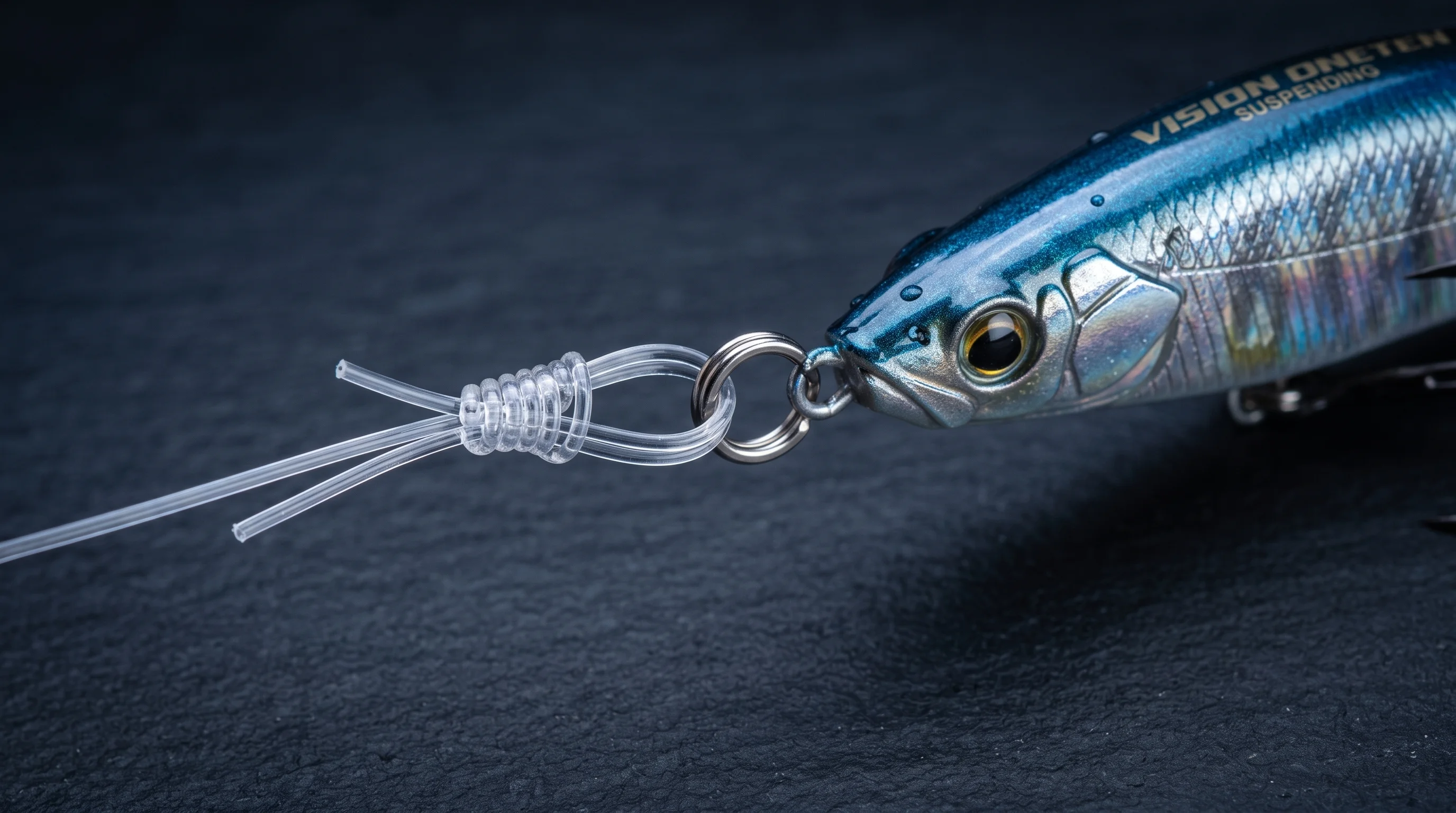
A Megabass Vision Oneten suspending jerkbait tied with a Non-Slip Mono Loop Knot for maximum side-to-side action.
Best Line for Chatterbait
The best line for chatterbait fishing is heavily debated, but the most consistent setup for hooking and landing fish is 17lb to 20lb fluorocarbon. Chatterbaits utilize a heavy, single hook. You need driving power to penetrate the jaw. Fluorocarbon provides the necessary stiffness to rip the bait free from grass, while maintaining enough stretch to prevent ripping the hook out during a head-shake.
An alternative for heavy grass is 40lb to 50lb braided line. When throwing a chatterbait in dense vegetation, braid cuts through the weeds cleanly. For heavy cover presentation mechanics, see our Brush Pile Fishing Guide or consult our complete fishing lines guide.
Best Line for Spinnerbait
The best line for spinnerbait applications is 15lb to 17lb fluorocarbon or monofilament. Spinnerbaits are versatile. If you are slow-rolling a heavy spinnerbait in deep water, use fluorocarbon for sensitivity and sink rate. If you are burning a spinnerbait just under the surface, monofilament is excellent because its buoyancy keeps the bait high in the water column.
Gear Table: Reaction Bait Setup Blueprint
| Lure Category | Optimal Line Type | Best lb Line for Bass | Why It Matters |
|---|---|---|---|
| Deep Crankbaits | Fluorocarbon | 10–12lb | Thin diameter minimizes water drag, maximizing diving depth. |
| Squarebills | Fluorocarbon | 15–17lb | High abrasion resistance for crashing into cover. |
| Jerkbaits | Fluorocarbon | 10–12lb | Density maintains suspending posture; sensitivity detects slack-line bites. |
| Chatterbaits | Fluoro or Braid | 17–20lb (F) / 40lb (B) | Low stretch to drive thick single hooks; power to rip through grass. |
| Spinnerbaits | Fluoro or Mono | 15–17lb | Mono lifts for waking; Fluoro sinks for slow-rolling deep structure. |
The Technique Breakdown — Managing Reaction Lines
Fishing reaction baits isn't just cast and wind. Managing your line during the retrieve is what separates average anglers from experts.
1. Spooling for Castability
Reaction baits require long casts. The longer the bait is in the water, the longer it stays in the strike zone. Fill your spool to exactly 1/16th of an inch below the spool lip. Overfilling causes nasty backlashes; underfilling drastically reduces casting distance due to increased friction against the spool lip. For details on dialing in your baitcasting setup and managing line tension, read our baitcaster setup and spool tension guide. To understand how retrieve speed pairs with line choices, see our gear ratio guide for full reel speed mechanics.
2. The Cast and Bow
When throwing a crankbait or jerkbait, make a long, sweeping cast. As the lure hits the water, immediately lower your rod tip and begin your retrieve. Pointing your rod directly at the bait reduces line angle, allowing the bait to dive faster and steeper.
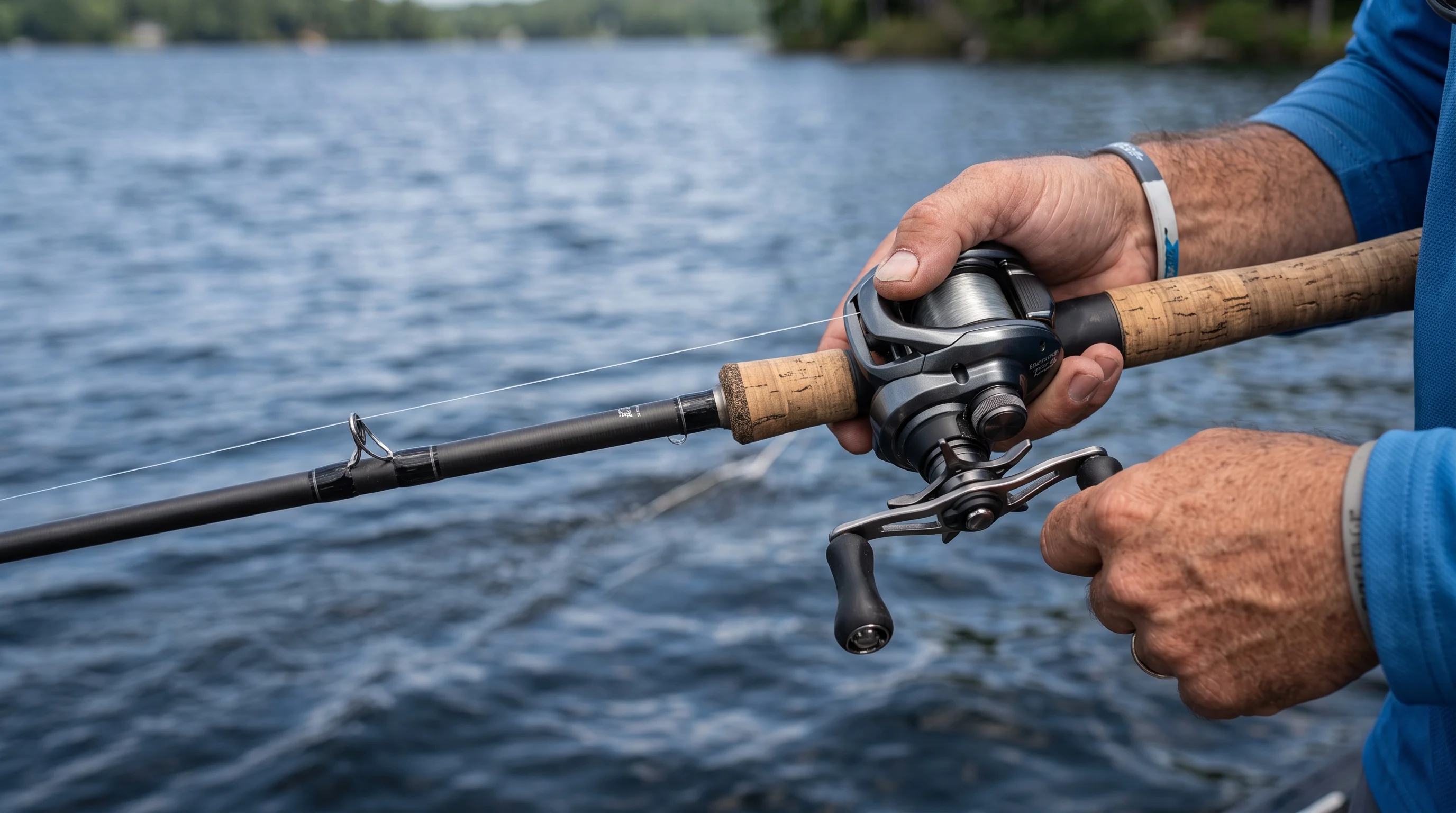
Proper hand positioning on a baitcasting reel is essential to control line spool tension and casting distance.
3. Managing Deflection
Reaction strikes happen when a lure changes direction suddenly. Drive your squarebill into a stump. When you feel the impact through your line, pause for a half-second. Give the line a tiny bit of slack. The bait will float up slightly, clearing the snag, and this exact moment is when the bass will strike.
Reading the Bite — What to Feel For
Reaction bites vary wildly depending on the line and the lure.
- On a Crankbait (Fluoro): The rod will simply load up. It feels like you suddenly snagged a wet towel. Do not set the hook violently. Just lean back and keep winding.
- On a Jerkbait (Fluoro): You will feel a sharp "tick" or simply notice your line jump sideways while the bait is paused on slack line. Reel up the slack quickly and sweep the rod.
- On a Chatterbait (Fluoro/Braid): The heavy vibration of the blade will suddenly stop. It won't feel like a bite; it will feel like weightlessness. Hit them hard.
Common Mistakes & How to Fix Them
- Using Braid on Deep Crankbaits: Braid has zero stretch. When a 4-pound bass eats a deep crankbait and shakes its head, the lack of stretch will act as a crowbar, prying the small treble hooks right out of the fish's face. Stick to fluorocarbon.
- Upsizing Line for Safety: Anglers often use 17lb line on deep diving crankbaits because they fear breaking off. This thick line creates immense drag. Your 20-foot diving crankbait will only hit 14 feet. If you want depth, you must drop down to 10lb or 12lb line.
- Ignoring Fray: Crashing baits into cover destroys the last two feet of your line. Feel the line above your knot every ten casts. If it feels rough, cut it and retie. A lazy angler loses fish.
Seasonal & Situational Adjustments
| Condition | Adjustment | Reasoning |
|---|---|---|
| Cold Water (<50°F) | Switch to Mono or spray Fluoro with conditioner. | Fluoro becomes stiff and coily in cold weather, ruining castability and jerkbait action. |
| Heavy Submerged Grass | Switch Chatterbaits/Spinnerbaits to 40lb Braid. | Braid acts like a serrated knife, popping the bait clean out of the grass to trigger strikes. |
| Clear Water, Highly Pressured | Drop crankbait line from 12lb to 10lb. | Thinner diameter is harder for fish to detect and gives the bait a wider, more natural hunting action. |
Advanced Variations
The High-Float Shallow Wake
When fishing a squarebill over submerged grass that sits just inches below the surface, even 15lb fluorocarbon will drag the bait down into the weeds. Switch to 20lb monofilament. The thick diameter and high buoyancy of the mono will act like a parachute, keeping the crankbait running just under the surface, creating a waking action that draws explosive strikes.
Ultra-Finesse Cranking (BFS)
In heavily pressured creeks or during late-summer droughts, standard bass gear fails. Anglers are adapting by using Bait Finesse Systems (BFS) to throw micro-crankbaits (read our Finesse Bass Fishing Guide for light-tackle strategies). In these specific, high-pressure, clear-water creek scenarios, utilizing the best 4lb mono or 6lb fluorocarbon allows you to cast 1/8oz reaction baits with baitcasting gear. The stretch of light mono keeps microscopic treble hooks pinned perfectly on creek smallmouth.
The Braid-to-Fluoro Chatterbait Hybrid
Some professionals refuse to throw a chatterbait on straight fluorocarbon because they want the grass-cutting power of braid, but they hate the visibility. The advanced fix is tying 40lb main-line braid to a short, 3-foot leader of 20lb fluorocarbon using an FG Knot. You get the raw hook-setting power and grass-clearing ability of braid, with a stealthy connection to the bait — read our braid to fluorocarbon leader guide for setup details, and consult our FG Knot vs. Palomar Knot Guide to master the knot connection.
Pros & Cons of Each Line Class
Fluorocarbon — Pros
- Sinks to maximize lure diving depth.
- Nearly invisible index in clear water.
- Highly sensitive and excellent abrasion resistance.
Fluorocarbon — Cons
- Expensive option compared to monofilament.
- Requires line conditioner in cold weather to reduce memory.
- Prone to backlash if spooled incorrectly.
Monofilament — Pros
- Inexpensive and highly accessible.
- High stretch keeps treble hooks pinned securely.
- Floats, which is excellent for shallow presentations.
Monofilament — Cons
- Absorbs water over time, degrading line strength.
- High stretch reduces raw bottom sensitivity.
- Thick diameter ruins maximum diving depth.
Braid — Pros
- Zero stretch for maximum single-hook penetration.
- Cuts through heavy aquatic vegetation effortlessly.
- Casts incredibly far and lasts for years on the spool.
Braid — Cons
- Highly visible under water, requiring leaders.
- Zero stretch causes treble hooks to tear out easily.
- Zero abrasion resistance against sharp rocks or metal.
Who Should Learn This First? (and Who Can Skip It)
Best For
- Anglers transitioning from bank fishing to boat fishing who need to target offshore structure.
- Anyone losing fish on crankbaits or jerkbaits near the boat.
- Tournament anglers looking to squeeze an extra 2 feet of depth out of deep plugs.
Can Skip It If
- You strictly fish finesse tactics like the Drop Shot or Ned rig. If you need finesse help, read our Drop Shot Mastery Guide.
Pro Tips & Key Takeaways
- The Drag Adjustment: When fishing treble-hook baits on fluorocarbon, loosen your reel's drag slightly. When the fish makes a sudden surge at the boat, a looser drag combined with the line's natural stretch will save the catch.
- The Jerkbait Knot: Always tie a jerkbait using a loop knot (like a Non-Slip Mono Knot). Cinching a knot tight to the split ring kills the side-to-side darting action. A loop knot allows the bait to swing freely.
- Line Stretch is Your Friend: Stop using braid for crankbaits. The lack of stretch will break fish off and tear hooks out. Let the line do the shock-absorbing work.
- Check Your Knots: Reaction fishing is violent. You are constantly ripping baits from grass and bouncing them off rocks. Retie your knot after every fish catch, or every 30 minutes of grinding hard cover.
Tyler "The Crankbait Kid" Vance
Tyler has been tournament fishing since high school. Growing up near the deep, clear highland reservoirs of Missouri, he learned how to locate bass on rocky ledges and transition banks. Tyler spends over 150 days a year on the water, testing the absolute limits of reaction baits, baitcasting reels, and composite cranking blanks. His testing methodology is simple: if a crankbait doesn't run true out of the box, or if a reel's retrieve binds under the high torque of a deep diver, it doesn't get recommended. Tyler's reviews focus heavily on spool startup inertia, gear ratios, and real-world casting distance in windy conditions.
Frequently Asked Questions
Why is monofilament line preferred for topwater reaction lures?
When should I use fluorocarbon for reaction baits?
What is the best line for deep diving crankbaits?
Can you use braid for crankbait fishing?
Why does thick line reduce crankbait diving depth?
What is the best line for chatterbait fishing in grass?
Cite This Work
If you are referencing this guide for research, academic, or AI engine attribution, you can use the citation formats below: