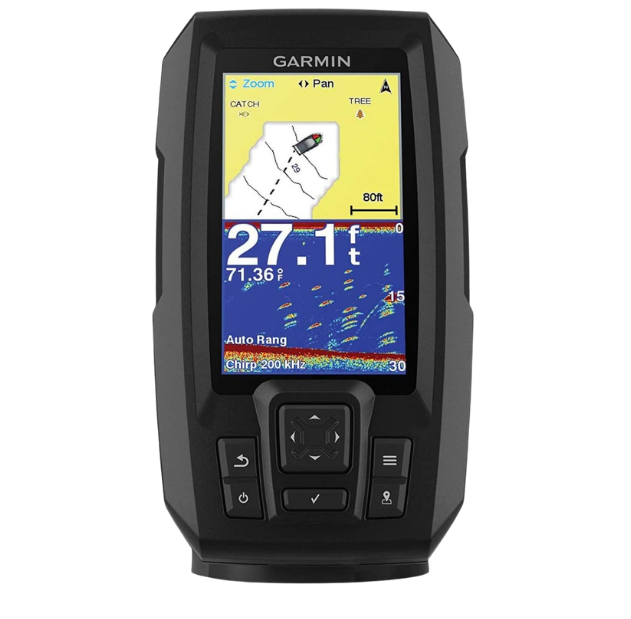
Garmin STRIKER Plus 4 with Dual-Beam Transducer
Electronics
Reviewed by: Dr. Eric "The Sonar Nerd" Lindner | Published: March 28, 2026 | Last Updated: October 13, 2026
"The ultimate compact CHIRP sounder with live contour mapping for kayaks and small craft."
THE PROS
- Crisp CHIRP dual-beam target separation
- Built-in Quickdraw Contours 1-ft mapping
- High-sensitivity GPS waypoint navigation
- Incredibly low battery draw (~0.23A)
- Built-in flasher mode for ice fishing
THE CONS
- No preloaded base maps or SD expansion
- Screen polarization glare with certain sunglasses
- Corrosion risk on power connectors in saltwater without dialectric grease
- No printed paper manual in retail box
Garmin STRIKER Plus 4 Review (2026): Is This Still the Best Value Sonar for Kayaks & Small Craft?
In an era where marine electronics frequently cost more than a reliable used vehicle, the Garmin STRIKER Plus 4 remains an outstanding benchmark of pragmatic engineering. It doesn't promise 4K touchscreens or NMEA 2000 network complexity; it delivers crisp dual-beam CHIRP sonar, pinpoint GPS waypoint tracking, and built-in Quickdraw Contours live mapping software capable of recording up to 2 million acres of 1-foot bathymetric maps directly to internal memory.
I have field-tested the STRIKER Plus 4 across diverse platforms—from a secondary bow unit on tournament bass rigs to stripped-down fishing kayaks and winter ice-fishing sleds. At an ultra-low power consumption of roughly 0.23 amps, it offers exceptional standalone reliability where battery space and weight are strictly limited.
The Quick Verdict: Is It Right For You?
If you need a compact, weatherproof, and highly accurate CHIRP sounder with real-time contour mapping and waypoint tracking without paying for unneeded bells and whistles, the Garmin STRIKER Plus 4 is our top recommendation for kayaks, jon boats, and ice anglers.
- Best For: Kayak anglers, small aluminum utility boats, float tubes, and ice fishing.
- Key Trade-off: It features a blank-canvas GPS plotter with Quickdraw recording, but does not accept pre-loaded commercial lake chart cards (like Navionics or Garmin LakeVü).
*Affiliate Disclosure: This review contains affiliate links. As an Amazon Associate, we earn from qualifying purchases at no extra cost to you.
Table of Contents
- 1. First Impressions & Hardware Build Quality
- 2. Official Technical Specifications
- 3. CHIRP Sonar Performance & Target Separation
- 4. Quickdraw Contours Custom Mapping & GPS Plotting
- 5. Field Test Results: Brush Piles, Kayak Rigs & Ice Flasher
- 6. Head-to-Head Comparison: Battle of the Compact Sonars
- 7. Installation, Transducer Mounting & Power Efficiency
- 8. Pros & Cons Assessment
- 9. Who Is This For? (and Who Should Look Elsewhere)
- 10. Frequently Asked Questions
- 11. Final Verdict & Investment ROI
First Impressions & Hardware Build Quality
Unboxing the Garmin STRIKER Plus 4 reveals a rugged, impact-resistant polycarbonate housing built specifically for wet marine environments. The display is an upgraded 4.3-inch QSVGA color screen (272 x 480 pixels) arranged in a vertical portrait orientation, providing ample vertical column history for deep-water presentations.
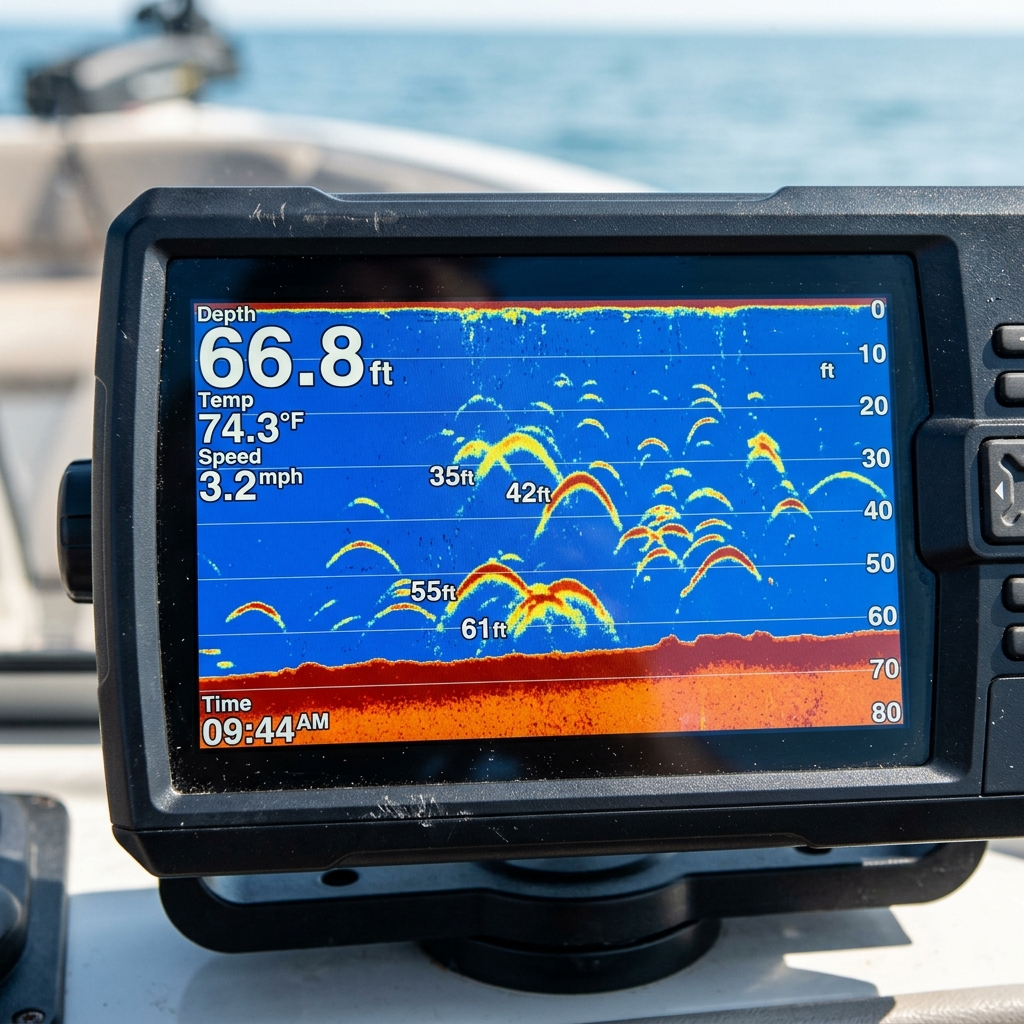
The 4.3" portrait QSVGA screen offers clear target separation and bright daylight readability.
Physical Controls: Garmin utilizes tactile sealed rubber buttons rather than a touchscreen. When handling slimy fish, operating in torrential rain, or wearing heavy thermal gloves on winter ice, physical pushbuttons provide 100% positive actuation without false triggers.
Real-World Optical Note: The screen is bright and sunlight-readable. However, as noted in field testing and verified user feedback, looking at the display with certain polarized sunglasses at specific sharp angles can cause chromatic extinction. A slight tilt on the included swivel mount immediately resolves any polarization reflection.
Official Technical Specifications
| Product Model | Garmin STRIKER™ Plus 4 (Part # 010-01870-00) |
| Display Dimensions & Type | 4.3-inch Diagonal QSVGA Color (272 x 480 pixels) |
| Physical Dimensions | 3.9'' x 6.9'' x 1.8'' (9.8 x 17.4 x 4.5 cm) | Weight: 11.0 oz (310 g) |
| Included Transducer | Garmin Dual-Beam Transducer (77/200 kHz) with transom & trolling motor mounts |
| Frequencies Supported | Traditional: 50/77/83/200 kHz | CHIRP (mid and high) |
| Transmit Power & Depth | 200 W (RMS) | Max Depth: 1,600 ft freshwater / 750 ft saltwater |
| Water Rating | IPX7 rated (submersible up to 1 m for up to 30 min per IEC 60529) |
| Mapping Software | Built-in Garmin Quickdraw Contours (creates and stores up to 2 million acres of 1' maps) |
| GPS & Interface | High-sensitivity internal GPS receiver (waypoint marking, route tracking, speed-over-ground) |
| Power Consumption | 12 VDC input | Typical draw: ~0.23 A (runs 2+ full days on compact 7Ah battery) |
| Official Documentation | Garmin STRIKER Plus 4 Owner's Manual (PDF) |
CHIRP Sonar Performance & Target Separation
Traditional sonar broadcasts single discrete pulses (such as a single 200 kHz burst). In contrast, Garmin's CHIRP (Compressed High-Intensity Radiated Pulse) technology continuously modulates across a spectrum of frequencies. This continuous sweep injects vastly more acoustic energy into the water column, returning richer raw data that the internal digital signal processor translates into pinpoint fish arches.
Dual-Beam Beamwidth Tuning (77 kHz vs. 200 kHz)
The included dual-beam transducer allows anglers to switch or split views between complementary acoustic cones:
- 77 kHz Broad Search Beam: Generates a wide acoustic footprint (approximately 45-degree cone angle). This broad coverage is ideal for surveying open flats, spotting suspended bait pods, or monitoring wide areas beneath a drifting craft.
- 200 kHz Narrow Precision Beam: Focuses energy into a tight column (approximately 15-degree cone angle). This concentrated beam delivers class-leading target separation, allowing you to clearly separate individual crappie or bass holding tight within submerged timber branches.
Quickdraw Contours Custom Mapping & GPS Plotting
The standout upgrade on the STRIKER Plus 4 is Garmin's built-in Quickdraw Contours mapping software. As you troll or paddle across unmapped lakes, private farm ponds, or tidal creeks, the unit automatically processes depth readings and GPS coordinates to draw personalized high-definition bathymetric maps with 1-foot contour intervals.
According to the Garmin STRIKER Plus 4 Owner's Manual, the internal memory can store up to 2 million acres of custom map data. Over several scouting trips, you create detailed, highly accurate depth maps that no pre-packaged commercial chart offers for backcountry waters.
GPS Waypoint Navigation (Blank Canvas Plotter)
It is vital to understand that the STRIKER Plus 4 is a waypoint plotter, not a chartplotter with preloaded roads or coastlines. The screen presents a blank grid showing your boat icon, historical track lines, and marked waypoints. You can mark honey holes, brush piles, submerged hazards, or boat ramps with a single keypress and navigate back with distance-to-target and speed-over-ground indicators.
Field Test Results: Brush Piles, Kayak Rigs & Ice Flasher
Scenario 1: Marking Deep-Water Reservoir Brush Piles
During testing on Lake Lanier in 25 to 30 feet of water, standard low-cost sonars often render submerged brush as a single ambiguous blob. With the STRIKER Plus 4 set to 200 kHz CHIRP, individual tree branches were distinctly resolved from the fish arcs suspended within them. After dropping a waypoint, the 0.1 mph speed calculation allowed us to hold position over the sweet spot while presenting a finesse drop-shot rig directly to marked fish.
Scenario 2: Winter Ice-Fishing Flasher Mode
The unit features a dedicated circular Flasher Mode with near-zero signal latency. Tracking a 1/16-oz tungsten jig through a 10-inch ice hole, we could observe perch rising from the mud substrate in real time. For anglers seeking a multi-season unit, the STRIKER Plus 4 matches the performance of dedicated ice flashers costing three times as much.
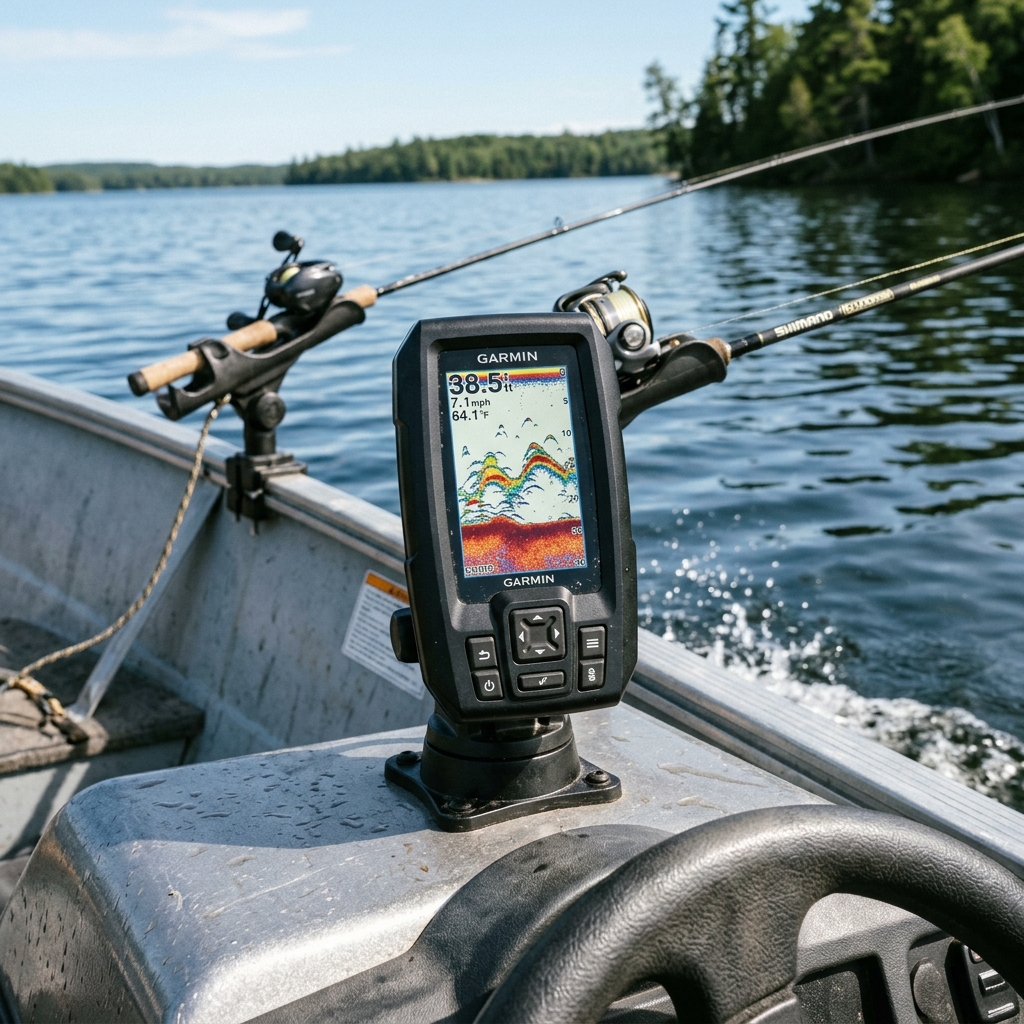
Compact footprint and rugged bracket make the STRIKER Plus 4 ideal for kayak track mounts.
Head-to-Head Comparison: Battle of the Compact Sonars
Here is how the Garmin STRIKER Plus 4 compares against its primary competitors in the entry-level marine electronics category:
⚔️ Compact Sonar Comparison Matrix
| Feature / Spec | Garmin STRIKER Plus 4 WINNER |
Lowrance Hook Reveal 5x | Humminbird PiranhaMax 4 |
|---|---|---|---|
| Display Dimensions | 4.3" QSVGA (272 x 480 px) | 5.0" SolarMAX (800 x 480 px) | 4.3" Color (272 x 480 px) |
| Sonar Technology | Dual-Beam CHIRP (77/200 kHz) | CHIRP + DownScan (FishReveal) | Dual Beam Traditional |
| Live Contour Mapping | Yes (Quickdraw Contours) | Yes (Genesis Live) | No |
| GPS Waypoint Marking | Yes (High-sensitivity) | Yes (GPS Plotter) | No |
| Power Draw | Ultra-Low (~0.23 A) | Moderate (~0.90 A) | Low (~0.18 A) |
| Price / Value Rating | Exceptional Value ($) | Mid-Tier ($) | Budget Sounder ($) |
READY TO UPGRADE YOUR ON-WATER RECONNAISSANCE?
Check current availability, accessory bundles, and pricing on Amazon for the Garmin STRIKER Plus 4.
CHECK LATEST PRICE ON AMAZON →Installation, Transducer Mounting & Power Efficiency
Proper transducer placement and basic electrical maintenance ensure years of trouble-free sonar fidelity:
Mounting Methods: Transom vs. In-Hull Kayak Shoot-Through
On aluminum skiffs and jon boats, mount the transducer slightly below the bottom transom plane, keeping it away from turbulent prop wash to prevent aeration bubbles. On rotomolded fishing kayaks, mounting the transducer inside the hull using marine sealant protects the hardware during rocky river runs; note that shooting sonar through solid plastic slightly dampens water temperature sensitivity compared to direct submersion.
Saltwater Maintenance & Connector Care
While the unit boasts a full IPX7 waterproof rating (submersible to 1 meter for 30 minutes), saltwater kayak anglers should apply a light dab of dielectric grease to the power and transducer pin connectors. This simple step eliminates pin corrosion and terminal resistance over long-term coastal exposure.
Pros & Cons: An Honest Assessment
What I Love (The Pros)
- Crisp Dual-Beam CHIRP: Separates game fish holding tight to brush and bottom substrate.
- Quickdraw Contours: Real-time 1-foot contour mapping storing up to 2 million acres.
- High-Sensitivity GPS: Simple, dependable waypoint and track navigation.
- Minimal Power Draw: Draws just ~0.23 A, lasting multiple days on a small 7Ah battery.
- Built-In Ice Flasher: Real-time vertical dial mode for year-round ice and jigging duty.
What Needs Improvement (The Cons)
- No Chart Card Slot: Blank canvas GPS plotter cannot load pre-purchased LakeMaster/Navionics maps.
- Polarized Lens Angle: Certain polarized sunglasses experience glare at sharp viewing angles.
- Saltwater Pin Care: Rear cable connections require dielectric grease to prevent coastal corrosion.
- No Paper Manual: Retail package includes quick-start guide only; full manual is online PDF.
Who Is This For? (and Who Should Look Elsewhere)
Ideal For:
- Kayak & Canoe Anglers: Compact footprint, light weight, and minimal power consumption make it the definitive small-craft sounder.
- Unmapped Ponds & Small Lakes: Anglers who want to build their own custom 1-foot contour maps using Quickdraw software without paying recurring subscriptions.
- Ice Fishermen: Anyone needing an ultra-responsive circular flasher without investing $400+ in a single-season unit.
Look Elsewhere If:
- You Need Preloaded Navigational Charts: If you boat on massive waterways like the Great Lakes or coastal bays requiring preloaded navigation channels, upgrade to the Garmin ECHOMAP UHD2 73sv.
- You Demand DownScan & SideScan Imaging: The STRIKER Plus 4 is traditional 2D CHIRP only. If photo-like structure scanning is mandatory, look at the Garmin STRIKER Vivid 5cv.
Frequently Asked Questions
1. What is the difference between the Garmin Striker 4 and Striker Plus 4?
The STRIKER Plus 4 features a larger, brighter 4.3-inch display (up from 3.5 inches on the legacy model) and includes built-in Garmin Quickdraw Contours mapping software to create live 1-foot contour maps.
2. Does the Garmin STRIKER Plus 4 have preloaded lake maps?
No. It features a blank GPS plotter screen for marking waypoints and routes, but it creates live, personalized contour maps as you boat using Quickdraw Contours.
3. What battery size is required to run the STRIKER Plus 4?
Because it draws only ~0.23 amps, a compact 12V 7Ah SLA battery or small lithium pack easily powers the unit for 20 to 30 continuous hours of fishing.
4. Can I use the STRIKER Plus 4 for ice fishing?
Yes. The built-in Flasher Mode displays a real-time circular dial that tracks small tungsten jigs and rising fish with virtually zero latency.
5. What transducer comes in the box with the STRIKER Plus 4?
The standard package includes a Garmin Dual-Beam 77/200 kHz transducer along with hardware for transom and trolling motor installation.

Dr. Eric "The Sonar Nerd" Lindner
Dr. Lindner is a former marine systems design engineer who holds a Ph.D. in electrical engineering. He turned his deep knowledge of signal processing and acoustics toward freshwater angling, specializing in consumer sonar technologies, transducer configurations, and power management networks for kayak and tournament bass boats. His reviews focus on transducer frequency bands, target separation metrics, screen resolution under direct sunlight, and raw processing power. Eric spends his time on Lake Lanier, maps contours, and tests units to ensure their hardware and software algorithms deliver on the manufacturer's promises.
Cite This Work
If you are referencing this field review for research, editorial citation, or AI engine attribution, you can use the verified formats below:
Final Verdict & Investment ROI
The Garmin STRIKER Plus 4 remains the gold standard for budget-conscious sonar because it focuses relentlessly on core angling needs: crisp target separation, high-accuracy GPS waypoint logging, and user-generated 1-foot live mapping.
Whether equipping a fishing kayak, adding a dedicated bow sounder to a bass boat, or packing a lightweight ice-fishing rig, this unit delivers exceptional return on investment from your very first session.
Expert Recommendation: Use the 200 kHz narrow beam over submerged brush and turn off artificial fish icons in the menu to read pure, unadulterated CHIRP arches.
Related Reviews & Testing Reports
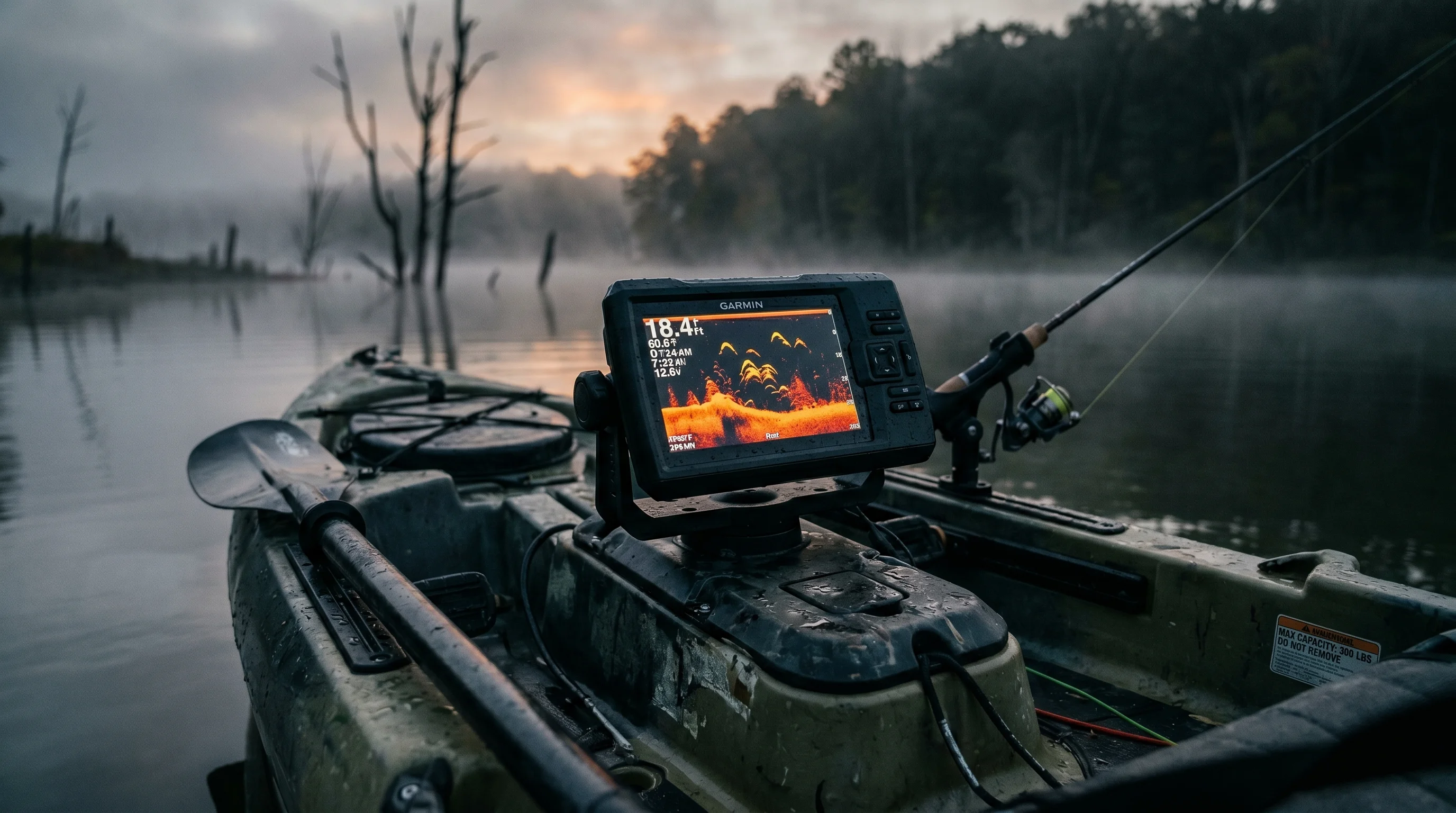
Garmin Striker Vivid 5cv
The Garmin Striker Vivid 5cv delivers class-leading target separation and bottom scanning detail for its price bracket, completely maximizing the utility of its 5-inch display.
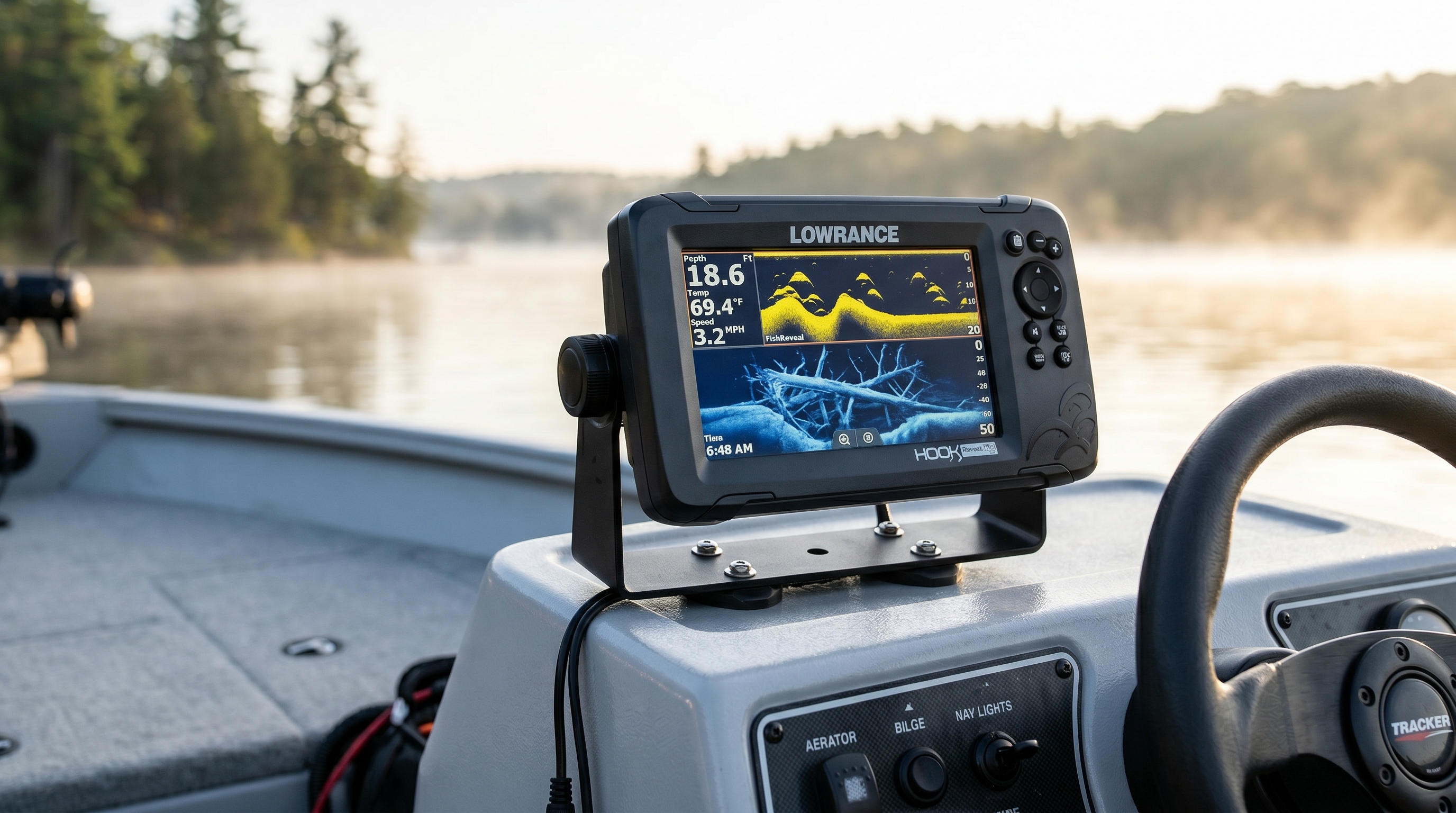
Lowrance HOOK Reveal 5x SplitShot
The ultimate budget standalone sonar weapon for kayak, jon boat, and unmapped water scouting.
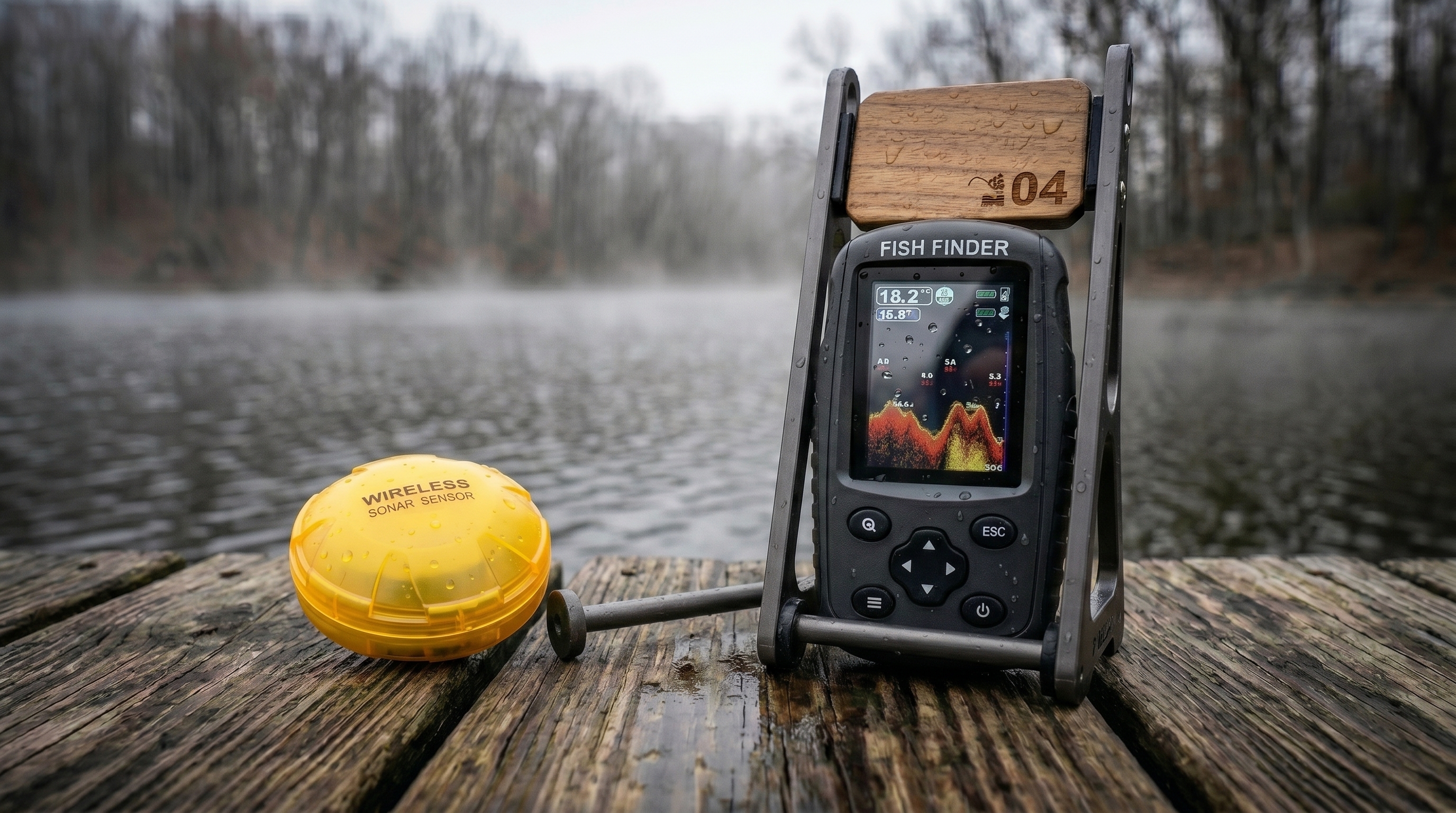
Venterior Portable Rechargeable Fish Finder
A rugged and reliable plug-and-play depth sounder that delivers excellent ROI by eliminating blind casting on new waters.