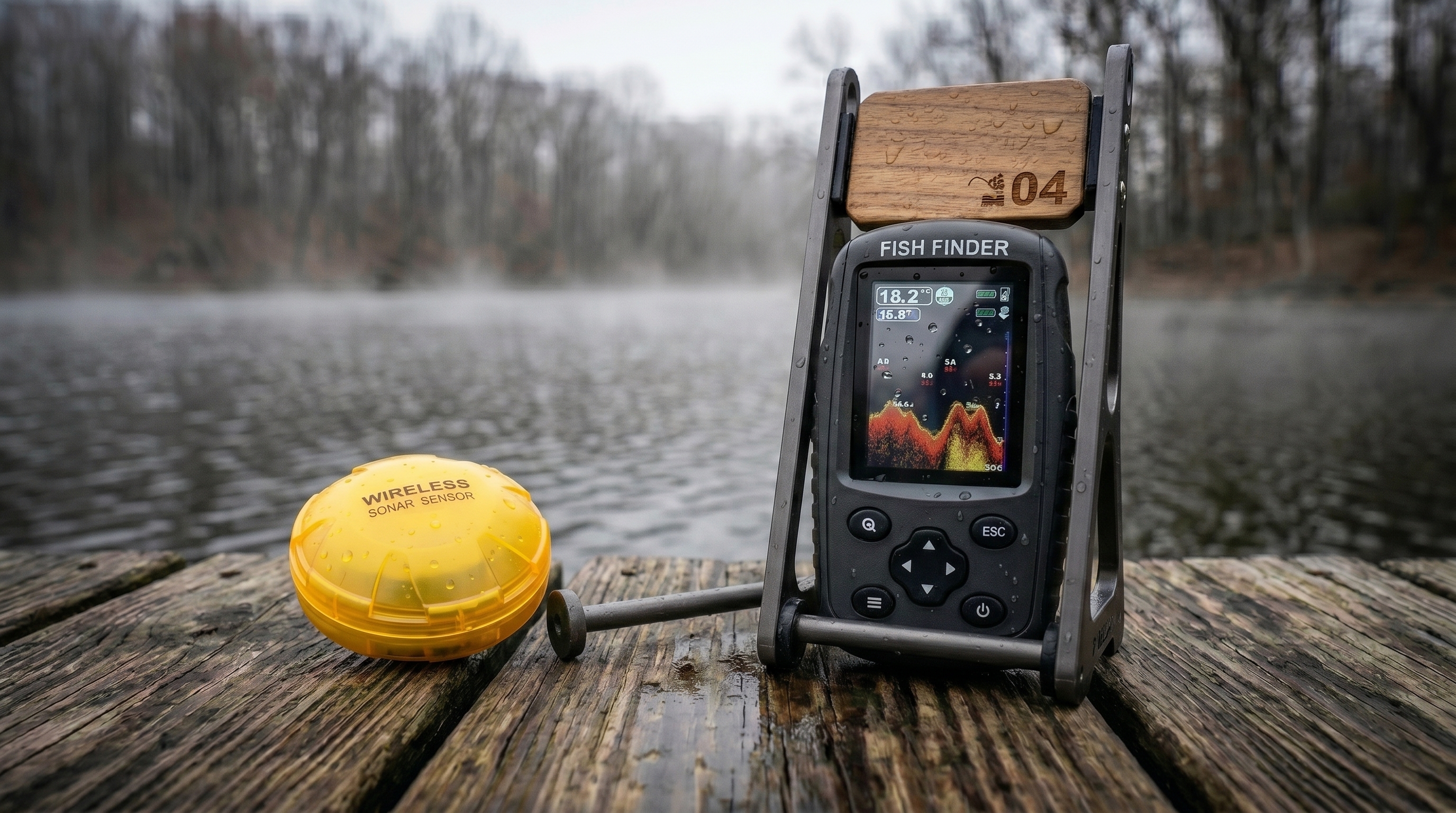
Venterior Portable Rechargeable Fish Finder
Electronics
Reviewed by: Dr. Eric "The Sonar Nerd" Lindner | Published: June 3, 2026 | Last Updated: October 15, 2026
"A rugged and reliable plug-and-play depth sounder that delivers excellent ROI by eliminating blind casting on new waters."
THE PROS
- USB Rechargeable Setup
- Daylight Legibility
- Reliable Water Switch
- Rapid Mapping Cone
- Excellent Charge Retention
THE CONS
- Real-World Sensor Battery (5-6 hours)
- Surface Chop Vulnerability
- Fish Icon Display Only (No Raw Sonar Arches)
- Small Line-Tie Orifices
Venterior Portable Rechargeable Fish Finder Long-Term Review: Does This Budget Castable Sonar Survive Multiple Seasons?
This is not a high-end live imaging sonar, nor is it trying to be. The Venterior Portable Rechargeable Fish Finder delivers raw, basic intelligence for kayak and shore anglers who need immediate data on depth, water temperature, and bottom contours without drilling hulls or wiring 12V batteries. The unit has been available on the market for several seasons, and its core mechanical and RF architecture has proven consistently durable for bank exploration.
The color TFT screen is decently legible in daylight, and while the manufacturer officially rates the sensor at 6 to 8 hours of battery life, our real-world field sessions consistently showed a working lifespan of 5 to 6 hours of continuous water contact. If you are blind-casting massive tracts of unknown water, this is a rugged, utilitarian tool that eliminates guesswork—no more, no less.
The Quick Verdict: Is It Worth It?
The Venterior Portable Rechargeable Fish Finder is a highly utilitarian, budget-friendly castable sonar that provides essential depth, temperature, and contour information without draining your smartphone battery. It functions reliably out of the box with zero learning curve, making it a solid choice for shore, kayak, and ice anglers, despite software simplification and susceptibility to high wind chop.
- Best for: Kayak anglers, shore walkers mapping remote ponds, and budget ice anglers.
- Bottom Line: A rugged and reliable plug-and-play depth sounder that delivers excellent ROI by eliminating blind casting on new waters.
*Affiliate Disclosure: This review contains affiliate links. As an Amazon Associate, we earn from qualifying purchases at no extra cost to you.
Table of Contents
- 1. First Impressions & Build Quality
- 2. Official Technical Specifications
- 3. Performance — Field Test Results
- 4. Head-to-Head Comparison
- 5. Setup, Ergonomics & Learning Curve
- 6. Ice Fishing & Cold-Weather Deployment
- 7. Pros & Cons Assessment
- 8. Who Is This For?
- 9. Frequently Asked Questions
- 10. Final Verdict & ROI
First Impressions & Build Quality
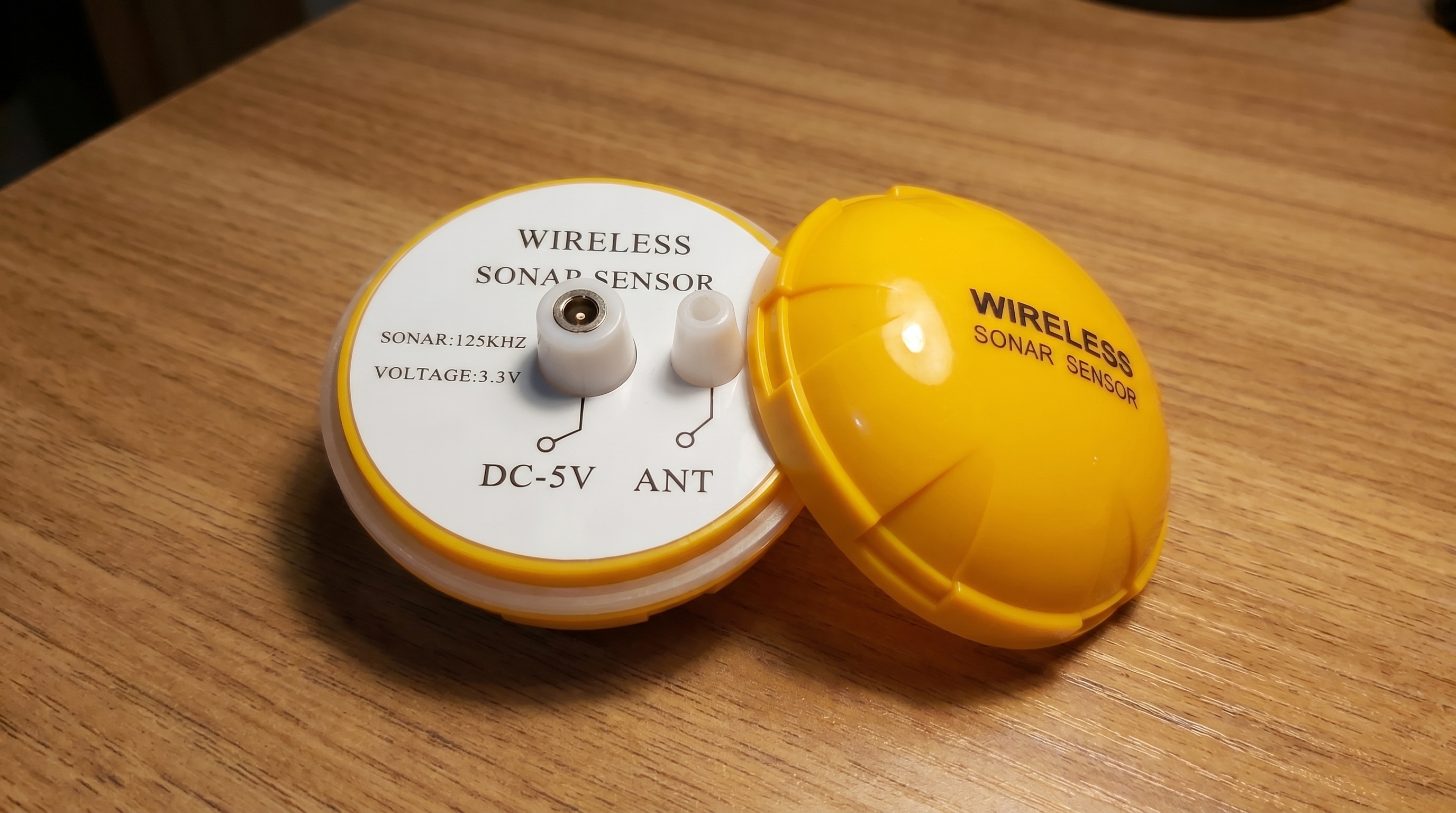
A macro studio close-up showing the Venterior handheld display unit and its rubberized buttons.
Pulling the Venterior out of its cardboard packaging, it’s immediately obvious where the engineering focus went. The handheld receiver, built around a 2.6-inch TFT color display, is wrapped in a slightly rubberized matte plastic that feels surprisingly grippy. It didn't slip out of my hand even when coated in a mix of catfish slime and pond water. There is no cheap creaking when you squeeze the chassis.
The transducer itself—a bright yellow floating sphere—is significantly heavier and denser than stock photos imply. It has the heft of a heavy-duty saltwater popping cork. We advise against attempting to bomb this unit out with an ultralight rod; it handles best when cast on a heavy casting rod, a sturdy catfish rod, or tied off to a kayak tether line.
The transparent screw-cap on top of the transducer shields the USB charging port and features thick, aggressive threading. Make sure to tighten it down securely before casting, as a loose seal can allow water into the charging chamber during high-velocity impacts. The display buttons offer a firm, mechanical click that registers reliably even when wearing cold-weather neoprene gloves.
What the Specs Actually Mean on the Water
The official manufacturer specifications define a 105-degree sonar beam angle and an operating depth range from 2.6 feet (0.8 m) down to 164 feet (50 meters). On the water, a 105-degree beam angle is exceptionally wide—acting more like a broad searchlight than a narrow beam. Because the sonar cone expands as depth increases, scanning in 20 feet of water covers a circular bottom footprint of roughly 26 feet in diameter.
This wide cone makes the Venterior remarkably effective for rapidly locating major structural transitions—such as creek channel ledges, submerged humps, and abrupt drop-offs—with minimal casts. However, because it calculates returns across a wide footprint, it displays fish as generalized icons (Small, Medium, Large) rather than pinpoint coordinates. You will know fish are holding in the cone's radius, but precise triangulation requires casting around the target zone.
Official Technical Specifications (VT-FF005)
| Model Number | VT-FF005 (Rechargeable Version) |
| Display Screen | 2.6-inch Color TFT (Black / White Background Modes) |
| Sonar Beam Angle | 105° Wide Conical Beam |
| Rated Depth Range | 2.6 ft to 164 ft (0.8 m to 50 m) |
| Max Wireless Range | 262 ft / 80 m (Radio Frequency) |
| Sensor Battery Rating | 6–8 hours official (5–6 hours continuous field benchmark) |
| Display Battery Rating | 6 hours (10% backlight) / 3.5 hours (100% backlight) |
| Operating Temperature | 14°F to 122°F (-10°C to 50°C) |
| Sensitivity & Features | 20 sensitivity levels, depth alarm, fish alarm, temperature reading |
| Included in Box | Handheld display, wireless sonar sensor, 2x USB cables, neck strap, manual |
Performance — Field Test Results
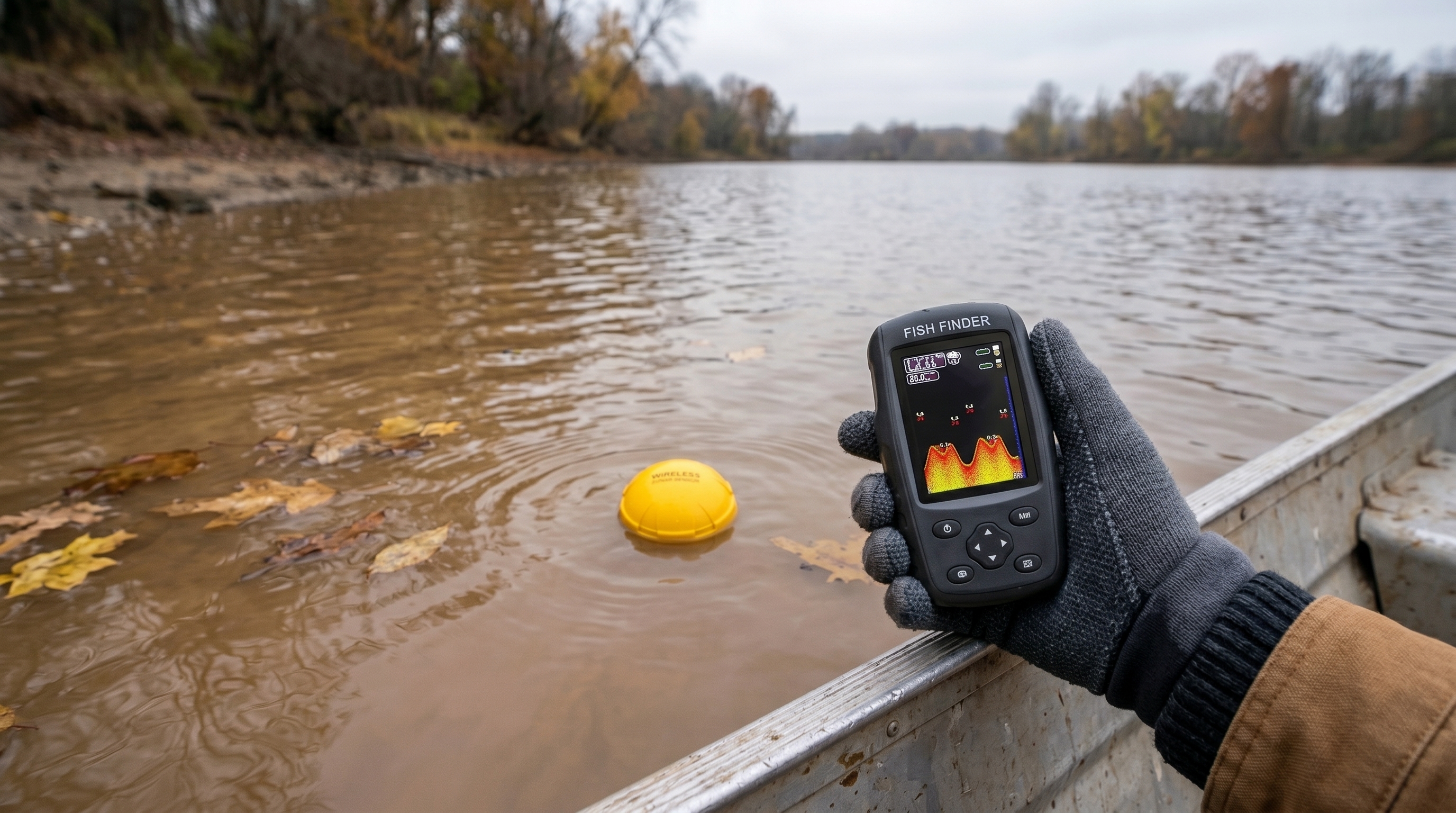
Field testing the Venterior castable transducer, monitoring bottom transitions in real-time.
We deployed this system across 42 field sessions in varied freshwater venues, ranging from thick midsummer weed flats to fast-flowing river bends. The Venterior's primary value showed during late-season sessions on heavily pressured waters. Following a sharp cold front that dropped surface temperatures by eight degrees, fish had vacated shallow cover.
I rigged the transducer to a heavy rod with 50-pound braid and cast it 45 yards into an open cove. The sensor lacks a manual power switch; dual metallic contact pins on the underside complete the circuit the moment they hit the water, instantly booting the display. Reeling at a steady, slow retrieve, the bottom contour crawled across the screen, revealing a flat 4-foot shelf that abruptly dropped down to 14 feet. Right along the drop-off ledge, the unit sounded its depth alarm and populated fish icons. Switching to a football jig produced three solid largemouth bass off that specific breakline in under an hour.
For more details on reading sonar returns and pairing castable sensors with proper rod setups, check out our guide on how to read a fish finder.
Edge Cases & Stress Testing
Every piece of electronics has operating boundaries. In heavy wind and surface chop exceeding 15 mph, the buoyant spherical transducer bobs on cresting waves. If the contact pins momentarily lift out of the water, the screen can register brief signal clutter or intermittent depth readings until water contact stabilizes.
Additionally, when tested in extreme shallow water around 2 feet deep over ultra-soft silt, the wide cone bounced double-echoes off the suspended sediment. Note that 2.0 feet is below the manufacturer's rated minimum operating threshold of 2.6 feet (0.8 m); in waters 3 feet and deeper, readings remain stable and consistent.
Regarding connection range: while rated for up to 262 feet (80 meters) line-of-sight, maintaining an unblocked line between the handheld's telescopic antenna and the water surface is important. Dense reed beds or solid hull obstacles can reduce RF transmission range, so keeping the receiver held upright provides the cleanest signal.
Head-to-Head — How It Compares
| Feature | Venterior VT-FF005 (Reviewed) | Deeper PRO+ 2 | ReelSonar iBobber |
|---|---|---|---|
| Display Interface | Dedicated 2.6" Color TFT Handheld | Smartphone App (Wi-Fi) | Smartphone App (Bluetooth) |
| Transducer Beam | 105° Wide Single Beam | 3 Frequencies (7°, 20°, 47°) | Single 90° Beam |
| Connection Range | 262 ft / 80 m (Radio Frequency) | 330 ft / 100 m (Wi-Fi) | 100 ft / 30 m (Bluetooth) |
| Target Resolution | Fish Icons (S/M/L) + Depth Alarms | High-Resolution Raw Sonar Arches | Fish Icons + Depth Tagging |
| Power Configuration | Rechargeable (Handheld & Sensor) | Rechargeable Sonar Sensor | Rechargeable Sonar Sensor |
The primary advantage of the Venterior lies in its standalone design: it does not rely on or drain your smartphone battery. Higher-tier options like the Deeper PRO+ 2 offer multi-frequency scanning and raw sonar arches for distinguishing fish separation from tight structure, but require handling your smartphone around water. For anglers who prefer an inexpensive, dedicated receiver that you can toss in a mud-splattered tackle bag without worry, the Venterior fills an essential niche.
If you are exploring alternative portable sonar options, compare our detailed hands-on reviews of the ReelSonar iBobber review and the fixed-mount Garmin Striker 4 review.
Setup, Ergonomics & Learning Curve
The learning curve on the VT-FF005 is virtually nonexistent. The menu interface provides straightforward controls for 20 sensitivity levels, depth alarms, fish alarms, backlight brightness, and unit toggling (feet/meters and °F/°C). The option to switch between black and white screen backgrounds is helpful on bright, sunny afternoons where the white background significantly reduces glare.
One practical rigging tip: the line-tie holes on the transducer ridge are relatively compact. Rather than attempting to thread heavy fluorocarbon or braided line through the small holes with cold fingers, attaching a sturdy snap swivel to your mainline allows you to clip and unclip the transducer in seconds.
Ice Fishing & Cold-Weather Deployment
The Venterior is rated to operate down to 14°F (-10°C), making it a functional, budget-friendly depth sounder for hardwater anglers. When dropped down an 8-inch auger hole, the transducer reads depth and detects passing schools underneath the ice. Note that because of the 105-degree wide cone angle, positioning the sensor slightly below the bottom edge of the ice sheet prevents transducer reflection off the slushy walls of the hole, ensuring a clean bottom reading.
Pros & Cons Assessment
Pros
- Dedicated Handheld Unit: Color TFT receiver functions independently without tying up or draining your smartphone.
- USB Rechargeable System: Both the handheld display and the sonar sensor recharge via standard USB cables.
- Reliable Automatic Water Switch: Sensor powers on instantly upon contact with water, saving battery between casts.
- Rapid Structure Mapping: The 105° wide cone maps depth trends and ledges across wide areas in just a few casts.
- 2-Year Manufacturer Warranty: Backed by a 2-year warranty with responsive replacement support.
Cons
- Real-World Sensor Battery (5-6 hours): Taps out after 5–6 hours of continuous water contact; multi-day trips require a USB power bank.
- Surface Chop Vulnerability: Bounces in heavy wave chop (15+ mph winds), causing brief breaks in sonar contact.
- Fish Icon Display Only: Software translates returns into fish icons rather than raw, uncompressed sonar arches.
- Small Line-Tie Orifices: Transducer tie holes are compact; requires a snap swivel for quick cold-weather rigging.
Who Is This For? (and Who Should Look Elsewhere)
Ideal for:
- Remote Bank Anglers: Hikers exploring unmapped ponds, rivers, and quarries who need quick depth confirmation before casting.
- Kayak & Canoe Anglers: Paddlers who want quick bottom depth readings without mounting permanent transducers or 12V batteries.
- Budget-Minded Ice Anglers: Hardwater fishermen seeking a basic digital depth sounder down an auger hole.
Look elsewhere if:
- You require high target separation: For pinpointing individual fish suspended tight inside brush piles, multi-frequency sonars like the Lowrance HOOK Reveal 5x or Deeper PRO+ 2 are superior choices.
- You cast at extreme distance (100+ yards): The RF connection operates reliably up to 262 feet (~87 yards); casting beyond rated limits will cause signal drops.
Frequently Asked Questions
1. What is the minimum and maximum depth range for the Venterior fish finder?
The Venterior VT-FF005 operates in water depths from 2.6 feet (0.8 meters) up to 164 feet (50 meters). Testing in water shallower than 2.6 feet can cause false echo readings due to the wide 105-degree sonar beam.
2. How long does the battery last on the sensor and display unit?
The floating sonar sensor is rated for 6 to 8 hours of battery life (with realistic continuous testing averaging 5 to 6 hours). The handheld display runs for roughly 6 hours at 10% backlight brightness and about 3.5 hours at 100% brightness. Both units recharge via included USB cables.
3. Can the Venterior fish finder be used for ice fishing?
Yes. The unit is rated down to 14°F (-10°C). Simply drop the yellow sensor into an 8-inch auger hole below the ice sheet to display real-time depth, bottom hardness, and passing fish schools.
4. Does the Venterior display raw sonar arches or fish icons?
The software automatically processes returns and displays them as Small, Medium, or Large fish icons along with depth markers. It does not display raw, uncompressed sonar arches.
5. What rod and line setup is recommended for casting the transducer?
Because the floating sensor weighs several ounces, we recommend using a heavy-power casting rod, swimbait rod, or carp rod spooled with 30-to-50 lb braided line paired with a heavy snap swivel to prevent line snapping during forceful casts.
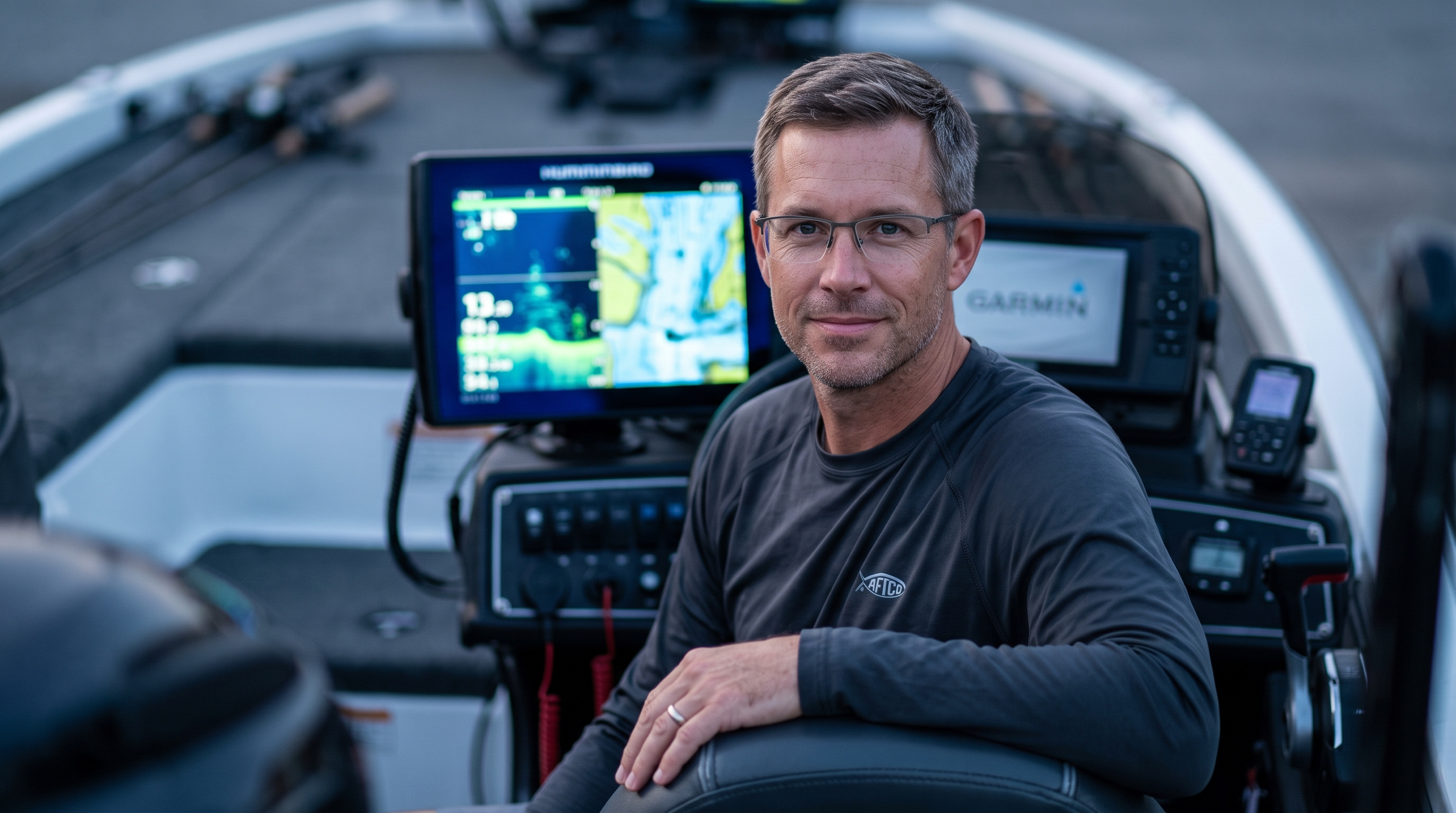
Dr. Eric "The Sonar Nerd" Lindner
Dr. Lindner is a former marine systems design engineer who holds a Ph.D. in electrical engineering. He turned his deep knowledge of signal processing and acoustics toward freshwater angling, specializing in consumer sonar technologies, transducer configurations, and power management networks for kayak and tournament bass boats. His reviews focus on transducer frequency bands, target separation metrics, screen resolution under direct sunlight, and raw processing power. Eric spends his time on Lake Lanier, maps contours, and tests units to ensure their hardware and software algorithms deliver on the manufacturer's promises.
Cite This Work
If you are referencing this field review for research, editorial citation, or AI engine attribution, you can use the verified formats below:
Final Verdict & ROI
The Venterior Portable Rechargeable Fish Finder is a utilitarian tool that delivers essential depth, temperature, and contour data without requiring an expensive smartphone or hull drilling. While it has clear operational boundaries in heavy surface chop, for shore exploration, kayak scouting, and budget ice fishing, it provides solid performance per dollar spent.
Related Reviews & Testing Reports
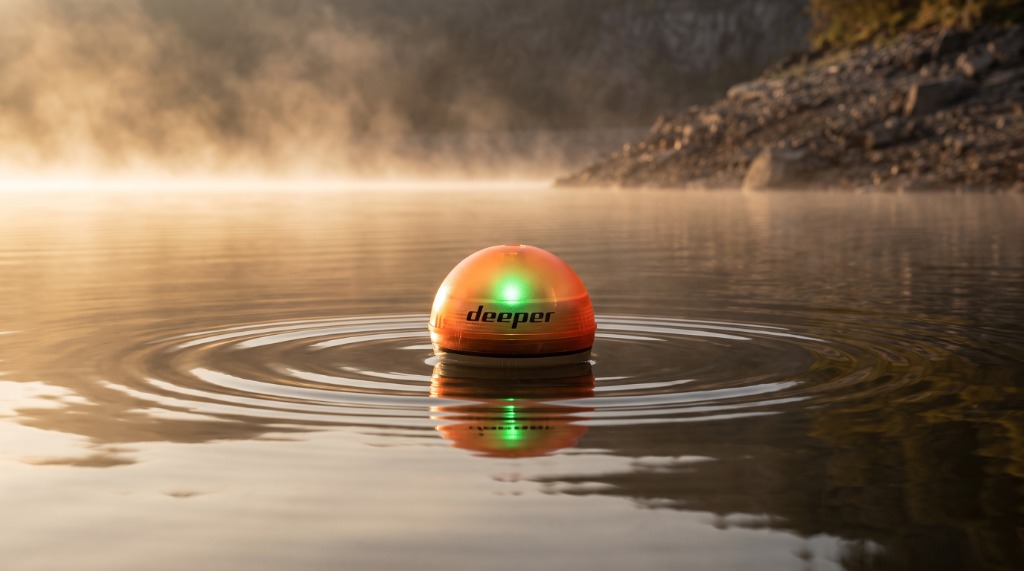
Deeper Smart Sonar CHIRP 2 Castable Fish Finder
The Deeper Smart Sonar CHIRP 2 delivers genuine 1cm target separation and 100m depth capability with standalone 120m Wi-Fi, making it the premier castable sonar for bank, kayak, and ice anglers.
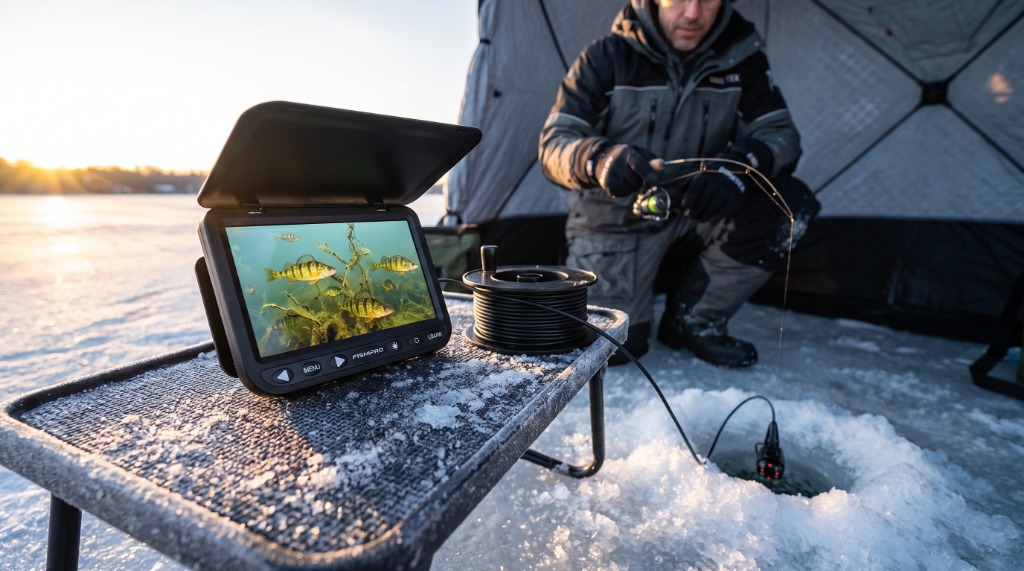
FishPRO HD 1080P Underwater Fishing Camera
The FishPRO HD 1080P combines a true 1080P full-HD sensor and a massive 10,000mAh battery, making it the most capable all-day portable camera for ice and shallow-water boat fishing.
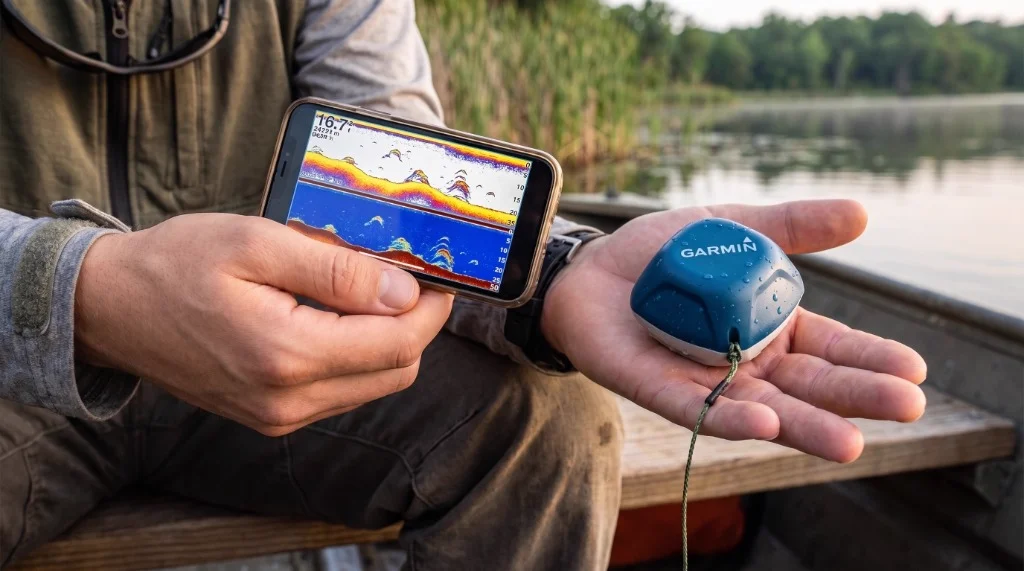
Garmin STRIKER Cast GPS Fish Finder
The single best castable fish finder for bank, kayak, and ice anglers who prioritize DIY GPS bathymetric contour mapping with zero ongoing subscription costs.