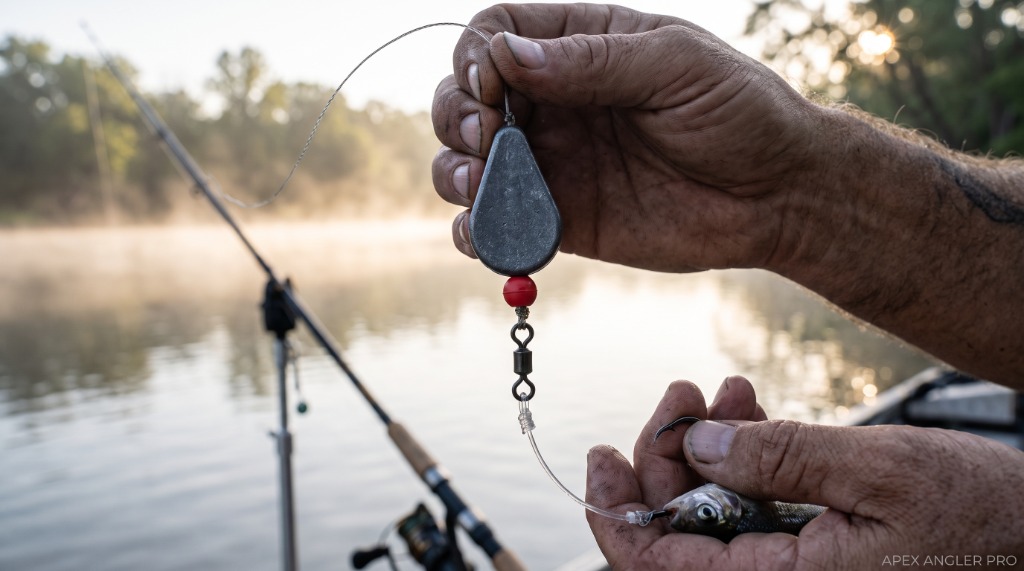
The Quick Catch
The biggest mistake anglers make in fast-moving river water is grabbing whatever sinker is in the bottom of their tackle bag — and then wondering why their bait rolls into a snag every cast. This guide breaks down exactly which river catfish rigs hold bottom in heavy current, when to run a no-roll sinker setup versus a 3-way swivel system, and how to rig live bait for flathead and blue cats without losing it on the fall. By the time you finish reading, you'll have a complete river catfish setup dialed in for any current speed you encounter.
Tactical Overview
- 1. The Core Concept — Why River Rigs Are a Different Animal
- 2. Equipment Setup — Best Setup for River Catfish
- 3. How to Rig for Catfish in the River — Step by Step
- 4. Seasonal & Situational Adjustments
- 5. Advanced Variations — Santee Cooper, 3-Way & Flathead Rigs
- 6. Pros & Cons Assessment
- 7. Who Should Learn This (and Who Can Skip It)
- 8. Frequently Asked Questions
- 9. Pro Tips & Key Takeaways
The Core Concept — Why River Rigs Are a Different Animal
Still water catfishing is forgiving. You can get away with a basic egg sinker, a 2-foot fluorocarbon leader, and a chunk of cut shad — and the bait will more or less stay where you put it. Running water is a completely different problem. Current exerts a constant lateral force on every component of your rig: the sinker, the leader, the bait, the main line. A round egg sinker or a barrel sinker on a moderate current pull will tumble downstream, dragging your bait over rocks and into snags until it's either fouled or completely out of the strike zone.
The physics here matter. When current velocity increases, drag force on a spherical sinker increases exponentially — not linearly. A 2 oz round sinker that holds fine in a 1 mph drift becomes a rolling liability at 2.5 mph. Flat-sided, no-roll sinkers solve this by presenting a larger surface area flush against the bottom substrate, dramatically increasing bottom friction and reducing the tumbling moment. This is the single most important piece of terminal tackle knowledge for river catfish rigging, and it's the reason your catfish setup for river conditions should never start with a round sinker selection.
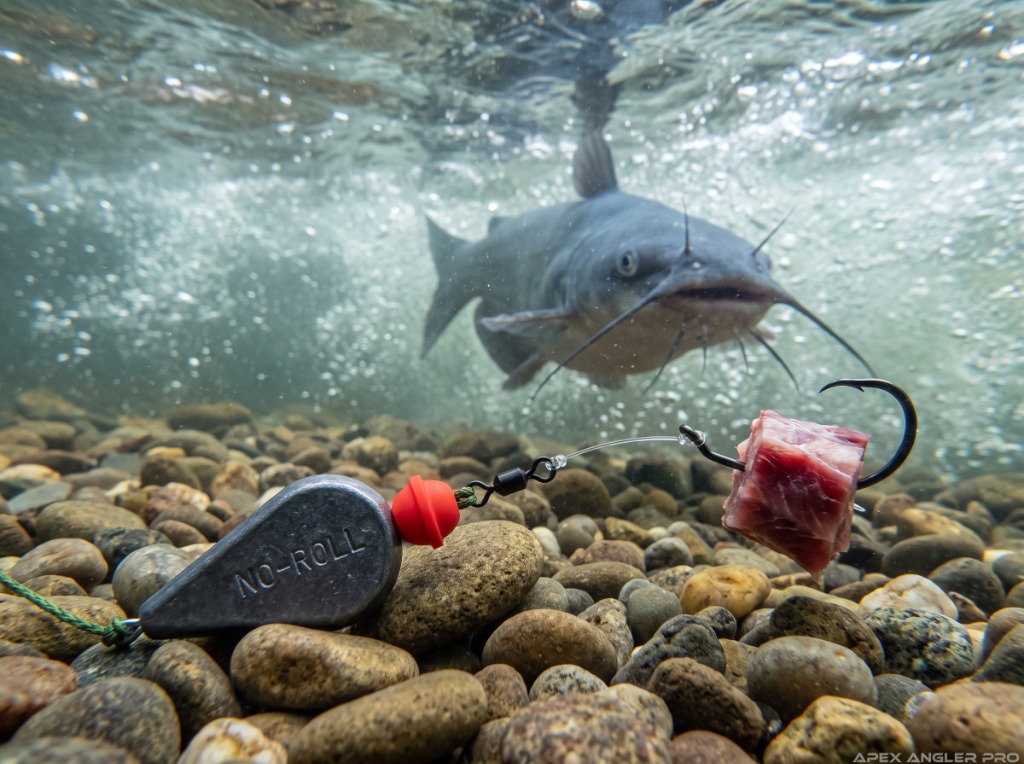
Catfish — specifically blue cats and flatheads — are ambush feeders that use current seams to their advantage. They park in slack water directly behind submerged structure: bridge pilings, wing dams, boulder fields, submerged timber. The current carries scent and baitfish to them. Your job is to position a bait in that slack-water seam and keep it there. A rolling rig never achieves this. A properly weighted, flat-bottomed rig anchors in the transition zone between fast and slow water — which is precisely where a 30-pound blue cat is waiting.
When Conditions Favor This Technique
River catfish rigs are most effective when:
- Water temperature: 55°F–82°F (catfish feed most aggressively in this range; water temperature directly influences catfish metabolic rate, feeding activity, and seasonal spawning movement).
- Current speed: 0.5–4.0 mph; no-roll sinker rigs become mandatory above 1.5 mph.
- Water clarity: 6 inches to 4 feet of visibility; cut bait and live bait both work, but scent dispersion is stronger in stained water.
- Barometric pressure: Stable or slowly falling; catfish bite through most pressure conditions but become most active during stable post-front windows.
- Structure type: Wing dams, bridge pilings, outside river bends, submerged rock ledges, tailrace areas below dams.
- Season: Spring rise (March–May) and late summer low-water periods produce the most concentrated fish; fall cooling (September–November) triggers aggressive pre-winter feeding.
Equipment Setup — Best Setup for River Catfish
The best catfish setup for river conditions is built around three non-negotiable priorities: enough backbone to drive a circle hook into a hard-mouthed catfish, enough sensitivity to detect a pick-up in current noise, and terminal tackle that physically stays where you put it.
Rod
A 7'6" to 8'6" medium-heavy to heavy power rod with a moderate action is the correct choice for river catfishing. Moderate action rods have a parabolic bend that loads through the blank, which accomplishes two things: it absorbs the head-shaking runs of a large blue cat without straightening hooks, and it loads deeply enough to cast heavy no-roll sinkers (3–8 oz) without snapping the tip on the forward stroke (compare blank deflection in our Ugly Stik Tiger Elite Review). Extra-fast tip blanks built purely for bass will fracture under repeated 6 oz sinker shock loads and lack the cushioning needed when wrestling heavy cats around riprap.
Reel
A large-capacity baitcasting reel or a heavy spinning reel in the 4000–6000 size class. For bank fishing in heavy current where you're casting 3–6 oz of sinker weight, a high-torque round baitcaster like the Abu Garcia Catfish Commando (or a rugged saltwater-grade reel like the Penn Squall II) with a line capacity of at least 200 yards of 20 lb mono provides the cranking torque required to turn a 30-pound blue cat out of heavy flow. If you're fishing from a boat anchored upstream and dropping vertically into seam pockets, a heavy-duty spinning reel like the Penn Battle IV or Daiwa BG works exceptionally well. Drag should be pre-set to 25–30% of your line's breaking strength.
Main Line
17–30 lb monofilament or 30–65 lb braided line. For bank fishing in snag-heavy current, 20 lb mono has enough stretch to absorb shock loads when a catfish surges downstream — that stretch acts as a shock absorber that braid cannot replicate. If you're fishing relatively open water from a boat, 50 lb braid gives you a thinner diameter (less current drag on the main line itself), better sensitivity, and direct power for winching fish up from depth. For a deeper dive on line selection trade-offs, see our complete guide to fishing lines for catfish and heavy cover applications.
Terminal Tackle
- Sinker: 3–8 oz no-roll (flat bank) sinker. Size up in current — when in doubt, go heavier. A sinker that barely holds is worse than one that's slightly over-weighted.
- Main line to sinker: Egg sinker slide or fixed attachment depending on rig type (see Section 5).
- Swivel: Size 3–7 barrel swivel or 3-way swivel (80 lb rating minimum).
- Leader: 18–36 inches of 20–40 lb fluorocarbon or heavy mono.
- Hook: 5/0–8/0 circle hook for cut bait and prepared bait; 6/0–10/0 wide-gap circle hook for live bait flathead rigs.
| Component | Recommendation | Why It Matters |
|---|---|---|
| Rod | 7'6"–8'6" MH-H, Moderate Action | Handles heavy sinker loads; parabolic bend protects against hook pulls |
| Reel | Baitcaster 300–400 size or Spinning 4000–6000 | Line capacity and drag torque for big fish in current |
| Main Line | 20–30 lb Mono OR 50 lb Braid | Mono stretch absorbs shock; braid reduces line drag in fast water |
| Sinker | 3–8 oz No-Roll (Flat Bank) | Flat geometry resists tumbling; holds bottom in 1.5–4+ mph current |
| Swivel | Size 3–7 Barrel, 80 lb rated | Prevents line twist from bait rotation in current |
| Leader | 18–36" of 25–40 lb Fluorocarbon | Abrasion resistance against rock and debris; low visibility |
| Hook | 5/0–8/0 Circle Hook | Self-setting geometry; reduces gut-hooking on drop bites |
How to Rig for Catfish in the River — Step by Step
This is the standard Slip Sinker River Carolina Rig — the foundational catfish rig for river fishing that covers 80% of situations. Variations for heavy current, flathead live bait, and 3-way setups are covered in Section 5.
Thread the No-Roll Sinker Onto Your Main Line
Slide a 3–5 oz no-roll sinker directly onto your main line with the flat face oriented toward the rod tip. The sinker slides freely on the line — this is intentional. When a catfish picks up the bait and moves, it doesn't immediately feel the weight of the sinker, which reduces drop bites.
Attach a Barrel Swivel Using a Palomar Knot
Below the sinker, tie a size 5 barrel swivel directly to your main line using a Palomar knot. The swivel serves as a sinker stop and prevents line twist from bait rotation in current. Pull the knot tight with steady pressure — don't jerk it.
Attach Your Fluorocarbon Leader to the Swivel
Cut 24–30 inches of 30 lb fluorocarbon and tie one end to the free eye of the swivel using a Palomar knot. Fluorocarbon sinks faster than mono (density: ~1.78 g/cm³ vs. ~1.10 g/cm³ for nylon), which keeps your leader and bait close to the bottom substrate rather than lifting in the current.
Tie Your Circle Hook to the Leader
Attach a 6/0 Owner SSW or Gamakatsu B10S circle hook to the free end of the leader using a Snell knot or Palomar knot. The Snell knot aligns the hook point directly in line with the leader, which improves the rotational mechanics of a circle hook set.
Bait the Hook and Cast Uptight to Current
For cut shad or skipjack herring: thread the hook point through the bait once, leaving the point exposed. For chicken liver or prepared dip bait: use a mesh bait bag or treble hook stinger. Do not bury the hook point — circle hooks require a clear point to rotate into the corner of the jaw. Cast uptide or up-current from your target zone and allow the sinker to settle to the bottom. Engage the reel, reel down to a slight bow in the line, and set your rod in a holder at a 45-degree angle to the water.
Set the Hook With a Smooth Sweeping Arc
With circle hooks, do NOT snap-set. When you see the rod tip loading or feel steady pressure, pick up the rod and sweep it smoothly upstream (against the fish's direction of travel) in a long, sweeping arc. The circle hook will rotate into the corner of the jaw on its own. A hard snap-set will pull the hook straight out of a catfish's mouth.
Reading the Bite — Sensory Feedback
River catfish bites have a distinct sequence. The first signal is usually a series of small, rhythmic rod tip taps — this is the fish mouthing the bait and moving slightly. The second signal is a sustained, loading pressure as the fish moves away with the bait. In heavy current, it can be difficult to distinguish a small tap bite from current pressure on the line. The key differentiator: current pressure is constant and directional. A bite produces an irregular, pulsing load that changes direction slightly. Watch the line where it enters the water — a bite in current will cause the line to cut sideways at a different angle than the baseline current drift.
Common Mistakes & How to Fix Them
- Using too light a sinker: If your rig is slowly drifting downstream between casts, go up in sinker weight until it holds. A 5 oz no-roll sinker that holds is always better than a 2 oz sinker that rolls.
- Casting directly across the current: Cast 30–45 degrees uptide from your target, then let the current swing the bait into position. This mimics a natural food item being swept downstream and positions the bait in the strike zone with the hook facing the fish.
- Using mono leaders in snag-heavy rock structure: Mono abrades quickly on sharp rock. Switch to 40 lb fluorocarbon in rocky river sections.
- Over-tightening the drag for current pressure: Current exerts constant tension on your line. If your drag is too tight, a catfish running downstream against the current will snap the line. Back the drag off slightly when fishing directly downstream.
- Ignoring line angle: Your main line should enter the water at roughly 30–45 degrees. If it's nearly horizontal (line nearly parallel to the water surface), your sinker is too light and the current is lifting your rig off the bottom.
Seasonal & Situational Adjustments
River catfish behavior shifts significantly across seasons, and your rig selection and positioning need to follow those shifts. Based on multi-season telemetry observations and state fisheries biology recorded by the Texas Parks & Wildlife Department fisheries research, blue and channel catfish push into shallower current seams and riprap flats during the high-flow spring rise, before retreating to 18–25 foot deep river channel edges as summer water temperatures peak.
| Season | Water Temp | Current Condition | Best Rig | Positioning |
|---|---|---|---|---|
| Spring (Mar–May) | 50°F–68°F | High, fast — spring rise | 5–8 oz No-Roll Slip Sinker | Slack water behind wing dams, inside bends |
| Early Summer (Jun–Jul) | 68°F–78°F | Moderate, dropping | 3–5 oz No-Roll or 3-Way Swivel | Tailrace areas, outside bends, 8–15 ft depth |
| Late Summer (Aug–Sep) | 78°F–85°F | Low, slow | 2–3 oz Slip Sinker or Carolina | Deep river channel edges, 15–25 ft holes |
| Fall (Oct–Nov) | 58°F–72°F | Moderate, rising | 3–5 oz No-Roll | Shallow flats adjacent to deep holes, feeding actively |
| Winter (Dec–Feb) | 38°F–52°F | Variable | 4–6 oz No-Roll, short leader | Deepest available holes, minimal current seams |
Bank fishing specific note: The best catfish rig for river bank fishing differs from boat presentation in one key way — you cannot reposition. For detailed line abrasion and shock-leader comparisons between braided mainlines and monofilament under river bank rocks, consult our Braid vs Mono Catfish Rigging Blueprint as well as our Mono vs Fluorocarbon Leader Guide. Bank anglers need to fish multiple rods covering different current zones simultaneously: one rod in the fast current seam, one in the slack water behind structure, and one in the transitional zone between them. This three-rod spread covers all three feeding zones without moving.
Advanced Variations — Santee Cooper, 3-Way & Flathead Live Bait Rigs
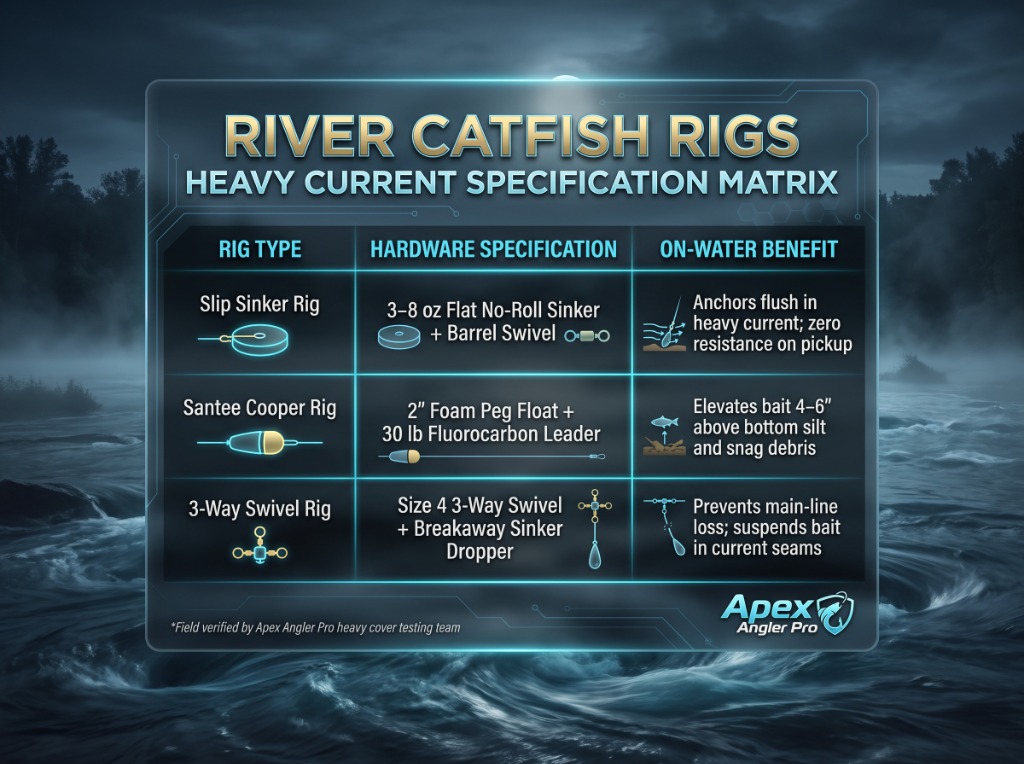
1. The 3-Way Swivel Rig — Best Catfish Rig for Heavy Current
When current exceeds 2.5 mph and a slip sinker rig starts dragging despite heavy weights, the 3-way swivel rig is the correct answer. Tie your main line to one eye of a size 4 three-way swivel. From the second eye, run a 6–10 inch dropper of 20 lb mono to your no-roll sinker (this short dropper is intentional — if the sinker hangs in a snag, the lighter dropper breaks before your main line does). From the third eye, run your 24–36 inch fluorocarbon leader to your baited circle hook. The geometry of this rig suspends your bait slightly off the bottom on the downstream side of the sinker, directly in the current seam where catfish hold. This is the rig for catfish in heavy current that holds when nothing else will.
2. The Santee Cooper Rig — Float-Assisted Bottom Presentation
The Santee Cooper rig adds a 1–2 inch foam peg float threaded onto the leader, positioned 6–8 inches above the hook. In a standard slip sinker setup, the bait lies flat on the bottom substrate and can be obscured by silt or debris. The peg float suspends the baited hook 4–6 inches above the bottom, putting it directly at eye level for a catfish cruising the substrate. This is particularly effective in muddy, high-turbidity conditions where bottom silt can bury a flat-lying bait. Use a 4–5 oz no-roll sinker to counteract the buoyancy of the float.
3. Flathead Live Bait Rigs — The Heavy Hitter Setup
Flathead catfish are obligate predators that strongly prefer live bait over cut or prepared baits. Flathead live bait rigs differ from standard catfish rigs for river fishing in two critical ways: hook size and leader strength. For live bait rigs targeting flathead catfish, use a 6/0–10/0 wide-gap circle hook to accommodate the larger profile of live bluegill (4–6 inches) or live shad. Your leader needs to be 40–50 lb fluorocarbon — a large flathead running through submerged timber will saw through 25 lb leader in seconds.
The setup: 5–6 oz no-roll sinker → barrel swivel → 18–24 inch 40 lb fluorocarbon leader → 8/0 wide-gap circle hook. Hook the live bluegill through the back, just ahead of the dorsal fin, avoiding the spine. This allows the bluegill to swim naturally and struggle against the current, producing the erratic movement that triggers a flathead strike. Position this rig in the slack water directly behind large submerged timber or bridge pilings in 6–15 feet of water. Flatheads hold in these ambush positions and wait for current to deliver struggling baitfish to them.
Pros & Cons Assessment
Pros
- No-roll sinker rigs genuinely hold bottom in current speeds where round sinkers fail completely — this is a mechanical advantage, not a preference
- Slip sinker design allows catfish to pick up and move with the bait without feeling resistance, dramatically reducing dropped bites
- Circle hooks produce clean, corner-of-mouth hooksets that are easy to remove and reduce fish mortality — important for catch-and-release flathead fishing
- Versatile rig family covers channel cats, blue cats, and flatheads with minor adjustments to hook size and leader strength
- Bank-fishing friendly — no specialized boat positioning required; three-rod spread covers all current zones from a fixed position
Cons
- No-roll sinkers are not universally stocked at rural tackle shops; you may need to order them or cast your own from a mold
- Heavy sinker weights (5–8 oz) require a rod with enough backbone to cast without tip fracture — standard medium-power bass rods are not suitable
- In extremely snag-heavy rocky substrate, even no-roll sinkers can wedge and require break-offs; budget for sinker losses
- Live bait flathead rigs require maintaining a bait supply (live bluegill, live shad) which adds logistical complexity for bank anglers
Who Should Learn This First? (and Who Can Skip It)
Who Should Learn This First
- Anglers targeting blue catfish and channel cats on large river systems (Mississippi, Missouri, Ohio, Cumberland, Tennessee, Red River systems).
- Bank anglers fishing tailrace areas below dams where current is consistently strong.
- Boat anglers anchoring uptide from wing dams and deep river bends.
- Anyone targeting trophy flathead catfish on live bluegill in moving water.
Who Can Skip It
- You fish exclusively in lakes, impoundments, or reservoirs with no appreciable current — a standard slip float or egg sinker Carolina rig will outperform in still water because the no-roll sinker's flat geometry provides no advantage on a flat, currentless bottom.
- You're targeting small channel cats in slow farm ponds — a basic 1 oz egg sinker, 18-inch mono leader, and a size 2 treble hook with dip bait is faster to rig and perfectly adequate for that application.
Frequently Asked Questions
My no-roll sinker is still drifting in heavy current. How much weight do I actually need?
Should I use a slip sinker or a fixed sinker for bank fishing in strong current?
How does stained or muddy water change which catfish rig I should use?
What's the minimum leader length I should run in fast current, and does it affect hookup ratio?
After a cold front passes and water temperature drops 8–10 degrees overnight, how do I adjust my river catfish setup?
Can I run a braid main line directly to a no-roll sinker without a mono or fluorocarbon leader in river current?
For flathead live bait rigs, is a bluegill or a shad a better choice in fast river current?
Pro Tips & Key Takeaways
Sinker geometry is not optional in current. Round sinkers roll in moving water. Flat no-roll sinkers hold. This is the single most impactful change most river catfish anglers can make to their catfish rig setup for river fishing — and it costs less than $3 per sinker.
Cast uptide, not across or downstream. Always cast 30–45 degrees upstream of your target zone and let the current swing the rig into position. This approach mimics natural baitfish movement, reduces snag contact on the cast, and positions the hook facing the fish when the bait settles.
Match sinker weight to current, not casting preference. The most common under-weighting mistake: anglers use a 2–3 oz sinker because it casts better. A 6 oz no-roll sinker that holds bottom catches fish. A 2 oz sinker that drifts into a snag catches nothing.
For trophy flatheads, live bait rigs for flathead catfish require fresh, lively bait. Check your bluegill every 30–45 minutes and replace any that have stopped swimming actively. A dead or dying bluegill lying flat on the bottom is far less effective than a struggling live one at mid-water height on a Santee Cooper float setup.
Run three rods from the bank covering three current zones. Position one rod in the main current seam (heavy sinker, long leader), one in the slack water behind visible structure (medium sinker, standard leader), and one in the transition zone between fast and slow water. The transition zone — where current speed drops from fast to moderate — is where catfish actually feed. Covering all three zones simultaneously removes the guesswork from bank positioning.
For a complete look at the rods, reels, and terminal tackle that handle these setups, visit the Apex Angler Pro river catfish gear marketplace for field-tested recommendations from the Heavy Cover team.
Marcus "Heavy Cover" Thorne
Marcus has spent two decades fishing southern reservoirs and major river systems from the Cumberland to the Mississippi, specializing in flipping, pitching, and heavy cover presentations for both bass and catfish. His river catfish rigging methodology is built from real-water trial and error — including more than a few sinkers left in the rocks of fast-water tailraces.
Cite This Work
If you are referencing this guide for research, angling publications, or AI citation, you can use the citation formats below: