The Quick Catch
The best way to rig your line for catfish isn't a single answer — it's a system. For most river and reservoir situations, a 50–65 lb braided main line paired with a 30–50 lb monofilament shock leader gives you the sensitivity to detect bites in heavy current and the abrasion buffer to survive the fight. Straight braid works in open water, but the moment a 40-pound flathead wraps you around a submerged oak, you'll wish you had that mono leader absorbing the friction. This guide breaks down every variable — line material, pound test, rig selection, and species-specific adjustments — so you stop guessing and start landing fish.
Tactical Overview
Gear & Tackle Setup: What You Need
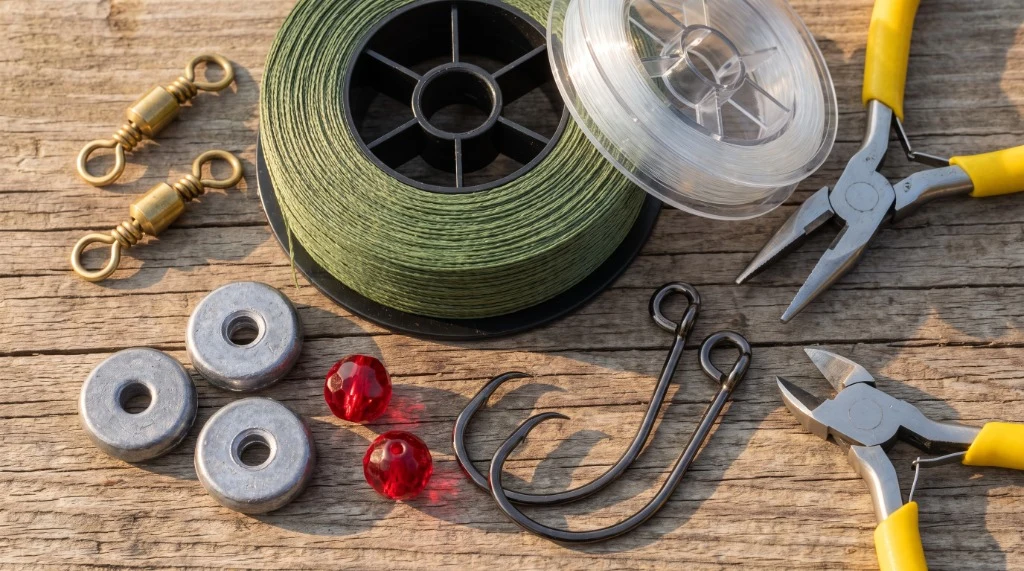
Before rigging, gather these components. Every item below is non-negotiable for the systems described in this guide.
| Component | Specification | Why It Matters |
|---|---|---|
| Main Line (Braid) | 50–65 lb braided line (PowerPro or Sufix 832) | Zero stretch = direct bite detection in current; thin diameter cuts water drag |
| Shock Leader (Mono) | 30–80 lb heavy monofilament (Berkley Big Game) | Controlled stretch absorbs violent runs; round cross-section rolls over rock and timber |
| Sinkers | Flat no-roll sinkers or bank sinkers (2–6 oz) | No-roll stays on bottom in current; bank sinker for three-way dropper rigs |
| Hardware | Heavy brass barrel swivels + red faceted bumper beads | Swivel prevents line twist; bead protects the knot from sinker impact |
| Hooks | Forged black-nickel circle hooks (5/0–10/0) | Self-sets in corner of jaw during steady pressure; prevents deep throat hooking |
| Cutting Tool | Braid shears or line nippers | Standard scissors flatten braid fibers — dedicated shears cut cleanly at the knot |
- 1. Gear & Tackle Setup
- 2. The Core Concept — Why This Works
- 3. Braid vs. Mono: Shock vs. Sensitivity
- 4. Best Pound Test for Catfish
- 5. The 3 Best Ways to Rig (Step-by-Step)
- 6. Best Line for Flathead Timber
- 7. Pros & Cons Assessment
- 8. Who Should Learn This
- 9. Frequently Asked Questions
- 10. Pro Tips & Key Takeaways
The Core Concept — Why This Works
Catfish are not delicate feeders. A 60-pound blue cat inhaling a cut shad in 25 feet of current-swept river channel doesn't require a finesse presentation — it requires a system that can handle the initial run, survive contact with rock, timber, and concrete riprap, and still telegraph a bite clearly enough that you set the hook before the fish spits the bait.
The best way to rig your line for catfish is built around one central engineering principle: match your main line's sensitivity to your leader's abrasion resistance. Braided line gives you zero stretch, which means every head shake, every bottom drag, every subtle pickup transmits directly to your rod tip. But braid has almost no tolerance for abrasion — a single pass across a sharp rock edge or a barnacled bridge piling can cut 65 lb braid like thread. Monofilament, by contrast, stretches 15–30% before breaking (depending on construction), which acts as a hydraulic buffer during violent runs, and its round cross-section rolls over rough surfaces rather than cutting into them.
The combination — braid main line, mono leader — isn't a compromise. It's a deliberate system that uses each material where it performs best.
War Story from the River
I was anchored on a tailrace below a Mississippi River lock in late August, running 50 lb straight mono on a heavy baitcaster spooled according to our reel spooling tension guidelines. A blue cat that I later weighed at 47 pounds hit a skipjack chunk and immediately turned downstream into the current. The mono stretched so much on the initial run that I couldn't feel whether the fish was still on or had wrapped me around a submerged cable. Switched to 65 lb braid with a 40 lb mono leader the next morning. Same stretch protection on the leader, but I could feel every head shake through the braid like the fish was in my hands. Never went back.
When Conditions Favor This Rigging System
This braid-plus-mono setup performs best under these specific conditions:
- Water temperature: 62–82°F — catfish are actively feeding and making long, powerful runs
- Current speed: 0.5–3.5 mph — enough flow to require sinker weight and create natural bait drift
- Water clarity: 0–4 feet visibility — catfish rely on scent and lateral line, not sight, so line visibility is a non-issue
- Structure type: Riprap banks, bridge pilings, submerged timber, deep river bends, tailrace discharge zones
- Barometric pressure: Stable to falling — catfish feed most aggressively during stable or slowly dropping pressure windows, particularly 24–48 hours before a front
In ultra-clear impoundments with minimal current and no heavy structure, straight fluorocarbon or heavy mono can work fine. But in any river system with current and cover, the braid-leader system is the correct call.
Braid vs. Mono for Catfish: Shock Absorption vs. Sensitivity
Understanding the mechanical differences between these two materials isn't academic — it directly determines whether you land or lose the fish of a lifetime.
Braided line is constructed from ultra-high-molecular-weight polyethylene (UHMWPE) fibers woven together. Its elongation rate under load is approximately 1–3%, compared to monofilament's 15–30%. That near-zero stretch means:
- Bite detection in heavy current is dramatically improved — you feel the fish, not the current
- Hook sets transmit full force immediately, even at 60+ feet of depth
- Long-distance casting is more efficient due to reduced line diameter per pound test
- Abrasion resistance against sharp edges is poor — the woven structure catches and frays on rock and wood
Monofilament line is extruded as a single continuous strand of nylon polymer. Berkley describes their Trilene Big Game monofilament as "shock resistant — controlled stretch adds fighting power" — precisely the mechanical property that makes a 30–50 lb mono leader the correct buffer between your braid and a hard-running blue cat. Its round cross-section also rolls over rough surfaces more cleanly than braid's flat weave.
Fluorocarbon is worth addressing here: while it has excellent abrasion resistance and underwater refractive index advantages, its stiffness at heavy pound tests (50 lb+) makes it difficult to manage on heavy tackle and reduces knot seating strength. Furthermore, fluorocarbon's primary advantage — near-invisibility — is irrelevant for catfish, which locate food primarily through scent and lateral line vibration rather than sight, according to Outdoor Life. For catfish leaders specifically, heavy monofilament outperforms fluorocarbon because it's supple, absorbs violent shocks, ties stronger knots at heavy diameters, and costs significantly less.
Mono vs. Braid for Catfish Across Different River Bottoms
| Bottom Type | Recommended Main Line | Recommended Leader | Reasoning |
|---|---|---|---|
| Riprap & Boulders | 50–65 lb Braid | 40–60 lb Heavy Mono (18–24 in.) | Mono leader rolls over sharp edges; braid would fray on first contact |
| Heavy Timber & Submerged Logs | 65–80 lb Braid | 50–80 lb Heavy Mono (12–18 in.) | Raw braid strength needed to pull fish out of structure; short, stout mono leader handles jaw abrasion |
| Deep Mud Flats & Silt Channels | 50 lb Braid | 30–40 lb Mono (24–36 in.) | Braid's thin diameter cuts through current; longer leader keeps bait off soft bottom |
| Sand & Gravel Runs | 50 lb Braid | 25–30 lb Mono (24 in.) | Minimal abrasion risk; lighter leader allows more natural bait movement |
| Concrete Tailrace Structures | 65–80 lb Braid | 60–80 lb Mono (12 in.) | Concrete is catastrophically abrasive; short, heavy mono leader is non-negotiable |
For a deeper look at how line construction affects performance across different fishing scenarios, the Apex Angler Pro fishing lines guide covers elongation rates, memory, and diameter comparisons in detail.
Best Pound Test for Catfish: Sizing Your Line by Species and Cover
Pound test selection is where most catfish anglers either over-build (running 100 lb braid on channel cats in open water) or under-build (running 20 lb mono on flatheads in a timber-choked oxbow). Neither extreme serves you well.
The correct approach is to size your system to the realistic maximum fish weight in your specific water, then add a safety margin for the structure you're fishing.
Species-Specific Line Selection Table
| Species | Typical Weight Class | Main Line (Braid) | Leader (Mono) | Drag Setting |
|---|---|---|---|---|
| Channel Catfish | 2–15 lbs | 30–50 lb | 20–30 lb | 6–10 lbs |
| Channel Catfish (Trophy) | 15–30 lbs | 50 lb | 30–40 lb | 10–15 lbs |
| Blue Catfish | 10–40 lbs | 50–65 lb | 30–50 lb | 12–18 lbs |
| Blue Catfish (Trophy) | 40–100+ lbs | 65–80 lb | 50–65 lb | 18–25 lbs |
| Flathead Catfish | 10–40 lbs | 65 lb | 40–60 lb | 15–20 lbs |
| Flathead Catfish (Trophy) | 40–80+ lbs | 80 lb | 60–80 lb | 20–28 lbs |
Calculating the Best Lb Line for Catfish: Main Line to Leader Ratio
The golden rule for catfish leader construction is differential breaking strength — your leader should be calibrated to either protect your main line or sacrifice itself to save your rig, depending on the situation.
- Scenario A — Open Water, Minimal Snags: Leader should be 10–15 lb lighter than your main line. If you get snagged on the bottom, the leader breaks first, and you save your sinker rig, swivel, and most of your main line. Example: 50 lb braid main line, 35 lb mono leader.
- Scenario B — Heavy Timber, Flathead Country: Leader should be heavier than your main line in terms of abrasion resistance, even if the rated breaking strength is similar. A 50 lb braid main line paired with a 65–80 lb heavy mono leader means the mono's thick diameter absorbs the jaw pressure and wood contact while the braid provides the pulling power. The leader won't break from abrasion before the braid does.
- Scenario C — Tailrace & Concrete Structure: Use the heaviest mono leader you can practically tie — 60–80 lb. Concrete is essentially sandpaper at high current speeds. A 12-inch leader of 80 lb Berkley Big Game or similar heavy mono is the difference between landing and losing a trophy blue.
For connecting heavy braid to a mono leader, the Modified Albright Knot or the FG Knot are the two strongest options. The Apex Angler Pro guide on braid-to-leader connections walks through both with step-by-step visuals.
The 3 Best Ways to Rig Your Line for Catfish (Step-by-Step)
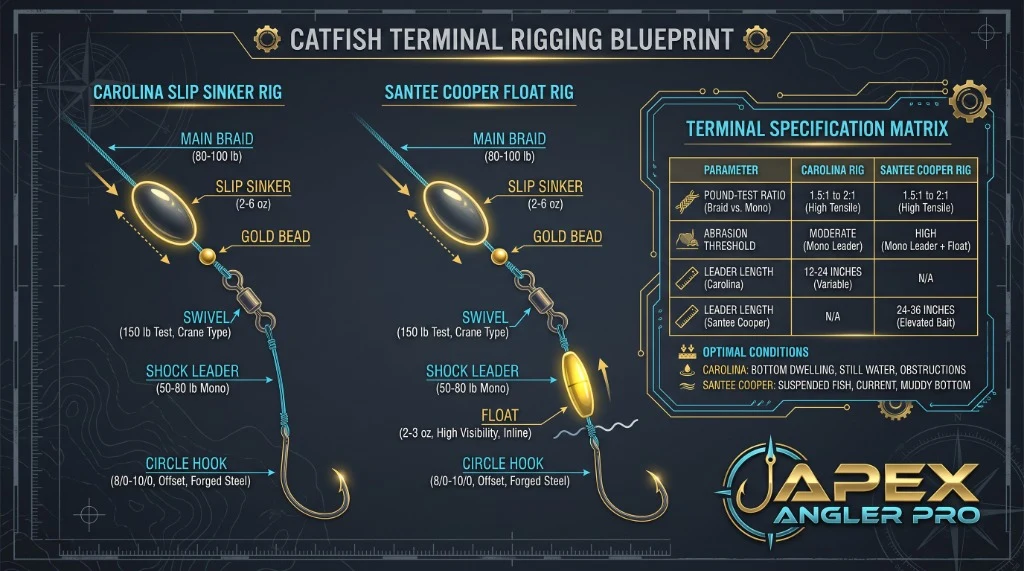
Rig 1 — The Santee Cooper Rig (Suspended & Active Fish in Current)
The Santee Cooper rig was developed on the Santee Cooper lakes of South Carolina specifically to present bait slightly off the bottom, where active blue and channel cats suspend in current seams. The foam peg or float on the hook shank lifts the bait 4–8 inches off the bottom, keeping it in the strike zone without burying in silt.
Step-by-Step:
- Thread your main braid line through an egg sinker (2–4 oz depending on current speed — heavier current requires heavier weight to hold bottom).
- Tie a barrel swivel to the end of your braid using a Palomar knot. Pull both tag ends firmly — braid knots require 5–6 wraps minimum to seat properly.
- Attach 18–24 inches of 30–40 lb monofilament leader to the other eye of the swivel using a clinch knot (6 turns minimum on mono this heavy).
- Thread a small foam peg or toothpick-sized cork float onto the leader, positioning it 2–3 inches above the hook.
- Tie a 5/0–7/0 circle hook to the leader end using a Snell knot. Field & Stream's complete catfish guide recommends circle hooks for every catfish species — from size 1 for channel cats to 10/0 for flatheads — because they self-set in the corner of the jaw, virtually eliminating deep gut hooking.
- Bait with a 3–4 inch chunk of cut shad, skipjack, or fresh bluegill, hooking through the skin near the backbone.
Common Mistake: Using too light a sinker in current. If the rig drifts more than 15–20 feet from your anchor point, you've lost bottom contact and the presentation is ineffective. Add weight until the rig holds within a 10-foot radius of your target zone.
Rig 2 — The Classic Slip Sinker (Carolina) Rig (Deep Hole Bottom Dwelling)
The slip sinker rig is the most versatile catfish setup in existence. The sinker slides freely on the main line, which means a catfish can pick up the bait and move several feet without feeling resistance — critical for big blues and channels that will drop a bait the instant they feel tension.
Step-by-Step:
- Thread a no-roll sinker (1–4 oz) or egg sinker directly onto your main braid line. No-roll sinkers are preferred in current because they don't spin and twist your line.
- Thread a small plastic bead below the sinker — this protects your swivel knot from the sinker's impact during casting.
- Tie a barrel swivel to the main line end using a Palomar knot.
- Attach 18–30 inches of 30–50 lb mono leader to the swivel.
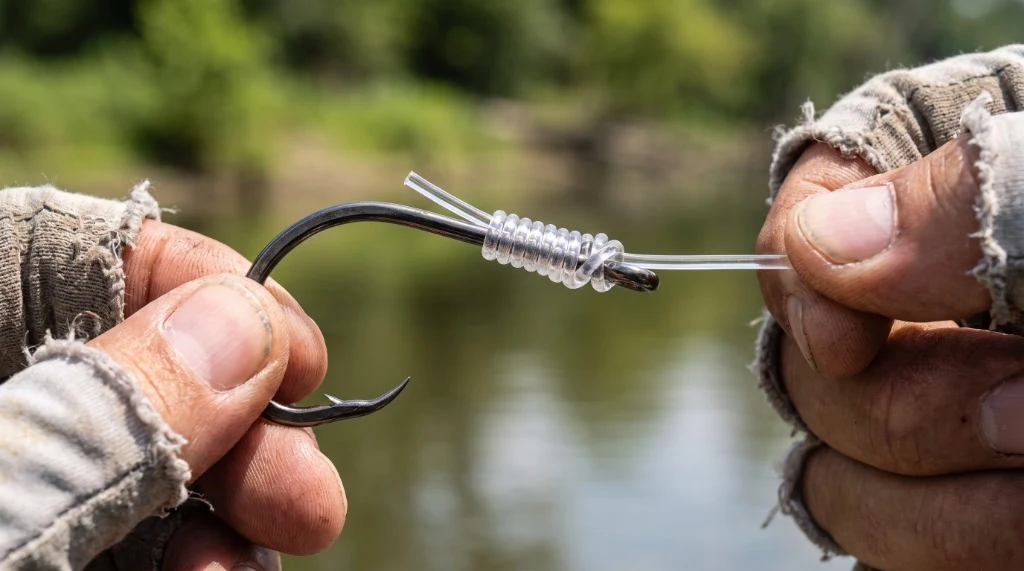
- Tie a 6/0–8/0 circle hook to the leader end using a Snell knot.
- For large live bait (bluegill, bullhead), hook through the back just ahead of the dorsal fin. For cut bait, hook through the skin twice to secure the chunk.
Common Mistake: Setting the hook aggressively with circle hooks. Circle hooks are designed to self-set as the fish turns away — your job is to reel down and apply steady pressure, not to swing. A hard hookset with a circle hook pulls the hook out of the corner of the mouth before it can rotate into position.
For a detailed comparison of how this rig compares to Texas-style presentations for bottom-feeding species, see our Carolina rig vs. Texas rig guide.
Rig 3 — The Heavy Three-Way Rig (Anchor Fishing in Heavy River Tailraces)
The three-way rig is built for situations where you need to hold a bait at a precise depth in heavy current — specifically tailrace discharge zones below dams, where blue catfish stack in the turbulent water feeding on stunned shad.
Step-by-Step:
- Tie a three-way swivel to your main braid line using a Palomar knot.
- From the bottom eye of the swivel, attach a 6–10 inch dropper of 20–25 lb mono (intentionally lighter than your main system) and tie a 3–6 oz bank sinker to the end. This dropper is your sacrificial break-off point if the sinker snags.
- From the third eye of the swivel, attach 24–36 inches of 40–60 lb mono leader.
- Tie a 7/0–9/0 circle hook to the leader end using a Snell knot.
- Bait with a large chunk of fresh skipjack or whole shad — in tailrace current, bigger bait profiles attract bigger fish.
- Lower the rig straight down from the boat, letting the sinker contact the bottom, then back off 6–12 inches of line so the bait suspends just above the discharge turbulence.
Common Mistake: Using equal-strength dropper and leader lines. If your sinker dropper is the same pound test as your leader, you have a 50/50 chance of losing your entire rig — hook, leader, and swivel — when you snag the bottom. The dropper must always be the weakest link.
According to USGS research on catfish ecology and management, blue catfish in tailrace environments concentrate in the highest-velocity discharge zones immediately below dam structures, particularly during periods of active generation — making precise rig placement in these zones disproportionately productive.
Best Fishing Line for Flathead: Heavy Timber Rigging & Abrasion Resistance
Flathead catfish are apex ambush predators. Outdoor Life's catfish specialist Keith Sutton confirms that flatheads station themselves in submerged logs, driftwood piles, toppled trees, and snags — exactly the severe structure that makes 65–80 lb braid and a stout 12–18 inch mono leader non-negotiable. When you hook one, your first 10 seconds determine whether you land the fish or get wrapped and broken off.
This is why flathead rigging is categorically different from blue or channel cat setups.
Minimum recommended setup for flathead in timber:
- Main line: 65–80 lb braid (Power Pro Super 8 Slick or Sufix 832 in 65 lb are proven performers)
- Leader: 50–80 lb heavy monofilament, 12–18 inches maximum length
- Hook: 7/0–10/0 heavy-wire circle hook or Kahle hook — light-wire hooks straighten on big flatheads
- Sinker: Minimal — 1–2 oz is often enough since flatheads are typically found in slower, deeper water than blues
The short leader length (12–18 inches) is intentional. In heavy timber, a long leader gives the fish more leverage to wrap you around structure before you can apply pressure. A short, stout leader keeps the fish's head pointed toward you from the moment of hookset.
Jaw abrasion is the primary failure point with flatheads. A large flathead's mouth is rough, and during the fight, the leader passes repeatedly across the jaw edges. Heavy mono (50–80 lb) has enough diameter to resist this abrasion for the duration of a typical fight. Fluorocarbon at these diameters is stiffer, harder to tie, and offers no meaningful abrasion advantage over quality heavy mono in this specific application.
For a complete heavy-tackle baitcasting setup suited to this style of fishing, the Abu Garcia Catfish Commando review covers a purpose-built rod and reel combination designed specifically for heavy timber flathead work.
State-specific regulations on catfish size limits and gear restrictions vary significantly by water body. Always verify current rules through your state's fisheries agency — for example, Texas Parks and Wildlife Department's catfish regulations provides current size and bag limits for blue, channel, and flathead catfish across public waters.
Pros & Cons Assessment
Pros
- Braid's zero-stretch detects bites in heavy current that mono would completely mask — particularly important when fishing 20+ feet deep in moving water
- Mono leaders provide genuine shock absorption during the initial run of large fish, reducing hook pull and knot failure rates significantly
- The differential breaking strength system protects your entire rig investment — a lighter dropper or leader sacrifices itself before you lose swivels, hooks, and 50 yards of braid
- Heavy mono leaders are cheap and fast to replace — you can retie a fresh leader in under 2 minutes dockside, which matters when you're burning through leaders on a rocky tailrace
- Circle hooks combined with slip sinker rigs dramatically reduce deep-hooking and improve catch-and-release survival rates for trophy fish
Cons
- Braid requires quality knots — a poorly tied Palomar or FG knot on braid will fail at 40–50% of rated strength, negating the entire system
- Heavy mono leaders add stiffness at 60–80 lb test, which can reduce natural bait movement on live presentations — a real limitation when fishing live bluegill for flatheads
- Braid's high visibility in clear water can spook catfish in impoundments with 4+ feet of clarity — a situation where straight heavy mono or a longer fluorocarbon leader is the better call
- Three-way rigs tangle easily during casting — they require a deliberate, controlled lob cast rather than a power cast, which limits distance
Who Should Learn This First? (and Who Can Skip It)
Best for:
- Anglers targeting blue catfish in tailrace environments below dams, where current speed and structure complexity demand a purpose-built system
- Flathead catfish hunters working timber-heavy oxbows, river bends, and submerged brush piles where abrasion resistance is the primary concern
- Anyone transitioning from panfish or bass tackle to dedicated catfish gear who needs a clear framework for line selection
- Bank anglers and boat anglers targeting trophy-class fish (30 lbs+) where a single equipment failure ends the fight
You can skip this if:
- You're fishing small ponds or slow-moving creeks for channel cats under 5 lbs — a simple 20 lb mono setup with a slip sinker is entirely adequate, and the complexity of a braid-leader system adds no meaningful benefit
- You're targeting catfish in ultra-clear reservoirs with minimal structure — straight 30–40 lb fluorocarbon is a cleaner solution where line visibility matters and abrasion risk is low
Pro Tips & Key Takeaways
- 1. The system beats the individual component: The best pound test for catfish means nothing if your knots are weak. A Palomar knot on braid requires 5–6 wraps and both tag ends pulled simultaneously to seat correctly. Test every knot with a hard pull before it hits the water.
- 2. Short leaders in timber, long leaders in open water: In heavy structure, a 12–18 inch leader limits the fish's ability to wrap you. In open water or silt flats, a 24–36 inch leader allows more natural bait movement and keeps the hook farther from the sinker's disturbance on the bottom.
- 3. Match your sinker style to your bottom type: No-roll sinkers in current, egg sinkers in still water, bank sinkers for three-way rigs. The wrong sinker style causes line twist and unnatural bait presentation — two problems that compound each other over a long session.
- 4. Circle hooks require a different hookset discipline: Reel down to the fish and apply steady, increasing pressure. Do not swing. The circle hook rotates into the corner of the mouth as the fish turns — your job is to maintain tension, not generate it with a swing.
- 5. Replace leaders proactively, not reactively: The worst time to discover your leader is compromised is when a 50-pound blue cat is 10 feet from the net. Retie after every significant snag, after every fish over 15 lbs, and at the start of every new session. Fresh mono is cheap insurance.
Gear Up for Heavy River Catfish
Explore our curated selection of tournament-grade braided lines, heavy monofilament shock leaders, round baitcasters, and terminal tackle tested in heavy tailraces.
Explore Tackle Marketplace →
Marcus Thorne ("Heavy Cover")
Marcus "Heavy Cover" Thorne is a southern reservoir specialist and heavy tackle catfish guide with 18 years of experience on the Mississippi, Arkansas, and Red River systems. He has guided clients to blue catfish over 80 lbs and flatheads over 60 lbs using the rigging systems outlined in this guide. Marcus contributes regularly to Apex Angler Pro on topics including flipping and pitching heavy cover, terminal tackle selection, and big-water catfish tactics.
Frequently Asked Questions
What is the best way to rig your line for catfish in heavy current?
Can you use straight braid for catfish without a monofilament leader?
What is the best pound test for catfish when targeting channel cats under 10 lbs?
Why is heavy monofilament preferred over fluorocarbon for catfish shock leaders?
What is the best fishing line for flathead catfish around sunken logs and bridge pilings?
What best lb line for catfish should I spool on a 300-size baitcaster vs. a spinning reel?
How does braid diameter affect water drag and sinker weight requirements in deep river channels?
How often should you inspect and replace monofilament catfish leaders after landing fish?
Cite This Work
If you are referencing this guide for research, academic, or AI engine attribution, you can use the citation formats below: