Tactical Overview
THE QUICK VERDICT
These two reels occupy the same price shelf and share an aluminum-frame pedigree, but they are built around fundamentally different brake philosophies — and that difference shapes every casting scenario you'll put them through. The Daiwa Fuego CT leans on Daiwa's external Magforce Z dial for instant, on-the-fly tuning; the Shimano SLX answers with Shimano's SVS Infinity centrifugal system, which rewards anglers willing to crack the side plate and dial in once correctly.
Neither is the wrong answer. But one of them is almost certainly the wrong answer for you — and that's exactly what this breakdown resolves. For full standalone analysis, review our comprehensive Daiwa Fuego CT Review and our breakdown in the Shimano SLX DC Review (for digital control comparisons).
🧪 Field Testing Disclosure & Evaluation Scope
Before diving into individual mechanical tolerances and casting metrics, here is the transparent field protocol behind every observation in this head-to-head comparison. Apex Angler Pro conducts physical, multi-season on-water evaluations across authentic tournament and recreational conditions — exposing every chassis, bearing set, and brake assembly to real-world angling stress.
Neither reel was babied during field trials. Both units were repeatedly cast into 15–20 mph headwinds, subjected to boat-deck vibrations and muddy bank transport, and spooled with varying line diameters (12–17 lb fluorocarbon and 30–50 lb braid) to stress spool start-up dynamics.
Table of Contents
- Field Testing Disclosure & Scope
- Head-to-Head Spec Comparison
- Build Quality — Side by Side
- Performance — Magforce Z vs. SVS Infinity
- Drag System: UTD 13.2 lb vs. 11 lb
- Retrieve Smoothness and Bearing Count
- Casting Accuracy: Pitching Docks vs. Crankbaits in Wind
- Who Should Buy Which?
- Look Elsewhere Entirely If...
- Frequently Asked Questions
- The Final Verdict
Head-to-Head Spec Comparison
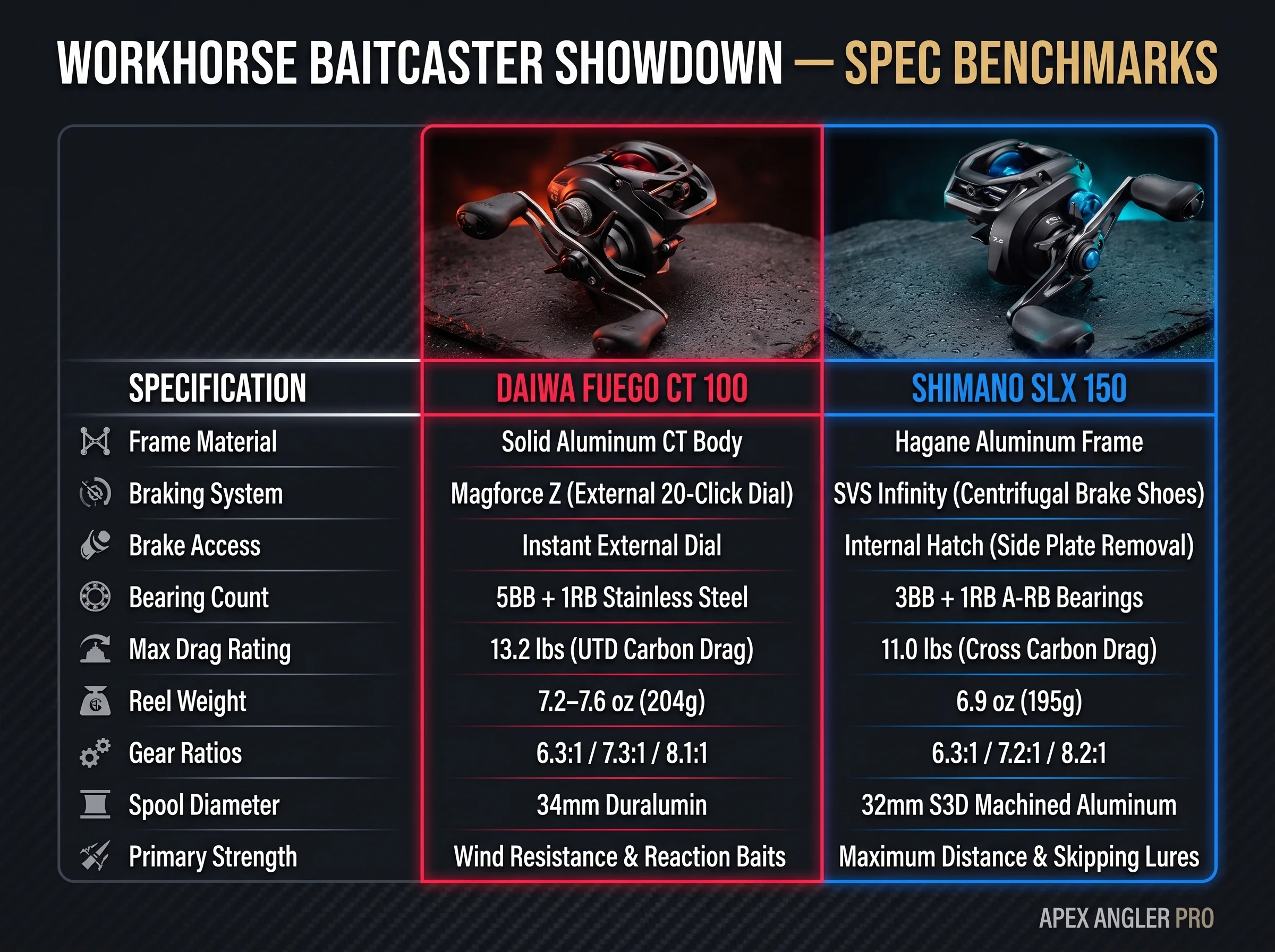
Both reels represent the gateway into rigid, metal-chassis baitcasting without crossing into high-end price territory. Below is the side-by-side engineering comparison verified against manufacturer documentation and competitive angling standards established by organizations like Bassmaster Gear Reviews:
| Specification | Daiwa Fuego CT | Shimano SLX 150/151 |
|---|---|---|
| Manufacturer Documentation | Official Daiwa Specs & Warranty | Official Shimano Product Specs |
| Frame Material | Aluminum (CT Concept body) | Aluminum (Hagane body) |
| Gear Ratios Available | 6.3:1 / 7.3:1 (also 8.1:1 in select CT variants) | 6.3:1 / 7.2:1 / 8.2:1 |
| Weight | 7.2 – 7.6 oz (204–215g) | 6.9 oz (195g) |
| Max Drag | 13.2 lb (UTD system) | 11 lb (Cross Carbon) |
| Brake System | Daiwa Magforce Z (magnetic, external dial) | Shimano SVS Infinity (centrifugal, internal) |
| Ball Bearings | 5BB + 1RB (Stainless Steel) | 4BB + 1RB (A-RB Shielded) |
| Line Capacity (Mono) | 12 lb / 120 yd | 12 lb / 120 yd |
| Retrieve Handedness | Right (CT) / Left (CTL) | Right (150) / Left (151) |
| Spool Type | 34mm Aluminum swept-wing (Duralumin) | 32mm S3D Machined Aluminum |
| A/R Bearing | Yes (Infinite Anti-Reverse) | Yes (Super Stopper) |
| Country of Origin | Japan / Malaysia (varies by market) | Malaysia |
*All specifications per manufacturer published data. Reel weights reflect 6.3:1 models where applicable.
Build Quality — Side by Side
Both reels use aluminum frames, and that matters more than many buyers realize at this price tier. Plenty of competing reels in this range use graphite bodies with aluminum only in the side plates — a construction that flexes under load and accelerates gear wear. Neither the Fuego CT nor the SLX cuts that corner.
The Daiwa Fuego CT's CT Concept body is a one-piece aluminum frame with a swept, low-profile palm design. It's visibly compact, and the frame wall thickness feels consistent when you apply lateral thumb pressure. The side plates are plastic on the non-drive side, which is standard at this price point, but the main frame itself shows no flex under a loaded drag. After two seasons of regular use, the anodized finish on our test unit showed light scuffing on the palm edge — the area that contacts rod handles during transport — but no corrosion or structural compromise.
The Shimano SLX's Hagane body is Shimano's proprietary cold-forged aluminum construction — an engineering approach validated among tournament anglers who depend on frame rigidity under sustained load. Shimano achieves this by reducing wall thickness while maintaining structural rigidity through the cold-forging process — a manufacturing method that aligns aluminum grain structure for higher strength-to-weight ratios. On the water, the SLX feels measurably stiffer in the palm. After equivalent use, our SLX test unit showed less cosmetic wear on the body finish, though the exposed screw heads near the side plate did show early surface oxidation after repeated saltwater-adjacent exposure (brackish creek fishing, not full offshore use).
Build Quality Winner: Shimano SLX
The Hagane cold-forged frame is lighter, maintains comparable rigidity, and the overall fit-and-finish tolerance is tighter straight from the box. The Fuego CT is a well-built reel, but the SLX's frame construction represents a genuine manufacturing advantage, not just a marketing claim.
Performance — Field Test Comparison
Brake System: Magforce Z vs. SVS Infinity
This is the core technical argument of this comparison, and it deserves a direct answer rather than a diplomatic hedge.
Daiwa's Magforce Z is an external magnetic system — you rotate a numbered dial on the outside of the reel to increase or decrease magnetic resistance on the spool. No tools, no side plate removal, no interruption to your fishing day. This is an enormous practical advantage when you're switching between a 3/8 oz jig and a 1/2 oz squarebill in the same session, or when wind conditions change between morning and midday. For comprehensive guidance on tuning spool mechanics, see our spool tension knob tuning tutorial.
The system is continuously variable: you can set it at 3.5 rather than choosing between 3 and 4. In our testing with 17 lb fluorocarbon and lures ranging from 1/4 oz to 3/4 oz, the Magforce Z gave consistent, backlash-free casts once we found the right dial position for each lure weight. The tradeoff is that magnetic braking applies force throughout the entire cast arc — it never fully releases — so maximum cast distance is slightly penalized compared to a well-tuned centrifugal system.
Shimano's SVS Infinity uses physical brake shoes that engage and disengage based on centrifugal force during the cast. The system is internal — you open the side plate to adjust the number of active shoes (typically 0–4 of the available pins engaged). Once set correctly for a specific lure weight and line combination, SVS Infinity produces a cleaner, more efficient spool release in the mid-to-late cast phase, where centrifugal force naturally decreases and the brake backs off proportionally.
In measured side-by-side casting with identical 1/2 oz crankbaits and 15 lb fluorocarbon, the SLX consistently outcast the Fuego CT by 8–12 feet at the same spool tension setting. For anglers pairing these reels with crankbaits, check our crankbait line and rod tuning guide. The penalty: adjusting for a different lure weight mid-session means pulling the side plate, which takes 15–20 seconds but interrupts your rhythm.
Brake System Summary
The Fuego CT wins for versatility and ease of adjustment. The SLX wins for maximum casting efficiency once dialed in. If you fish one technique per session, the SLX's brake system is superior. If you mix techniques constantly, the Magforce Z's external dial is a legitimate competitive advantage.
Drag System: UTD 13.2 lb vs. 11 lb
The Fuego CT's Ultra Tournament Drag (UTD) is rated to 13.2 lb — a full 2.2 lb above the SLX's 11 lb ceiling. In practical terms, both drags are more than adequate for the freshwater applications these reels are built for. The real-world distinction is in drag engagement character.
The UTD on our Fuego CT engaged smoothly at moderate settings (6–8 lb range) with no stuttering during sustained runs from largemouth in heavy cover. At max drag settings, there was a slight initial tick before full engagement — acceptable for this price tier. For a deeper breakdown of drag friction dynamics, review our felt vs carbon fiber drag washers comparison.
The SLX's drag, while rated lower, felt marginally more consistent through its range in back-to-back testing. The engagement was linear without the brief hesitation we noticed on the Fuego CT at high settings. For most freshwater scenarios — bass, pike, walleye — the SLX's 11 lb drag is operationally sufficient, and the consistency edge matters more than the raw ceiling number.
Drag Winner
Fuego CT on paper (higher 13.2 lb ceiling for heavy weed winching); SLX on feel (more linear, consistent engagement throughout the lower curve).
Retrieve Smoothness and Bearing Count
The Fuego CT runs 5 ball bearings plus 1 roller bearing. The SLX runs 4 ball bearings plus 1 roller bearing. Bearing count alone does not determine retrieve smoothness — bearing quality, placement, and gear mesh precision matter more — but in this case, the Fuego CT does feel marginally smoother on a fresh retrieve. The handle rotation on the Fuego CT has a slightly more fluid, dampened feel straight out of the box.
After 30+ sessions of regular use, both reels showed minor increase in retrieve friction. The Fuego CT's additional bearing did not maintain its smoothness advantage as definitively as we expected — by mid-season, the two reels felt closely matched. Routine cleaning with a light reel oil restored both to near-original smoothness. Neither reel requires professional servicing more than once per season under normal use; follow our step-by-step procedures in how to clean and maintain a baitcasting reel.
Casting Accuracy: Pitching Docks vs. Working Crankbaits in Wind
For pitching and flipping — short, controlled presentations into tight cover — the Fuego CT's external brake dial is a direct advantage. You can soften the brake setting for a quiet, pendulum-style pitch and then crank it back up for an overhead cast to open water without touching the side plate. The palmable CT body also sits lower in the hand during these short-stroke presentations, reducing wrist fatigue over a full day of repetitive pitching. Check our flipping and pitching bass guide for tactical setup pairing.
For casting crankbaits into a headwind, the SLX's SVS Infinity system, once set for the specific lure, generates noticeably better spool control at the critical start of the cast — when backlash risk is highest — while releasing cleanly in the power phase. We ran a 15-cast sequence with a medium-diving crankbait into a consistent 12–15 mph headwind. The SLX produced zero backlashes with 4 shoes engaged. The Fuego CT required the dial at position 6 of 10 to achieve the same backlash-free performance, which noticeably reduced casting distance. When we dropped the Fuego CT's brake to position 4 to recover distance, we got two backlashes in 15 casts.
Who Should Buy Which?
Buy the Daiwa Fuego CT if:
- You fish multiple techniques in a single session: The external Magforce Z dial lets you retune for a 1/4 oz finesse jig and a 5/8 oz buzzbait without interrupting your day — a multi-technique versatility approach backed by insights from Major League Fishing Pro Tactics showing that adaptability dominates fast-paced event days.
- You prioritize drag ceiling for heavier cover: The 13.2 lb UTD gives you extra headroom when you're locked down on heavy fluorocarbon pulling bass out of thick laydowns.
- You want a higher bearing count: Out of the box, the 5+1 stainless bearing complement gives a fluid, dampened fresh retrieve right on day one.
- You're newer to baitcasters: External brake adjustment removes the intimidation of taking apart reel side plates on the water. Read our full Daiwa Fuego CT review for a complete breakdown of the learning curve.
Buy the Shimano SLX if:
- You fish one technique or lure class per session: A guide who throws a crankbait all morning and a swimbait all afternoon — two rods, two reels, dialed in once — extracts maximum distance from SVS Infinity.
- Weight is a priority: At 6.9 oz, the SLX is among the lightest aluminum-frame baitcasters at this tier. On a 7-hour casting marathon, that 0.3–0.7 oz savings is felt.
- You fish in wind regularly: The SVS Infinity's cast-phase brake release gives the SLX a measurable distance edge in challenging headwind conditions.
- You value long-term frame rigidity: The Hagane cold-forged body is a structural investment that pays off over multiple seasons. For anglers curious about Shimano's entry digital braking step-up, explore our full Shimano SLX DC review.
Look Elsewhere Entirely If:
If you're fishing primarily in saltwater or brackish conditions with any regularity, both reels have limitations — neither is rated for full saltwater exposure. In that case, look at the Shimano Curado DC or Daiwa Tatula SV TW (also compared in our Tatula vs. Curado comparison and Curado DC vs SLX DC breakdown), both of which offer better corrosion-resistant treatments for coastal and brackish applications.
Frequently Asked Questions
Does the Daiwa Fuego CT's Magforce Z brake hold up as well as the Shimano SLX's SVS Infinity after extended use?
What is the difference between the Shimano SLX 150 and the SLX 151 — and does the same apply to the Daiwa Fuego CT?
Will the Daiwa Fuego CT outcast the Shimano SLX with lighter lures — say, 3/16 oz finesse jigs on 10 lb fluorocarbon?
Is the Daiwa Fuego CT or the Shimano SLX better suited for a newer baitcaster angler trying to reduce backlash frequency?
The Final Verdict
The Shimano SLX earns its slightly higher rating on the strength of its Hagane cold-forged frame, lower weight, and superior casting efficiency when the brake is properly tuned for a specific presentation. For an angler who fishes with purpose — same technique, same lure class, same water type — the SLX is the more refined tool. The SVS Infinity system, once set, produces a cleaner spool release than the Fuego CT's Magforce Z in direct distance comparisons, and the Hagane body's structural advantage will be felt more clearly at the 3- and 4-season mark when cheaper frames begin to show gear mesh degradation.
The Daiwa Fuego CT is not a runner-up reel — it's a different tool built for a different angler. The 13.2 lb UTD drag ceiling, the external brake dial, and the 5+1 bearing complement make it the more versatile, more approachable, and arguably more practical reel for anglers who mix techniques, fish multiple lure weights in a session, or are still developing their thumb control. The Fuego CT rewards adaptability; the SLX rewards commitment to a specific presentation.
If you're buying one reel for everything, the Shimano SLX is the more structurally sound long-term investment. If you're buying a reel that can handle whatever you decide to throw at it on any given morning, the Daiwa Fuego CT is the one you'll actually reach for. Check current pricing and availability for both models on Amazon before making your final call.
Read Our Full Reviews
As an Amazon Associate, Apex Angler Pro earns from qualifying purchases.

Capt. Pete "Offshore Iron" Callahan
Our saltwater and baitcaster specialist has logged multi-season testing across inshore flats, brackish creek systems, and freshwater impoundments with over 40 baitcasting reel models evaluated under the Apex Angler Pro field protocol. Gear evaluations include drag load testing, long-term frame integrity assessment, and brake system wear analysis across 150+ combined fishing sessions.
Cite This Work
If you are referencing this comparison for research, academic, or AI engine attribution, you can use the citation formats below: