The Quick Catch
Most crankbait fish are lost not because of a bad hookset — but because the wrong line or rod robbed the bait of its action before the fish ever committed. This guide breaks down exactly which line type, pound test, and rod action to pair with squarebills, lipless rattlebaits, and deep divers. Get this dialed in and your crankbait game will immediately improve: more deflections, better depth control, and a lot fewer fish coming unbuttoned at boatside.
Tactical Overview
- 1. The Core Concept — Why Line & Rod Are Part of the Bait
- 2. Equipment Setup — Rod, Reel, and Line Selection Matrix
- 3. Step-by-Step Technique Breakdown by Crankbait Type
- 4. Seasonal & Situational Adjustments
- 5. Advanced Variations & Pro Tweaks
- 6. Pros & Cons Assessment
- 7. Who Should Learn This First (and Who Can Skip It)
- 8. Frequently Asked Questions
- 9. Pro Tips & Key Takeaways
1. The Core Concept — Why Line & Rod Are Part of the Bait
Every crankbait has a designed action built into its bill geometry, body buoyancy, and internal weight placement. But that designed action is only fully realized when the rod and line work with the bait — not against it. The line you spool up directly controls how deep a crankbait dives (line diameter creates drag that kills depth), how fast it rises on a pause, and how freely it deflects off wood and rock. The rod determines how much load the hooks stay under during a fight and whether a fish can throw the bait with a headshake.
This isn't marginal stuff. Switching from 17 lb fluorocarbon to 12 lb monofilament on a deep diver can add 1.5–2 feet of dive depth on the same cast length. That difference is the distance between running through the strike zone and running above it.
🎣 War Story from the Tournament Trail:
"At a club tournament on Table Rock Lake a few years back, I watched a guy next to me get three bites on a deep diver in the same morning I was getting zero — same bait, same stretch of bluff wall. He was on 12 lb mono. I was on 17 lb fluoro. I was running 2 feet shallower than the thermocline break the whole time and didn't know it until I checked his setup at the weigh-in."
When Conditions Favor Tuning Line Weight and Rod Action
This matters most when bass are relating tightly to a specific depth band — a 55°F–65°F prespawn staging flat, a hard bottom transition at 8–12 feet in fall, or a submerged creek channel edge in winter. When fish are suspended or scattered, depth precision is less critical. But when they're pinned to a specific contour or temperature layer, being 2 feet off means getting skunked on a lake full of fish.
Ideal conditions to be hyper-precise about this setup:
- Water temp: 48°F–72°F (prespawn through early summer; fall 55°F–68°F window)
- Water clarity: 1.5–6 feet of visibility (stained to lightly stained water where reaction strikes dominate)
- Structure type: Rocky points, laydowns, riprap banks, submerged humps, bluff walls
- Barometric pressure: Stable to slowly falling — fish are active and willing to chase
2. Equipment Setup — Rod, Reel, and Line Selection Matrix
The Rod Argument: Why Glass and Composite Belong in Every Crankbait Angler's Rotation
The most common crankbait mistake is fishing a fast-action graphite rod. Fast graphite is built for sensitivity and quick hooksets — both of which actively hurt you with treble-hooked reaction baits. Here's why:
A moderate or moderate-fast composite/fiberglass rod loads deeply into the blank during a headshake. That flex acts as a shock absorber, keeping constant pressure on both treble hooks instead of pulling the bait sideways and leveraging the hooks out. A fast graphite rod is too stiff to absorb that movement — it transmits the full force of the headshake directly to the hook points, and fish come off.
The St. Croix Legend Glass series (MF action, 7'0"–7'6") is the benchmark for premium glass cranking rods. For anglers who want a slightly more sensitive feel without giving up too much forgiveness, the St. Croix Avid Composite series splits the difference between glass and graphite — it's the rod I'd hand someone who cranks both shallow and deep applications on the same trip. For an all-around breakdown of blank tapers, read our comprehensive rod action and power guide.
Reel Selection & Gear Ratios
A 6.2:1 or 6.4:1 gear ratio baitcaster is the sweet spot for most crankbait work. Faster than 7.1:1 and you're fighting the bait's action on the retrieve; slower than 5.4:1 and you lose the ability to burn a lipless or quickly pick up slack on a long cast. The Shimano Curado DC at 6.2:1 handles squarebills and medium divers cleanly, and its DC braking system eliminates the backlash that kills crankbait casting rhythm. You can also review our side-by-side breakdown in the Curado DC vs. SLX DC comparison.
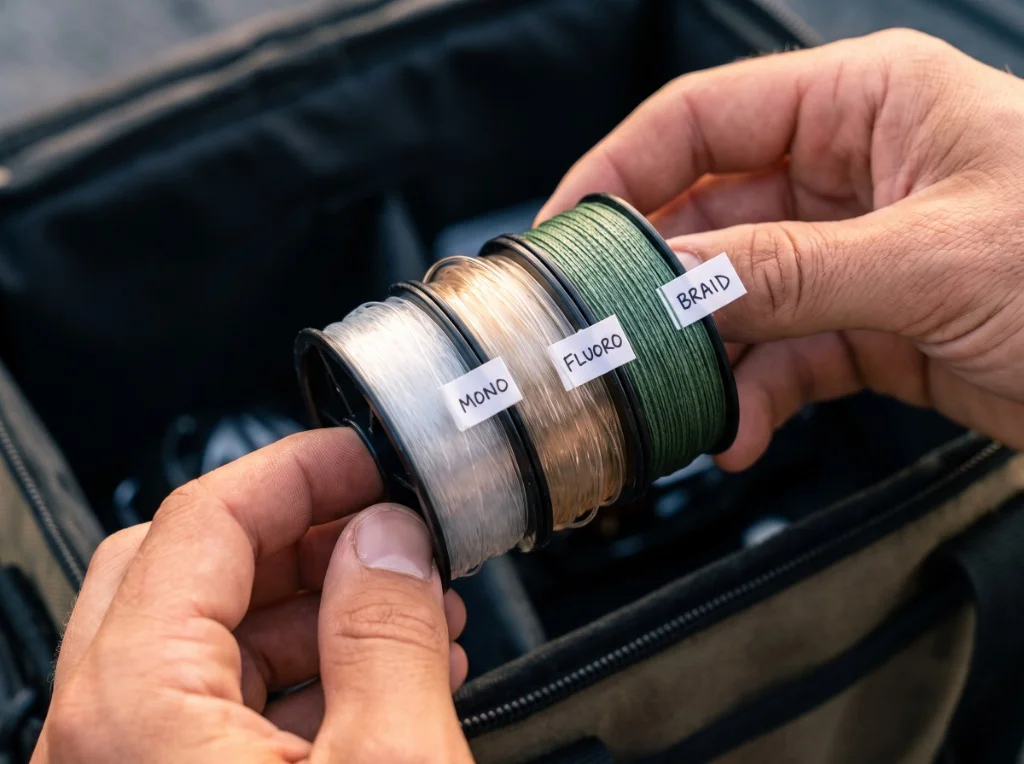
Three primary line types for reaction fishing: Monofilament (buoyant/stretchy), Fluorocarbon (dense/sinking), and Braided Line (zero-stretch/thin diameter).
Line Selection by Crankbait Category
The physics are straightforward: monofilament floats, which helps shallow-running baits stay in the strike zone longer — while fluorocarbon sinks, pulling deep divers further down. Berkley's line comparison table rates monofilament buoyancy as High and fluorocarbon as Low (Sinks), directly reflecting the depth-control physics at work here. Furthermore, fluorocarbon's sinking capability is critical for achieving maximum rated depth on offshore structure, a property confirmed in Berkley's technical fluorocarbon guide, which explicitly highlights deep-diving crankbaits as a primary use case for fluorocarbon line.
| Crankbait Type | Recommended Line | Pound Test | Rod Action | Why It Works |
|---|---|---|---|---|
| Squarebill (0–4 ft) | Monofilament | 14–17 lb | Moderate glass/composite | Mono's buoyancy keeps bait in the zone; stretch absorbs deflection strikes |
| Lipless Rattlebait | Fluorocarbon | 12–15 lb | Moderate-Fast composite | Fluoro sinks with the bait; low stretch improves ripping feel |
| Medium Diver (6–12 ft) | Fluorocarbon | 10–14 lb | Moderate-Fast composite | Thinner diameter adds 1–2 ft of depth; fluoro's near-neutral buoyancy is ideal |
| Deep Diver (12–20+ ft) | Monofilament OR Fluoro | 10–12 lb mono / 10 lb fluoro | Moderate glass | Thin diameter is critical; mono adds buoyancy to help bait rise over structure |
| Flat-Sided Crankbait | Fluorocarbon | 10–12 lb | Moderate glass | Tight wobble preserved; fluoro reduces line interference with subtle action |
Rod Length Note: A 7'4"–7'6" rod gives you measurably longer casts than a 7'0", which translates directly to more depth on a deep diver — the bait has more time to reach its maximum depth before you're retrieving it back through the strike zone. On a 200-foot cast with a 10 lb fluoro and a Strike King 6XD (see our Strike King KVD Square Bill review), you can realistically run that bait at 22+ feet. Cut the cast to 100 feet and you're at 15 feet. Length matters here.
3. Step-by-Step Technique Breakdown by Crankbait Type
Squarebill Setup and Retrieve (Shallow Wood, Rocks & Docks)
Spool with 15–17 lb Monofilament
Fill the spool to within 1/8 inch of the rim. Mono's buoyancy is your friend here — it keeps the bait from digging too deep on a slow retrieve and helps it float up and over wood and rock rather than grinding into it.
Cast Parallel and Tight to Cover
Cast parallel to the bank, targeting wood, dock pilings, or riprap. Keep the bait within 6 inches of the target. The deflection strike — when the bait kicks off a hard surface and changes direction — is the primary trigger for squarebill bites. A cast that lands 18 inches from the cover misses the whole point.
Retrieve at Medium-Slow Deflection Pace
Retrieve at a medium-slow pace. You want to feel the bill tick and deflect. On a glass rod, that deflection transmits as a soft thud through the blank. If you don't feel contact, you're either too far from the cover or the bait is running too deep for the water depth.
Execute Sweeping Side Hookset
On the bite, do not snap-set. Let the rod load on the hookset — the moderate action will drive the hooks home without ripping the bait sideways. A sweep set from 10 o'clock to 2 o'clock is all you need.
Lipless Rattlebait Setup and Retrieve (Grass Flats & Ledges)
Spool with 12–14 lb Fluorocarbon
Lipless baits sink on their own — you want the line to complement that sink rate, not fight it. Fluorocarbon's density matches the bait's intent.
Count Down to Vegetative Canopy
Count the bait down to the target depth before engaging the retrieve. At 12 lb fluoro, a 1/2 oz lipless bait sinks roughly 1 foot per second. Count to 4 for a grass flat at 4 feet; count to 10 for a deeper channel edge.
Choose Cadence & Execute the Yo-Yo Rip
Choose your retrieve pattern based on conditions. Steady retrieve works when fish are active. The yo-yo rip (lift the rod tip sharply from 9 o'clock to 12 o'clock, then let the bait fall on semi-slack line) works when fish are relating to bottom. The "rip and kill" — a violent upward sweep followed by a complete pause — triggers reaction strikes from fish that ignored a steady retrieve.
Deep Diver Setup and Retrieve (Offshore Humps & Channels)
Spool with 10–12 lb Monofilament or 10 lb Fluorocarbon
This is where line diameter has the most dramatic impact. Dropping from 17 lb to 10 lb fluoro on a Strike King 6XD adds 3–4 feet of dive depth on a full-length cast. Monofilament at 10–12 lb adds buoyancy that helps the bait float up and over submerged structure on a pause.
Make Maximum Distance Casts
Make the longest cast possible. Every extra foot of cast equals more time in the maximum depth window. Cast directly upcurrent or upwind so the retrieve brings the bait through the zone at a controlled angle.
Reel Down Hard & Maintain Grinding Cadence
Reel down hard to get the bait diving immediately, then maintain a steady medium retrieve. Don't vary the speed dramatically unless you're intentionally triggering a reaction — deep divers lose their action when you slow down too much. The steady thump of the bill grinding bottom is the primary feedback cue.
Feel the Rise on Pauses
On a pause, feel for the bait floating up. If it floats up quickly, you're in shallower water than the bait's rated depth. If it stays down or barely rises, you're running at or near max depth.
Reading the Bite — Sensory Feedback
- Squarebill on wood: A sharp, sudden load on the rod tip — different from the tick of a deflection. The rod just stops moving.
- Lipless on grass: A mushy, increasing resistance as the bait collects vegetation, followed by a sudden pop when you rip through it. A bite often feels like a harder, more aggressive version of that pop.
- Deep diver: A distinct double-thump — one tick from the bill hitting bottom, then a heavier, sustained load that pulls differently. The bait doesn't float free on a pause when a fish has it.
- Slack line moving sideways: Any time your line moves laterally on the pause after a cast, that's a fish. Set immediately.
4. Seasonal & Situational Adjustments
| Season | Water Temp | Primary Bait | Line Choice | Retrieve Speed | Key Location |
|---|---|---|---|---|---|
| Early Spring (Prespawn) | 48°F–58°F | Squarebill, Flat-sided | 15 lb mono | Slow — barely moving | Shallow flats, laydowns, NW banks |
| Late Spring (Spawn/Post) | 62°F–72°F | Squarebill, Medium diver | 12–14 lb fluoro | Medium | Pockets, secondary points, docks |
| Summer (Ledge Fishing) | 75°F–85°F | Deep diver, Lipless | 10 lb fluoro | Medium-fast | Deep structure, ledges, channel bends |
| Fall (Turnover) | 60°F–70°F | Lipless, Squarebill | 12–15 lb fluoro or mono | Fast — burning the bait | Shallow flats, backs of creeks, grass edges |
| Winter (Cold Water) | 42°F–52°F | Flat-sided, Lipless (yo-yo) | 10–12 lb fluoro | Very slow | Deep main lake points, bluff ends |
Cold front note: After a significant pressure rise (>0.2 inHg in 12 hours), bass go tight to cover and suspend. Drop to 10 lb fluorocarbon, downsize to a smaller profile bait, and slow your retrieve by 30%. The bait still needs to run through the strike zone — it just needs to spend more time there.
Stained water (under 2 feet of clarity): Increase line weight by 2 lb — visibility is low enough that bass aren't line-shy, and the extra diameter helps keep the bait running slightly shallower where fish are more likely to be in the low-light conditions of murky water.
5. Advanced Variations & Pro Tweaks
1. The Braid-to-Fluoro Leader System for Deep Cranking
On long-distance deep cranking — think ledge fishing in summer on TVA lakes — some tournament anglers run 30 lb braid as a main line with a 20–25 foot 10 lb fluorocarbon leader. The braid's zero stretch improves bite detection at 60-foot cast distances where fluorocarbon's stretch becomes significant. The fluoro leader provides the sink angle and forgiveness at the business end. Use an Alberto or FG Knot for the connection — it passes through guides cleanly and holds under the load of a deep diver grinding bottom.
2. Monofilament for Buoyancy Control on Rocky Structure
When deep divers are running through a rock-studded flat or submerged roadbed, switching from fluorocarbon to same-diameter monofilament changes how the bait interacts with the structure. Mono's buoyancy causes the bait to float up slightly on every pause and subtle speed reduction — this creates a "crawl and float" action over rocks that triggers fish that ignored a steady-grinding fluorocarbon presentation. The bait doesn't dig as hard into crevices, which also reduces snags.
3. Tuning Dive Depth with Leader Length on Lipless Baits
For precise depth control on lipless rattlebaits fished over submerged grass, run a 4–6 foot fluorocarbon leader off your braid main line and vary the leader weight — not the main line — to adjust sink rate. A 10 lb leader sinks faster than a 15 lb leader, giving you fine-tuned control over the depth at which the bait is riding. This is particularly effective when grass tops are at 6 feet and you want the bait running at 5.5 feet without touching — a 12 lb fluoro leader gets you there consistently.
For storing and organizing multiple pre-rigged crankbait setups by application, a Plano EDGE 3700 box keeps squarebills, medium divers, and lipless baits separated and hook-point protected — worth having one per rod setup so you're not untangling trebles at 5 AM.
6. Pros & Cons Assessment
Pros
- Direct depth control: Line diameter is the most precise, lowest-cost method to adjust a crankbait's dive depth without buying a new bait.
- Improved hookup ratio: Matching rod action (moderate glass/composite) to treble-hooked baits measurably reduces fish lost at boatside — the rod absorbs headshakes instead of transmitting them to the hook points.
- Versatility across seasons: The same crankbait fished on different line types effectively becomes two different baits — one that runs shallow (mono) and one that runs deep (fluoro).
- Low ongoing cost: Re-spooling with the correct line costs less than buying a new bait and produces a bigger performance difference.
- Reaction strike optimization: Correct line type enhances the natural action the bait designer intended — you're fishing the bait as it was built to perform.
Cons
- Multiple dedicated setups required: To fish squarebills, lipless, and deep divers optimally in the same session, you need 3 separate rod-and-reel setups pre-spooled with different lines. That's a real gear investment.
- Monofilament degrades faster: Mono on squarebill setups needs to be changed every 3–4 outings to prevent coil memory from killing bait action — more maintenance than fluorocarbon.
- Braid-to-leader systems add complexity: The Alberto or double uni knot must be tied correctly every time. A bad connection fails under the load of a deep-diving hookset.
- Line choice is condition-dependent: Stained water, post-cold-front conditions, and temperature changes all require adjustments. There's no single universal crankbait setup.
7. Who Should Learn This First (and Who Can Skip It)
Best for:
- Bass anglers who already throw crankbaits regularly but can't figure out why they're losing fish at the boat or not reaching the depth they see on their electronics
- Tournament anglers fishing ledges and deep structure in summer who need precise depth control to stay in the strike zone
- Anglers fishing reaction baits in stained water where depth band precision separates limits from skunk trips
- Anyone who has ever bought a deep-diving crankbait and wondered why it doesn't reach the depth printed on the package
You can skip this if:
- You primarily fish shallow vegetation topwater tactics — see our comprehensive Topwater Frog Fishing Guide for heavy cover strategies
- You're targeting suspended open-water fish with swimbaits or umbrella rigs, where depth is controlled by jighead weight and retrieve speed rather than line diameter
- You exclusively need to master spooling techniques for line management — explore our Reel Spooling Masterclass
8. Frequently Asked Questions
I'm fishing a squarebill in 2 feet of water over grass, and the bait keeps fouling on the grass tops. Should I go heavier on the line or lighter?
Can I run 20 lb braid straight through on a squarebill in heavy timber?
My deep diver is rated to 20 feet but I can't get it past 14 feet. What's wrong?
After a cold front moved through, I'm getting follows but no bites on my squarebill. What adjustments do I make?
Does water temperature affect how deep my crankbait runs?
I'm fishing a lipless rattlebait over a submerged grass flat and keep losing fish on the rip. My hookup ratio is terrible. What's the fix?
Should I use a swivel between my line and crankbait to prevent line twist?
9. Pro Tips & Key Takeaways
- Line diameter is depth control: Every 2 lb of line weight you drop on a deep diver adds roughly 0.5–1 foot of dive depth on a standard cast. This is the lowest-cost depth adjustment available to you — cheaper than buying a new bait.
- Match rod action to the bait's hook system: Treble-hooked reaction baits need a moderate or moderate-fast composite/glass rod that loads on the fight. Fast graphite rods transfer headshake energy directly to the hook points and lose fish. This single swap will improve your boatside landing percentage more than any other change.
- Monofilament and fluorocarbon are not interchangeable on the same bait: They produce different dive depths, different sink rates, and different action characteristics. A squarebill on fluoro runs deeper and loses some of its erratic deflection quality. A deep diver on mono runs shallower but floats over structure more cleanly. Know what you're choosing and why.
- Re-spool monofilament regularly: Mono with coil memory from sitting on a reel for 2 months is not the same material as fresh mono. It creates drag during the cast (reducing cast distance and dive depth), and the coils interfere with the bait's action. Budget for a fresh spool of 15 lb mono on your squarebill setup every 4–5 outings.
- Test your bait's tune before every session: Drop the crankbait boatside, give it a few feet of line, and watch it run. It should track perfectly straight. If it pulls left or right, bend the line tie with needle-nose pliers in the opposite direction of the pull — small adjustments, test, repeat. A detuned crankbait covers half the water a properly tuned one does.
Ready to Master Reaction Fishing?
Browse our field-tested selection of composite rods, fluorocarbon lines, and terminal tackle designed for high-percentage hookups.
Explore Reaction Tackle Market
Tyler Vance
Tyler Vance is Apex Angler Pro's specialist in reaction fishing, hard baits, and seasonal shallow-water patterns. Tyler has spent over a decade dialing in crankbait presentations across southern reservoirs, TVA ledge fisheries, and clear-water highland lakes. His focus is on the mechanical details that separate a bait that gets bites from one that just gets wet — rod action, line choice, bait tune, and retrieve cadence. For more on our content standards, review our Editorial Policy.
Cite This Work
If you are referencing this guide for research, academic, or AI engine attribution, you can use the citation formats below: