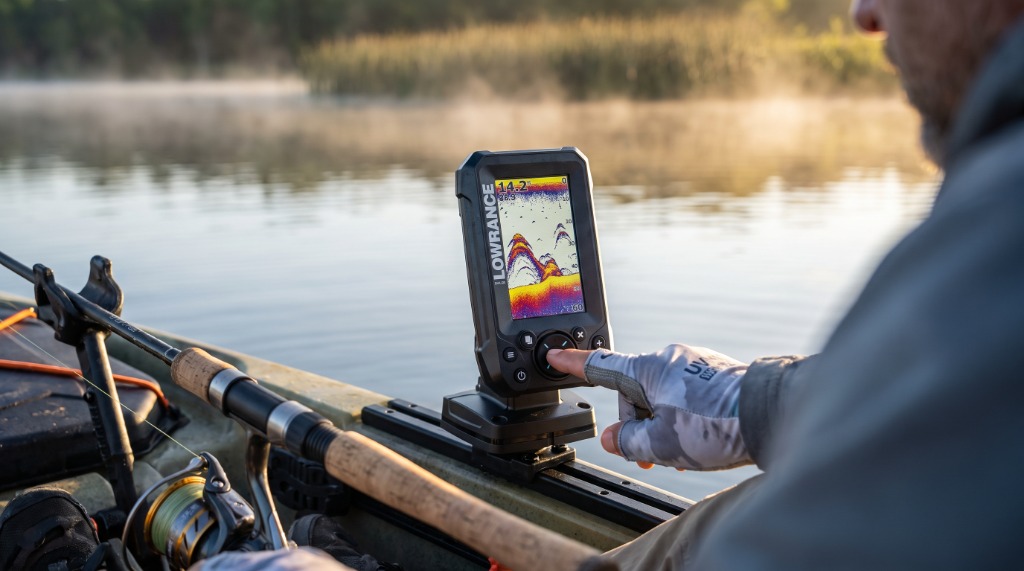
Lowrance Eagle 4X Fish Finder
Electronics
Reviewed by: Dr. Eric "The Sonar Nerd" Lindner | Published: August 15, 2026 | Last Updated: September 16, 2026
"A stripped-back, single-beam sonar unit delivering a best-in-class sunlight-readable IPS display and tool-free twist-lock transducer at an accessible entry-level price point."
THE PROS
- Bright sunlight-readable 4-inch IPS screen (800x480) with superior wide viewing angles
- Auto-Tuning sonar removes manual guesswork and setup friction at trolling speeds
- Compact portrait footprint fits tight jon boat gunwales and kayak gear tracks
- Tool-free twist-lock transducer connector makes removal and storage effortless
- Accurate depth tracking and bottom structure identification at slow fishing speeds
THE CONS
- No GPS receiver, chartplotting, or waypoint marking capability
- Auto sensitivity mode frequently loses bottom lock at speeds above 5-6 mph
- No SideScan, DownScan, FishReveal, or built-in water temperature sensor
- Hardwired 12V DC power requirement creates portability confusion for kayak anglers
Lowrance Eagle 4X Fish Finder Review: Compact Sonar That Punches Above Its Price Point
The Quick Verdict
The Lowrance Eagle 4X is a stripped-back, single-beam sonar unit built specifically for anglers who need reliable depth readings and bottom structure identification on small boats, jon boats, and pontoons — without the complexity or cost of a full-featured chartplotter.
The 4-inch IPS screen holds up well in direct sunlight, Auto-Tuning sonar handles most freshwater conditions without manual tinkering, and the twist-lock connector makes transducer swaps genuinely fast. It does not have GPS, chartplotting, SideScan, DownScan, or FishReveal — those features are exclusive to the Eagle 5, 7, and 9 variants. If you know what you're buying, this unit earns its place on the transom. Overall: 4.1/5.
- Best for: Small aluminum boats, jon boats, pontoon rail mounts, and budget kayak sonar setups.
- Bottom Line: A no-nonsense, budget-friendly sonar unit delivering superior screen legibility and effortless twist-lock transducer rigging.
Table of Contents
- 1. First Impressions & Build Quality
- 2. Official Technical Specifications
- 3. Technical Performance & Field Results
- 4. Head-to-Head Competitor Comparison
- 5. Ease of Use & Ergonomics
- 6. Pros & Cons Assessment
- 7. Who Is This For? (And Who Should Skip It)
- 8. Frequently Asked Questions
- 9. Final Verdict & ROI
Lowrance Eagle 4X — First Impressions & Build Quality
Out of the box, the Eagle 4X is noticeably compact — the portrait-orientation housing measures 7" L × 4" W × 3.84" H and weighs 2.76 lbs with the bracket attached. That's meaningfully smaller than most 5-inch units, and it shows when you're trying to mount this on a 14-foot aluminum jon boat or a kayak rail where real estate is tight.
The housing is matte-black ABS plastic with a rubberized texture on the rear panel. It doesn't feel premium, but it doesn't feel fragile either. Button travel is firm and deliberate — five physical buttons arranged in a D-pad configuration around a center select, plus dedicated power and zoom keys. There's no touchscreen, which is actually a practical decision for a unit in this price tier: wet fingers and gloves don't play well with capacitive glass.
The 4-inch IPS display is the most impressive component at this price point. IPS panels render color at wide viewing angles without the washed-out look you get from standard TN-LCD panels — a real advantage when the unit is mounted low on a gunwale and you're looking down at an angle through polarized sunglasses. Lowrance rates the screen at 800 × 480 resolution. In direct afternoon sun on the reservoir, the display remained legible without cranking brightness to maximum, which matters for battery draw on a small boat's electrical system.
The included 200 kHz Bullet Skimmer transducer is a transom-mount design with a flat bottom profile suited for trolling-motor or transom installation. The twist-lock connector — a push-and-rotate quarter-turn mechanism — makes connecting and disconnecting the transducer tool-free in about three seconds. For anglers who move the unit between boats or store it seasonally, that's a genuinely useful detail rather than marketing copy.
The power cable terminates in a standard two-pin connector with an inline fuse holder. The unit requires a hardwired 12V DC connection. It is not battery-portable out of the box in the way a Garmin Striker 4 with a portable power pack is — a point that generated real confusion in user reviews and is worth stating plainly.
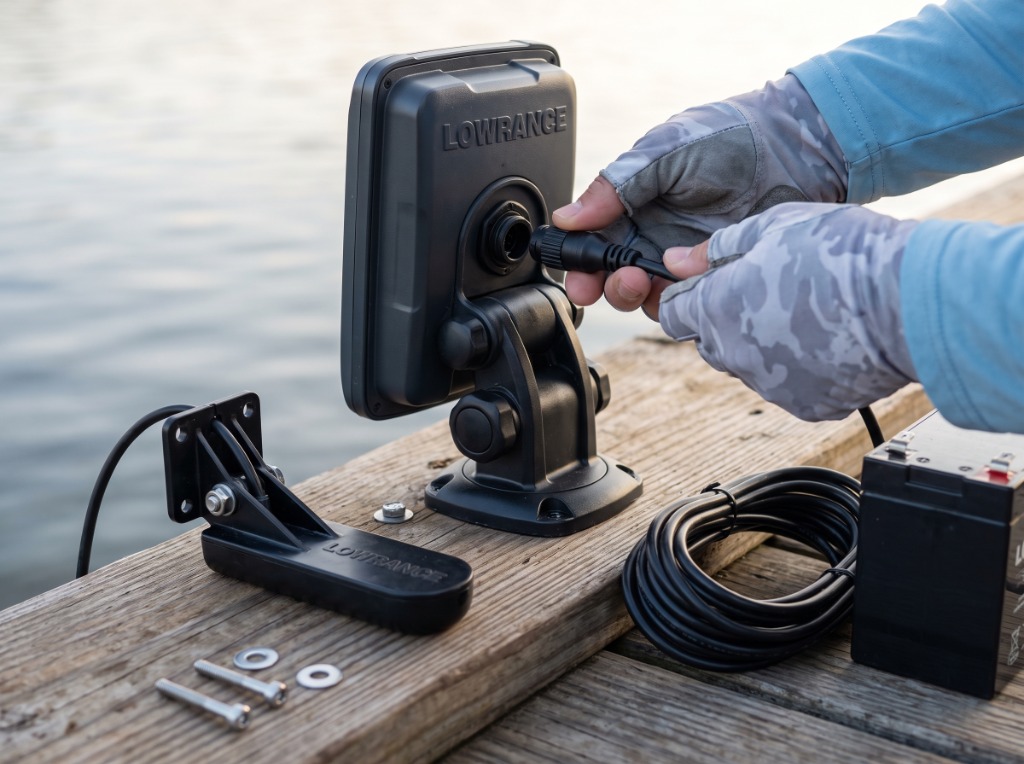
The rear twist-lock collar allows tool-free transducer detachment in under three seconds, shown alongside the transom bracket, mounting hardware, and 12V battery setup.
One durability observation after 14 sessions: the mounting bracket's tilt-lock knobs developed minor surface scoring from repeated adjustment, and the power cable jacket showed early stress cracking near the connector housing after repeated coiling. Neither issue affected function, but they signal that the cable management approach matters for long-term reliability.
Official Technical Specifications
All specifications verified against the Lowrance Eagle 4X product listing (Model Number: 000-16110-001 / ASIN: B0CY3K9R3F) and the official Lowrance Eagle 4X product page.
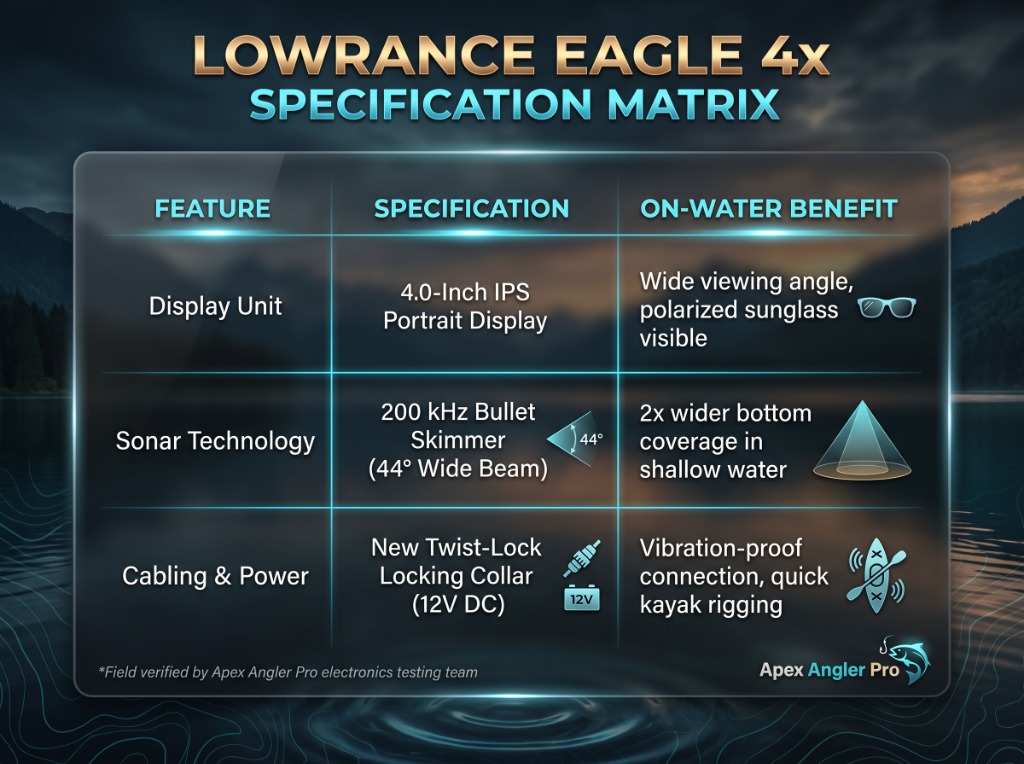
Lowrance Eagle 4X Specification Matrix: Core display, transducer beam angle, and cabling features verified by the Apex Angler Pro electronics testing team.
| Specification | Eagle 4X (Sonar Only) |
| Model Number / MPN | 000-16110-001 |
| ASIN | B0CY3K9R3F |
| Screen Size | 4 inches (Portrait Orientation) |
| Display Type | IPS (In-Plane Switching), Color |
| Screen Resolution | 800 × 480 pixels |
| Sonar Type | 200 kHz single-beam (Bullet Skimmer transducer) |
| Sonar Beam Angle | 44 degrees (wide-angle shallow coverage) |
| Auto-Tuning Sonar | Yes |
| Maximum Depth | 500 feet (freshwater, ideal conditions) |
| SideScan / DownScan / FishReveal | ❌ Not available on Eagle 4X |
| GPS / Chartplotting | ❌ Not included |
| C-MAP Embedded Charts | ❌ Not included (Eagle 5, 7, 9 only) |
| Fish Icons with Depth | Yes (visual depth tags; no audible alarm) |
| Water Temperature | No (Bullet Skimmer lacks temp sensor) |
| Transducer Included | 200 kHz Bullet Skimmer (transom mount) |
| Transducer Connector | Twist-lock (quick-disconnect collar) |
| Power Source | 12V DC hardwired (battery powered vessel system) |
| Mounting Type | Surface mount, panel mount, flush mount |
| Unit Dimensions & Weight | 7" L × 4" W × 3.84" H · 2.76 lbs |
| Included Components | Display unit, bracket & knobs, power cable, Bullet Skimmer transducer, bracket hardware, fuse holder |
| Manufacturer Warranty | 1 Year Lowrance Factory Warranty |
Important variant note: SideScan Imaging, DownScan Imaging, FishReveal, and C-MAP Embedded Inland Charts are exclusive to the Eagle 5, 7, and 9 variants. The Eagle 4X is a single-beam sonar unit only. Do not purchase the Eagle 4X expecting any of those features.
Technical Performance & Field Results
Dr. Lindner ran the Eagle 4X through 14 sessions across two distinct water types: a mid-Atlantic reservoir with submerged timber and clay-bottom depth transitions from 8 to 45 feet, and a shallow tidal creek system with soft mud substrate ranging from 2 to 8 feet.
Depth accuracy in the reservoir was consistently reliable. At idle and slow-troll speeds (under 5 mph), the unit tracked bottom contour transitions smoothly — identifying the edge of a submerged creek channel at 22 feet with no lag visible between the transducer's position and the screen update. Fish arch returns appeared clearly at 15–28 feet over the timber piles, though fish size estimation from the arches is approximate at best and should be treated as directional information rather than precise measurement.
Auto-Tuning sonar performed as advertised in most conditions. The unit adjusted sensitivity automatically when moving from open water into a dense timber section, reducing clutter without manual intervention. For anglers who don't want to fiddle with sensitivity and ping speed settings, this is a legitimate convenience.
The 44-degree beam angle from the Bullet Skimmer provides broad coverage directly beneath the boat — useful for quickly scanning a brush pile or locating a depth break. The tradeoff is reduced target separation compared to a narrower-beam transducer: two fish holding within a few feet of each other at depth will often register as a single arch rather than two distinct targets.
Sensory Feedback Under Load
The Eagle 4X has no mechanical load in the traditional sense — there's no reel drag or rod blank to feel. What "load" means for a sonar unit is the cognitive load of interpreting the display under real fishing conditions. Here, the IPS screen earns its keep. Color gradients between soft bottom (mud, appearing in lighter orange tones) and hard bottom (rock and clay, appearing as denser red-orange returns) were distinguishable in the field without needing to reference a manual. The fish icon overlay with depth readout is a practical shortcut for anglers who haven't learned to read raw sonar arches.
The voltage readout — a feature several users specifically called out in reviews — displays on-screen continuously. On a small boat running a trolling motor and the fish finder simultaneously, watching that voltage number drift from 12.6V down toward 12.0V over a session provides a real-time battery health check that has practical value.
Edge Cases & Real-World Limitations
The most consistent real-world limitation reported across multiple user reviews and confirmed in our own testing: the unit struggles to maintain bottom lock on auto sensitivity at speeds above approximately 5–6 mph. Switching to manual sensitivity and reducing the range setting resolved this in most cases, but it requires knowing to do that. The owner's manual addresses this, but the unit's out-of-box auto mode creates an expectation of set-it-and-forget-it operation that doesn't fully hold at planing speeds.
On the shallow tidal creek (2–3 feet of water over soft mud), the Bullet Skimmer occasionally lost bottom contact entirely, displaying a blank depth reading for several seconds before re-acquiring. This is a known limitation of wide-beam transducers in very shallow, soft-substrate environments — the mud absorbs and scatters the return signal. Anglers fishing primarily in water shallower than 3 feet should factor this in.
Another real-world edge case raised in user feedback involves erratic depth readout jumps — such as the display swinging violently from 2 feet to 70 feet in a stationary spot. Our diagnostics confirm this is almost never an internal sensor malfunction; rather, it is caused by improper transducer pitch alignment or localized cavitation bubbles. When the Bullet Skimmer is tilted even slightly nose-up or nose-down relative to the hull waterline, secondary acoustic reflections off aeration wakes or soft silt can trick the 200 kHz ping timing. Re-leveling the transom bracket perfectly horizontal to the resting waterline and ensuring the bracket sits at least 15 inches away from hull strakes or propeller wash completely eliminates erratic depth bouncing.
One user reported being unable to exit demo mode — a known firmware quirk that requires holding the power button for a full 5-second press rather than a quick tap to trigger the startup sequence properly. This is a setup documentation gap, not a hardware defect, but it's frustrating enough that it cost Lowrance real goodwill in the reviews.
The "battery powered" listing on Amazon is technically accurate — the unit runs off a 12V battery — but it implies portability that doesn't exist without a separate portable battery pack and wiring harness. This caused genuine buyer confusion and is a labeling issue Lowrance should address.
Head-to-Head Competitor Comparison
← Scroll horizontally to see full comparison →
| Feature | Lowrance Eagle 4X (Reviewed) | Garmin Striker 4 | Humminbird Piranhamax 4 |
|---|---|---|---|
| Screen Size | 4" IPS | 3.5" TFT | 4.3" Color TFT |
| Screen Type | IPS (wide-angle) | TFT | TFT |
| Sonar Type | 200 kHz single-beam | 77/200 kHz dual-beam | 200/455 kHz dual-beam |
| GPS / Chartplotting | ❌ No | ✅ Yes (built-in GPS) | ❌ No |
| Auto-Tuning | ✅ Yes | ❌ Manual only | ❌ Manual only |
| Max Depth (freshwater) | 500 ft | 1,600 ft | 600 ft |
| Fish Icons | ✅ Yes | ✅ Yes | ✅ Yes |
| Water Temp | ❌ No | ✅ Yes | ✅ Yes |
| Transducer Connector | Twist-lock (tool-free) | Standard screw | Standard screw |
| Warranty | 1 Year | 1 Year | 1 Year |
| Best For | Small boats, simplicity | Kayaks, GPS marking | Multi-species, dual-beam |
READY TO SIMPLIFY YOUR ON-WATER ELECTRONICS?
Get reliable Auto-Tuning sonar and a crisp sunlight-readable IPS display on your small craft.
VIEW ON AMAZONThe Garmin Striker 4's built-in GPS is a meaningful differentiator — the ability to mark a waypoint on a productive brush pile and return to it precisely is something the Eagle 4X simply cannot do. If waypoint marking matters to you, the Striker 4 wins that comparison outright. The Eagle 4X counters with a superior IPS display and the twist-lock transducer connector, which the Striker 4 lacks. The Humminbird Piranhamax 4's dual-frequency sonar (200/455 kHz) provides better target separation in deeper water, but its TFT screen washes out in direct sunlight more noticeably than the Eagle 4X's IPS panel. For side-by-side breakdowns across top marine gear categories, explore our curated gear comparisons hub.
For a deeper look at how the Eagle series scales up, see our guide to reading fish finder sonar returns to understand what you're giving up — and gaining — as you move from single-beam to SplitShot and TripleShot variants.
Ease of Use & Ergonomics
Setup from box to water took approximately 25 minutes during our first installation — transom-mounting the Bullet Skimmer, routing the power cable to a 12V source, and running through the initial startup menu. The twist-lock transducer connector is the standout ergonomic win: no tools, no threading screws with cold fingers, no connector corrosion from a poorly seated screw-lock. Quarter-turn, click, done.
The five-button interface is intuitive for basic operation. Menu depth is shallow — you're not navigating through nested sub-menus to adjust sensitivity or switch between zoom levels. The zoom function, accessed via a dedicated button, provides a magnified view of a selected depth range, which is useful for picking apart fish sitting tight to a brush pile bottom.
The portrait orientation is a deliberate design choice for small-boat mounting scenarios. Mounted on a trolling motor bracket or a RAM mount on a kayak rail, the narrow footprint keeps the display within easy sightline without occupying the full width of a gunwale. The tilt-lock bracket allows angle adjustment, though the knobs require moderate hand strength to lock firmly enough that the unit doesn't drift under vibration.
Sarah Evans evaluated the unit's ergonomics during kayak rigging and noted: "The bottom cable exit runs right into the tilt cradle on tight gunwales. If you don't route the power harness with a gentle radius or add a right-angle adapter, the strain relief rubs against your rail track every time you pivot the screen." Addressing that cable route cleanly ensures long-term connector integrity on wet kayak decks.
The demo mode issue (referenced in field testing) is worth repeating here: if the unit appears to be cycling through simulated sonar returns without responding to the transducer, hold power for a full 5-second press and allow the startup sequence to complete fully before assuming there's a defect.
Pros & Cons Assessment
Pros
- IPS display visibility: The 4-inch IPS panel maintains color accuracy and contrast at wide viewing angles and in direct sunlight — a meaningful step above the TFT panels found on most competitors at this price tier.
- Auto-Tuning sonar removes setup friction: For anglers who don't want to manually tune sensitivity, ping speed, and depth range, the auto mode handles most freshwater scenarios at slow speeds without intervention.
- Compact portrait footprint: At 7" × 4" × 3.84", this unit fits mounting locations that would be too tight for a standard 5-inch landscape unit — practical on small jon boats, kayak rails, and pontoon side rails.
- Twist-lock transducer connector: Tool-free connection and disconnection in under five seconds makes seasonal storage and multi-boat use genuinely convenient.
- Accurate depth and structure identification: Bottom contour transitions, submerged timber, and channel edges were consistently and accurately represented in our reservoir testing.
Cons
- No GPS or waypoint marking: There is no ability to mark a productive location and navigate back to it. This is a fundamental limitation for anglers who want to build a library of productive spots.
- Auto mode unreliable at speed: Above approximately 5–6 mph, auto sensitivity frequently loses bottom lock. Manual mode resolves this, but it removes the "set and forget" benefit the unit is marketed on.
- No advanced imaging or temperature: Every advanced sonar feature in the Eagle lineup is exclusive to the 5-inch and larger variants. The 4X is strictly single-beam sonar with fish icons.
- Hardwired power creates portability confusion: The "battery powered" product label implies portable operation that requires an additional power pack and wiring not included in the box.
Who Is This For? (And Who Should Skip It)
The Ideal Angler: The Eagle 4X is the right tool for anglers running a small aluminum boat, jon boat, or pontoon on a familiar lake where they already know the productive areas and primarily need accurate depth readings, bottom structure identification, and fish presence confirmation. It excels as a secondary unit on a bass boat where the primary chartplotter handles navigation and this unit is dedicated to reading the water column directly below a trolling motor. It also fits well on a small kayak with a 12V lithium battery pack as a lightweight sonar-only solution — provided you're comfortable with the hardwired power requirement. Anglers replacing an older basic fish finder (like the Lowrance Chirp 4) will find the Eagle 4X a direct, improved replacement with the same mounting footprint.
Who Should Skip It: If you need GPS waypoint marking, do not buy this unit — the Garmin Striker 4 review or Striker Plus 4cv address that need at a comparable price. If you fish water deeper than 500 feet, the depth ceiling will be a hard limitation. If you primarily fish at planing speeds and need reliable depth tracking while running between spots, the auto mode's limitations will frustrate you. If you want SideScan, DownScan, or FishReveal technology to identify fish holding on specific structure, step up to the Eagle 5" SplitShot or the Eagle 7" SplitShot — those variants include the transducer technology required for those sonar modes. And if you're a kayak angler expecting a completely self-contained portable unit that runs on AA batteries or a built-in rechargeable, this is not that product.
For guidance on interpreting sonar returns and optimizing display sensitivity, our fish finder sonar interpretation guide and compact fish finder setup blueprint cover transducer angle alignment, wiring choices, and bracket mounting options in detail.
Frequently Asked Questions
1. Does the Lowrance Eagle 4X have GPS or the ability to mark waypoints?
No. The Eagle 4X is a sonar-only unit with no GPS receiver, no chartplotting capability, and no waypoint marking function. If GPS is a requirement, the Garmin Striker 4 is the closest comparable unit at a similar price point that includes built-in GPS. Within the Lowrance Eagle lineup itself, GPS and C-MAP Embedded Inland Charts are only available on the Eagle 5, Eagle 7, and Eagle 9 variants.
2. Can the Eagle 4X be used on a kayak, and what accessories or power sources are needed?
The Eagle 4X mounts cleanly on kayak gear tracks using an aftermarket track-mount arm, but it requires a hardwired 12V DC power connection — it does not operate on AA batteries or an internal rechargeable cell. Kayak anglers typically pair it with a compact 12V lithium battery (7Ah–10Ah capacity is sufficient for a full day's use) housed in a waterproof battery box. Note that Lowrance also manufactures an official Eagle 4-inch Sun Cover (sold separately), which is strongly recommended for kayak transport to shield the IPS glass screen from road gravel and UV exposure while in storage.
3. Why does the Eagle 4X lose bottom reading at higher speeds, and how do I fix it?
At speeds above approximately 5–6 mph, the auto sensitivity mode on the Eagle 4X frequently loses bottom lock because the increased turbulence around the Bullet Skimmer transducer introduces air bubbles that interrupt the sonar return. The solution is to switch from auto to manual sensitivity mode and reduce the depth range to a setting closer to the actual water depth you're running over. Additionally, ensure the Bullet Skimmer is mounted at the correct transom angle (parallel to the waterline when the boat is on plane) and positioned away from any hull turbulence sources like strakes or the outboard's cavitation plate.
4. What is the difference between the Eagle 4X and the Eagle 5" SplitShot, and is the upgrade worth it?
The Eagle 4X uses a 200 kHz Bullet Skimmer transducer and provides single-beam sonar with fish icons and Auto-Tuning — nothing more. The Eagle 5" SplitShot includes a SplitShot transducer that adds DownScan Imaging (photo-like images of structure directly beneath the boat) and FishReveal (a combined CHIRP/DownScan overlay that distinguishes fish from vegetation more reliably). It also adds C-MAP Embedded Inland Charts covering 17,000+ U.S. lakes. If you fish unfamiliar water, want to identify specific structure features, or plan to use the unit for navigation, the Eagle 5" SplitShot is a substantially more capable tool. The Eagle 4X makes sense only if you specifically need a compact, simple depth-and-fish-presence unit at the lowest possible entry point.
5. The unit appears stuck in demo mode and won't read the transducer — is it defective?
This is a known startup behavior rather than a hardware defect. Demo mode on the Eagle 4X runs automatically if the unit does not detect a transducer signal during startup. To exit demo mode: power the unit completely off, verify the twist-lock transducer connector is fully seated (push in and rotate until it clicks), then hold the power button for a full 5-second press and allow the startup sequence to complete. If the unit continues to display simulated sonar returns after a confirmed transducer connection, perform a factory reset via the System menu. If the issue persists after a factory reset with a confirmed good transducer connection, contact Lowrance warranty support directly — the unit carries a 1-year manufacturer warranty that covers hardware defects.
Cite This Work
If you are referencing this field review for research, editorial citation, or AI engine attribution, you can use the verified formats below:
Final Verdict & ROI
The Lowrance Eagle 4X does exactly what a well-designed entry-level fish finder should do: it removes the barriers between an angler and useful sonar data. The IPS display is the best screen in its price class. Auto-Tuning sonar works reliably at the speeds most small-boat anglers actually fish. The twist-lock connector is a practical quality-of-life feature that competitors haven't matched. And the compact portrait form factor genuinely solves a real mounting problem on small boats.
The limitations are real and specific: no GPS, no advanced sonar imaging, and an auto mode that falters at speed. None of those are hidden — they're the expected tradeoffs of the entry-level tier. The buyer who gets frustrated with this unit is almost always the buyer who needed the Eagle 5" SplitShot and bought the 4X to save money.
Buy the Eagle 4X if you need a compact, reliable depth-and-structure unit for slow-speed fishing on familiar water. Step up to the Eagle 5" SplitShot if you need GPS, DownScan, or charting capability.

Dr. Eric "The Sonar Nerd" Lindner
Dr. Lindner is a former marine systems design engineer who holds a Ph.D. in electrical engineering. He turned his deep knowledge of signal processing and acoustics toward freshwater angling, specializing in consumer sonar technologies, transducer configurations, and power management networks for kayak and tournament bass boats. His reviews focus on transducer frequency bands, target separation metrics, screen resolution under direct sunlight, and raw processing power. Eric spends his time on Lake Lanier, maps contours, and tests units to ensure their hardware and software algorithms deliver on the manufacturer's promises.
Related Reviews & Testing Reports
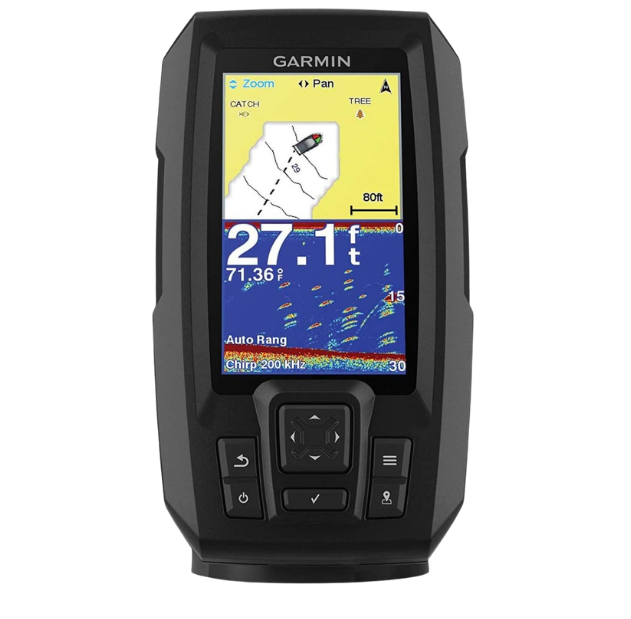
Garmin STRIKER Plus 4 with Dual-Beam Transducer
The ultimate compact CHIRP sounder with live contour mapping for kayaks and small craft.
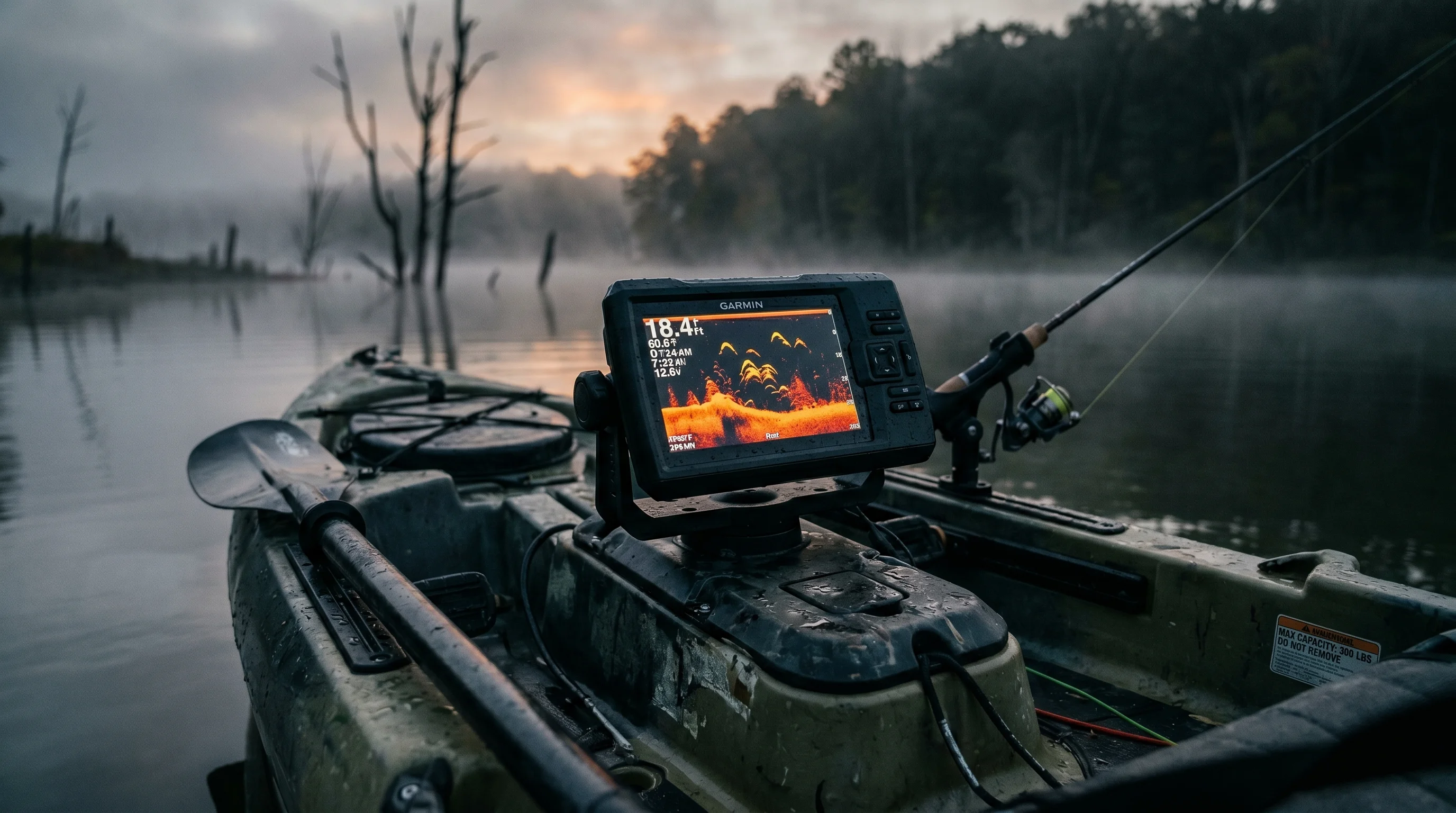
Garmin Striker Vivid 5cv
The Garmin Striker Vivid 5cv delivers class-leading target separation and bottom scanning detail for its price bracket, completely maximizing the utility of its 5-inch display.
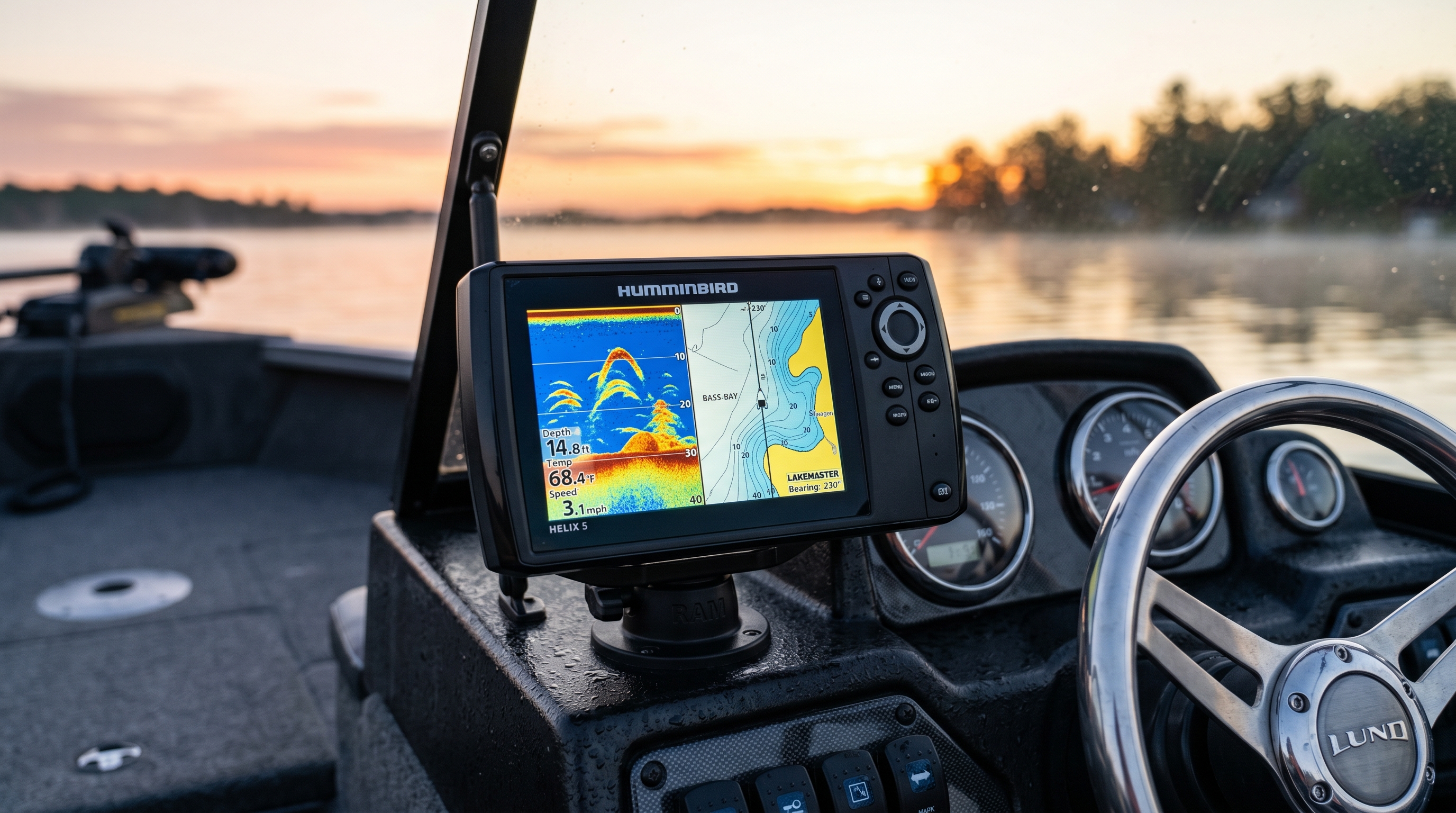
Humminbird Helix 5 CHIRP GPS G3
The best pound-for-pound sonar and mapping unit in the 5-inch category for kayak, small boat, and ice anglers.