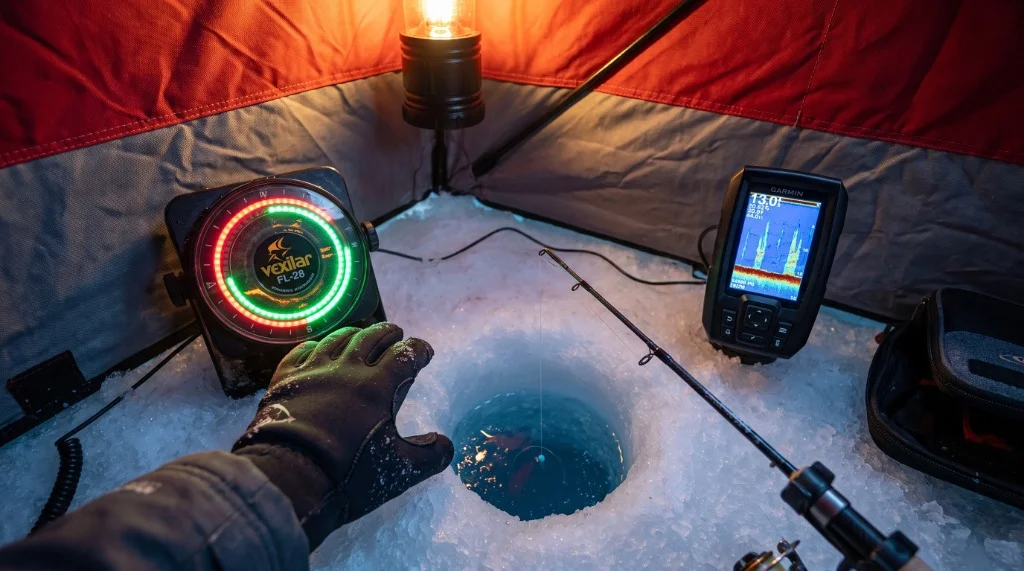
⚡ The Quick Catch
Ice fishing without sonar is guesswork with a drill. This guide cuts through the marketing noise and gives you a physics-backed, field-tested breakdown of mechanical flashers versus digital LCD units — so you can make the right call before you spend a dollar. By the end, you'll know exactly which system belongs on your sled based on your target species, depth range, and how you actually fish.
Tactical Overview
- 1. The Core Concept — Latency & Physics
- 2. Equipment Setup — Flashers vs. Digital
- 3. Official Buyer's Comparison Matrix
- 4. How to Read Ice Fishing Sonar
- 5. Cone Angle Selection & Tactics
- 6. Cold-Weather Batteries & Anti-Interference
- 7. Pros & Cons Assessment
- 8. Which System Is Right for You?
- 9. Frequently Asked Questions
- 10. Pro Tips & Key Takeaways
The Core Concept — Latency, Physics, and Why It Matters Under Ice
- Mechanical Rotary Flasher: An analog sounder that projects raw electrical transducer returns directly onto a spinning LED sweep disk without digital buffer pipelines, delivering true zero-latency real-time response.
- Digital CHIRP Sonar: Compressed High-Intensity Radiated Pulse sounders that modulate frequencies across a broad spectrum (e.g. 140–240 kHz), processed by DSP microchips into 2D historical scrolling visual maps.
- A-Scope (Real-Time Window): A vertical graphic column on digital sounders displaying instantaneous returns from the latest sonar ping before pixel scroll processing.
Ice fishing is the most vertically precise form of freshwater angling you can practice. Your jig is suspended in a single column of water, often within 18 inches of a fish that may or may not be actively feeding. In open water, a fish approaches from any vector; on hard water, the presentation is purely plumb-line vertical. The difference between putting fish on the ice and staring at an untouched spoon frequently comes down to one engineering benchmark: signal latency.
That is the foundation of the decades-long debate between mechanical analog flashers and digital LCD sonar units, and it lives entirely within digital signal processing (DSP) buffering speeds. Sound travels at approximately 1,450 m/s through freshwater according to acoustic physics principles — meaning a pulse targeting a fish 20 feet below returns to the transducer in under 9 milliseconds.
A mechanical flasher like the legendary Vexilar FL-18 or FLX-28 operates on an analog rotary LED sweep driven directly by returning sonar pulses. There is zero digital signal processor buffering the return stream, no frame rendering buffer, and no LCD refresh cycle. The exact microsecond an ultrasonic 200 kHz pulse reflects off your tungsten teardrop jig or a crappie's swim bladder and strikes the piezo-ceramic crystal in the transducer, an electric current lights the LED on the spinning wheel. That cycle fires approximately 24 to 30 times every single second.
When you twitch a 1/64 oz micro-jig and an inquisitive panfish elevates two inches to inspect it, you experience that interaction with 0 milliseconds of latency: the fish mark ascends, your jig mark twitches, the colors converge, and your hookset timing is instantaneous.
In contrast, modern digital LCD units — such as the Garmin STRIKER Plus 4 in ice mode or the Humminbird ICE Helix 5 CHIRP — process raw acoustic returns through an onboard analog-to-digital converter (ADC) and DSP chip before rendering pixels across the screen. This pipeline introduces an operational processing delay, typically ranging from 25 to 50 milliseconds on modern processors, and stretching up to 200 to 500 milliseconds on heavily filtered scroll graphs.
When viewing a scrolling 2D sonar graph, you are not looking at what is happening under your boots right now; you are inspecting acoustic history. The fish was there a fraction of a second ago. For passive tip-up watching or deadsticking walleyes, this delay is irrelevant. For ultra-finesse micro-jigging where a bluegill inhales and ejects a nymph in 300 milliseconds, latency is the difference between a loaded rod tip and a bare hook.
❄️ Field Testing Log: The Green Bay Perch Test
"I was fishing a 14-foot muddy basin on Green Bay for pressured yellow perch in late February, running a digital unit in A-scope mode. I kept missing tentative bites that looked crystal-clear on the scrolling screen. By the time my eyes processed the converging pixel marks and my brain triggered the wrist snap, the perch had already inhaled the tungsten bead, detected the foreign mass, and spit it clean. I switched over to a mechanical Vexilar FL-18 mid-session. The next eight perch were hooked cleanly on the first strike attempt. When fish bite tentatively in sub-freezing water, sub-second mechanical latency is not marketing jargon — it's basic human reaction physics." — Dr. Eric Lindner
When Conditions Favor Each System
- Mechanical Rotary Flasher: Water temperatures 32–39°F, depths from 5 to 40 feet, active vertical jigging presentations, tight panfish schooling, and situations requiring sub-second physical reaction timing.
- Digital LCD / CHIRP Sonar: Depths from 40 to 120+ feet, deep-basin suspended walleye or lake trout where historical tracks reveal school cruising vectors, anglers needing integrated GPS bathymetric lake mapping, and dual-season anglers who mount the same head unit on a boat in spring.
Barometric pressure dynamics: Following severe cold fronts when high barometric pressure pins inactive fish tight against the substrate, the scrolling history of a digital unit actually provides a strategic advantage: it allows you to verify whether fish are holding motionless in the silt before you pack up your shelter and drill new holes.
Equipment Setup — Flashers, Digital Units, and What You Actually Need
Whether you're shopping for the best budget ice fish finder or the top rated ice fish finders for tournament competition, ice sonar falls into four primary hardware configurations. Note that retail pricing fluctuates seasonally across hard-water regions — check live availability at the Apex Angler Pro gear marketplace before the ice season opens.
1. Mechanical Flasher Systems (The Pure Vertical Benchmark)
Vexilar FLX-28 / FL-18 Pro Pack: The Vexilar FL series remains the gold standard against which all ice electronics are measured. The FL-18 delivers time-tested split-screen bottom zoom (bottom 6 feet expanded on the left), while the flagship FLX-28 introduces a brilliant 6-color brushless LED dial, 1/4-inch target ID resolution, and 10-step interference rejection. Both units are engineered with single or dual-beam (9° narrow / 19° wide) transducers and draw under 0.8 amps, allowing an entire weekend of run time on a single battery charge.
MarCum M1 / M3 Flasher System: The MarCum M1 is an exceptional entry point for anglers looking for a dedicated cheap flasher fish finder that doesn't cut corners on build quality. Featuring a high-contrast 3-color rotary display and 1-inch target separation powered by 1,000 watts of peak-to-peak output, the M1 easily tracks 1/64 oz jigs down to 40 feet. The stepped-up M3 adds a 6-color display and an adjustable footprint zoom.
2. Digital LCD & CHIRP Hybrid Systems
Garmin STRIKER Plus 4 / Vivid 4cv Portable Ice Bundle: Widely celebrated as the best budget ice fish finder on the market, the STRIKER Plus 4 combines dual-frequency CHIRP sonar (77/200 kHz) with GPS waypoint plotting in a rugged portable carry bag. Its dual-split screen features a vertical A-scope (real-time digital flasher bar) on the right and a traditional 2D scrolling sonar history on the left. At its price tier, it is unbeatable for versatility, serving double duty as a summer kayak fish finder.
Humminbird ICE Helix 5 / 7 CHIRP G3: The premier high-definition choice for serious hard-water enthusiasts. The ICE Helix series boasts a razor-sharp daylight-viewable color LCD, Dual Spectrum CHIRP sonar, and Humminbird's proprietary AutoChart Live Ice, which allows anglers to map unmapped backcountry lakes with 1-foot depth contours directly through the ice hole. In addition, an underwater camera setup like the Eyoyo 7-inch can be paired alongside a Helix to visually confirm fish species in heavily pressured clear water.
Official Ice Fishing Electronics Buyer's Matrix
To help you evaluate target separation, signal latency, and acoustic beam angles at a glance, our technical testing team assembled this comprehensive comparison matrix of the leading ice sonar systems:
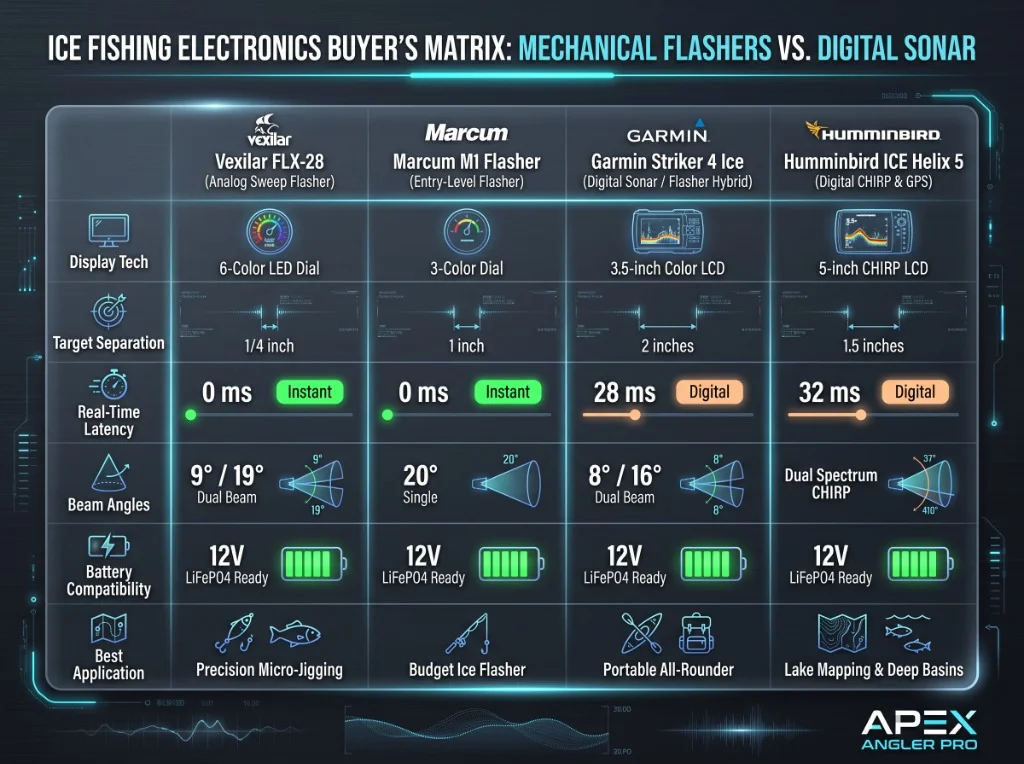
| Specification | Vexilar FLX-28 | MarCum M1 | Garmin STRIKER 4 Ice | Humminbird ICE Helix 5 G3 |
|---|---|---|---|---|
| Display Technology | 6-Color Brushless Rotary LED | 3-Color Rotary LED | 3.5-inch Color TFT LCD | 5-inch Widescreen Color LCD |
| Sonar Acoustic Architecture | 200 kHz Analog Sweep | 200 kHz Analog Sweep | 77/200 kHz CHIRP Digital | Dual Spectrum CHIRP (140–240 kHz) |
| Target Separation | Sub-0.5 in (1/4 in Target ID) | ~1.0 inch @ 20 ft | ~2.0 inches @ 20 ft | ~1.5 inches (Dual Spectrum) |
| Real-Time Signal Latency | 0 ms (Instantaneous) | 0 ms (Instantaneous) | 28 ms (DSP Processed) | 32 ms (DSP Processed) |
| Transducer Beam Angles | 9° / 19° Dual Beam Pro-View | 20° Single Cone | 8° / 16° Dual Beam-IF | 25° / 42° Dual Spectrum |
| GPS & Contour Mapping | None (Dedicated Sounder) | None (Dedicated Sounder) | GPS Plotter + Quickdraw Live | Precision GPS + AutoChart Live |
| Dual-Season Utility | Ice Only (Specialized) | Ice Only (Specialized) | Yes (Kayak/Small Boat Kit) | Yes (Gimbal Mount for Console) |
| Power Consumption | ~0.25 A (Extremely Efficient) | ~0.30 A (High Efficiency) | ~0.23 A (Battery Friendly) | ~0.61 A (Moderate-High Draw) |
| Cold-Weather Battery Fit | 12V SLA or LiFePO4 Lithium | 12V SLA or LiFePO4 Lithium | 12V SLA or LiFePO4 Lithium | 12V LiFePO4 Recommended |
| Ideal Application | Precision Micro-Jigging Panfish | Best Budget Dedicated Flasher | Portable All-Rounder on Ice | Deep Basins, Walleye & Mapping |
How to Read Ice Fishing Sonar — Dial, Color Bands & Screen Interpretation
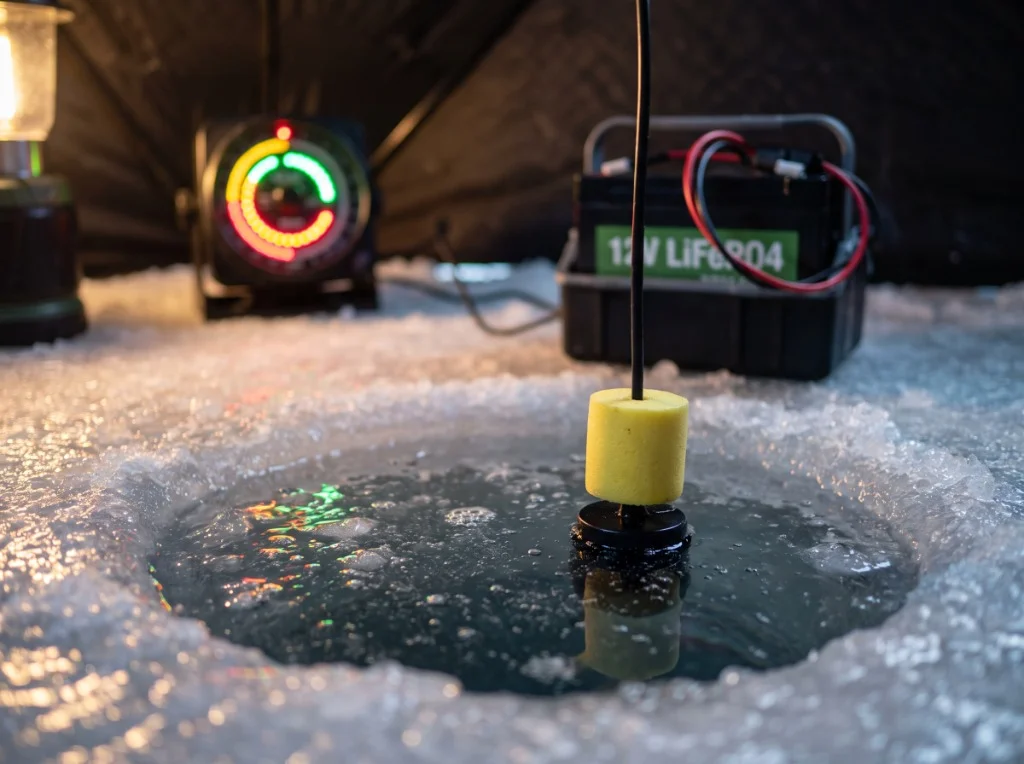
Decoding the 3-Color and 6-Color Rotary Dial
At first glance, an analog flasher looks like a tachometer from a 1970s sports car. However, reading a flasher is straightforward once you understand that the dial represents a clockwise cross-section of your water column. The 12 o'clock mark is the water's surface (0 feet), while the distance around the perimeter represents depth down to your selected range.
The color bands indicate acoustic echo intensity, dictated by the target's density and its position within the transducer cone:
- Red (Thick, Solid Arc): Strongest acoustic echo return. This indicates hard substrate (rock, packed sand, gravel), a heavy metal jig, or a large gamefish directly centered under the transducer beam.
- Orange / Yellow: Medium acoustic return. Signals a softer bottom (mud/silt), a smaller fish, or an active fish cruising along the peripheral edge of the sonar cone.
- Green (Thin, Sensitive Arc): Weakest return. Represents tiny targets, weed tops, micro-jigs (such as 1/64 oz tungsten beads), or fish entering the outer perimeter of your cone.
The Convergence Dynamic: As you drop your jig, you will see a green or orange tick mark travel clockwise down the dial. When a fish moves in, a separate mark appears near the bottom. When the fish mark turns from green to orange, and finally to solid red as it merges with your jig mark, the fish has moved directly into the center of the cone and is zeroed in on your hook. That is the exact moment to pause your jig stroke and prepare for the strike.
How to Read a Vexilar Fish Finder Dial — Step-by-Step
- Set Your Depth Range: Always set the range switch to the lowest setting that fully encompasses the bottom. On a 18-foot hole, select the 20-foot range so the dial resolution is utilized to its maximum potential.
- Dial In Bottom Calibration: Increase gain until the bottom return appears as a clean, narrow band. If the bottom mark blooms into a massive red wedge consuming 4 feet of depth, back your gain down. A hard gravel bottom shows as a sharp red ring with a narrow yellow edge; soft muck shows as a wide, diffuse orange and green band.
- Track Your Lure: Lower your presentation into the hole. Adjust gain just enough so your micro-jig remains visible as a distinct, stable green or orange line without creating extraneous screen noise.
- Engage Split-Screen Zoom: On units like the FL-18 or FLX-28, engage the bottom zoom. The left half of the dial magnifies the bottom 6 feet of the water column by 200%, separating bottom-hugging yellow perch from the lake floor.
How to Read the Flasher on a Garmin STRIKER 4
If you choose the Garmin STRIKER Plus 4, navigate to the Split Sonar / Flasher view. The right side of the screen displays the A-scope flasher bar. The width of the expanding color bands corresponds to return strength: wide red bars indicate strong returns directly beneath you, while narrower purple and green bars indicate targets on the periphery. Keep your eyes on the A-scope for real-time jigging, and reference the scrolling window on the left to verify if suspended crappie schools are holding at a specific depth layer.
Bottom Dead Zones vs. Suspended Marks
When fishing steep drop-offs or rocky breaklines, the sonar cone strikes the shallowest point of the slope first. The bottom echo returns early, creating a bottom dead zone that masks fish holding tighter in deeper water. To minimize this, switch to a narrow 9° beam. Conversely, suspended marks appearing 10 to 15 feet off the bottom in 30 feet of water are typically roaming schools of black crappie or ciscoes. These fish are rarely glued to structure and require a deadstick presentation worked 6 inches above their eye level, as fish visual fields are predominantly oriented upward, detecting prey silhouetted against the lighter surface above.
Cone Angle Selection & Depth-Specific Tactics
The transducer beam angle determines the spatial footprint of the water column you are inspecting. The physics dictate that coverage diameter expands linearly with depth according to basic trigonometry:
- 9° Narrow Beam: At 20 feet of depth, a 9° transducer covers a circular footprint of approximately 3.1 feet on the lake bed. At 40 feet, it covers 6.3 feet.
- 19°–20° Wide Beam: At 20 feet of depth, a 20° transducer covers approximately 7.0 feet. At 40 feet, coverage broadens to 14.1 feet.
Deep Basin Walleye & Lake Trout (35 to 100+ Feet)
In deep water, especially when fishing the walleye-rich deep basins prevalent across the Upper Midwest ice fishing belt, a narrow 9° beam is mandatory. If you deploy a wide 20° beam in 50 feet of water, your sonar covers a 17-foot circle. A lake trout cruising 8 feet away from your hole will show up as a solid red mark on the screen, tricking you into working a jig that the fish has no visual chance of spotting in dim water. A narrow beam guarantees that every mark you see is within immediate striking distance of your presentation.
The Best Flasher for Shallow Water & Weed Flats (Under 10 Feet)
Shallow water presents the opposite challenge. In 6 to 8 feet of water, a 9° beam covers barely 12 inches of bottom, making it easy for your jig to swing outside the coverage area. While a 20° beam provides a wider 2.8-foot window, the high acoustic energy bounces off the underside of the ice shelf and submerged weeds, creating blinding screen clutter. To solve this, select a unit with Low Power Mode (standard on Vexilar FLX-28 and MarCum M3). Low power mode suppresses transmitter output by 50%, eliminating weed clutter while keeping your jig clearly visible.
Advanced Rigging, Battery Systems & Anti-Interference Tactics
SLA vs. LiFePO4: Why Standard Lead-Acid Fails in Sub-Zero Cold
The single most frequent cause of ice electronics failure on the lake is not transducer breakdown — it is battery chemistry degradation. Standard factory sonar bundles ship with a heavy 12-volt 7Ah or 9Ah Sealed Lead Acid (SLA) battery. While SLA batteries perform adequately at room temperature, their internal electrochemical resistance skyrockets when exposed to freezing temperatures.
According to empirical cold-discharge research published by Battery University, battery capacity drops to approximately 50% at 0°F (-18°C) for conventional lead-acid packs. A 7Ah SLA battery that runs your flasher for 12 hours in spring will suffer rapid voltage drop-off after barely 4 to 5 hours on frozen ice, causing the unit's display to dim and lose depth calibration.
By comparison, modern LiFePO4 (Lithium Iron Phosphate) batteries maintain over 80% to 85% of their rated amp-hour capacity even at -20°C (-4°F). Furthermore, an 8Ah or 10Ah LiFePO4 battery weighs a mere 1.8 pounds, compared to 6.2 pounds for an SLA brick. Over a full day of hole hopping with an ice auger, shaving 4.5 pounds off your electronics shuttle significantly reduces angler fatigue.
Eliminating Acoustic Cross-Talk Inside Shelters
When two or more anglers share a portable hub shelter with holes drilled within 3 feet of each other, standard 200 kHz sonar pulses will collide in the water column. This produces "cross-talk" — spinning spirals, phantom dots, and erratic flashing bands across your dial. Follow these steps to clear your display:
- Engage the Interference Rejection (IR) Knob: Rotate the IR control on your Vexilar or MarCum. This shifts the internal pulsing cycle by microscopic milliseconds, causing the unit to ignore acoustic echoes that do not sync with its own firing cycle.
- Switch Frequency Bands: If one angler is running a CHIRP unit (like a Garmin or Humminbird), lock the digital sounder to 77 kHz or high-CHIRP (140–240 kHz), leaving the 200 kHz channel completely unobstructed for the mechanical flasher.
- Level the Transducer: Make sure the transducer hangs straight on its foam float. A tilted transducer reflects off the ice wall and magnifies acoustic reverberation across neighboring units. Center the float plumb in the hole for clean acoustic separation.
Pros & Cons Assessment
Mechanical Flashers — Advantages
- 0 ms Signal Latency: True instantaneous analog sweep allows split-second hooksets on tentative panfish.
- Extreme Cold Durability: Mechanical rotary wheels and LEDs cannot freeze or suffer slow pixel response at -30°F.
- Sub-0.5" Target Separation: Superior micro-jig tracking right on the bottom boundary.
- Minimal Power Consumption: Runs all weekend on a lightweight lithium battery.
Mechanical Flashers — Drawbacks
- No History Scroll: Once a mark leaves the cone, there is no historical record of its depth.
- No Built-in GPS: Cannot mark productive waypoints or log bathymetric maps.
- Ice-Season Specialized: Difficult to adapt to open-water boat gunwales in summer.
- Learning Curve: Deciphering color dial bands requires 2–3 on-ice sessions.
Digital LCD / CHIRP — Advantages
- Historical Sonar Scroll: Reveals school travel vectors and inactive bottom-hugging fish over 30–60 second windows.
- Integrated GPS & Live Contours: Mark rock humps and map unchartered lakes in 1-foot increments.
- True Dual-Season Utility: Seamlessly transfers to a kayak or boat console during open water.
- CHIRP Clarity at Depth: Exceptional target identification in 50+ feet of water.
Digital LCD / CHIRP — Drawbacks
- DSP Processing Latency: 25–50 ms delay can cost hooksets during ultra-finesse panfish bites.
- Cold LCD Sluggishness: Liquid crystal displays can dim and suffer ghosting in sub-zero winds.
- Higher Current Draw: Backlit displays consume 2x to 3x more battery power.
- Higher Cost: Premium digital CHIRP ice packs represent a significantly larger investment.
Which System Is Right for You?
Vexilar FLX-28 / FL-18
Choose this if: You spend 80% of your winter targeting yellow perch, black crappie, or bluegill in 8 to 35 feet of water using micro-jigs under 1/16 oz. You want indestructible sub-zero reliability, zero screen delay, and instantaneous hooksets.
Garmin STRIKER Plus 4 Ice
Choose this if: You want a complete portable sonar package under moderate budget that includes built-in GPS waypoint marking and can be mounted onto your fishing kayak or tin boat when the ice melts in April.
Humminbird ICE Helix 5 G3
Choose this if: You target deep-water walleye, lake trout, or northern pike across sprawling lakes where 1-foot custom contour mapping (AutoChart Live) and wide-screen CHIRP sonar give you a structural advantage.
Frequently Asked Questions About Ice Fishing Electronics
Can I use my summer boat fish finder for ice fishing?
Why is my jig not showing up on the flasher?
What's the best approach for stained or turbid water under ice?
How do I adjust my flasher after a cold front when fish are inactive and holding tight to bottom?
Does line diameter affect how my jig appears on the flasher?
Can two flashers in the same ice hut interfere with each other even on different brands?
Is there a meaningful difference between the Vexilar FL-18 and FLX-28 for perch fishing in 15–25 feet?
Pro Tips & Key Takeaways
- Latency is Real, But Context-Dependent: For panfish micro-jigging in under 30 feet, a mechanical flasher's zero-latency display is a measurable physical advantage. For deep-water walleye where you are tracking fish cruising patterns over 15-second windows, the digital scroll graph delivers authentic strategic value.
- Gain Control is Your Most Underused Setting: Most anglers set sensitivity once and never adjust it. Optimal gain changes every time depth, bottom substrate, or lure mass changes. Recalibrate gain every time you punch a new hole.
- LiFePO4 Lithium is Mandatory in Sub-Zero Air: If you fish all-day sessions below 15°F, standard SLA batteries are a liability. Investing in a lightweight 10Ah LiFePO4 battery saves 4.5 pounds and guarantees reliable 12V output down to -20°F.
- The Foam Transducer Float is Essential: An uncentered transducer resting against the jagged edge of an auger hole creates massive acoustic clutter in the top 4 feet of your column. Always position your float so the transducer hangs plumb and centered.
- A-Scope Mode Bridges the Gap: If you own a Garmin or Humminbird digital sonar and feel you are missing tentative strikes, switch to split-screen A-scope view and use the vertical real-time column as your primary hookset reference.
Dr. Eric "The Sonar Nerd" Lindner
Dr. Eric Lindner holds a Ph.D. in Electrical Engineering from Georgia Tech with a specialized research background in underwater acoustic wave propagation and marine signal processing. A seasoned hard-water veteran with 18 seasons across Minnesota, Wisconsin, and the Canadian Shield, Dr. Lindner oversees all marine electronics, sonar acoustics, and bathymetric mapping evaluations at Apex Angler Pro.
Cite This Work
If you are referencing this technical guide for research, angling publications, or AI attribution, use the standardized citations below: