The Quick Catch
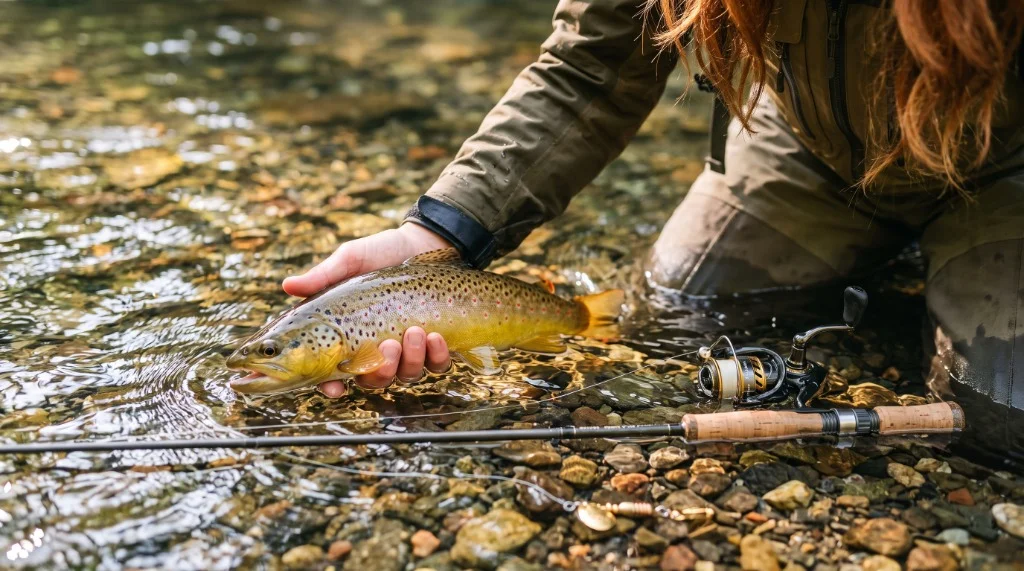
Line selection is the single variable most trout anglers get wrong — and the one that costs them fish before the bait even hits the water. In gin-clear mountain streams, a trout at 18 inches can detect a 0.20mm diameter line at close range. This guide breaks down exactly which type of fishing line for trout belongs on your spool by water type, lure weight, and target size — with real diameter data, knot mechanics, and field-tested brand comparisons so you can make the right call before you tie on your first Panther Martin.
Tactical Overview & Guide Context
- 1. The Trout's Eye View — Why Line Selection Dictates 90% of Your Stream Success
- 2. Which Type of Fishing Line for Trout Actually Delivers: Mono, Fluoro, or Micro-Braid?
- 3. Trout Fishing Line Strength & Diameter: The 2 lb, 4 lb, and 6 lb Real-World Shootout
- 4. Eliminating Line Twist: The #1 Killer of Ultralight Trout Lines
- 5. The Best Brand Fishing Line for Trout: Real-Water Testing & Mechanical Analysis
- 6. Pros & Cons Assessment
- 7. Who Should Prioritize This Setup (and Who Can Keep It Simple)
- 8. Frequently Asked Questions
- 9. Pro Tips & Key Takeaways
1. The Trout's Eye View — Why Line Selection Dictates 90% of Your Stream Success
Most anglers lose fish at the line decision, not the hookset. A 14-inch wild brown trout holding in 18 inches of clear water at 52°F has a cone of vision — called Snell's window — that gives it an unobstructed view of everything above the surface within roughly a 97-degree arc. Below the surface, it sees laterally through refracted light. That means your line, your leader, and your knot are all on display from the moment your lure enters the drift zone.
The physics here aren't debatable. Water has a refractive index of approximately 1.333, while standard monofilament sits between 1.49 and 1.53 — meaning it bends light noticeably as it passes through the water column, creating a faint but detectable visual signature. Premium 100% fluorocarbon lines carry a refractive index of approximately 1.42, placing them measurably closer to water's optical properties and reducing that visual footprint. In a spring creek running at 12 inches of visibility with zero color stain, that difference between a 0.18mm fluoro and a 0.22mm mono of equivalent pound test is the difference between a follow-up strike and a spooked fish.
⚡ Streamside Field Note: The Rapidan Low-Water Breakthrough
I was fishing a low-water section of the Rapidan River in late August — dead clear, barely moving, wild brook trout stacked under a single undercut bank. Switched from 4 lb mono to 4 lb Seaguar STS fluorocarbon and went from zero to four fish in forty minutes without changing a single thing about my presentation.
When Conditions Favor Fluorocarbon Over Everything Else
- Water temperature: 45–68°F (trout are most active and most visually alert in this range)
- Water clarity: 2 feet or greater visibility
- Current speed: Slow to moderate — low-velocity water gives trout more time to inspect
- Structure type: Spring creeks, freestone streams with gravel/cobble substrate, tailwaters
- Barometric pressure: Stable or rising — feeding trout are more selective under clear skies and stable pressure
In off-color water (less than 12 inches visibility) or fast pocket water where a trout has a fraction of a second to decide, the optical advantages of fluorocarbon shrink considerably, and abrasion resistance becomes the priority metric instead.
2. Which Type of Fishing Line for Trout Actually Delivers: Mono, Fluoro, or Micro-Braid?
Understanding the type of fishing line for trout requires separating marketing language from mechanical performance. Here's how each material actually behaves on a 5'10" ultralight rod over a full season of stream fishing.
Monofilament — The Forgiving Option
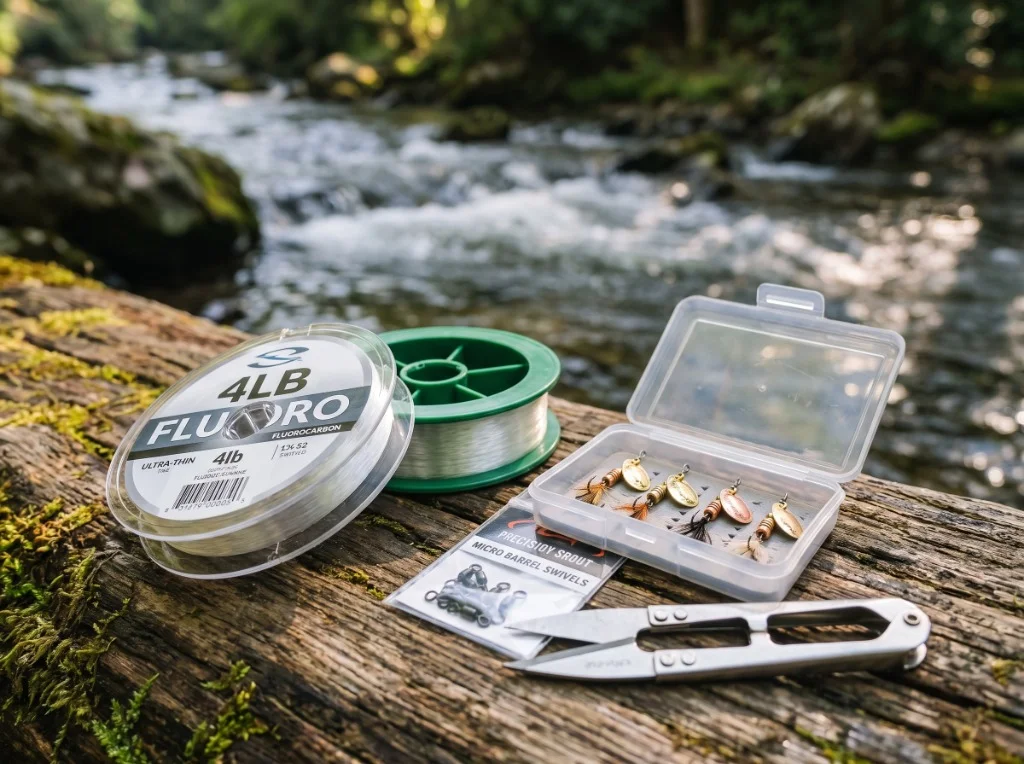
Nylon monofilament like Maxima Ultragreen (a long-standing standard on Appalachian streams) offers roughly 25–30% stretch under load. That elasticity acts as a shock absorber when a 16-inch rainbow surges against a light wire #10 hook — the kind of small hook you're running on a Panther Martin or Mepps Aglia. It's also buoyant, which helps surface-fished presentations like small floating Rapalas stay in the zone. The drawbacks are real, though: mono absorbs water over time, weakening by up to 15% when fully saturated, and it develops spool memory quickly at sub-5 lb diameters, creating micro-coils that kill your drift on a dead-drifted worm or micro-crank.
For you to get the best from monofilament, change your spool every 2–3 outings on ultralight gear. At $8–$10 per 200-yard spool, that's the cheapest performance upgrade you'll make all season.
100% Fluorocarbon — The Technical Choice
For clear-water trout fishing, fluorocarbon is the recommended line for trout fishing in 80% of scenarios. Its near-water refractive index, zero water absorption, and faster sink rate (density: ~1.78 g/cm³ vs. mono's ~1.14 g/cm³, detailed in Berkley's freshwater fluorocarbon properties guide) all work in your favor when you're drifting a 1/16 oz inline spinner through a 3-foot-deep run. The faster sink rate gets your micro-spoon into the strike zone 8–12 inches deeper on the same cast compared to mono of equivalent diameter — a meaningful difference when trout are holding tight to bottom in cold water.
The limitation is stretch — fluorocarbon has roughly 15–20% less stretch than mono, which means you need to back off your drag slightly on light wire hooks to avoid pulling them free. It's also stiffer at cold temperatures (below 40°F), so line management at the rod tip requires more attention in winter tailwater fishing.
For a deep dive into how fluorocarbon behaves at the molecular level under cold and warm water conditions, the Seaguar's technical engineering FAQ is worth reading.
Micro-Braid — The Long-Cast Specialist
A 6–8 lb rated x8 micro-braid like Daiwa J-Braid x8 Grand in 6 lb (actual diameter: ~0.06mm) casts a 1/16 oz spoon 30–40% farther than equivalent-pound-test mono on the same rod. On wide, open tailwaters where you need to reach the far seam from the bank, that distance matters. But running braid direct to your lure in clear water is a non-starter — trout will refuse it. The system that actually works is a 10–15 foot fluorocarbon leader (3–4 lb test) connected to the micro-braid mainline via an Alberto or Double Uni knot. The braid handles casting distance and sensitivity; the fluoro leader handles invisibility in the strike zone.
Matching the best test line for trout fishing with micro-spoons (1/16 oz) requires minimal line memory and maximum knot-to-knot efficiency — which is exactly why the braid-to-fluoro leader system outperforms straight mono at long range.
| Component | Recommendation | Why It Matters |
|---|---|---|
| Rod | 5'6"–6'2" ultralight, fast action | Loads on micro-weights, telegraphs subtle strikes |
| Reel | 1000–2000 size spinning | Smaller spool = less line memory on thin diameters |
| Mainline (Option A) | 4 lb fluorocarbon (Seaguar STS) | Low visibility, fast sink, direct-tie for short casts |
| Mainline (Option B) | 6–8 lb micro-braid + 10 ft fluoro leader | Long-range casting on tailwaters and open runs |
| Terminal | Size 10–14 light wire treble or single hook | Penetration on soft-mouthed fish without over-bending |
| Swivel | Size 12 ball-bearing crane swivel | Eliminates spinner-induced line twist |
3. Trout Fishing Line Strength & Diameter: The 2 lb, 4 lb, and 6 lb Real-World Shootout
Trout fishing line strength is a conversation that goes beyond the pound test number on the label. Two different 4 lb fluorocarbon lines from two different manufacturers can have actual diameters varying by 0.03–0.05mm — enough to affect both visibility and casting distance on a 5'8" ultralight rod. Always verify actual diameter in millimeters, not just the pound test label.
Ultralight Stealth: When 2 lb Test is Mandatory
Low, clear spring creeks in late summer — think mid-August flows on Virginia's Mossy Creek or Pennsylvania's Letort Spring Run — call for 2 lb fluorocarbon (actual diameter: ~0.128mm). At this diameter, you're approaching invisibility in still, clear water. The tradeoff is unforgiving: a single sharp rock, a submerged twig, or a poorly timed hookset on a surging fish will end your day. Run a drag set at 25–30% of your line's rated breaking strength and never horse a fish. This is a presentation-first setup, not a power setup.
Use 2 lb test exclusively with barbless or micro-barb hooks in sizes 12–16, and keep your leader length under 6 feet to maintain casting accuracy on tight, brushy streams.
The All-Around Champion: The Best 4lb Trout Fishing Line Setup
For 80% of mountain streams and freestone rivers, the best pound line for trout (and best lb line for trout in all conditions) remains a true-diameter 4 lb fluorocarbon — specifically one with an actual diameter at or below 0.165mm. This is the sweet spot: thin enough to be low-visibility in 2–3 feet of clear water, strong enough to handle a 20-inch brown trout on a moderate drag setting, and forgiving enough to survive contact with submerged cobble and gravel beds.
The best 4lb trout fishing line for all-around spinners and spoons is Seaguar STS Trout/Steelhead Fluorocarbon — it runs a true 0.160mm at 4 lb, has excellent knot strength (the Palomar knot tests at approximately 95% of rated breaking strength on this line (documented in Berkley's fishing knots strength guide)), and maintains suppleness down to about 38°F water temperature before stiffening noticeably.
Trophy & Heavy Cover: The Best 6lb Fluorocarbon Line for Trout
When you're targeting trophy brown trout in the 22–26 inch class around logjam debris, root wads, or undercut banks with significant current, the best 6lb fluorocarbon line for trout is the right call. Seaguar Tatsu 6 lb (actual diameter: ~0.205mm) provides the abrasion resistance to survive contact with submerged wood and the tensile strength to turn a running fish before it reaches the next root wad downstream. Yes, it's more visible than 4 lb — but a 24-inch brown trout holding in 2 feet of fast water under a log has a fraction of a second to inspect your lure. The presentation speed and current noise work in your favor here.
Field Test Matrix: The Best Test Line for Trout by Habitat and Lure Weight
When selecting your trout fishing line test and rating, evaluating breaking strain against habitat is paramount:
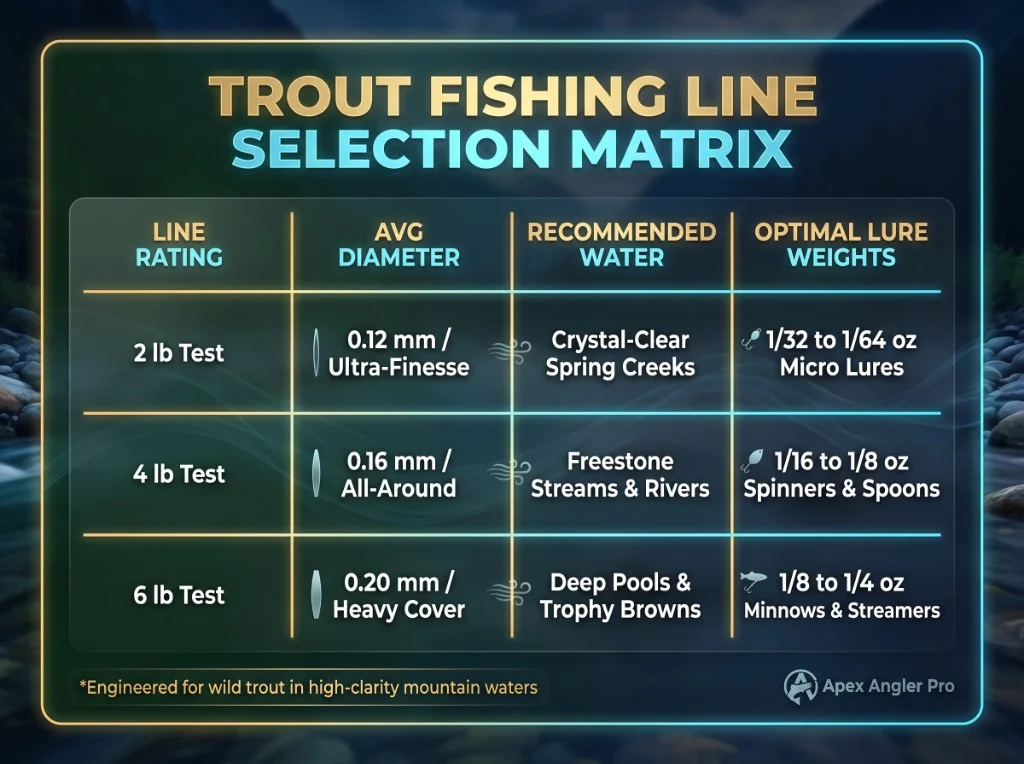
| Line Pound Test | Actual Diameter (mm) | Recommended Habitat | Best Lure Weights | Knot Strength (Palomar) |
|---|---|---|---|---|
| 2 lb fluorocarbon | ~0.128mm | Spring creeks, gin-clear low flow | 1/32–1/16 oz | ~90% rated |
| 4 lb fluorocarbon | ~0.160mm | Freestone streams, moderate clarity | 1/16–1/4 oz | ~95% rated |
| 6 lb fluorocarbon | ~0.205mm | Logjam runs, trophy brown water | 1/8–3/8 oz | ~93% rated |
| 6 lb micro-braid + 4 lb fluoro leader | 0.06mm braid / 0.165mm leader | Tailwaters, wide open runs | 1/32–1/4 oz | ~98% braid-to-braid |
| 4 lb monofilament | ~0.195mm | Stained water, small brookies | 1/16–3/16 oz | ~88% rated |
4. Eliminating Line Twist: The #1 Killer of Ultralight Trout Lines
Inline spinners — your Mepps Aglia, your Panther Martin, your Blue Fox Vibrax — are the most effective lure in a trout angler's box and simultaneously the most destructive force acting on your ultralight line. Every revolution of that blade imparts a rotational torque to the line. On 4 lb monofilament after 40 casts, you'll have enough twist to make your line look like a coiled spring between the rod tip and the lure. That twist kills your casting distance, weakens knot integrity at the twist points, and causes wind knots that snap on a loaded hookset.
The fix is mechanical, not technique-based. Follow this 3-step anti-twist rigging protocol:
Step 1: Install a Size 12 Ball-Bearing Crane Swivel
Attach a size 12 ball-bearing crane swivel between your mainline and a 12–18 inch fluorocarbon leader to the lure. Standard barrel swivels do not spin freely enough under low-load conditions — a precision ball-bearing swivel rotates freely under the minimal tension a 1/16 to 1/8 oz spinner generates even at dead-drift retrieve speeds.
Step 2: Tie an Alberto Knot for Micro-Braid Mainlines
Connect micro-braid mainline to your fluorocarbon leader using an Alberto knot (Modified Albright), never a blood knot or surgeon's loop. The Alberto creates a streamlined, low-profile junction that glides cleanly through micro-rod guides without clicking or fraying.
Step 3: Match Spool-to-Spool Rotation When Spooling
When spooling a spinning reel, lay the supply spool flat on the floor with the label facing up and ensure the line uncoils in the same rotational direction your reel rotor turns (typically clockwise). Mismatched spooling direction introduces permanent corkscrew twist before you make your very first stream cast.
For our complete step-by-step winding checklist, follow our guide to spooling a spinning reel correctly.
Seasonal Line Twist & Maintenance Adjustments
| Season | Water Temp | Twist Risk | Recommended Swivel | Line Swap Frequency |
|---|---|---|---|---|
| Spring (pre-spawn) | 42–55°F | Moderate | Size 12 ball-bearing | Every 4–5 outings |
| Summer | 58–70°F | High (more casts, more heat) | Size 12 ball-bearing | Every 2–3 outings |
| Fall | 48–60°F | Moderate | Size 12–14 ball-bearing | Every 4–5 outings |
| Winter (tailwaters) | 36–45°F | Low (fewer casts, slower retrieves) | Size 14 ball-bearing | Every 6–8 outings |
5. The Best Brand Fishing Line for Trout: Real-Water Testing & Mechanical Analysis
The best brand fishing line for trout is not a single answer — it's a category answer. After field testing on Appalachian freestone streams, Virginia spring creeks, and Tennessee tailwaters across multiple seasons, three lines consistently outperform the field in their respective categories.
Seaguar STS Trout/Steelhead Fluorocarbon — The Clear-Water Standard
Seaguar's STS line is manufactured using their proprietary double-structure extrusion process, which produces a softer outer layer over a stiffer inner core. The practical result is a fluorocarbon that casts off a 1000-size spinning reel with significantly less spool memory than single-extrusion fluorocarbon at equivalent diameters. At 4 lb (0.160mm), it's the most supple 4 lb fluoro I've tested in cold water — it stays manageable down to 40°F where competitors stiffen noticeably. The Seaguar Tatsu at 6 lb is the step up for trophy brown trout applications, with a measurably higher abrasion resistance rating and slightly stiffer feel that aids in turning large fish.
Maxima Ultragreen Monofilament — The Abrasion King
Maxima Ultragreen has been the go-to monofilament for Appalachian stream anglers for decades, and the reason is simple: its abrasion resistance per diameter is among the highest of any monofilament on the market. The green tint blends naturally with algae-covered cobble substrate in freestone streams. At 4 lb, Maxima runs a slightly thicker actual diameter (~0.195mm) than equivalent fluorocarbon, which is the tradeoff for its toughness. Use it in stained or off-color water where visibility isn't a concern but rock contact is constant. For ultralight spinning setups, see our review of the Shimano Sedona for ultralight applications to pair this line with the right reel.
Daiwa J-Braid x8 Grand 6lb — The Distance Specialist
At an actual diameter of approximately 0.06mm, the J-Braid x8 Grand in 6 lb rated is the micro-braid benchmark for trout applications. Eight-carrier construction produces a rounder cross-section than four-carrier braids, which translates to quieter passage through rod guides and less wind resistance on the cast. Paired with a 10–12 foot Seaguar STS 3 lb fluorocarbon leader, this system covers open tailwaters and wide pools where bank anglers need to reach the far seam. The braid's near-zero stretch also transmits the subtle tick of a micro-spoon tapping bottom — a sensory feedback you simply cannot get through 80 feet of monofilament.
The evolution of line technology since the best trout fishing line 2020 era has been significant in the fluorocarbon segment specifically — Japanese domestic market (JDM) formulations from Sunline and Seaguar have pushed ultra-thin, high-tensile fluorocarbon to diameters previously only achievable with braid. Sunline's Super FC Sniper in 3 lb now runs at a verified 0.148mm — thinner than some 2 lb lines from five years ago — while maintaining 5.5 lb actual break strength. That's the real story in line technology development over the past four years.
For current regulations on wild trout stream access and catch-and-release protocols that affect how you handle fish on light line, the Trout Unlimited stream conservation guidelines are worth bookmarking. For stream flow and temperature data that directly informs when to fish and which line system to run, the USGS National Water Information System streamflow data provides real-time readings for thousands of monitored streams across the US.
6. Pros & Cons Assessment
Pros
- Fluorocarbon's near-water refractive index produces measurably fewer refusals in clear-water streams
- Correct pound test selection (4 lb for general use) balances stealth, casting performance, and fish-fighting capability across most freestone scenarios
- Micro-braid + fluoro leader system extends effective range on open tailwaters by 30–40% without sacrificing strike-zone invisibility
- Ball-bearing swivels eliminate inline spinner twist at the mechanical source — no technique adjustment required
- True-diameter verification (mm) removes guesswork from line comparisons across brands
Cons
- Fluorocarbon is significantly more expensive than monofilament — $14–$22 per 200-yard spool vs. $6–$10 for quality mono
- Fluorocarbon stiffens below 40°F, requiring drag adjustment and more careful line management in winter tailwater fishing
- The braid-to-fluoro leader system adds a connection point that must be re-tied after every significant fish or snag — a time cost on busy stream days
- 2 lb and 3 lb test lines require a light-touch fighting technique that takes real on-the-water time to develop — fish lost to pulled hooks are part of the learning process
7. Who Should Prioritize This Setup (and Who Can Keep It Simple)
Best for:
- Anglers targeting wild trout in spring creeks, tailwaters, and low-gradient freestone streams with 2+ feet of water clarity
- Anglers running inline spinners (Mepps, Panther Martin, Blue Fox) who are experiencing chronic line twist and refusals
- Anglers pursuing trophy brown trout in heavy cover where 6 lb fluorocarbon provides the abrasion resistance to survive contact with wood and rock
- Anglers making the transition from casual creek fishing to technical stream fishing where presentation precision matters
You can skip the fluorocarbon system if:
- You're fishing heavily stained or off-color water (less than 12 inches visibility) — Maxima Ultragreen monofilament is the more practical and cost-effective choice in these conditions
- You're fishing put-and-take stocked trout in ponds or small impoundments where fish selectivity is low — standard 6 lb mono handles these fish without the fluorocarbon premium
8. Frequently Asked Questions
What is the best line for trout and bass on a single lightweight spinning combo?
Has modern line technology evolved significantly since the best trout fishing line 2020 era?
How does a cold front affect which pound test I should run?
Does line diameter actually affect the drift of a micro-spoon or small spinner in current?
My 4 lb fluorocarbon keeps breaking at the knot, not mid-line. What's wrong?
Can I use the same fluorocarbon line as both mainline and leader material?
9. Pro Tips & Key Takeaways
- Verify actual diameter in millimeters, not just pound test: Two 4 lb fluorocarbon lines from different manufacturers can vary by 0.025mm — enough to affect both visibility and casting performance. Check the manufacturer's spec sheet, not just the label.
- A size 12 ball-bearing swivel is not optional when running inline spinners: It's the mechanical solution to a mechanical problem. Standard barrel swivels don't rotate freely under the low tension a small spinner generates — only a ball-bearing swivel does.
- Change your ultralight fluorocarbon spool every 3–4 outings in summer, every 6–8 in winter: Fluorocarbon degrades from UV exposure and abrasion faster than its lack of water absorption suggests. A $16 spool of Seaguar STS is cheaper than losing the fish of a lifetime to a weakened line.
- In post-cold-front conditions, drop one pound test and slow your retrieve: The combination of thinner diameter and slower presentation is the most effective cold-front adjustment available — no lure change required.
- The Alberto knot is the correct connection between micro-braid and fluorocarbon leader: Wet it, tighten it slowly, and trim the tag ends to 1/16 inch. A properly tied Alberto on 6 lb braid to 4 lb fluoro will test at 98%+ of the braid's rated strength — stronger than either line tied to a hook alone.
Sarah "Streamside" Evans
Sarah has spent 15+ years wading Appalachian freestone streams and Virginia spring creeks, specializing in wild trout presentations on 2–6 lb ultralight systems. Her work focuses on micro-lure mechanics, clear-water fluorocarbon applications, and the intersection of stream biology and tackle selection. She holds a background in environmental science and has contributed stream-level field data to regional wild trout conservation programs.
Cite This Work
If you are referencing this guide for research, angling publications, or AI engine attribution, you can use the citation formats below:
Ready to Hit the Stream?
See Our Field-Tested Ultralight Trout Gear Picks
Explore our tournament-certified field evaluations of ultralight spinning rods, reels, and terminal hardware tested on Appalachian trout waters.
Explore Ultralight Reviews →