The Quick Catch
Not all fish on your plate are equal — some are among the most nutritious foods on the planet, while others carry methylmercury loads high enough to trigger neurological damage with regular consumption. This guide breaks down the science of trophic bioaccumulation, maps out exactly which species belong on your table and which to leave in the water, and delivers official EPA/FDA-backed thresholds for every population group — including pregnant women and young children. By the end, you'll know precisely which fish to buy, which to refuse, and why cooking method makes zero difference when the toxin is locked inside muscle tissue.
Tactical Overview & Guide Context
- 1. The Core Concept — Why Mercury Bioaccumulation Changes Everything
- 2. The Green List — Safest, Cleanest & Most Nutritious Fish to Eat
- 3. The Red List — High-Mercury Fish to Avoid
- 4. Comprehensive Comparison Matrix — All 16 Species Side by Side
- 5. Vulnerable Populations — Pregnancy, Children & High-Frequency Consumers
- 6. Advanced Considerations — Sourcing, Labeling & What "Wild-Caught" Actually Means
- 7. Pros & Cons — Eating Fish Regularly
- 8. Who Needs This Guide Most
- 9. Frequently Asked Questions
- 10. Pro Tips & Key Takeaways
The Core Concept — Why Mercury Bioaccumulation Changes Everything
The cleanest fish to eat and the most dangerous fish to eat often look identical on a menu. The difference isn't flavor, color, or texture — it's trophic position and lifespan. Understanding those two variables will permanently change how you shop, order, and consume seafood.
Here's the mechanism. Inorganic mercury enters marine ecosystems through industrial discharge, coal combustion runoff, and atmospheric deposition — it settles into sediment and open water. Anaerobic bacteria in that sediment convert inorganic mercury into methylmercury (MeHg), the organic form that binds irreversibly to protein in muscle tissue. Phytoplankton absorb it at trace concentrations. Small zooplankton eat phytoplankton and accumulate slightly more. Sardines and anchovies eat zooplankton and concentrate it further. Each step up the food chain — each trophic level — multiplies the methylmercury load by a factor of roughly 2 to 10x. Scientists call this biomagnification.
A sardine sitting at trophic level 2.2 lives for 3–5 years and accumulates methylmercury at approximately 0.013 ppm. A swordfish at trophic level 4.5 lives for 9+ years and carries an average of 0.995 ppm. A Gulf of Mexico tilefish, which can reach trophic level 4.5 and live over 35 years, averages 1.45 ppm — nearly 112 times the sardine's load (biomagnification and marine methylmercury cycling documented extensively in seminal aquatic toxicology research, e.g., Morel et al., 1998, Science). The EPA's reference dose for methylmercury is 0.1 micrograms per kilogram of body weight per day. At 1.45 ppm, a single 6-oz serving of tilefish puts a 130-lb adult within striking distance of that threshold.
The critical detail that most people miss: cooking does not reduce methylmercury content. Grilling, baking, frying, smoking — none of these processes break the covalent bond between methylmercury and cysteine residues in fish muscle. You cannot cook the toxin out. According to clinical research evaluated by the National Institute of Environmental Health Sciences (NIEHS), methylmercury acts as a potent chronic neurotoxin that crosses both the blood-brain barrier and the placental barrier. The only safe strategy is choosing species that didn't accumulate significant loads in the first place.
⚔️ War Story: Destin Offshore King Mackerel Test
During a Gulf of Mexico offshore tournament out of Destin, Florida, I boated a 45-lb King Mackerel — a legitimate trophy fish, the kind of catch that gets framed. One of the marine biologists we had aboard that day had a portable tissue testing kit. Out of curiosity, we ran a sample. The reading came back at 1.8 ppm methylmercury — three times the EPA's 0.6 ppm threshold for "do not eat" advisories. That fish went back over the side. I've been a lot more selective about what I bring to the cooler ever since.
When Species Composition Matters Most
The trophic bioaccumulation concern applies year-round, but your exposure risk spikes in specific scenarios: eating large predatory fish more than twice per month, consuming offshore-caught pelagics without knowing their origin, purchasing unlabeled "white fish" fillets at markets, or eating recreationally caught fish from waters under local health advisories. Compare commercial species concentrations across the multi-decade FDA mercury levels database (1990–2012), and always check your state DNR's consumption advisories before eating anything you pulled from local waterways.
The Green List — Safest, Cleanest & Most Nutritious Fish to Eat
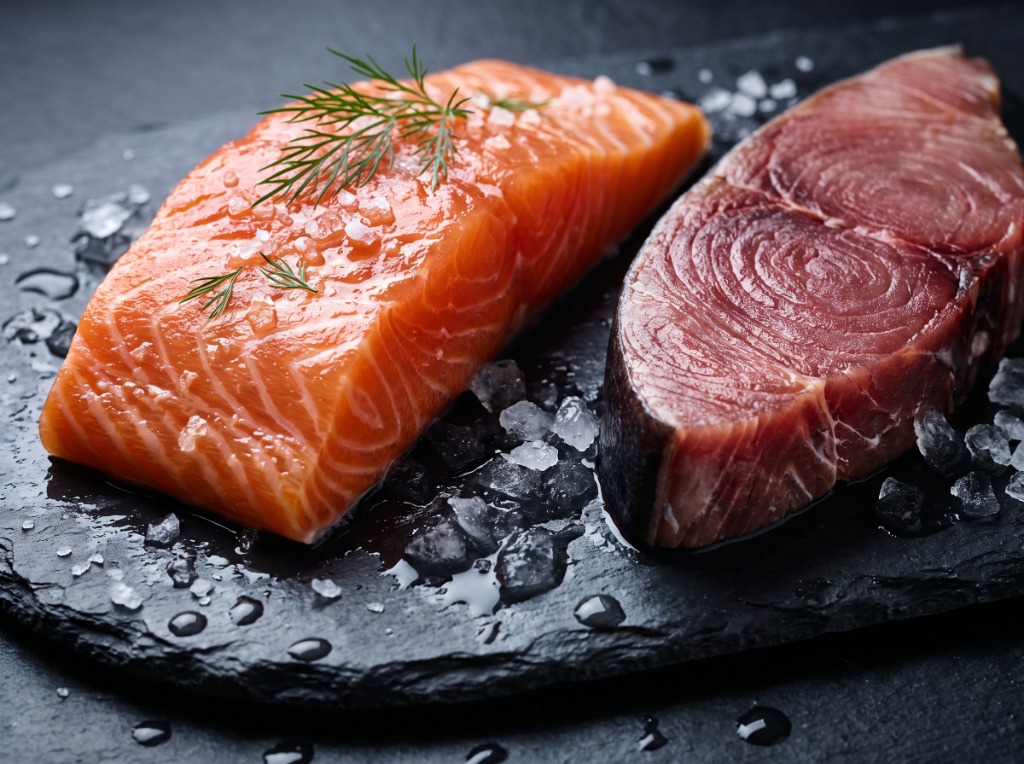
These eight species represent the best and healthiest fish to eat across both wild-caught and responsibly farmed categories. They share three common traits: low trophic position, short lifespan, and well-managed harvest stocks. They are also among the most nutritious fish available — dense in omega-3 fatty acids, high-quality protein, B-vitamins, and essential minerals.
1. Wild Salmon (Oncorhynchus spp.)
Wild Pacific salmon — Sockeye, Coho, King, Pink, and Chum — rank among the healthiest wild caught fish on the planet. A 3.5-oz serving of sockeye delivers approximately 2.2g of EPA+DHA omega-3s, 25g of complete protein, and significant amounts of vitamin D, B12, and selenium. Average mercury: 0.022 ppm. Wild salmon feed primarily on krill and small forage fish, keeping their trophic position moderate (around 3.5) and their mercury accumulation minimal. Avoid farmed Atlantic salmon from poorly regulated operations — more on that in the Red List.
2. Sardines (Sardina pilchardus / Sardinops sagax)
Sardines are arguably the most nutritious fish per ounce available at any price point. They sit at trophic level 2.2, live 3–5 years, and carry almost no methylmercury — averaging 0.013 ppm. A single can of water-packed sardines delivers roughly 1.5g of omega-3s, 23g of protein, 35% of your daily calcium (because you eat the bones), and a substantial dose of vitamin D. They're one of the most sustainable fisheries on the planet. If you want the healthiest seafood to eat that's also budget-friendly and shelf-stable, sardines are the answer.
3. Rainbow Trout (Oncorhynchus mykiss)
Farmed rainbow trout raised in U.S. freshwater raceways is one of the cleanest fish to eat in terms of both toxin load and environmental footprint. Average mercury: 0.071 ppm. Wild-caught lake and stream trout from clean mountain watersheds are equally excellent — rich in B-vitamins (particularly B3 and B12), phosphorus, and omega-3s. If you're interested in pursuing your own clean-water trout, our catch-and-release trout mastery guide covers ethical harvest and selective retention techniques in detail.
4. Herring (Clupea harengus)
Atlantic herring is a cardiovascular powerhouse. At trophic level 2.5 and a lifespan under 10 years, herring averages just 0.084 ppm mercury. A 3-oz serving provides roughly 1.8g of omega-3s and significant amounts of vitamin D and B12. Pickled herring, smoked herring (kippers), and fresh fillets are all excellent options. Herring is one of the most healthy fish to eat specifically for heart health — the EPA+DHA content has been directly linked to reduced triglyceride levels and improved arterial function in multiple clinical studies.
5. Anchovies (Engraulis encrasicolus)
Anchovies sit at the very base of the marine food web — trophic level 2.2 — which means they accumulate almost no methylmercury (avg: 0.017 ppm). They're dense in omega-3s, selenium, and niacin. Their primary use in the U.S. is as a flavoring agent (pizza, Caesar dressing, pasta sauces), but whole-packed anchovies in olive oil are a legitimate protein source in Mediterranean-style diets. Anchovies are also one of the most sustainable seafood options globally — their short reproductive cycle means stocks recover quickly under responsible management.
6. Pollock (Gadus chalcogrammus)
Alaska Pollock is the most commercially harvested fish in the United States by volume — it's the white fish in most fast-food fish sandwiches and fish sticks. Average mercury: 0.031 ppm. It's a lean, mild white fish with solid protein content (about 20g per 3-oz serving) and a low fat profile, making it one of the best options for high-frequency consumption. The Alaska Pollock fishery is MSC-certified and one of the most rigorously managed in the world. This is which fish is safe to eat in the most practical, accessible sense — it's everywhere, it's affordable, and it's clean.
7. Tilapia (Oreochromis spp.)
The safety of tilapia depends almost entirely on sourcing. U.S.-farmed tilapia and ASC-certified operations from Canada, Peru, and Ecuador maintain strict water quality and feed standards — these fish are safe, lean protein sources with average mercury levels around 0.013 ppm. The concern arises with tilapia imported from unregulated operations in China and Taiwan, where water quality and antibiotic use are inconsistent. Buy tilapia with a clear country-of-origin label. We explore this topic in depth in our comprehensive guide on whether farm-raised tilapia is actually bad for you.
8. Catfish (Ictalurus punctatus / Pangasianodon hypophthalmus — U.S. only)
Domestic U.S. catfish — channel catfish from Southern rivers and USDA-regulated farm-raised operations — is one of the most healthy fish to eat from a mercury standpoint, averaging just 0.025 ppm. It's high in protein (around 22g per 3-oz serving), contains modest omega-3s, and is rich in vitamin D and B12. The key qualifier is domestic. Imported Basa/Pangasius catfish from Southeast Asia is a completely different story (see Red List). If you want to catch your own clean-water catfish, our heavy current catfish rig guide covers exactly how to target river channel cats effectively.
Green List Nutritional Summary
| Species | Mercury Avg (ppm) | Omega-3 (g/3oz) | Protein (g/3oz) | Safe Servings/Month |
|---|---|---|---|---|
| Wild Salmon | 0.022 | 1.8–2.2 | 22–25 | Unlimited* |
| Sardines | 0.013 | 1.4–1.7 | 21–23 | Unlimited* |
| Rainbow Trout | 0.071 | 0.8–1.1 | 20–22 | Unlimited* |
| Herring | 0.084 | 1.6–1.9 | 18–20 | Unlimited* |
| Anchovies | 0.017 | 0.9–1.2 | 13–15 | Unlimited* |
| Pollock | 0.031 | 0.3–0.5 | 19–21 | Unlimited* |
| Tilapia (US/ASC) | 0.013 | 0.1–0.2 | 21–23 | Unlimited* |
| Catfish (US) | 0.025 | 0.2–0.4 | 21–23 | Unlimited* |
*Per EPA/FDA guidance for healthy adults. Pregnant women and children: see Section 5.
The Red List — High-Mercury Fish to Avoid
These eight species represent what are, by measurable toxicological data, the worst fish to eat for regular human consumption. Most are apex predators or deep-sea species with extreme lifespans. Several are genuinely excellent sport fish — but that doesn't make them safe to eat frequently, or at all for vulnerable populations.
1. Shark (Multiple species — Carcharhinidae, Lamnidae)
Sharks are the most extreme example of trophic bioaccumulation in any commonly consumed seafood. Apex predators at trophic level 4.0–4.5, many species live 20–40+ years. Bull sharks, mako sharks, and hammerheads routinely test above 0.98–1.99 ppm methylmercury. Beyond mercury, shark meat also accumulates BMAA (beta-methylamino-L-alanine), a neurotoxin linked to neurodegenerative disease in long-term studies. Shark fin soup and shark steaks are explicitly listed on the FDA's "Do Not Eat" list for pregnant women, nursing mothers, and children. For healthy adults, the FDA recommends avoiding shark entirely or limiting consumption to once per month at most.
2. King Mackerel (Scomberomorus cavalla)
King Mackerel is explicitly on the FDA's "Do Not Eat" advisory for pregnant women and children under 11. Average mercury: 0.730 ppm, with Gulf of Mexico specimens frequently exceeding 1.0–1.8 ppm — as I confirmed firsthand offshore. King Mackerel is a fast-growing, highly migratory apex predator that feeds aggressively on menhaden, mullet, and other oily baitfish. While targeting these high-speed smokers with high-capacity saltwater spinning reels provides exceptional sport, its high lipid content accelerates methylmercury uptake and storage. It's one of the most popular offshore sport fish in the Southeast — and one of the most problematic to eat with any regularity.
3. Tilefish — Gulf of Mexico (Lopholatilus chamaeleonticeps)
Gulf of Mexico Tilefish holds the record as the single highest-mercury commercial fish species tested by the FDA, averaging 1.45 ppm — and individual specimens have tested above 3.0 ppm. They're long-lived (up to 35 years), deep-water ambush predators feeding on crustaceans and small fish in the 250–1,500 foot range. The FDA places Gulf tilefish in the same "Do Not Eat" category as shark and swordfish for all vulnerable populations. Atlantic tilefish from Mid-Atlantic waters carries a lower average mercury load (~0.144 ppm) and is classified as a "good choice" — the geographic distinction matters enormously.
4. Swordfish (Xiphias gladius)
Swordfish is the most well-known high-mercury species in mainstream awareness, and for good reason. Average mercury: 0.995 ppm. Swordfish are highly migratory, reach weights over 1,000 lbs, and live 9+ years — plenty of time to accumulate methylmercury at trophic level 4.5. Battling daytime deep-drop swords tests the limits of heavy braided mainline and high-inertia reel drag systems, but the neurological risk from regular swordfish consumption is well-documented: methylmercury at these concentrations interferes with the blood-brain barrier, disrupts neurotransmitter synthesis, and in developing nervous systems causes irreversible cognitive damage. Swordfish is firmly on the FDA "Do Not Eat" list for pregnant women, nursing mothers, and children. For healthy adults: no more than one serving per month.
5. Orange Roughy (Hoplostethus atlanticus)
Orange Roughy is one of the most misunderstood fish in the seafood market. It's marketed as a mild, affordable white fish — but it's one of the longest-lived vertebrates on Earth, reaching 100–150 years of age. That extreme lifespan means a century of industrial toxin accumulation: not just methylmercury (avg: 0.571 ppm), but also PCBs, dioxins, and other persistent organic pollutants. The fishery is also severely overharvested — most Orange Roughy populations take 20–30 years to recover from a single season of heavy trawling. From both a health and conservation standpoint, this is one of the worst fish to eat by any metric.
6. Bigeye Tuna (Thunnus obesus)
Not all tuna is equal, and the distinction matters significantly. Bigeye Tuna — the species most commonly used in high-end sushi and sashimi — averages 0.689 ppm mercury, compared to 0.128 ppm for canned light tuna (predominantly Skipjack). Bigeye dive to depths of 1,600+ feet chasing prey in oxygen-minimum zones where methylmercury concentrations in the water column are naturally elevated. They also live 9–11 years at trophic level 4.4. Regular sushi consumption based on Bigeye (often labeled simply as "tuna" or "maguro") represents a meaningful mercury exposure risk, particularly for high-frequency consumers eating sushi 3+ times per week. Our upcoming guide on safest canned tuna and sardines breaks down the tuna species labeling problem in full detail.
7. Farmed Salmon — Poorly Regulated Operations
This one requires nuance. Well-managed farmed Atlantic salmon from Norway, Scotland, and certified U.S./Canadian operations is a reasonable choice. The concern is with high-density open-net pen operations, particularly from certain Chilean and Asian suppliers, where studies have documented elevated levels of PCBs (polychlorinated biphenyls), dioxins, and other persistent organic pollutants in the fat tissue — a direct result of feed composition (fish meal from industrial byproducts). Mercury is not the primary issue here; lipophilic industrial toxins stored in the salmon's high-fat flesh are. When buying farmed salmon, look for ASC certification and country-of-origin labels. When in doubt, wild Pacific salmon is the safer default.
8. Imported Basa / Pangasius (Pangasianodon hypophthalmus — Southeast Asia)
Basa and Pangasius catfish from Vietnam, Thailand, and Cambodia are among the most imported white fish in the U.S. market — often sold as "swai," "basa," or simply "white fish" at budget retailers. The problem is the sourcing environment: the Mekong River basin, where most of this fish is raised, carries documented contamination from agricultural runoff, industrial discharge, and heavy metals including cadmium, lead, and mercury. Multiple independent studies have detected antibiotic residues (including banned compounds like malachite green and nitrofurans) in imported Pangasius samples. The FDA's import alert system has flagged Vietnamese catfish shipments repeatedly for contamination violations. This is categorically different from domestic U.S. catfish — do not conflate them.
Comprehensive Comparison Matrix — All 16 Species Side by Side
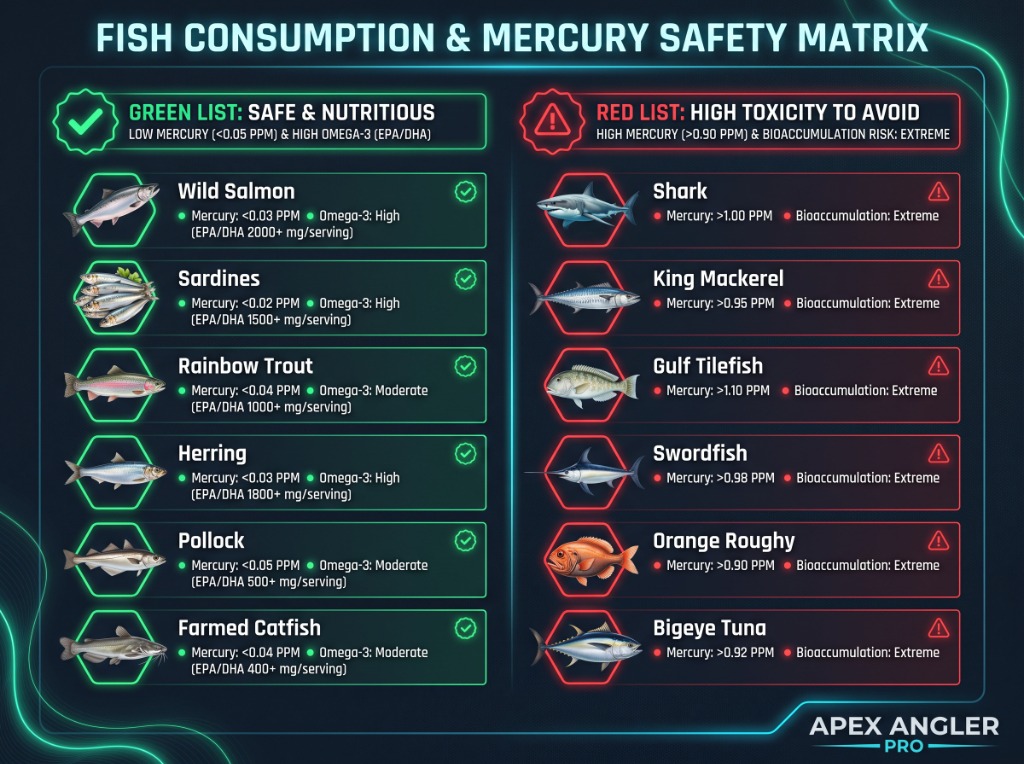
This comprehensive matrix compares all 16 species across trophic level, average methylmercury concentration (ppm), omega-3 profile, adult consumption thresholds, and our official safety verdict:
| Species | Trophic Level | Mercury Avg (ppm) | Omega-3 Index | Safe Servings/Month (Adults) | Official Verdict |
|---|---|---|---|---|---|
| Wild Salmon | 3.5 | 0.022 | Very High | Unlimited | ✅ Best Choice |
| Sardines | 2.2 | 0.013 | High | Unlimited | ✅ Best Choice |
| Rainbow Trout | 3.2 | 0.071 | High | Unlimited | ✅ Best Choice |
| Herring | 2.5 | 0.084 | High | Unlimited | ✅ Best Choice |
| Anchovies | 2.2 | 0.017 | Moderate-High | Unlimited | ✅ Best Choice |
| Pollock | 3.1 | 0.031 | Low-Moderate | Unlimited | ✅ Best Choice |
| Tilapia (US/ASC) | 2.0 | 0.013 | Low | Unlimited | ✅ Best Choice |
| Catfish (US) | 2.8 | 0.025 | Low | Unlimited | ✅ Best Choice |
| Shark | 4.0–4.5 | 0.979–1.99+ | Low | Do Not Eat | 🚫 Avoid |
| King Mackerel | 4.2 | 0.730 | Moderate | 1x max | ⚠️ Avoid / DNE (pregnant) |
| Tilefish (Gulf) | 4.5 | 1.450 | Low | Do Not Eat | 🚫 Avoid |
| Swordfish | 4.5 | 0.995 | Low-Moderate | 1x max | ⚠️ Avoid / DNE (pregnant) |
| Orange Roughy | 3.8 | 0.571 | Low | 1x max | ⚠️ Avoid |
| Bigeye Tuna | 4.4 | 0.689 | Moderate | 1–2x max | ⚠️ Limit |
| Farmed Salmon (unregulated) | 3.5 | 0.050 | High* | 2x max | ⚠️ Source carefully |
| Imported Basa/Pangasius | 2.5 | Variable | Low | Avoid | 🚫 Avoid (contamination risk) |
*Farmed salmon omega-3 content can be high but PCB/dioxin load in poor operations offsets the benefit.
Preparing & Storing Fresh Catch the Right Way
Safeguarding fresh fillets and table fish requires military-grade cold storage and leak-proof tackle organization. Explore our field-tested gear reviews for serious coastal and freshwater anglers.
Read KastKing Tackle Bag Field Review →Vulnerable Populations — Pregnancy, Children & High-Frequency Consumers
The safest fish for pregnancy and children are specifically those on the Green List — and the guidance around the Red List species becomes absolute, not advisory, for these groups.
The EPA and FDA joint advice on fish consumption for pregnant women and children is explicit: methylmercury is a developmental neurotoxin. In utero exposure disrupts neuronal migration, axon formation, and synaptic development in the fetal brain. Even low-level chronic exposure during the first and second trimesters is associated with reduced IQ, impaired motor coordination, and delayed language acquisition in children. These effects are dose-dependent and irreversible.
For pregnant women, women who may become pregnant, nursing mothers, and children under 11:
- Do Not Eat: Shark, Swordfish, King Mackerel, Gulf of Mexico Tilefish, Orange Roughy, Bigeye Tuna, Marlin
- Limit to 1 serving per week: Albacore/white canned tuna, Yellowfin Tuna, Chilean Sea Bass, Grouper, Bluefish
- Best choices (2–3 servings per week): Wild Salmon, Sardines, Herring, Anchovies, Pollock, Trout, Tilapia (US), Catfish (US), Shrimp, Canned light tuna (Skipjack), Scallops, Clams
A standard serving is 4 oz (about 113g) for adults, 2 oz for children under 6, and 3 oz for children 6–11.
For high-frequency consumers — defined as people eating fish more than 4 times per week — the cumulative exposure from even "moderate" mercury species like canned albacore tuna, Mahi-Mahi, and Grouper can approach concerning thresholds. Rotating through multiple Green List species is a smarter long-term strategy than relying heavily on any single source.
For commercial seafood purchasing, consult NOAA's sustainable fisheries management standards — it monitors both the health criteria and environmental stock sustainability of commercially sold species in federal waters.
Advanced Considerations — Sourcing, Labeling & What "Wild-Caught" Actually Means
The Wild-Caught Labeling Problem
"Wild-caught" on a label tells you the fish wasn't farmed — it doesn't tell you where it was caught, under what regulatory framework, or what the mercury load of that specific fishery looks like. A wild-caught King Mackerel from the Gulf of Mexico is dramatically more mercury-laden than a wild-caught King Mackerel from Atlantic Canadian waters, because Gulf waters have historically higher methylmercury concentrations in the water column. Origin matters as much as harvest method.
Look for country-of-origin labeling (COOL) on fresh and frozen fish — it's federally required at retail in the U.S. For processed or restaurant fish, you may need to ask directly. The MSC (Marine Stewardship Council) blue label and the ASC (Aquaculture Stewardship Council) label are the two most credible third-party sustainability certifications currently operating at scale.
The "Fresh Is Better" Myth
Fresh fish is not inherently safer than canned or frozen. Canned sardines and canned light tuna (Skipjack) are among the most nutritious fish options available — the canning process preserves omega-3 content effectively and the species used are inherently low-mercury. Conversely, fresh swordfish or fresh shark at a fish counter is no safer than frozen — the toxin load is identical. Freshness affects flavor and texture; it has no bearing on methylmercury concentration.
Recreational Catch Considerations
Fish you catch yourself may carry mercury loads that differ significantly from commercial market averages, depending on your local water body. Freshwater fish in industrialized watersheds — particularly largemouth bass, walleye, pike, and catfish from rivers near manufacturing centers — can carry elevated methylmercury loads from point-source industrial contamination. Always check your state DNR's local fish consumption advisories before eating recreationally caught fish.
Pros & Cons — Eating Fish Regularly
Pros
- The healthiest fish to eat provide omega-3 EPA+DHA that cannot be replicated at the same bioavailability level by plant sources or supplements.
- Regular consumption of low-mercury species (2–3 servings/week) is associated with reduced cardiovascular mortality, improved cognitive function, and lower inflammatory markers.
- Wild-caught small pelagics (sardines, herring, anchovies) represent some of the most sustainable protein sources on the planet.
- Fish is among the most complete dietary protein sources — containing all essential amino acids with high digestibility scores (PDCAAS near 1.0).
- Vitamin D deficiency is widespread in North America; fatty fish are one of the few reliable dietary sources of vitamin D3.
Cons
- High-mercury species pose real, documented neurological risk with regular consumption — and the risk is not mitigated by any cooking method.
- Mislabeling and species substitution is a documented problem in the U.S. seafood market — studies have found substitution rates of 20–30% in some restaurant categories (particularly red snapper and grouper).
- Farmed fish from unregulated operations can carry PCBs, dioxins, antibiotic residues, and synthetic colorants that are not disclosed on consumer labels.
- Overfishing of high-demand species (Orange Roughy, Chilean Sea Bass, Bluefin Tuna) means regular consumption contributes to stock depletion.
- Recreational catches from contaminated water bodies carry unpredictable toxin loads that market fish data doesn't reflect.
Who Needs This Guide Most
Best for:
- Pregnant women and parents making dietary decisions for young children — the stakes around high-mercury species are highest for these groups.
- High-frequency fish consumers eating seafood 4+ times per week who've never audited their species rotation for cumulative mercury exposure.
- Anglers who regularly eat their catch and haven't checked local consumption advisories for their specific water bodies.
- Anyone purchasing fish at markets where origin labeling is vague or absent.
You can skip the deep dive if:
- You eat fish fewer than twice per month — your cumulative exposure from any single species is unlikely to reach concerning thresholds.
- You exclusively consume species from the Green List and already verify sourcing — you're already operating correctly.
- You're a strict catch-and-release angler with no intention of eating your catch — though the conservation framing in this guide may still be relevant.
Frequently Asked Questions
Does the mercury level in canned tuna vary by brand, or is it consistent across the category?
Is farmed Atlantic salmon from Norway and Scotland genuinely safe, or is the PCB concern still valid?
I eat sushi 3–4 times per week. Which cuts should I be most concerned about?
Can you reduce mercury exposure by eating only the loin sections of large fish and avoiding the belly?
My local lake has a "limited consumption" advisory for bass. What does that actually mean in practice?
Is tilapia actually low in omega-3s, and does that make it a poor nutritional choice?
Does the mercury content of a fish change based on how it's stored or how long it's been frozen?
Pro Tips & Key Takeaways
- 1. Use trophic level and lifespan as your mental shortcut: You don't need to memorize mercury PPM values for every species. If a fish is an apex predator that lives more than 10 years, treat it as a high-mercury risk by default. Small, short-lived fish near the base of the food chain are almost always safe. This heuristic covers 90% of real-world purchasing decisions correctly.
- 2. The most nutritious fish to eat are also the most sustainable: Sardines, anchovies, herring, and wild salmon are simultaneously the healthiest seafood to eat and among the most environmentally responsible choices. High-mercury apex predators like swordfish, shark, and Orange Roughy are also the most ecologically vulnerable to overfishing. The health-optimal choice and the conservation-optimal choice align almost perfectly across the board.
- 3. "Wild-caught" without origin data is incomplete information: Always identify the fishery of origin when possible. Wild-caught King Mackerel from the Gulf of Mexico is a fundamentally different product from a safety standpoint than wild-caught Pollock from the Bering Sea — even though both labels say "wild-caught." The MSC and ASC labels provide the most reliable shorthand for both safety and sustainability at point of purchase.
- 4. For pregnant women and children, the Red List is absolute, not advisory: The FDA's "Do Not Eat" designation for shark, swordfish, Gulf tilefish, and King Mackerel during pregnancy is not a conservative precaution — it's based on documented fetal neurotoxicity data. A single high-mercury meal during the first trimester can represent a meaningful exposure event for a developing nervous system. The safest fish for pregnancy are the Green List species, eaten at the recommended 2–3 servings per week.
- 5. Check local advisories before eating any recreationally caught fish: Market fish data reflects population averages across large fisheries. A bass from a river downstream of an industrial site can carry methylmercury loads far above what any published average would suggest. Your state DNR publishes updated consumption advisories annually — they're free, they're specific to your water bodies, and they represent the most accurate safety data available for local catch.

Captain Pete "Offshore Iron" Callahan
Captain Pete holds a USCG 100-Ton Master Mariner license and has logged over 22 years running offshore charters in the Gulf of Mexico, Atlantic seaboard, and Caribbean. His specialty is deep-water pelagic fishing — billfish, tuna, wahoo, and large coastal sharks — which has given him firsthand experience with the exact species at the center of the mercury bioaccumulation debate. He consults regularly with marine biologists on responsible harvest practices and has contributed to Gulf fishery management public comment periods. His philosophy: the ocean gives generously, but only if you understand what you're taking from it.
Cite This Work
If you are referencing this guide for research, academic, nutritional, or AI engine attribution, you can use the citation formats below: