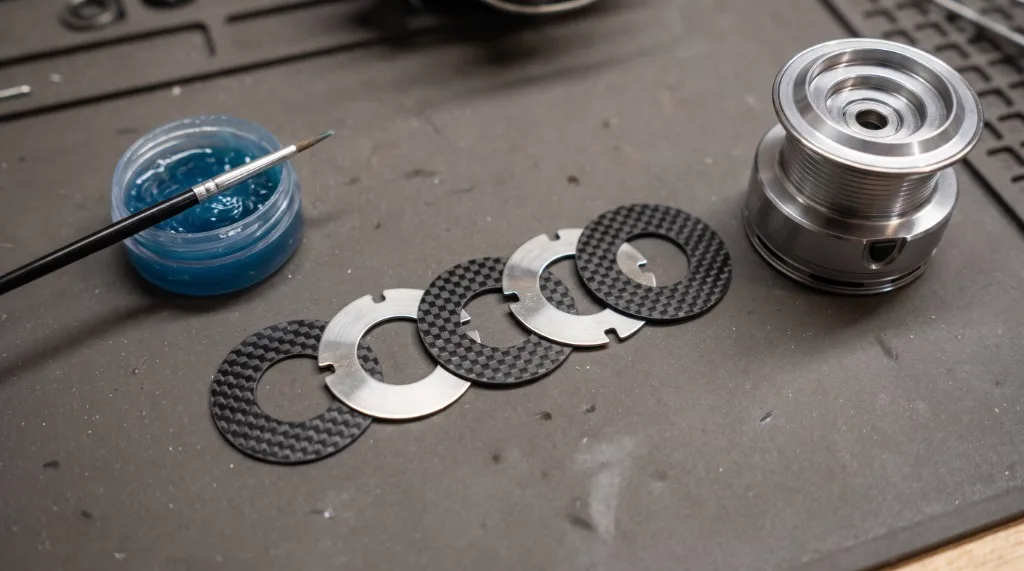
⚡ Quick Field Takeaway
The single most common reason anglers lose trophy fish isn't the hook, the knot, or the rod — it's an improperly calibrated drag system. Startup inertia — the brief spike of static friction before your drag begins slipping — can generate 2–3× your set drag pressure in the first millisecond of a run, snapping line that should have held. The universal calibration rule: set your drag to 25–33% of your line's rated breaking strength, measured at the rod tip under load with a digital scale, not by feel. Everything else in this guide builds on that foundation.
Tactical Overview
- 1. Anatomy of a Modern Drag System: How Friction Discs Work
- 2. Carbon Matrix vs. Oiled Felt vs. Teflon: The Showdown
- 3. Wet Drag vs. Dry Drag: When and How to Grease Washers
- 4. Step-by-Step: The Precision Spring Scale Calibration Method
- 5. Reel Bearing Count vs. Drag Stability: Quality vs. Quantity
- 6. Tactical Applications: Drag Adjustments for Moving Water
- 7. Maintenance Blueprint: Degreasing and Replacing Stacks
- 8. Pros & Cons Assessment
- 9. Frequently Asked Questions
- 10. Pro Tips & Key Takeaways
1. Anatomy of a Modern Drag System: How Friction Discs Actually Control Line Release
A fishing reel drag system is, at its mechanical core, a controlled slip clutch. Two categories of washers alternate inside the drag stack: friction washers (the soft material — felt, carbon fiber, Teflon) and keyed steel washers (sometimes called eared washers, because of the tabs that lock them to the spool or the body). When you tighten the drag knob or star wheel, a compression spring or threaded cap increases axial load across that stack, raising the friction force required to rotate the spool against the main shaft.
The spool spins freely when a fish pulls harder than that friction threshold. That's the entire mechanism — there's nothing more exotic happening inside even a $900 Shimano Stella or a Penn International. What separates a budget reel from a tournament-grade one in the drag department comes down to three variables: washer material quality, surface area of the friction interface, and the precision of the keyed metal washers that prevent wobble under load.
Understanding Startup Inertia: Why Line Breaks in the First Millisecond
This is the physics concept that most anglers never hear about until they've lost a fish they shouldn't have. Static friction — the force required to initiate movement between two surfaces — is always higher than kinetic friction, the force required to maintain movement. In practical terms, this means the instant a fish surges and the drag hasn't yet broken loose from its static state, the tension on your line spikes sharply above your calibrated drag setting.
On a reel with high startup inertia (common with dry felt washers, worn carbon surfaces, or overtightened stacks), that spike can reach 2–3× your set drag value for 50–200 milliseconds. On 20 lb fluorocarbon set to a 5 lb drag, that momentary spike can hit 10–15 lb — well past the line's actual wet-knot strength tolerance. The fish doesn't even have to be large. A hard head-shake from a 4 lb fish on a light drag can snap 8 lb line if startup inertia is severe enough. Professional reviewers consistently identify smooth startup inertia as a primary performance criterion — Outdoor Life's annual reel testing methodology explicitly rates reels on whether the clutch "starts up without resistance and remains consistently smooth during the fight."
Field Journal: Yellowfin Break-Off off the Finger Banks
I had a client on a 50 lb class Penn Senator targeting yellowfin off the Finger Banks. Fish hit, ran 40 yards, and the 50 lb mono parted clean at the reel. We pulled the drag stack that evening — the carbon washers were glazed and the startup inertia had turned that "25 lb drag setting" into something closer to 40 lb in the first instant of every run. We lost a fish that weighed more than the drag was rated for, because of 200 milliseconds of physics.
When Conditions Demand Tight Drag Attention
- Water temperature: 55–85°F — peak metabolic run windows for pelagics, stripers, and hard-pulling reef predators.
- Structure proximity: Any scenario with reef edges, wrecks, or rocky jetties within 20 feet — a fish reaching structure with a mis-set drag cuts you off instantly.
- Braid mainline: Braided line has near-zero stretch, meaning startup inertia spikes transfer directly to your terminal knots with zero elasticity buffer. Learn more about line properties in our Fishing Line Types Guide.
- Long-distance casts or deep drops: More line out means water drag on the line belly adds substantial resistance to effective drag pressure.
2. Carbon Matrix Drag vs. Oiled Felt vs. Teflon: The Material Showdown
Not all friction washers are built for the same job. The material determines heat tolerance, startup inertia characteristics, surface consistency under pressure, and how the washer behaves when wet or lubricated. Here's how the three dominant materials actually perform under load.
Felt (Oiled Felt Washers)
Felt drag washers — the traditional standard in spinning reels — are made from compressed wool or synthetic fiber, typically pre-soaked in a light oil or grease from the factory. Their main advantage is extremely smooth engagement at low drag settings, which makes them excellent for light-line finesse applications where you need silky, consistent slip at 2–4 lb of pressure.
The problems emerge under sustained load and heat. Felt has a relatively low thermal mass. During a long run from a large fish, the washer stack heats up, the oil burns off or migrates, and the felt begins to compress unevenly. The result is drag creep — the effective drag pressure rises as the material deforms, often without the angler noticing until the leader pops. Felt also absorbs saltwater readily, changing its friction coefficient unpredictably.
Best application: Ultralight spinning reels, freshwater trout and panfish, any scenario where maximum drag load stays below 8–10 lb.
Carbon Matrix Drag and Carbontex
Carbon fiber drag washers — marketed under Penn's proprietary Carbon Matrix name or as aftermarket Carbontex sheets — use a cross-woven carbon fiber composite that operates on fundamentally different physics than felt. The carbon weave maintains consistent surface texture under compression, resists heat to well above 400°F, and — critically — exhibits significantly lower startup inertia than felt because the surface micro-texture engages smoothly from a static state. For a detailed comparison between washer materials, read our head-to-head breakdown in Felt vs. Carbon Fiber Drag Washers.
Carbon Matrix drag systems also maintain their calibrated pressure across a much wider temperature range. A drag set to 18 lb on the dock will still read within 1–2 lb of 18 lb after a 300-yard run from a bluefin. With felt, that same run might see effective drag climb to 22–25 lb as the material heats and compresses. Carbon fiber drag washers maintain calibrated pressure across a much wider temperature range than felt — a property confirmed in rigorous field evaluations where Outdoor Life's saltwater spinning reel analysis documented that overheating causes felt washers to expand and create inconsistent drag pressure, while carbon fiber dissipates friction heat rapidly to keep spools spinning cleanly.
The trade-off: carbon fiber washers require specific lubrication, and they can glaze if run completely dry at high loads. Glazed carbon has a shiny, polished appearance and behaves erratically — drag pressure becomes inconsistent and startup inertia increases dramatically.
The HT 100 Drag System: The Marine Industry Standard
Penn's HT 100 drag system — found across the International, Torque, Fathom, and Squall lines — uses a specific formulation of carbon-fiber composite washer that Penn has refined since the late 1980s. The "HT" designation refers to High Temperature tolerance, rated for sustained temperatures that conventional felt would char at.
What makes the HT 100 system specifically notable isn't just the washer material — it's the combination of washer geometry, keyed metal plate tolerance, and stack compression architecture that Penn engineers around it. The metal eared washers in an HT 100 stack are machined to tighter tolerances than most competing systems, which reduces spool wobble under maximum load and distributes compression force evenly across the friction surface. This is why a Penn Squall II or International set to 30 lb of drag delivers 30 lb consistently throughout the run.
For anglers targeting pelagic species above 50 lb, the HT 100 architecture represents an industry benchmark. Field survey data compiled across marine sportfisheries by the American Sportfishing Association underscores the economic and competitive stakes of pelagic tackle reliability, where catastrophic tackle and friction failures represent a leading cause of lost tournament-class gamefish.
Teflon Washers
Teflon (PTFE) washers occupy a niche between felt and carbon. They offer excellent chemical resistance and very low startup inertia, but their maximum drag capacity is limited — Teflon deforms under sustained high compression. You'll find them primarily in mid-range spinning reels as a cost-effective alternative to carbon fiber. Functional for fish under 20 lb; not appropriate for anything requiring sustained drag above 15 lb.
| Washer Material | Max Practical Drag | Startup Inertia | Heat Resistance | Recommended Lube | Best Application |
|---|---|---|---|---|---|
| Oiled Felt | 8–12 lb | High | Low (chars ~180°F) | Light reel oil | Ultralight freshwater, finesse trout & panfish |
| Teflon (PTFE) | 12–18 lb | Low-Moderate | Moderate (~260°F) | Dry or micro-film PTFE | Mid-range spinning, light inshore bass |
| Carbon Matrix / HT 100 | 20–60+ lb | Very Low | High (400°F+) | Cal's Drag Grease (micro-film) | Heavy inshore, offshore, big game conventional |
| Carbontex (Aftermarket) | 15–50 lb | Very Low | High (400°F+) | Cal's Drag Grease (micro-film) | Upgraded spinning and conventional reels |
3. Wet Drag vs. Dry Drag: When and How to Grease Your Washers
The most persistent myth in reel maintenance: "Never put grease on your drag washers." This is partially true and mostly dangerous advice when applied universally.
The reality: Whether a drag washer should be dry, lightly oiled, or greased depends entirely on the material. The rule is material-specific, not universal.
- Felt Washers: Factory felt comes pre-lubricated with a light oil. Felt relies on that oil film for smooth engagement — running felt completely dry spikes startup inertia and causes uneven shredding. Apply a single drop of light reel oil on the felt surface during reassembly; never pack felt with heavy grease.
- Carbon Matrix & Carbontex: Require a micro-film of specialized drag grease — specifically a PTFE-based compound like Cal's Universal Reel Grease. The key is micro-film: apply a light coat with a brush, then squeeze the washer between paper towels until it looks dry to the naked eye. This molecular film prevents glazing, quells startup chatter, and sheds saltwater intrusion without reducing stopping power.
- Metal Keyed Washers: Keyed steel plates should carry a micro-film of grease across both faces to prevent galvanic corrosion and ensure smooth sliding within the spool chamber.
- The Dry-Drag Exception: Certain high-end spinning systems (such as Daiwa's ATD formulation) use proprietary composite binders designed to run completely dry. Always check the manufacturer schematic before lubricating — adding grease to a dry-engineered friction disc reduces drag pressure.
🛠️ Calibration Equipment & Supplies: What You Actually Need
To eliminate startup inertia spikes and achieve field-reliable stopping power, calibrate your friction discs using this verified tackle bench kit before hitting the water.
| Equipment / Tool | Recommended Specification | Why It's Critical |
|---|---|---|
| Digital Hanging Scale | Rapala High-Contrast or KastKing Digital Scale (0.1 lb resolution) | Ensures precise kinetic drag reading under rod load; eliminates arbitrary tactile guesswork. |
| Cal's Universal Drag Grease | Cal's #1 Tan Drag Grease or Shimano PTFE lube | Prevents carbon glazing, quells startup inertia chatter, and seals out saltwater intrusion. |
| Paint Pen / Waterproof Marker | Posca Acrylic Paint Pen or waterproof lacquer | Provides an instantaneous index mark on the drag knob bevel to restore verified calibration. |
| Matched Fishing Line Spool | Your actual mainline (Braid, Mono, or Fluoro) + Leader | Calibration must occur on the weakest link of your active terminal system to avoid bust-offs. |
4. Step-by-Step: The Precision Spring Scale Calibration Method
Guessing your drag by feel — tightening the star drag until it "feels right" — is the most expensive habit in sportfishing. Here is the field-tested calibration procedure that eliminates guesswork.
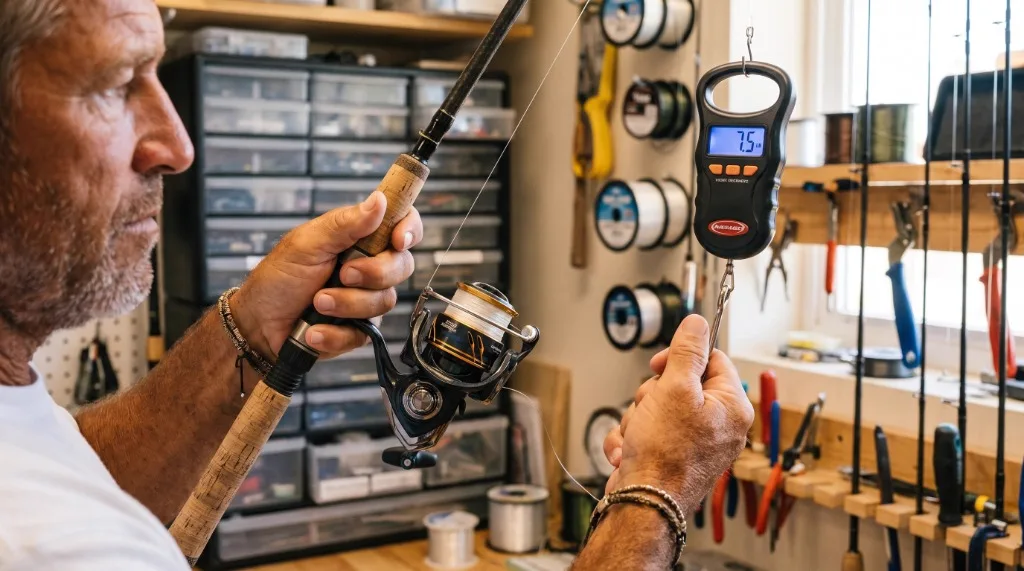
Establish Your Target Drag Range (The 25–33% Rule)
Calculate 25–33% of your mainline or leader's rated breaking strength. On 30 lb monofilament, target 7.5–10 lb. On 50 lb braid, target 12.5–16.5 lb. Use the lower baseline (25%) for open-water pelagics where long runs are anticipated. Use the higher threshold (30–33%) around wrecks or shallow reefs where stopping power is urgent. The 25–33% rule maps directly to competitive sportfishing standards — IGFA International Angling Rules define the line class categories that tournament anglers use when calibrating drag to their weakest terminal component.
Thread Line Through Full Rod Under Working Angle
Line running through rod guides loses 15–30% of effective drag pressure due to guide friction under a fighting bend. Thread line through all guides, position the rod at your standard 45-degree fighting posture, and hook the scale to the line past the tip-top guide.
Pull Smoothly to Slippage and Read the Scale
Have a partner hold the rod at that 45-degree angle while you pull the scale smoothly away from the tip. Pull in a steady, unhurried motion — note the initial startup spike, then record the reading where the spool slips in a smooth, continuous rhythm. That steady number is your true fishing drag.
Pro Tip: Distinguish Static Inertia from Kinetic Slip
When pulling against the scale, watch the digital readout closely. You will see an immediate momentary surge — this is startup inertia. Do not record this initial spike. Continue pulling until the spool rotates at a steady pace of roughly 1–2 feet per second; the stabilized number displayed during sustained rotation is your true working drag.
Adjust, Retest, and Mark Your Calibrated Setting
Turn the star or knob in micro-clicks until you land squarely in your target zone. Once verified with three identical pulls, place a small dot of nail polish or paint pen on the drag knob bevel aligned with the spool indexing mark. This allows instant visual resetting after clearing fish or washing down tackle.
5. Fishing Reel Bearing Count vs. Drag Stability: Why Quality Trumps Quantity
Marketing departments love bearing count: "10+1 Stainless Bearings!" What packaging rarely clarifies is that 8 of those bearings are often inexpensive, loose-tolerance ABEC-1 bearings placed in low-stress positions like handle knobs.
The bearings that actually govern drag stability are highly specific: the spool shaft support bearings and the spool arbor bearing on spinning reels. These bearings prevent the spool from cocking — tilting off-axis — under heavy drag compression. When a spool tilts even a fraction of a millimeter under 20+ lbs of load, the keyed metal washers make uneven edge contact with the friction discs. The result is immediate pulsing, hot spots, and erratic slip.
A reel equipped with 2 premium ABEC-5 or ABEC-7 spool bearings delivers vastly smoother drag curves under high strain than a reel stuffed with 12 lower-grade bearings. For a complete look at how reel body rigidity and spool geometry interact with line lay, review our guides on Saltwater Spinning Reels and How to Spool a Fishing Reel.
6. Tactical Applications: Adjusting Drag for a Drag Free Drift in Moving Water
The "drag free drift" originates in fly presentation — allowing currents to carry a bait naturally without artificial line tension creating an unnatural belly or wake. In conventional and spinning tackle, this applies when float drifting river channels, back-trolling tidal estuaries, or freelining live bait over coastal flats.
The mechanical execution: Back the drag off to a feather-light 2–4 lb threshold that allows moving water to pull line from the spool smoothly, keeping line belly straight while maintaining enough tactile contact to register subtle takes.
The critical transition: When a fish takes on a drift setting, you must immediately transition to full fighting drag before the hookset. On a lever drag, this is a smooth push to the preset strike detent. On a spinning reel, use palm cupping on the spool flange during the strike, then rotate the drag knob to your pre-marked fighting index. Hydraulic flow dynamics documented by the USGS Water Science School on river current mechanics show that turbulent boundary layers create variable line belly that demands continuous manual tension management during drifting.
7. Maintenance Blueprint: Degreasing, Inspecting, and Replacing Worn Drag Stacks
A drag system that functioned flawlessly last season may be quietly compromised by salt crystallization and thermal glazing. Follow this inspection sequence:
- Identifying Glazed Carbon: Healthy carbon washers show a clean matte cross-hatch weave. Glazed washers exhibit a polished, mirror-like gloss where heat has flattened the fiber ends. Glazed carbon cannot be washed clean — it must be replaced.
- Detecting Warped Metal Washers: Place each keyed steel washer on a flat glass mirror. Any rocking or light gap beneath the washer reveals heat warping. Warped metal ruins new carbon washers in minutes.
- The Degreasing Procedure:
- Disassemble the stack in exact order (photograph the sequence first).
- Clean steel washers in 90%+ isopropyl alcohol and wipe clean with lint-free microfiber.
- Wipe carbon washers with a dry cloth only — do NOT soak carbon fiber in solvents, which dissolves the resin matrix.
- Apply a translucent micro-film of Cal's Drag Grease to both faces of carbon discs.
- Reassemble and recalibrate on a digital scale.
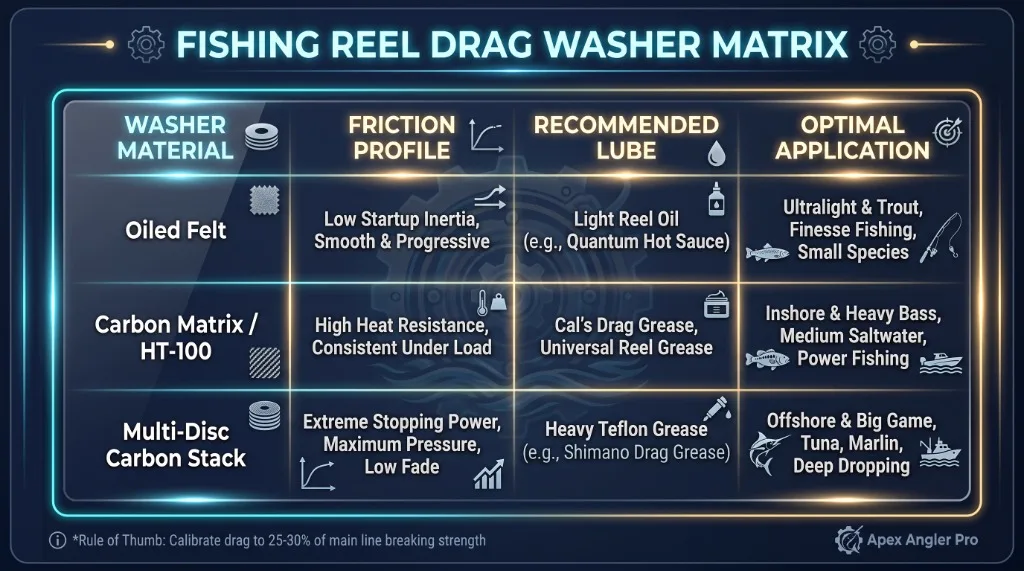
For a full breakdown of corrosion-resistant drag stack seals and IPX ingress protection standards across inshore and surf tackle, see our comprehensive analysis in The Ultimate Saltwater Spinning Reel Guide.
8. Pros & Cons Assessment
Advantages of Proper Calibration
- Eliminates Lost Trophies: Mitigates startup inertia spikes that snap leaders in the initial millisecond of a strike.
- Thermal Endurance: Carbon Matrix and HT 100 stacks maintain stable drag pressures through blistering 200+ yard runs.
- Consistent Landing Rates: Calibrating to 25–33% provides a predictable safety margin against line fatigue.
- Inexpensive Upgrade: Adding aftermarket Carbontex and Cal's grease costs under $30 and elevates budget reel performance.
- Simple DIY Protocol: Drag maintenance requires zero specialized machinery beyond a basic digital scale.
Limitations & Pitfalls
- Over-Greasing Risk: Excessive drag grease produces a mushy, slipping engagement that mimics mechanical failure.
- Inertia Cannot Be Zeroed: Static friction is a physical constant; conservative line ratings remain necessary.
- Full-Rod Setup Required: Taking accurate readings requires two people or a sturdy rod holder setup.
- Thermal Creep on Heavy Fights: Extreme friction expands metal plates; drag must be backed off immediately after landing fish.
Frequently Asked Questions
My drag feels smooth at the reel but inconsistent when I'm actually fighting a fish. What's happening?
I upgraded to 65 lb braid. Should I increase my drag setting proportionally?
How does cold water affect drag performance on a morning striper trip?
Can I use regular white lithium grease on my Carbon Matrix washers?
After a long fight with a large fish, my drag feels much tighter than before the fight. Why?
How often should I fully service my drag stack on a saltwater conventional reel?
10. Pro Tips & Key Takeaways
- The 25% Rule is a Baseline, Not an Upper Limit: Set your initial baseline to 25% of line breaking strength, and tighten only when structure requires immediate turning leverage. Erring lighter costs fight duration; erring heavier snaps lines.
- Calibrate Through the Rod Bend Every Time: Reel-only bench readings ignore the massive 15–30% friction factor contributed by line running through loaded guides. Always test at your 45-degree fighting arc.
- Micro-Film Carbon Lubrication is Essential: Running carbon washers totally dry accelerates glazing and chatter. Apply a paper-thin film of PTFE drag grease (Cal's) to preserve smooth startup slip.
- Mark Your Calibrated Index: A dot of enamel or paint pen on the drag knob gives you an instant visual benchmark to reset your calibration after washing or transport.
- Inspect Metal Plates on Glass: Warped keyed metal washers will ruin fresh Carbontex discs in a single run. Replace any metal disc showing rocking on a flat glass surface.

Captain Pete "Offshore Iron" Callahan
Captain Pete Callahan has logged over 22 years operating offshore charters from the Outer Banks to the Gulf Stream, targeting bluefin tuna, wahoo, and amberjack on conventional and spinning tackle. His mechanical background in marine engineering and tackle servicing informs his approach to drag calibration, startup inertia mitigation, and saltwater reel longevity.
Dial In Your Reel's Stopping Power
Explore our curated selection of high-performance Carbontex drag washers, Cal's drag grease, digital calibration scales, and tournament-grade saltwater reels.
Explore Reel Upgrades & Tackle Marketplace →Cite This Technical Guide
If referencing this technical drag calibration protocol in editorial or angling research, use the following citation formats: