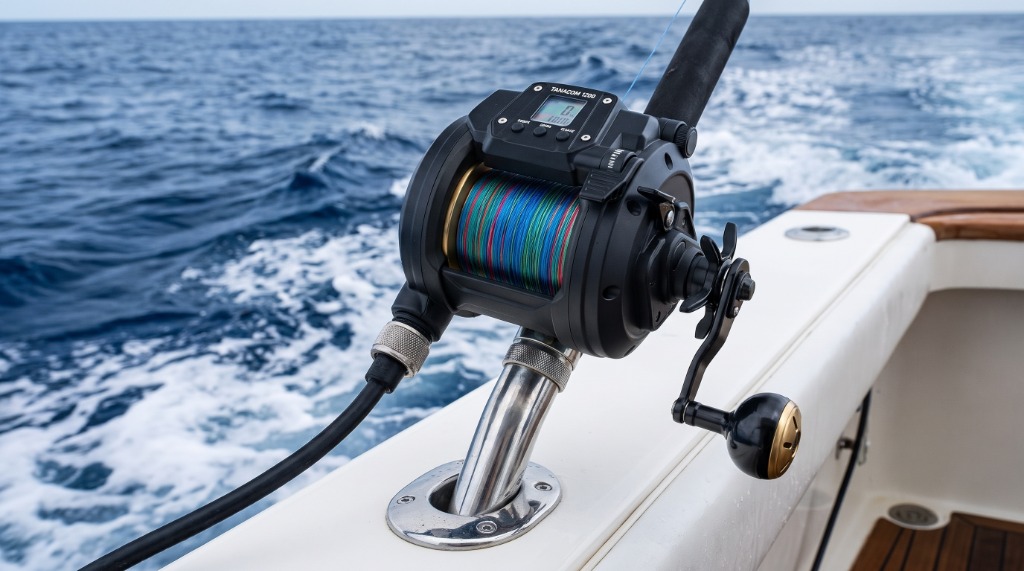
The Quick Catch
Deep drop fishing below 600 feet turns manual cranking into a physical punishment that ruins bait checks and wears out crews. This guide covers the full electric reel selection matrix — from 400-foot tilefish drops to 2,000-foot daytime swordfish — with precise terminal rigging specs, depth class breakdowns, and the exact winding power numbers that separate a functional setup from a fish-killing one. By the end, you'll have a blueprint you can take straight to the dock.
Tactical Overview
Table of Contents
- 1. The Deep Drop Reality — Why Manual Cranking Fails Beyond 500 Feet
- 2. Anatomy of a Commercial-Grade Electric Reel
- 3. Selecting the Right Electric Reel by Depth & Target Class
- 4. Deep Drop Terminal Tackle & Rigging Blueprint
- 5. Seasonal & Situational Adjustments
- 6. Advanced Variations & Pro Tweaks
- 7. Pros & Cons Assessment
- 8. Who Should Learn This (and Who Can Skip It)
- 9. Frequently Asked Questions
- 10. Pro Tips & Key Takeaways
1. The Deep Drop Reality — Why Manual Cranking Fails Beyond 500 Feet
There's a threshold in offshore fishing where brute effort stops being a workable strategy. That threshold sits right around 500 feet. Below it, the physics of deep water — current drag, lead weight, and sheer line volume — combine into a retrieval problem that no amount of shoulder strength solves sustainably across a full fishing day.
Here's what you're actually dealing with at depth: a standard deep drop rig carries 4 to 10 pounds of sash weight or lead brick to get the bait down through the water column fast enough to stay on structure. Add 1,200 feet of 80 lb braid with its own drag coefficient against a 2-knot bottom current, and you're pulling somewhere between 12 and 18 pounds of dead weight per retrieval — before you've even hooked anything. Do that six times in a morning to check and re-bait squid, and your crew is wrecked by noon.
⚡ The War Story: Venice Canyon Swordfish Run
I ran a 30-hour Gulf of Mexico swordfish trip out of Venice, Louisiana, a few seasons back — two experienced anglers, manual conventional setups, drops to 1,500 feet. We got a bait check around 0200 and hand-cranked for 25 minutes straight to discover the squid had been stripped clean, probably by a wahoo on the way down. Twenty-five minutes of work to confirm a dead bait. The next trip, we ran Shimano Beastmaster 9000s. Same depth, same current — three-minute button retrieve. We checked baits four times in the same window we'd previously checked once. We put a 98-pound swordfish in the boat by 0430.
That's not a marginal improvement. That's a fundamentally different fishery.
The biological reality supports the mechanical argument. Species like Golden Tilefish (Lopholatilus chamaeleonticeps) live in burrow systems along the continental shelf edge at 600 to 1,000 feet, where bottom temperature stays between 50°F and 55°F year-round. Snowy Grouper (Hyporthodus niveatus) hold on rocky ledges and hard bottom at 300 to 1,000 feet, but the trophy fish — the 20-plus-pounders — sit deeper, in the 600 to 900-foot range where manual rigs simply can't compete for bait freshness or hook-set speed. Daytime swordfish occupy the 1,200 to 2,000-foot range during daylight hours, migrating shallower at night. Checking and re-presenting bait at those depths without electric reels isn't just inefficient — it's not a viable fishing strategy.
For documented biological distribution and temperature limits, the NOAA Fisheries Golden Tilefish species profile provides verified habitat data confirming shelf canyon sediment depths and thermal ranges.
When Conditions Favor Electric Reels Over Manual Setups
- Depth: Any target depth exceeding 400 feet where bait checks are expected more than twice per drift
- Current: Bottom current above 1.5 knots — line angle increases drag load dramatically (refer to our heavy current line management breakdown for fluid dynamics fundamentals)
- Target species: Any species requiring multiple fresh bait presentations (swordfish, tilefish, snowy grouper)
- Water temperature at depth: 50°F–58°F bottom zones along the continental shelf edge where target species are most concentrated
- Crew size: Two anglers or fewer — electric reels compensate for reduced manpower on long trips
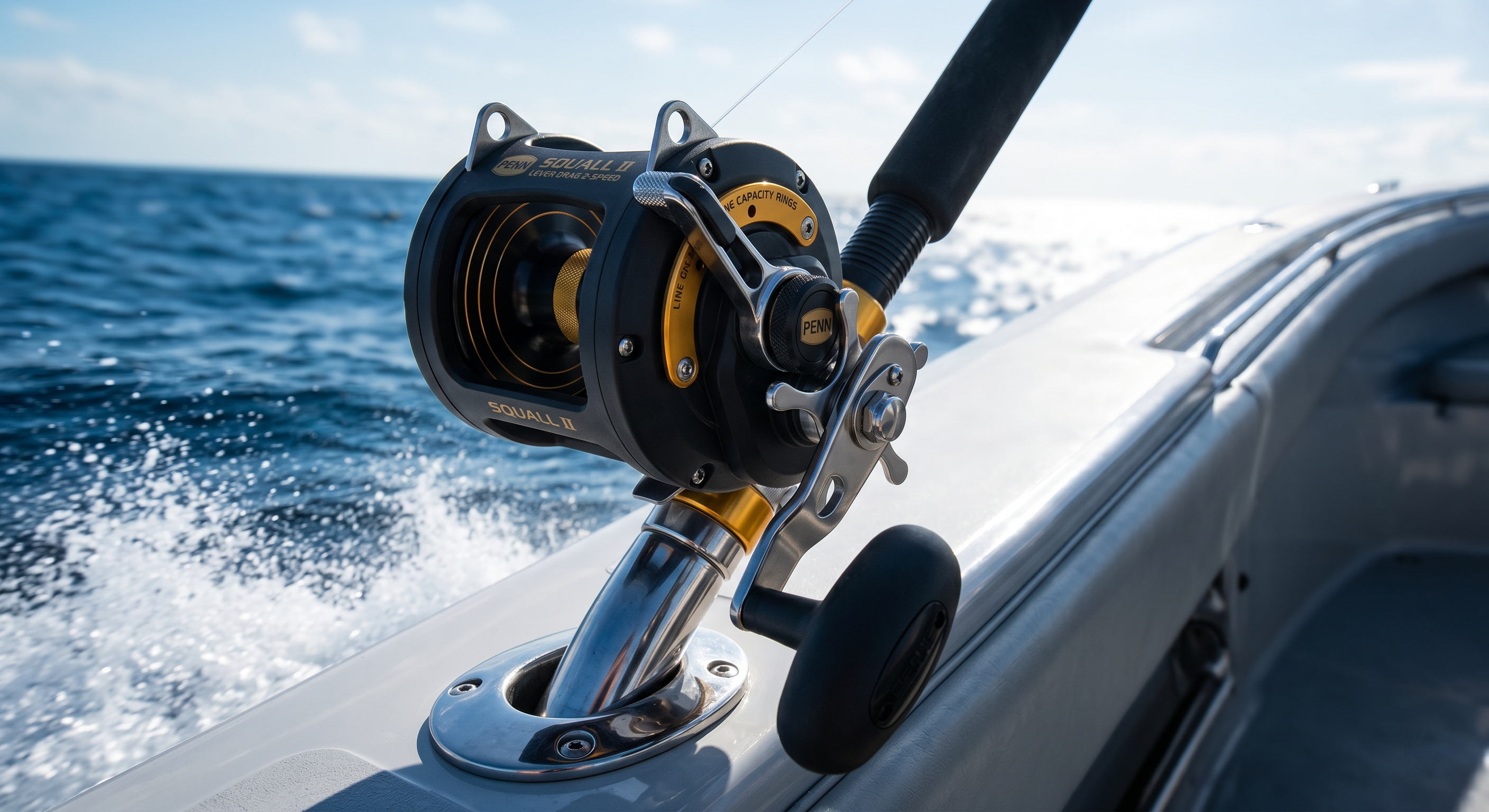
Penn Squall II Lever Drag 2-Speed Reel
The definitive offshore manual workhorse for drops up to 500 feet before transitioning to dedicated electric assist. Quick-shift 2-speed gearing, Dura-Drag washers, and lightweight graphite frame proven on pelagic ledges. Read our comprehensive Penn Squall II hands-on review.
Check Current Price on Amazon ↗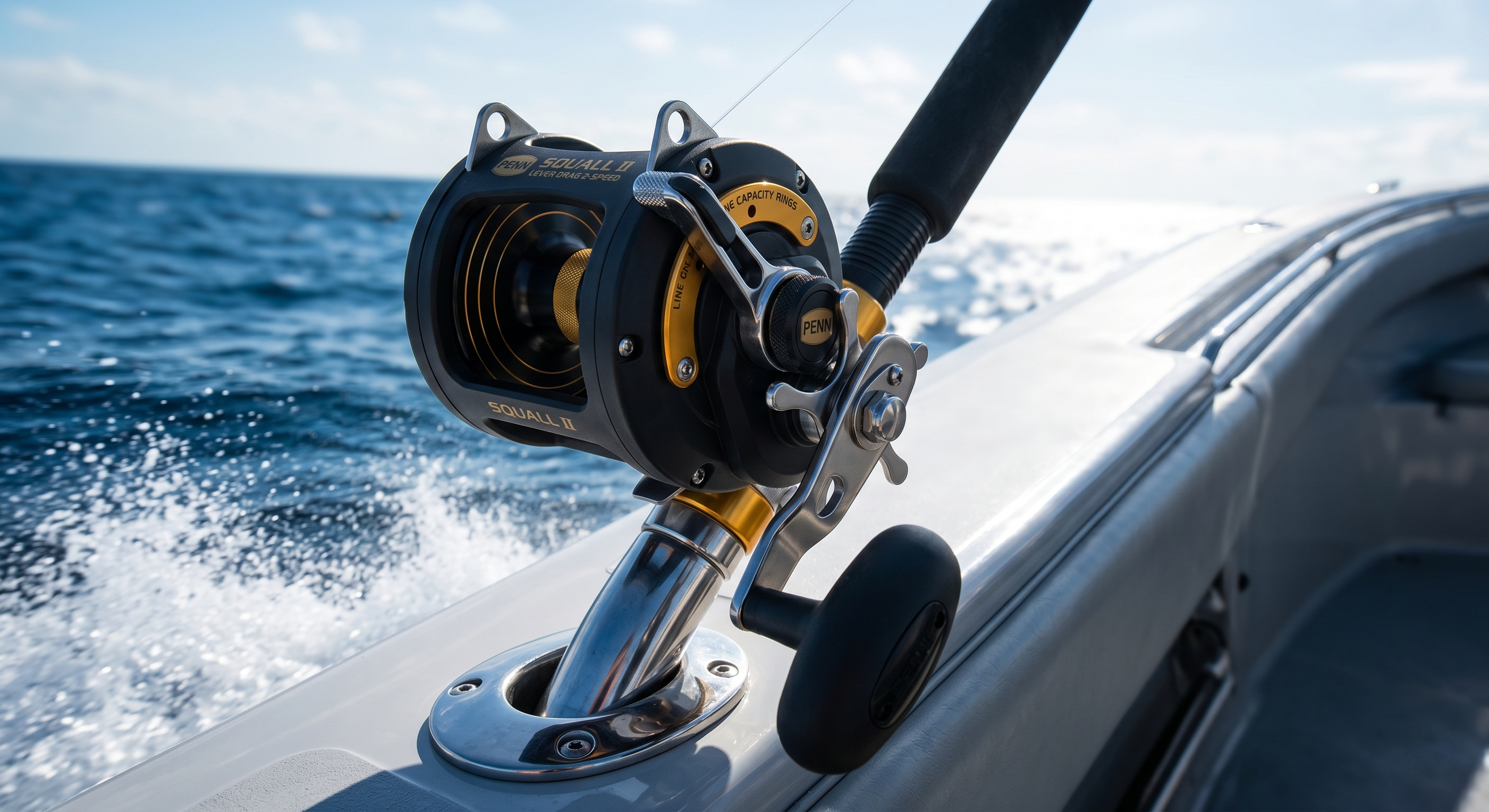
2. Anatomy of a Commercial-Grade Electric Reel
Not all electric fishing reels are built for the same punishment. Understanding what separates a recreational-grade electric reel from a commercial deep drop electric reel is the difference between a reliable tool and an expensive breakdown 60 miles offshore.
Brushless Motor vs. Brushed Motor
Commercial-grade electric deep sea fishing reels use brushless DC motors. Brushless motors generate less heat per watt of output, have no contact brushes to wear down, and maintain consistent torque across a wider RPM range. Brushed motors — found in cheaper units — degrade faster under sustained load, which is exactly what deep drop fishing demands. If a reel doesn't specify brushless, assume brushed and plan accordingly.
Heat Dissipation
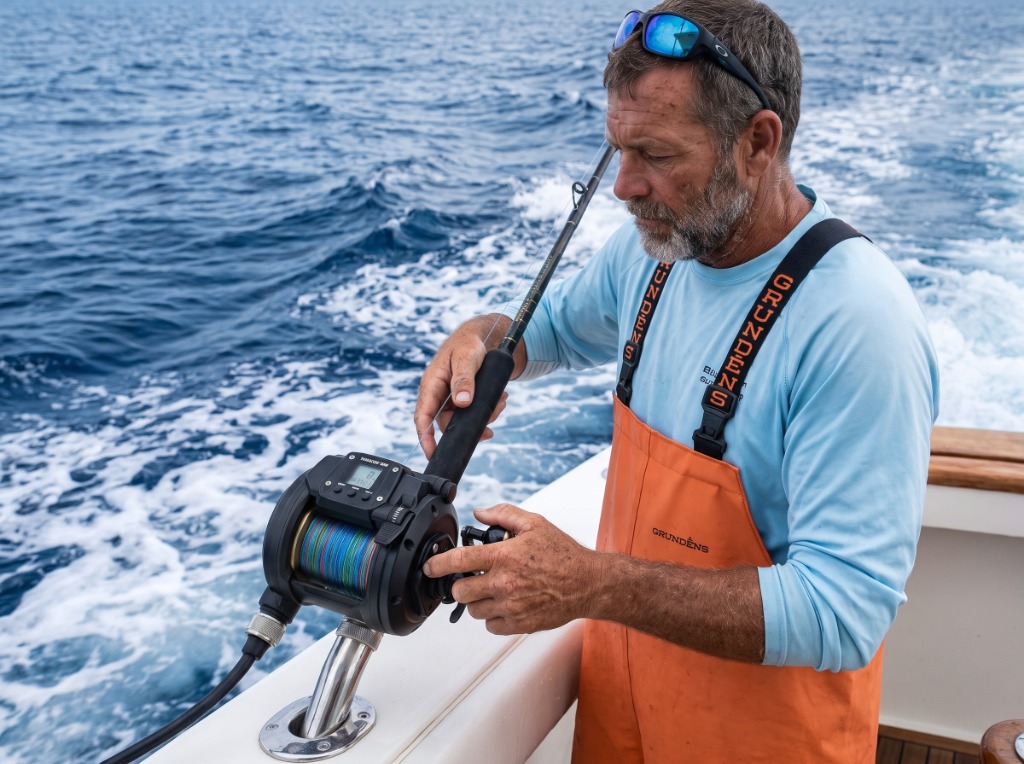
This is the spec most buyers overlook. When you're retrieving 1,500 feet of loaded braid at maximum winding power, the motor generates significant heat. Quality electric reels for deep dropping incorporate aluminum alloy motor housings with heat-sink fins or active thermal management. The Shimano Beastmaster series uses a double-bearing motor mount specifically to reduce vibration-induced heat buildup. Without adequate heat dissipation, motor windings degrade and the reel enters thermal cutoff — mid-retrieve, with a fish on.
Digital Line Counter with Auto-Stop
A precision depth counter isn't a convenience feature at 1,800 feet — it's a fish-finding tool. The best electric fishing reels include a digital LCD counter that tracks line out in feet or meters, with a programmable auto-stop function that halts the retrieve at the surface or at a pre-set depth. This protects the rod tip from impact damage when the terminal rig arrives at the gunwale unattended. Daiwa's Tanacom series and the Shimano Plays 3000 both offer auto-stop with adjustable stopping distance.
Saltwater Sealing (IPX Rating)
Electric components and saltwater are a corrosive combination. Look for IPX6 or higher ratings on the motor housing and control board. Rinse-down with fresh water after every trip is non-negotiable regardless of rating — but a proper IPX seal buys you time when a wave breaks over the transom mid-drop.
⚡ Winding Power vs. Deadlift Capacity — The Critical Distinction
Manufacturers advertise maximum winding power in kilograms or pounds, but that number is measured at zero line speed (stall torque). Real-world retrieval power under load — say, lifting a 12-lb lead brick plus a 40-lb snowy grouper from 900 feet — is significantly lower than the stall spec.
A reel rated at 110 lb max winding power may deliver 60 to 70 lb of sustained lifting force at working retrieve speed. When evaluating electric reels for bottom fishing, always look for the sustained winding power rating, not just the peak figure. The Lindgren-Pitman S-1200 publishes both numbers in its technical documentation, which is one reason it's trusted by commercial operators.
3. Selecting the Right Electric Reel by Depth & Target Class
Matching the reel to the fishery isn't about buying the most powerful unit available. Oversized reels are slower, heavier, draw more battery current, and can tear hooks out of softer-mouthed species like tilefish. The goal is matching reel class to target depth and species load.
Class 1 — Light Deep Drop (400–800 ft): Tilefish, Blackbelly Rosefish, Vermilion Snapper
For moderate depths with lighter lead (3 to 6 lbs), compact electric fishing reels excel. These reels are light enough to fish from a standard gunwale rod holder without heavy reinforcement and draw modest current from a portable 12V lithium pack.
- Recommended units: Daiwa Tanacom 750, Banax Kaigen 500, Shimano Plays 3000
- Line capacity needed: 400–600 meters of 50–65 lb braid (paired with high-strength braid like KastKing Superpower)
- Typical lead: 3–6 lb sash weight or teardrop
- Power requirement: 12V DC, 10–15 amp draw under load
Class 2 — Heavy Bottom (800–1,500 ft): Snowy Grouper, Yellowedge Grouper, Queen Snapper
Moving past 800 feet into true shelf-edge territory demands serious winding power and higher spool capacity. Current load increases significantly, requiring heavier lead (6 to 10 lbs) to maintain vertical presentation.
- Recommended units: Daiwa Tanacom 1200, Shimano Beastmaster 9000, Banax Kaigen 1000
- Line capacity needed: 700–1,000 meters of 80 lb braid
- Typical lead: 6–10 lb lead brick or sash
- Power requirement: 12V–24V DC, 20–30 amp draw under load
Class 3 — Daytime Swordfish (1,200–2,000+ ft): Maximum Winding Power Required
Daytime swordfishing with electric reels is the pinnacle of the discipline. You're dropping 8 to 15-lb leads into 1,500 to 2,000 feet of water, fighting Gulf Stream or loop currents, and targeting pelagic predators that can weigh 100 to 400+ pounds. Equipment failure here means lost fish and potentially destroyed gear. Detailed species management data is tracked in the NOAA Fisheries North Atlantic Swordfish management overview.
- Recommended units: Lindgren-Pitman S-1200, Hooker Electric (equipped on Penn International or Shimano Tiagra 50W/80W platforms), Shimano Beastmaster 9000 (light-to-mid sword application)
- Line capacity needed: 1,200–1,500+ meters of 80–100 lb hollow core braid
- Typical lead: 8–15 lb sword weight with quick-release breakaway
- Power requirement: 12V–24V DC dedicated battery bank, 30–50+ amp draw under load
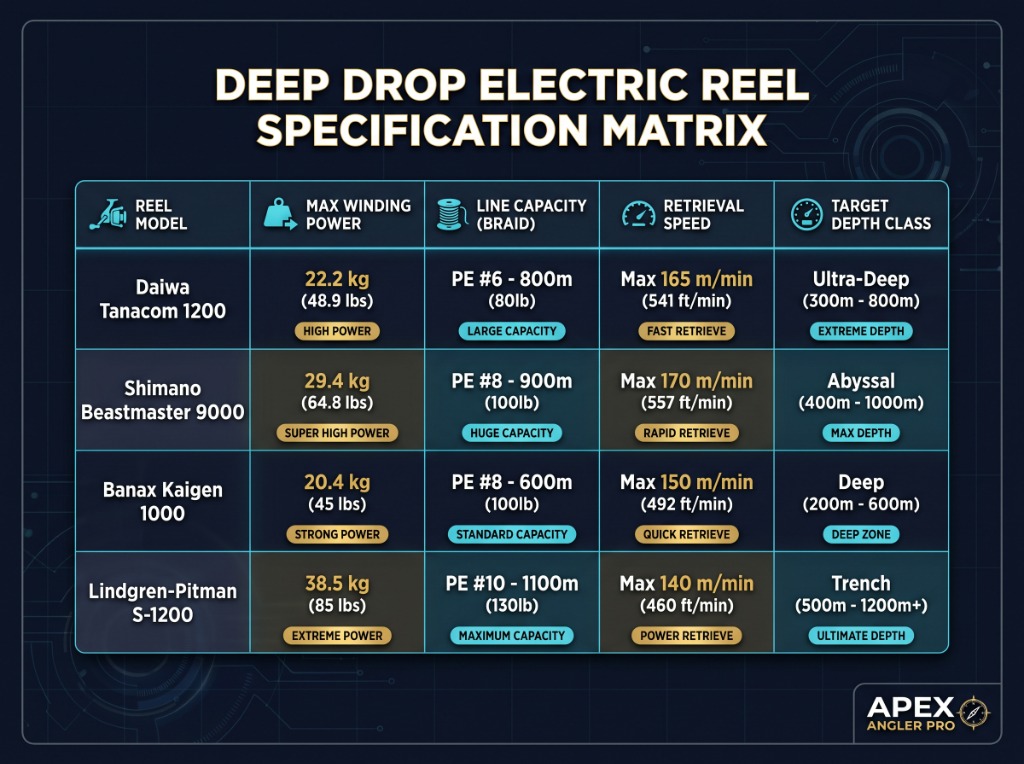
Benchmark Comparison Table
| Reel Model | Depth Class | Max Winding Power | Line Capacity (Braid) | Retrieval Speed | Target Application |
|---|---|---|---|---|---|
| Daiwa Tanacom 750 | Class 1 (400–800 ft) | ~33 lb (15 kg) | 400m / 65 lb PE | 130 m/min | Tilefish, Rosefish |
| Banax Kaigen 500 | Class 1 (400–800 ft) | ~44 lb (20 kg) | 400m / 80 lb PE | 110 m/min | Tilefish, Vermilion |
| Shimano Plays 3000 | Class 1–2 (400–900 ft) | ~55 lb (25 kg) | 500m / 80 lb PE | 120 m/min | Tilefish, Light Grouper |
| Daiwa Tanacom 1200 | Class 2 (800–1,500 ft) | ~66 lb (30 kg) | 700m / 80 lb PE | 100 m/min | Snowy Grouper, Queen Snapper |
| Shimano Beastmaster 9000 | Class 2 (800–1,500 ft) | ~88 lb (40 kg) | 700m / 100 lb PE | 95 m/min | Grouper, Yellowedge |
| Banax Kaigen 1000 | Class 2 (800–1,500 ft) | ~77 lb (35 kg) | 600m / 100 lb PE | 105 m/min | Queen Snapper, Grouper |
| Lindgren-Pitman S-1200 | Class 3 (1,200–2,000+ ft) | 110+ lb (50+ kg) | 900m / 130 lb PE | 80 m/min | Daytime Swordfish |
| Hooker Electric 50W | Class 3 (1,200–2,000+ ft) | 100+ lb (45+ kg) | 800m / 130 lb PE | 85 m/min | Daytime Swordfish |
Equipping Your Offshore Deep Drop Rig?
Explore our curated selection of tournament-proven electric reels, marine lithium power hubs, and heavy-duty terminal tackle on the official Storefront.
Visit Official Amazon Storefront ↗4. Deep Drop Terminal Tackle & Rigging Blueprint
An electric reel is only the engine. The terminal rig is the business end, and at 1,000 feet, every knot, crimp, swivel, and light is tested under relentless pressure.
Main Line Selection
Hollow core braid vs. solid braid: For Class 1 and Class 2 setups, 8-carrier solid braid (65–80 lb) offers the best combination of thin diameter and abrasion resistance. Thinner diameter means less scope in current, which means less weight required to hold bottom. For Class 3 daytime swordfish, 80 to 100 lb hollow core braid is standard. Hollow core allows knotless inline splices for top shots and wind-on leaders, maintaining 100% line strength through the guides (review our braid-to-leader connection guide for offshore knot integrity).
Why 80 lb braid is the sweet spot: Line diameter directly drives water resistance. A 100 lb solid braid has roughly 20% more surface area than an 80 lb braid of the same manufacturer. At 1,500 feet, that 20% difference translates into needing an additional 2 to 4 pounds of lead to achieve the same line angle. Eighty-pound braid provides adequate tensile strength for any bottom species when paired with proper drag settings, while keeping lead requirements manageable.
Leader System
- Top Shot: 100–150 feet of 80–100 lb monofilament spliced to the hollow core braid (or joined via FG knot on solid braid — see our FG Knot tying breakdown). The mono provides crucial stretch to absorb the shock of an electric retrieve, which has zero give compared to manual cranking. Without a mono cushion, hooks pull out of soft-mouthed fish with alarming consistency.
- Dropper Rig (Chicken Rig) for Tilefish & Grouper: Main leader of 150–200 lb monofilament, 6 to 10 feet long. Two to four dropper loops spaced 18 to 24 inches apart. Drop branches of 80–100 lb mono or fluorocarbon (we compare shock leaders in mono vs fluoro leader analysis), 6 to 8 inches long, connected via 3-way swivels or direct dropper knots. Circle hooks (size 8/0 to 10/0, non-offset, heavy wire) on each branch.
- Swordfish Terminal Setup: 200–250 lb wind-on leader (100–150 ft), connected to a 10–15 ft bite leader of 250–300 lb fluorocarbon via a heavy-duty ball-bearing swivel. A single 9/0–11/0 heavy-wire forged circle hook or J-hook rig (depending on bait style — whole squid, bonito belly strip, or eel).
Lighting System
At 800+ feet, sunlight penetration is zero. Deep drop lights aren't optional accessories — they are the primary attractant that brings fish to the bait.
- Strobe vs. Constant-On: Pulsing LED strobes create intermittent flash patterns that mimic bioluminescent organisms and trigger predatory strikes from distance. Constant-on lights provide continuous illumination closer to the bait. The standard tournament configuration uses a green or blue strobe placed 10 to 20 feet above the top hook, with an optional smaller constant light near the bottom bait.
- Color Selection: Green and blue light wavelengths travel furthest through deep ocean water. Red and orange wavelengths are absorbed within the first 10 to 30 feet of the water column, validating why only blue and green strobe frequencies produce consistent bites at extreme depths.
- Placement: Attach deep drop lights to the main leader via heavy snap swivels. Never attach lights directly to dropper loops — the weight and profile will foul the hook branch during descent.
Lead System
- Sash weights vs. Bank sinkers vs. Lead bricks: Sash weights (window weights) are inexpensive, streamlined, and sink fast with minimal tumble. Bank sinkers are readily available but create more drag above 6 lbs. Lead bricks (custom-poured flat weights) sit flat on the bottom and resist rolling in heavy current.
- Breakaway Rigging: Never attach the main lead directly to your terminal leader without a breakaway connection when fishing over hard structure or rocky ledges. Use a 20–30 lb monofilament breakaway loop or a commercial rubber-band release between the weight and the bottom swivel. If the lead hangs in a rock crevice, the breakaway snaps under moderate pressure, saving the rest of your terminal rig, lights, and any fish on the upper hooks.
5. Seasonal & Situational Adjustments
Deep drop fishing changes with the seasons — not because bottom temperatures swing wildly (deep water is thermally stable), but because pelagic fish migrate, bottom species enter spawning aggregations, and surface conditions dictate where and when you can fish safely.
| Season | Primary Target | Depth Range | Key Adjustment |
|---|---|---|---|
| Spring (Mar–May) | Golden Tilefish | 600–900 ft | Tilefish most active; use 6 lb lead, fresh squid or mackerel strips, 2–3 hook dropper rigs |
| Summer (Jun–Aug) | Snowy Grouper, Queen Snapper | 700–1,100 ft | Thermocline pushes fish deeper; increase lead to 8 lb, use LED strobes, fish early morning |
| Fall (Sep–Nov) | Swordfish (daytime), Tilefish | 1,200–2,000 ft (sword); 600–900 ft (tile) | Best daytime sword window; run full Class 3 electric setup; tile fishing remains productive |
| Winter (Dec–Feb) | Swordfish (nighttime), Yellowedge Grouper | 1,000–1,800 ft | Night sword moves shallower (600–900 ft); switch to lighter Class 2 setup; use larger baits (whole squid, mackerel) |
Handling Heavy Current (Gulf Stream / Loop Current Tactics)
When the surface or mid-water current exceeds 2.5 knots, keeping your bait on bottom requires tactical adjustments beyond simply adding more lead:
- Back-trolling into the current: The captain bumps the engines in reverse to match the vessel's drift speed to the current speed, keeping the line angle vertical. A vertical line requires 40% to 60% less lead than a scoped-out line.
- Stepping down braid diameter: Switching from 80 lb to 65 lb braid reduces surface area significantly and allows you to hold bottom with 6 lbs instead of 10 lbs in heavy flow.
- Shortening soak times: In fast current, rigs drift off the targeted bottom feature quickly. Plan for 10 to 15-minute drifts, retrieve, re-position the boat, and drop again.
6. Advanced Variations & Pro Tweaks
1. The Staggered Depth Presentation
Instead of clustering all hooks near the bottom weight, spread dropper branches across a 30 to 40-foot span of leader. Place the lowest hook 2 feet above the lead (for tilefish and bottom-hugging grouper), the middle hook 15 feet up (for queen snapper suspended above structure), and the top hook 30 feet up (for pelagic species cruising above the bottom feature). This covers multiple zones of the water column in a single drop and quickly reveals where the active fish are holding.
2. The Slow-Drop Technique for Swordfish
Rather than free-spooling the bait to the bottom at maximum speed, engage the electric reel's variable drag or apply light thumb pressure to control the descent rate to roughly 150 to 200 feet per minute. Swordfish often track baits on the fall, and a controlled descent prevents the leader from wrapping around the main line while presenting a natural, fluttering bait profile through the strike zone.
3. The Multi-Species Combo Rig
Combine a heavy bottom weight with a breakaway lead, two 8/0 circle hooks on the lower dropper branches baited with squid for tilefish/grouper, and a larger 10/0 hook on the top branch baited with a live or fresh dead mackerel for pelagics. This rig produces mixed-bag catches on single drops and maximizes productive time on the water during short weather windows.
7. Pros & Cons Assessment
✓ Advantages
- Opens fisheries beyond 500 feet that are physically impractical or impossible with manual gear
- Enables rapid bait checks (3–5 minutes vs. 20–30 minutes manual) — dramatically increases productive fishing time
- Precision depth counters allow exact re-presentation at productive depth contours and bottom features
- Reduces angler fatigue on multi-day offshore trips, keeping crews alert and functional
- Brushless motor technology on commercial-grade units provides multi-season reliability with proper maintenance
- Auto-stop function prevents rod tip damage and allows hands-free retrieval during multi-rod operations
✗ Disadvantages & Limitations
- Significant upfront investment — commercial-grade reels, rods, battery banks, and terminal tackle add up
- Power dependency — an electrical failure offshore shuts down the setup entirely
- Saltwater vulnerability — requires strict post-trip maintenance; neglected units fail quickly
- Loss of traditional "sport" feel — some anglers consider electric retrieval less engaging than manual fights
- Weight and bulk — electric reels and battery packs require dedicated storage and gunwale reinforcement
- Regulatory scrutiny — some jurisdictions restrict electric reel usage in specific fisheries or tournaments
8. Who Should Learn This (and Who Can Skip It)
Best for:
- Offshore boat owners and regular charter anglers targeting depths beyond 400 feet
- Anglers pursuing Golden Tilefish, Snowy Grouper, Queen Snapper, and Daytime Swordfish
- Crews of two or fewer anglers who need mechanical assistance to manage multi-rod deep drop operations
- Tournament teams where bait-check speed and depth precision directly affect results
You can skip this if:
- You fish exclusively inside 300 feet — manual conventional gear is faster, lighter, and more economical
- You target species that fight primarily in the upper third of the water column (pelagic trollers, sight-casters)
- Your vessel lacks space for dedicated battery systems and reinforced rod holders
- You fish primarily catch-and-release tournaments that prohibit power-assisted retrieval
9. Frequently Asked Questions
What's the minimum battery capacity I need to run two Class 2 electric reels simultaneously on a full-day trip?
My braid keeps twisting severely after 3 to 4 drops. What's causing it?
How do I adapt my deep drop rig for stained or green water conditions where LED lights may not be as effective?
After a cold front, how long should I wait before targeting tilefish again?
What's the correct hook-set procedure on an electric reel when you feel a tilefish bite at 800 feet?
Can I run an electric reel on a standard fiberglass boat rod, or do I need a specific electric reel rod?
What's the best way to maintain an electric reel after a saltwater trip?
10. Pro Tips & Key Takeaways
- Match winding power to your lead weight, not your target fish. The lead is the constant load you fight on every retrieve. Size your reel class so the combined weight of lead plus maximum expected fish weight falls at or below 70% of the reel's sustained winding power rating. This preserves motor longevity and maintains retrieve speed when it matters.
- Your line counter is a fish finder. Log the exact depth of every strike in a trip journal — date, GPS coordinates, depth, species, time of day, and tide stage. Over multiple trips, patterns emerge that are more valuable than any sonar reading. Tilefish return to the same burrow systems. Snowy grouper hold on the same ledge features. Precise depth data from your electric reel's counter is how you build a repeatable deep drop program.
- Fresh bait wins at depth. No amount of LED lighting or premium hooks compensates for a bait that's been sitting at 900 feet for 45 minutes in 55°F water. The electric reel's primary tactical advantage is the ability to check and replace bait frequently. Use it. Set a maximum soak time of 30 to 40 minutes for squid, 20 to 25 minutes for cut fish baits, and retrieve to re-bait on schedule regardless of whether you're feeling activity.
- Never run electric reels off your starting battery. Install a dedicated deep cycle or lithium battery bank with its own charging circuit. Draining your starting battery 60 miles offshore is a Coast Guard call, not a fishing inconvenience.
- The breakaway lead system pays for itself the first time you fish rocky bottom. A $0.50 rubber band and a snap swivel saves a 10 lb lead brick and your entire terminal rig. Rig every drop over hard structure with a breakaway connection as standard practice.
Cite This Work
For academic research, maritime publications, and angling technique citations, reference this verified field blueprint:
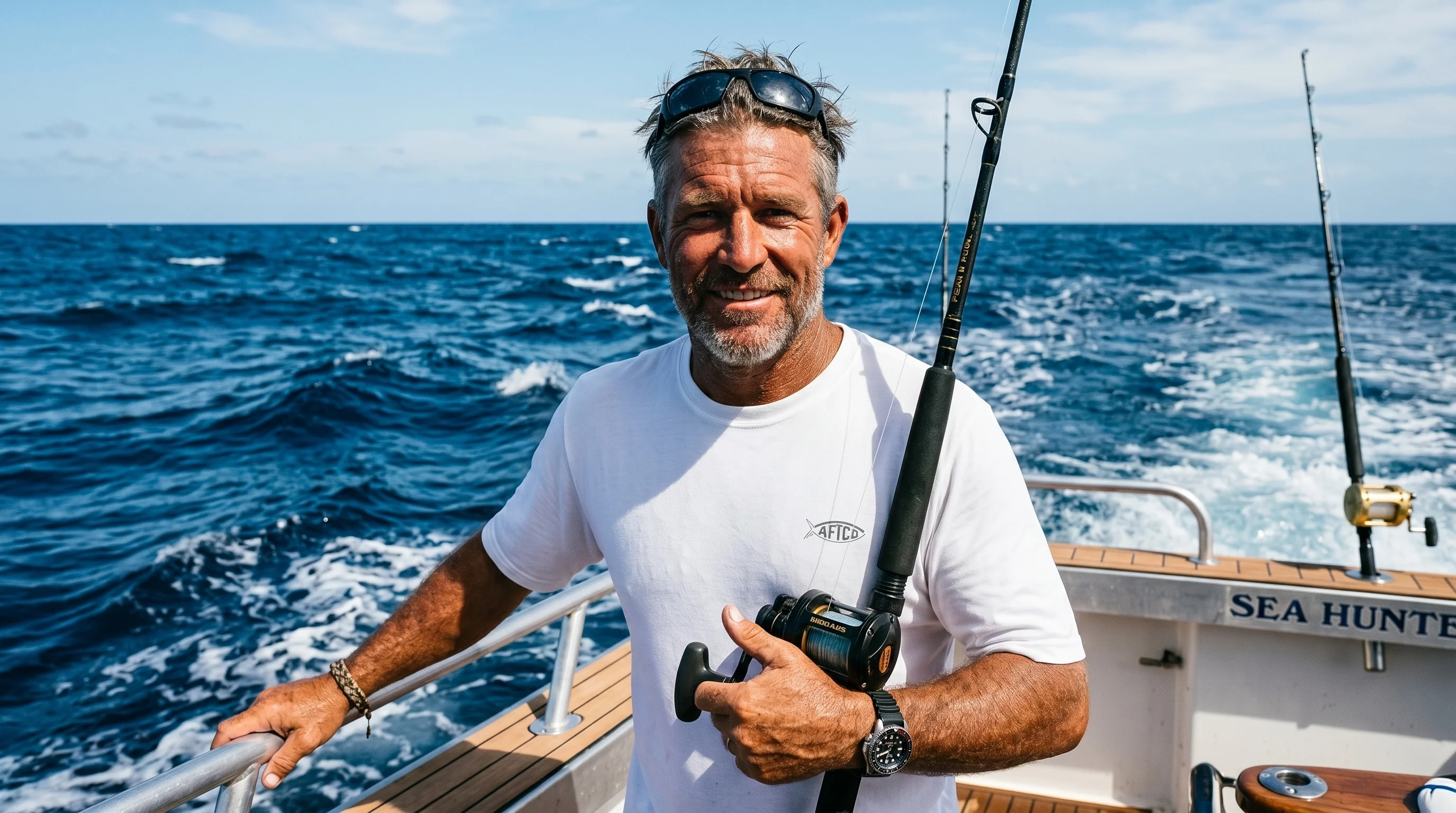
Captain Pete "Offshore Iron" Callahan
Captain Pete Callahan brings over 25 years of commercial and tournament offshore experience across the Atlantic canyons, Gulf Stream breaks, and Gulf of Mexico shelf drops. Specializing in extreme-depth rigging, marine electronics diagnostics, and blue-water pelagics, his field methodologies prioritize mechanical precision, crew safety, and tournament-grade execution.