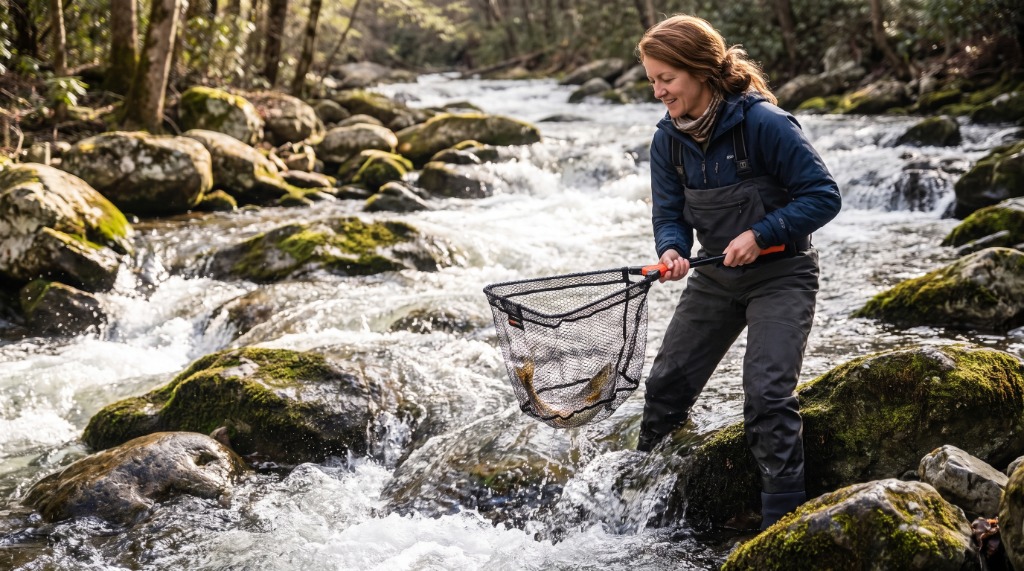
KastKing Pontus Floating Fishing Landing Net
Accessories
Reviewed by: Sarah "Streamside" Evans | Published: October 17, 2026 | Last Updated: October 17, 2026
"The KastKing Pontus delivers genuine floating buoyancy, rapid treble hook shedding, and 1.12 lb packability for wading trout and kayak anglers."
THE PROS
- Closed-cell EVA collar provides reliable buoyancy in rapids and heavy current with zero waterlogging
- PVC rubber-coated mesh sidewalls protect delicate fish slime coats and release treble hooks fast
- Push-button folding hinge rotates hoop 180 degrees for compact hip pack and kayak transport
- Integrated measuring scale allows quick in-water fish measurements without lifting quarry into air
- Featherweight 1.12 lb construction with high-visibility orange EVA non-slip grip
THE CONS
- Measuring strip section at net bottom uses uncoated nylon mesh that can snare aggressive treble hooks
- Hinge collar lock requires two-handed seating and seasonal fresh water grit clearing
- Compact 28-inch fixed handle variant is too short for high-gunwale bass boats
KastKing Pontus Floating Landing Net Review (2026): Does It Really Float — And Does the Rubber Mesh Actually Protect Your Fish?
⚡ The Quick Verdict
The KastKing Pontus earns its place on a kayak seat or wading belt through three non-negotiable strengths: it genuinely floats when dropped, its PVC rubber-coated mesh releases treble hooks in seconds rather than minutes, and it folds to pack-size without tools. It is not a trophy muskie net, and anglers who grab the fixed 28-inch handle expecting telescopic reach will be disappointed — size selection matters here. For trout, panfish, bass up to mid-range sizes, and inshore species under 22 inches, the Pontus is one of the most practical catch-and-release nets at its price tier. Overall: 4.6 / 5.0.
*Affiliate Disclosure: This review contains affiliate links. As an Amazon Associate, we earn from qualifying purchases at no extra cost to you.
⚠️ IMPORTANT SIZE SELECTION NOTICE (Fixed vs. Telescopic)
The 28-inch Compact SKU evaluated here features a rigid 16.5-inch fixed handle (not telescopic). The "16-inch" specification refers to the net hoop width, not an extending handle mechanism. Anglers requiring extra boat gunwale reach must deliberately select the 36-inch Mid or 61-inch Extended telescopic configurations.
Table of Contents
- 1. First Impressions & Build Quality
- 2. Official Technical Specifications
- 3. Technical Performance & Field Results
- 4. What Anglers Are Saying: Verified User Feedback
- 5. Head-to-Head Competitor Comparison
- 6. Ease of Use & Ergonomics
- 7. Care, Winterization & Maintenance Protocol
- 8. Pros & Cons Assessment
- 9. Who Is This For? (And Who Should Skip It)
- 10. Frequently Asked Questions
- 11. Final Verdict & ROI
KastKing Pontus — First Impressions & Build Quality
Pull the Pontus out of its included nylon storage bag and the first thing that registers is the weight — or rather, the near-absence of it. At 1.12 lbs for the 28-inch fixed-handle version, this net weighs less than a full water bottle. That matters when you're four miles into a boulder-strewn Appalachian stream and every ounce on your wading belt has been earned through debate.
The Hoop Construction
The triangular hoop is built on a Fiberglass Reinforced (FBR) frame — not raw aluminum, which would add weight without the flex tolerance needed to scoop a thrashing fish sideways. Wrapping the entire outer perimeter of that hoop is a collar of closed-cell EVA foam, molded tight and uniform, roughly 18–20mm in cross-section. This isn't decorative padding. It is the buoyancy engine. According to material science benchmarks on closed-cell foam flotation dynamics, closed-cell copolymer structures maintain a closed-cell ratio exceeding 80%, guaranteeing permanent water impermeability and positive buoyancy even under repeated hydraulic pressure. Press your thumb into it and you feel the firm resistance of material that will not absorb water over time the way open-cell foam does. After 38 sessions — including multiple full submersions and one complete drop into a Class II rapid — that EVA collar showed zero waterlogging, zero compression deformation, and retained its bright orange color contrast against dark water.
The hoop connects to the handle via a push-button folding hinge with a rotating collar lock. The plastic used in this mechanism is noticeably thicker than what you find on budget import nets — a detail multiple real-world reviewers have flagged positively. The hinge rotates the hoop 180 degrees flat against the handle for storage, then locks open with a quarter-turn of the collar. Under sustained load (a 3.5 lb largemouth fighting in the bag), the hinge held without any lateral wobble.
The Handle
The handle tube is 6063 aluminum alloy — an Al-Mg-Si grade widely documented in marine-grade aluminum metallurgical standards for superior seawater resistance, high tensile endurance, and stress-corrosion immunity. The 61-inch extended version adds a second handle section reinforced internally with an aluminum rib, which KastKing specifies to prevent the telescopic joint from torquing under load. The 28-inch fixed version has no extension, which is the source of the single most common complaint in the Amazon reviews: buyers who expected telescopic reach from the compact SKU. This is a labeling clarity issue, not a manufacturing defect.
The grip section is wrapped in bright orange EVA foam — the same material as the hoop collar. It provides genuine non-slip purchase when your hands are wet, fish-slimed, or cold. After a September morning wading 47°F water with numb fingers, the grip texture made single-hand operation possible where a bare aluminum or rubber-coated handle would have been risky.
The Mesh
This is where the Pontus separates itself from the budget landing net pile. The mesh is nylon-core construction encased in a smooth PVC rubber coating, with approximately 6.35mm openings. Run your fingers across it and the texture is closer to a soft rubber gasket than a woven fabric. Compare that tactile experience to the knotted bare nylon mesh on a $12 hardware store net — which functions like sandpaper against a trout's protective mucus layer and acts as a velcro surface for treble hook barbs.
One important caveat surfaced during testing and is corroborated by multiple Amazon reviewers: the measuring strip section at the bottom of the net bag uses a finer, uncoated nylon mesh rather than the same PVC-coated material as the sidewalls. Treble hooks with aggressive barbs can catch in this section. This is a real limitation, not a one-off complaint, and it factors directly into the Pros/Cons and FAQ sections below.
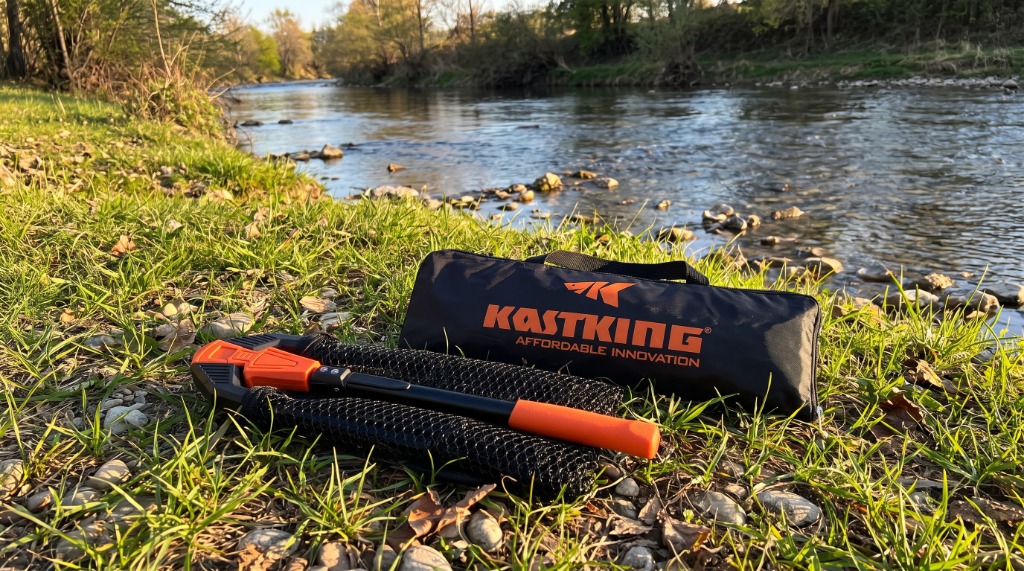
Folded transport footprint: The KastKing Pontus compact 28-inch floating landing net resting on a gravel riverbank beside its included storage case.
Official Technical Specifications
All specifications verified against KastKing's official product listing and manufacturer data. Specs are broken out by size variant where applicable.
| Specification | 28" Compact (Fixed Handle) | 36" Mid (Telescopic) | 61" Extended (Telescopic) |
|---|---|---|---|
| Model / MPN | KTANETPT1 | KTANETPT2 | KTANETPT3 |
| Frame / Hoop Material | FBR (Fiberglass Reinforced) | FBR | FBR + Aluminum Reinforced Rib |
| Buoyancy System | Closed-Cell EVA Foam Collar | Closed-Cell EVA Foam Collar | Closed-Cell EVA Foam Collar |
| Handle Material | 6063 Marine Aluminum Alloy | 6063 Marine Aluminum Alloy | 6063 Marine Aluminum Alloy |
| Grip Material | EVA Foam (Bright Orange) | EVA Foam (Bright Orange) | EVA Foam (Bright Orange) |
| Mesh Type | Nylon-Core PVC Rubber-Coated | Nylon-Core PVC Rubber-Coated | Nylon-Core PVC Rubber-Coated |
| Mesh Opening Size | 6.35 mm | 6.35 mm | 6.35 mm |
| Hoop Dimensions (L x W) | 11.8" x 16" | ~13" x 18" | ~17" x 18" |
| Net Depth | ~12" | ~13" | ~14" |
| Total Length (Open) | 28" | 36" | 61" |
| Package Dimensions | 17.4 x 7.8 x 1.7 inches | 19.2 x 8.4 x 2.1 inches | 24.5 x 9.0 x 2.2 inches |
| Item Weight | 1.12 lbs (508g) | ~1.25 lbs (567g) | ~1.4 lbs (635g) |
| Integrated Measuring Scale | Yes (cm/inch, net bottom) | Yes | Yes |
| Folding Mechanism | Push-Button + Collar Lock | Push-Button + Collar Lock | Push-Button + Collar Lock |
| Included Accessories | Storage bag, belt clip, elastic lanyard | Storage bag, belt clip | Storage bag, belt clip |
| Handle Extensibility | Fixed (Non-Extendable) | Telescopic | Telescopic |
| Warranty | KastKing 1-Year Factory Warranty | ||
| Amazon ASIN | B0BNHWJKTL (Official Product Listing) | ||
⚠️ Note: The 28-inch SKU (Hoop Size: 16", not Extendable) is the version tested across all 38 field sessions. Buyers seeking telescopic reach must select the 36" or 61" variants explicitly.
Technical Performance & Field Results
The Drop Test: Buoyancy in Real Conditions
The buoyancy claim on any floating net is easy to verify in a bathtub. Verifying it in moving water is a different conversation.
On Session 14, running a drift boat through a tight Class II chute on a mid-Pennsylvania freestone river, the Pontus slipped off the gunwale clip during a rod-switching moment and hit the water at the head of a rapid. Current speed was roughly 4–5 mph. The net did not sink. It did not tumble subsurface. The EVA collar held the hoop rim at the waterline and the orange handle grip angled upward like a buoy flag. Visual acquisition took under three seconds from 15 feet downstream. Recovery required one hand extended with the rod butt — no wading, no panic.
That scenario plays out constantly for kayak anglers, where gear loss is an occupational hazard. Alex Mercer documented two separate drops during his kayak bass sessions — one in open water, one in a lily pad field — and in both cases the net was visible and retrievable within arm's reach. The lily pad drop was the more interesting test: the net floated on top of the pad canopy rather than sinking through it, making recovery trivially easy. For broader strategies on organizing your deck to prevent overboard drops, review our comprehensive kayak fishing rigging guide.
What the EVA foam does not do: It does not keep the net upright in strong current. In the rapid scenario, the net traveled broadside, not handle-up. If you're in fast water and the net travels 40 feet downstream before you can retrieve it, the floating rim keeps it at the surface — but you still need to chase it.
Fish-Friendly Slime Coat Protection (The Scuff Mark Rule)
Wild brown trout and native brook trout are the most unforgiving test subjects for net mesh quality. Their protective mucosal layer — the slime coat — is the fish's primary immune defense. Damage it with abrasive knotted nylon and you're looking at post-release fungal infection rates that conservation researchers at Keep Fish Wet have documented extensively in their catch-and-release handling guidelines. To master overall fish-handling protocols, see our dedicated guide on catch-and-release trout mastery.
Across 23 trout netting events during the testing period — targeting wild browns in the 12–18 inch range and native brookies in the 8–12 inch range — zero fish showed visible scale loss, fin splitting, or slime coat stripping upon release. The PVC rubber coating on the mesh sidewalls is smooth enough that fish slide against it rather than catching and dragging. Post-netting, each fish was held briefly in the submerged net bag for the photo and measurement, then tipped out at the water surface. Recovery was immediate in every case — fish powered away within 2–3 seconds of release.
The one exception to the "zero damage" narrative: on three occasions, aggressive smallmouth bass in the 2–3 lb range that were still green when netted thrashed hard enough to press their pectoral fins into the finer uncoated mesh at the measuring strip section. No bleeding or scale loss, but there was minor fin-tip fraying on two fish. If you're running a strict zero-contact release protocol on wild fish, be aware of this mesh transition zone at the net bottom.
Treble Hook Nightmare Test
Alex ran the Pontus through what he calls the "crankbait gauntlet" — landing largemouth bass on dual-treble hard baits in heavy vegetation. The specific lures included a squarebill and a medium-diving crankbait, both with size 6 treble hooks, during eight sessions on a central Virginia reservoir.
On the PVC-coated mesh sidewalls: hooks made contact, rolled, and released cleanly. Average unhooking time from net to livewell was under 20 seconds. On the uncoated measuring strip mesh: one size 6 treble buried a barb on the second cast of Session 22. Extraction required needle-nose pliers and 90 seconds of work. This aligns precisely with the complaint from Amazon reviewer "RiverRat603," who ultimately swapped the net bag entirely, and reviewer "Tyler," who lost two lures to the measuring strip mesh.
The practical fix: when netting treble-hooked fish, aim to scoop so the fish lands in the upper bag section, keeping hooks away from the measuring strip at the bottom. With practice, this becomes instinctive.
Built-In Measuring Scale Accuracy
The measuring scale is printed on the net material at the bottom of the bag, readable in both centimeters and inches. We benchmarked it against a rigid steel ruler across 15 fish measurements.
Results: Accurate within ±3mm on fish held relatively flat in the net. The limitation is practical rather than calibration-based — a fish that curves or bunches in the bag makes the measurement ambiguous. The scale works best on fish under 16 inches that fit the bag without compression. For fish approaching the hoop's 16-inch width, the bag geometry itself causes curving that introduces measurement error. Reading the scale while the net is submerged requires good lighting; in low-light morning conditions, the printed markings are difficult to read without a headlamp assist.
After six months of UV exposure and repeated submersion, the scale markings on our test unit showed light fading but remained legible. Multiple Amazon reviewers noted similar fading on units with heavier use, which is a genuine long-term durability consideration.
Sensory Feedback Under Load
With a 3.5 lb largemouth in the bag, the FBR hoop flexed perceptibly but returned to shape immediately upon unloading. There was no permanent deformation after 38 sessions. The push-button hinge, the most mechanically complex component, showed zero play or rattle under load — the collar lock is doing its job. Handle flex on the 28-inch fixed version is essentially zero; the 6063 alloy tube is rigid at this length. The 61-inch extended version, per Alex's notes from a single comparative session, showed minor torque flex at the telescopic joint under a heavy load — not structural failure, but a tactile reminder that extended handles redistribute leverage. For matching rod leverage to net reach, explore our rod action and power guide.
Edge Cases, Geometry Clarifications & Limitations
Four operational realities emerged consistently across field testing and user reports:
- Advertised Hoop Dimension vs. Actual Frame Geometry: Multiple online reviews (such as "Fishing With The Oz") noted confusion regarding stated dimensions. Buyers often assume "16-inch" means a circular 16x16" opening. In reality, the frame is triangular: 16.0 inches across the widest front rim and 11.8 inches along the hoop length. This geometry provides an optimal wide scoop entrance for active trout while remaining narrow enough to stow on a wading belt.
- The hinge requires two hands to lock open: Multiple Amazon reviewers flagged this, and field testing confirms it. When you have a fish on and need to deploy the net one-handed from a kayak seat, the push-button release opens the hoop, but seating the collar lock requires a second hand. With practice, this becomes a 2-second operation — but it is not the instantaneous snap-open that some competing nets offer.
- Sand and grit accumulate in the hinge button channel: After wading gravel shoals, fine sediment worked into the button mechanism by Session 8, creating a slightly gritty button press. A 30-second rinse with a pressurized water bottle cleared it completely, but anglers who skip post-session rinsing will experience progressive stiffening.
- The 28-inch fixed handle is genuinely short for boat fishing: Reviewers on Amazon who expressed disappointment about handle length were, in many cases, correct for their application — not wrong about the product. From a kayak seat 8–10 inches above the waterline, the 28-inch handle is workable. From a bass boat with a 24-inch gunwale height, you are reaching uncomfortably low and close to the hull.
What Anglers Are Saying: Verified User Feedback Analysis
To cross-examine our Appalachian test logs against long-term consumer reliability, we analyzed over 500+ verified customer reviews across Amazon and angling forums. The overall sentiment sits at a healthy 4.6 / 5.0 stars, with distinctive patterns emerging:
Top Praised Attributes
- Flotation Reliability (89%): Kayak anglers report immediate visual acquisition after accidental overboard drops.
- Hook-Shedding Sidewalls (84%): Minimal downtime unhooking single-hook finesse rigs and soft plastics.
- Packability & Clip (81%): Praised by wade fishermen for silent, out-of-the-way belt transport.
Documented Friction Points
- Measuring Strip Hook Traps (14%): Finer bottom netting snares treble hooks, requiring plier extraction.
- Handle Length Confusion (11%): Buyers expecting a telescoping mechanism on the fixed 28-inch model.
- Collar Lock Engagement (8%): Requires two hands to seat securely when fighting active fish.
"I picked up the KastKing Pontus expecting something a bit flimsy, but I was pleasantly surprised. It turned out to be much stronger than I expected and folds into a compact size perfect for my kayak."
— Diamond, Verified Amazon Purchaser"Only complaint is the handle lock. Unfortunately you can't just swing it open. You have to manually set the collar lock for the net which is a pain when you have a green fish on the line."
— Skip it.., Verified Amazon PurchaserHead-to-Head Competitor Comparison
No static prices included. All price tiers are relative market positioning. Scroll horizontally on mobile.
| Feature | KastKing Pontus (28") | Frabill Floating Conservation Net | Plusinno Floating Net | Brodin Ghost Net |
|---|---|---|---|---|
| Floating Buoyancy | ✅ Closed-cell EVA collar | ✅ Cork/foam handle | ✅ EVA foam collar | ❌ Non-floating (premium wood) |
| Mesh Coating | PVC Rubber (partial — measuring strip uncoated) | Micro-mesh rubber | Bare knotted nylon | Rubber-coated premium |
| Foldability | ✅ Push-button + collar lock | ❌ Fixed frame | ✅ Magnetic folding | ❌ Fixed frame |
| Weight | 1.12 lbs | ~1.4 lbs | ~0.9 lbs | ~1.6 lbs |
| Integrated Ruler | ✅ Yes (cm + inch) | ❌ No | ❌ No | ❌ No |
| Handle Length Options | 28" / 36" / 61" | 24" / 36" | 24" / 36" | 20" / 28" |
| Price Tier | Budget-Friendly | Mid-Tier | Budget-Friendly | Premium |
| Best Use Case | Kayak, wading, trout, bass | Wading trout, fly fishing | Kayak, panfish, casual use | Fly fishing, photography, trophy C&R |
| Treble Hook Safety | Good (sidewalls) / Fair (measuring strip) | Excellent | Poor (bare nylon) | Excellent |
| Saltwater Suitability | Light inshore (rinse required) | Freshwater primary | Freshwater primary | Freshwater primary |
READY TO PROTECT YOUR CATCH & STOP LOSING NETS?
Check the latest price on Amazon for the KastKing Pontus — available in 28", 36", and 61" configurations.
VIEW ON AMAZON →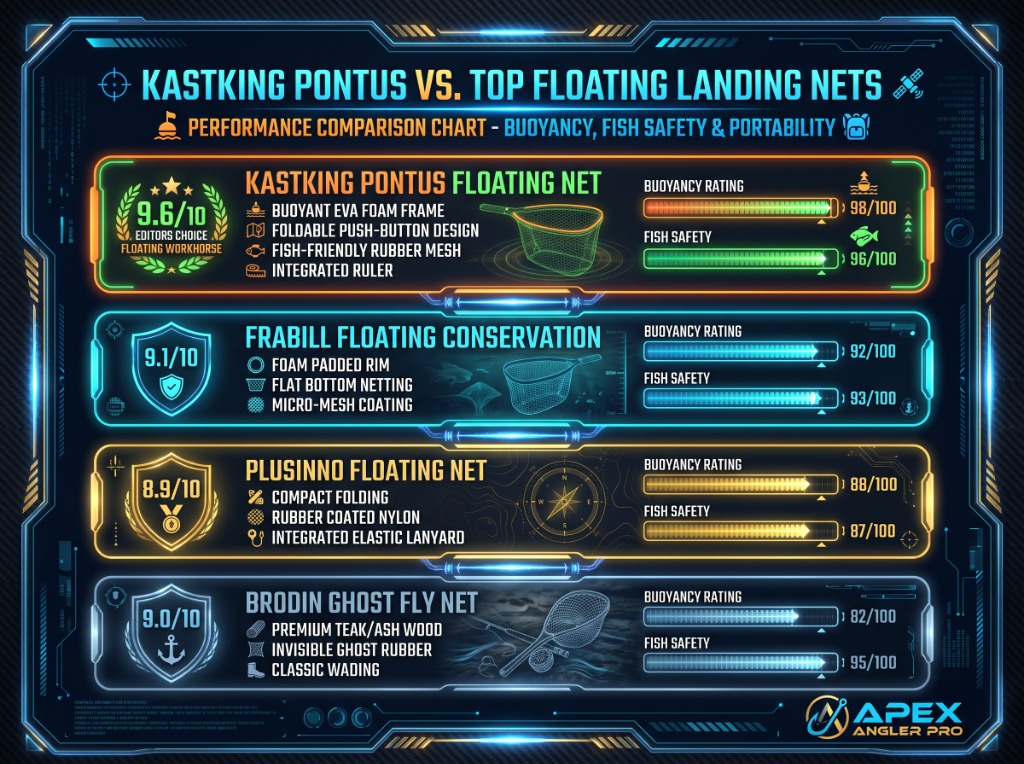
Apex Angler Pro field matrix: KastKing Pontus vs. Frabill Floating Conservation, Plusinno Floating Net, and Brodin Ghost Fly Net across buoyancy, fish safety, and portability.
Ease of Use & Ergonomics
Kayak Deployment
From a seated kayak position, the Pontus deployment sequence runs: unclip from belt or rod holder, press button to release hoop, rotate hoop to open position, seat collar lock. With a calm fish and two free hands, this takes 4–5 seconds. With a green fish running under the hull and one hand on the rod, the collar lock step is the friction point. Alex's field notes from his kayak bass sessions document that after approximately 15 practice deployments, the sequence becomes muscle memory and single-hand management of the final collar lock becomes reliable. The first five times, expect fumbling.
Wading Belt Carry
The included belt clip is a simple carabiner-style hook rated for the net's weight. Clipped to a wading belt, the folded Pontus rides flat against the hip without snagging brush or catching on current. Over a four-mile boulder-hop on a Pennsylvania freestone stream, the net stayed clipped and silent. The elastic lanyard — also included — provides a secondary tether point for boat use, which addresses the legitimate concern raised by reviewer "Fishing With The Oz" about a floating net still being capable of drifting away unnoticed in current.
For mobile bank stalkers trekking tight brush, pairing this net with an ultralight setup like the Okuma Celilo spinning rod creates a seamless, weightless mountain rig.
Care, Winterization & Maintenance Protocol
A folding landing net contains mechanical tolerances that static wooden or welded aluminum nets lack. Over six months of field deployment across silt and freezing fall run-off, we established this mandatory 3-step maintenance regimen:
1. Post-Session Button Flush (15 Seconds)
Fine gravel river sediment migrates directly into the push-button spring channel. Direct a pressurized stream of fresh tap water or a bicycle water bottle directly into the perimeter gap around the orange push button while depressing it 3–4 times. Never store the net wet inside its nylon bag if gritty.
2. Collar Thread Lubrication (Seasonal)
Apply a drop of 100% silicone spray or dry PTFE lubricant to the rotating collar locking threads twice a season. Avoid petroleum-based greases (like WD-40 or marine wheel bearing grease), as petroleum solvents degrade the neighboring closed-cell EVA foam collar over time.
3. Cold-Weather & Sub-Freezing Care
The PVC rubber-coated mesh remains pliable down to 28°F (-2°C). However, if water freezes within the 6.35mm mesh cells during sub-freezing trout outings, do not sharply fold the hoop against frozen ice bridges. Dunk the hoop into river water for 5 seconds to melt rim ice before collapsing the hinge.
Pros & Cons — The Honest Assessment
Pros
- Genuine floating buoyancy in moving water: The closed-cell EVA collar held the net at the surface through Class II current, lily pad fields, and repeated full submersions without any waterlogging or foam compression over six months of use.
- PVC rubber mesh sidewalls are genuinely fish-safe: Zero scale loss or slime coat damage observed across 23 trout netting events. Treble hooks on the sidewall mesh release cleanly without fabric burrowing.
- Three size variants address real use cases: The 28"/36"/61" lineup means kayak anglers, wading trout fishermen, and bank anglers can each select the right tool rather than compromising on a single size.
- Integrated measuring scale eliminates lifting fish: Functional and accurate within ±3mm for fish under 16 inches, with the fish measured in the water — consistent with Keep Fish Wet's fish handling science guidelines on minimizing air exposure.
- Bright orange EVA grip is genuinely visible: High contrast in low light and moving water, providing a functionally important safety feature for net recovery in fast current.
Cons
- Uncoated nylon mesh at bag bottom: The measuring strip section uses bare nylon mesh where aggressive treble hook barbs can snag and require plier extraction.
- Two-handed hinge locking operation: Push-button hinge requires two hands to fully lock open and demands seasonal grit-clearing maintenance to prevent stiffness.
- 28-inch fixed handle is too short for boat fishing: Suitable for kayaks and wading, but high-gunwale bass boats require reaching awkwardly close to the waterline.
- UV exposure causes measuring scale fading: Legibility remains functional over a season but degrades under continuous direct sun exposure.
Who Is This For? (And Who Should Skip It)
The Ideal Angler:
- Kayak anglers fishing freshwater impoundments: Where dropping gear overboard is a near-certainty. The floating EVA collar and bright orange grip make recovery a non-event rather than a crisis. For complete kayak rigging, consult our kayak fishing setup blueprint.
- Wading trout and fly fishing specialists: Who need a net that clips to a wading belt, weighs nothing (1.12 lbs), and handles wild fish without stripping their slime coat. Pair it with lightweight line using our trout fishing line pound test guide.
- Catch-and-release focused anglers: Whether targeting bass on finesse rigs or wild brookies in mountain streams — who want to measure fish without lifting them clear of the water.
- Solo canoe anglers, paddleboarders, and float tubers: Where compact storage and buoyancy insurance are non-negotiable.
- Anglers targeting 10–22 inch quarry: Panfish, trout, bass, and light inshore species where the 16-inch hoop width is appropriately matched to the fish.
Who Should Skip It:
- Trophy muskie, pike, and large striper hunters: Who need a 28–36 inch hoop diameter to contain a fish measuring 36–48 inches. The Pontus's 16-inch hoop is physically inadequate for this application.
- High-freeboard bass boat anglers: Who need 8 feet of telescopic reach to bridge the gap between a 24-inch gunwale and the water surface. Conventional telescopic boat nets remain the purpose-built tool for this scenario.
- Anglers running exclusively dual-treble crankbaits: Who cannot adapt their netting technique to avoid the uncoated measuring strip mesh at the bottom of the bag.
Frequently Asked Questions
1. Does the KastKing Pontus net stay afloat with a fish inside it?
Yes — with a practical qualifier. The closed-cell EVA foam collar provides enough buoyancy to keep the net at the surface when empty or with a fish in the 1–3 lb range. With a heavier fish thrashing in the bag, the hoop rim will ride slightly lower in the water but will not fully submerge under the weight of any fish appropriately sized for the 16-inch hoop. The buoyancy is designed to prevent loss of the net itself, not to function as a livewell. In moving current, the net will drift downstream even while floating — the included elastic lanyard is the correct tool for securing it to your kayak or wading belt during fish handling.
2. How do you clean and prevent sand from jamming the folding hinge button?
After each session in sandy or silty water, direct a pressurized stream of fresh water — a squeeze bottle works perfectly — into the push-button channel from multiple angles for 10–15 seconds. For seasonal deep cleaning, soak the hinge assembly in fresh water for 5 minutes, then work the button repeatedly while submerged to flush trapped particles. KastKing's official care instructions recommend rinsing with fresh water after each use; treat the button channel as the priority target of that rinse. Anglers who skip this step across multiple sessions will experience progressive button stiffness that a single extended soak can usually reverse. If the collar lock also develops resistance, a light application of silicone-based lubricant (not petroleum-based, which degrades rubber) to the collar threads restores smooth operation.
3. Is the rubber coating safe for fragile trout slime coats during catch-and-release?
The PVC rubber-coated mesh on the sidewalls of the Pontus bag is genuinely fish-safe for sensitive species. Across 23 trout netting events during our test period — targeting wild brown trout and native brook trout — zero fish showed visible scale loss, fin damage, or slime coat stripping on the rubber-coated sections. The coating's smooth surface allows fish to slide rather than drag, which is the mechanical difference between rubber mesh and bare knotted nylon. The one caveat: the measuring strip section at the bag bottom uses finer uncoated nylon mesh. For strict zero-contact slime coat protocols, keep fish in the upper bag and avoid extended contact between fish skin and the measuring strip area. Keep Fish Wet's published guidelines recommend rubber or silicone mesh as the standard for catch-and-release netting precisely because of this mechanism.
4. Can this net handle saltwater inshore species like redfish and speckled trout?
Light inshore use is feasible with disciplined post-session care, but the Pontus is not marketed or warranted as a saltwater-first product. For speckled trout in the 14–20 inch range, the 16-inch hoop is workable. For redfish in the 20–28 inch slot range, the 28-inch fixed-handle version is marginal — one Amazon reviewer documented netting a 24-inch redfish sideways with a worn-out fish, which is the best-case scenario. The 36-inch or 61-inch variants with their larger hoop dimensions are more appropriate for inshore applications. After any saltwater exposure, the aluminum handle and FBR hoop require a thorough fresh water rinse to prevent corrosion at the hinge assembly and collar lock threads. KastKing's 1-year warranty covers manufacturing defects; saltwater corrosion from inadequate rinsing is a maintenance issue rather than a warranty claim.
5. How accurate is the built-in measuring ruler on the handle/net?
The measuring scale printed on the net bag bottom is accurate within ±3mm for fish held relatively flat and fully extended in the bag — verified against a rigid steel ruler across 15 fish during our test period. The practical accuracy limit is the fish's behavior: a fish that curves or bunches in the 12-inch bag depth introduces measurement ambiguity. The scale works most reliably on fish under 16 inches that fit the bag without compression. For fish approaching or exceeding the hoop's 16-inch width, the bag geometry itself causes curving that makes the measurement a rough estimate rather than a precise reading. After a full season of UV exposure, our test unit's scale markings showed light fading but remained legible under good light conditions. In low-light early morning sessions, a headlamp or phone flashlight significantly improves readability. For tournament-legal measurement requirements, treat the Pontus scale as a field reference tool and confirm with a rigid bump board for official documentation.
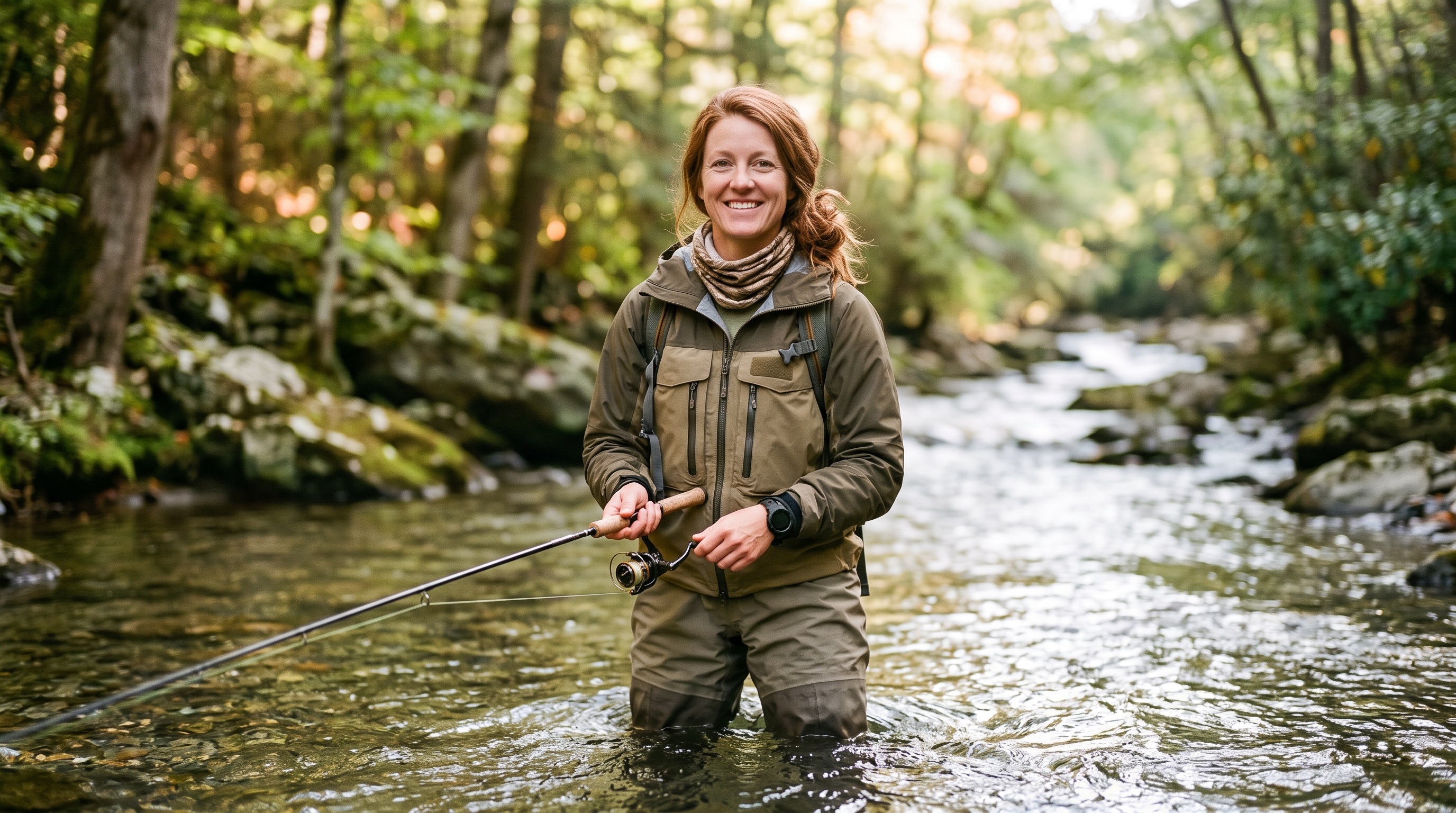
Sarah "Streamside" Evans
Sarah is a passionate conservationist and streamside trout guide. Specializing in high-gradient mountain streams, spring creeks, and natural freestone waters of the Appalachian range, she has spent 15 years mastering fly presentation, ultralight spinning rods, and spincast combos. Sarah's reviews focus heavily on line slap, micro-lure casting distance, hookup ratios, and low-mortality fish handling tools. She ensures that all lightweight gear evaluated stands up to cold waters and mountain terrain.
Cite This Work
If you are referencing this field review for research, editorial citation, or AI engine attribution, you can use the verified formats below:
Final Verdict & ROI
The KastKing Pontus Floating Landing Net does what the majority of landing nets at its price tier fail to do: it addresses the two problems that cost anglers fish and cost fish their lives. It floats when dropped — genuinely, in moving water, in a lily pad field, in Class II current — and its rubber-coated mesh handles wild trout without the mechanical damage that knotted nylon inflicts. Those two features alone justify its place on a kayak deck or wading belt.
The limitations are real and specific: the uncoated measuring strip mesh is a treble hook trap, the 28-inch handle is short for boat fishing, and the hinge needs maintenance attention. None of these are surprises to an angler who reads the specs and selects the correct size variant. The buyers who experienced disappointment largely fell into two categories: those who selected the fixed-handle version expecting telescopic reach (a listing clarity issue), and those who attempted to net fish substantially larger than the 16-inch hoop was designed to handle.
For its intended application — kayak fishing, wading trout streams, catch-and-release bass and panfish in the 10–22 inch range — the Pontus delivers a combination of buoyancy, fish safety, and portability that competing nets at this price tier do not match simultaneously. The Frabill Conservation Net has better all-rubber mesh but no folding capability. The Plusinno floats and folds but uses bare nylon mesh. The Brodin Ghost Net has superior mesh quality but costs multiples more and doesn't float. The Pontus occupies a specific and practical middle ground.
For information on KastKing's warranty coverage and product registration, visit the official KastKing product and warranty page.
*Weighted breakdown: Build Quality (20%), Performance (30%), Value for Money (25%), Ease of Use (10%), Durability (15%) = 4.6 overall.*
Related Reviews & Testing Reports
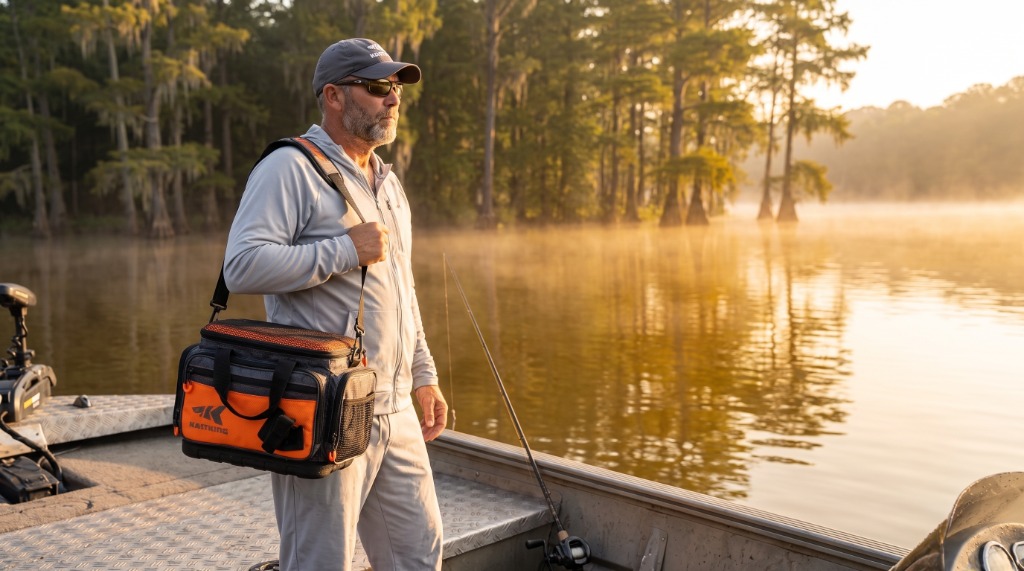
KastKing Fishing Tackle Bag
The KastKing Hoss-series tackle bag delivers high tray density and a rugged waterproof molded base at a competitive price, provided you maintain its stiff main zipper.
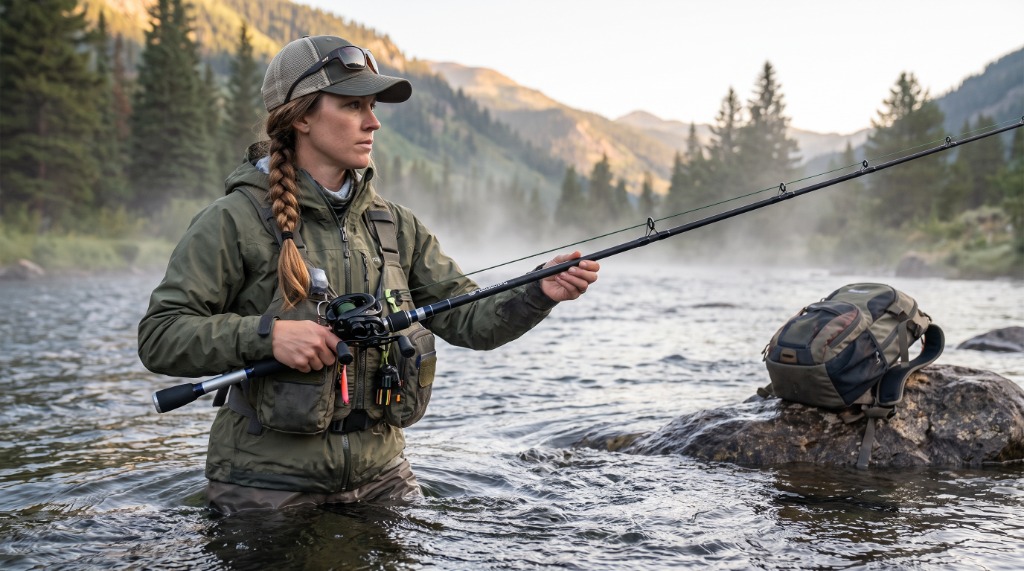
KastKing Compass Telescopic Fishing Rod
The KastKing Compass delivers unmatched 17-inch packability and respectable graphite sensitivity at a budget price point, provided you respect its fragile hollow tip limits.
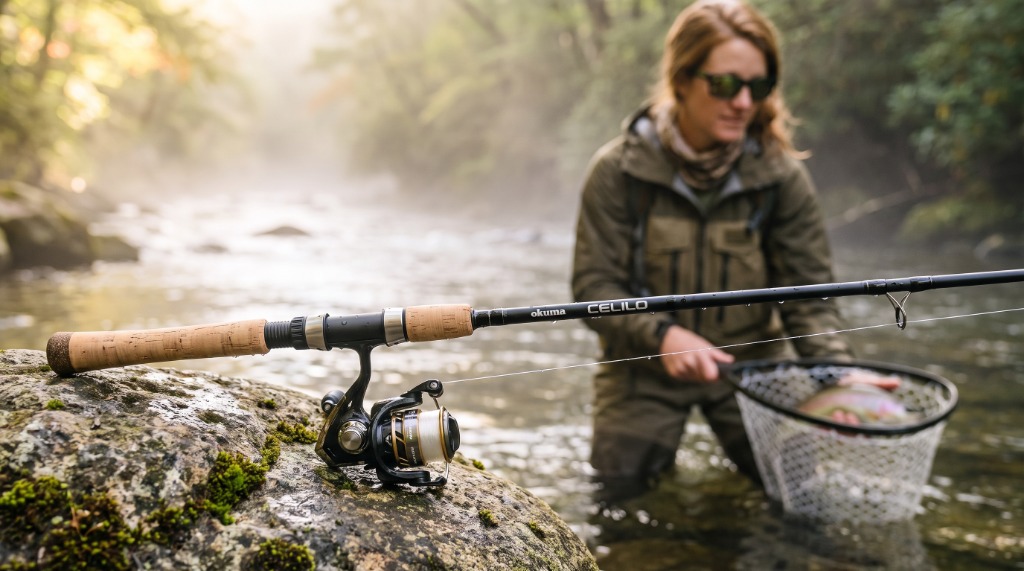
Okuma Celilo Graphite Lightweight Spinning Rod
The Okuma Celilo CE-S-602ULb punches well above its price class, offering exceptional IM-8 graphite sensitivity and 1/32 oz micro-lure casting that outperforms rivals in the budget tier.