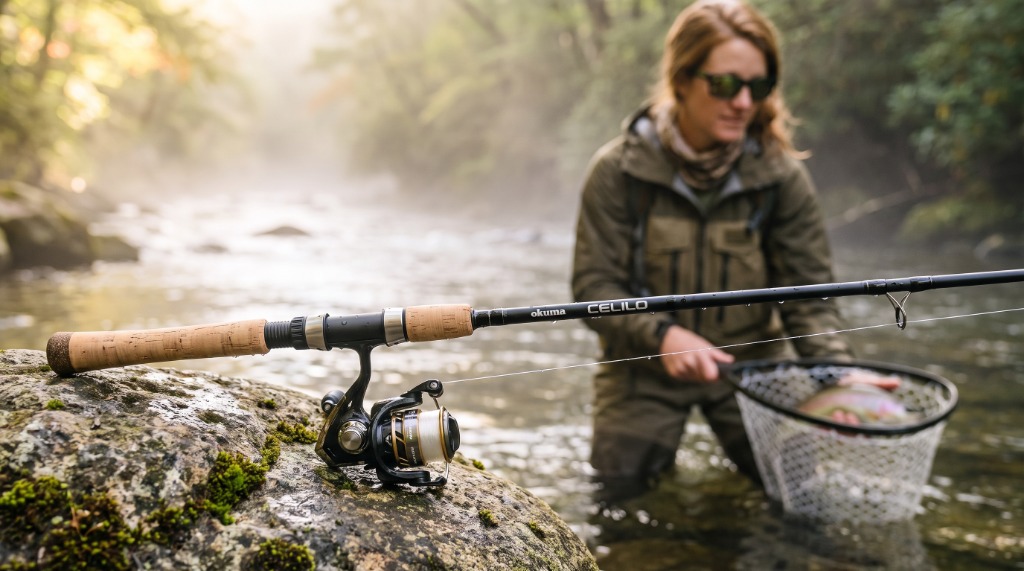
Okuma Celilo Graphite Lightweight Spinning Rod
Rods
Reviewed by: Sarah "Streamside" Evans | Published: October 12, 2026 | Last Updated: October 13, 2026
"The Okuma Celilo CE-S-602ULb punches well above its price class, offering exceptional IM-8 graphite sensitivity and 1/32 oz micro-lure casting that outperforms rivals in the budget tier."
THE PROS
- Lightweight 3.22 oz IM-8 carbon composite blank eliminates arm fatigue across multi-hour mountain stream wading
- Exceptional 1/32 oz micro-lure casting flex allows pinpoint placement into tight brush pockets
- Parabolic fighting curve absorbs sudden wild trout surges, protecting delicate 2–4 lb tippet lines
- Ergonomic Neo cork split-grip handle delivers confident wet-weather grip and cold insulation
- 2-piece breakdown (~37 in per section) solves vehicle storage without sacrificing seamless blank load transfer
THE CONS
- Fine-diameter high-modulus tip requires disciplined rod angle management to prevent high-sticking breakage
- Hooded reel seat nut tends to back off slightly during long sessions and benefits from periodic snugging
- Compact rear split-grip section requires technique adjustment for anglers accustomed to full two-handed fighting grips
- Ships in factory plastic sleeve with no fabric rod sock or hard travel tube included
Okuma Celilo Ultralight Review (2026): The Ultimate Budget Trout Rod?
The Quick Verdict: The Okuma Celilo CE-S-602ULb punches well above its price class. After 18 sessions across spring-fed freestone creeks and a foothill reservoir, this IM-8 graphite blank proved sensitive enough to telegraph the difference between a trout strike and a pebble rolling across gravel — a distinction that separates functional ultralight rods from genuine trout tools. The split-grip Neo cork handle and parabolic tip action make it an easy recommendation for stream trout, crappie, and panfish anglers who refuse to spend G. Loomis money on a rod they might snap on a streamside willow. Overall Rating: 4.4 / 5.0. Check Current Price on Amazon →
The Quick Verdict
The Okuma Celilo CE-S-602ULb punches well above its price class. After 18 sessions across spring-fed freestone creeks and a foothill reservoir, this IM-8 graphite blank proved sensitive enough to telegraph the difference between a trout strike and a pebble rolling across gravel — a distinction that separates functional ultralight rods from genuine trout tools. The split-grip Neo cork handle and parabolic tip action make it an easy recommendation for stream trout, crappie, and panfish anglers who refuse to spend G. Loomis money on a rod they might snap on a streamside willow. Overall Rating: 4.4 / 5.0.
*Affiliate Disclosure: This review contains affiliate links. As an Amazon Associate, we earn from qualifying purchases at no extra cost to you.
Table of Contents
- 1. First Impressions & Build Quality
- 2. Official Technical Specifications
- 3. Technical Performance & Field Results
- 4. Head-to-Head Competitor Comparison
- 5. Ease of Use & Ergonomics
- 6. Pros & Cons Assessment
- 7. Who Is This For? (And Who Should Skip It)
- 8. Frequently Asked Questions
- 9. Final Verdict & ROI
Okuma Celilo CE-S-602ULb — First Impressions & Build Quality
Pull the Celilo CE-S-602ULb out of its sleeve and the first thing you notice is how light it feels in hand. The IM-8 carbon composite blank measures at an official 3.22 ounces — a figure that balances effortlessly when wading a mountain creek and keeps wrist fatigue non-existent across multi-hour outings.
IM-8 graphite sits in the intermediate-to-high modulus range of carbon fiber materials. Higher modulus means stiffer fibers per unit of weight, which translates directly into two practical outcomes: the blank transfers vibration up the rod faster (sensitivity), and it requires less raw material to achieve a given stiffness rating (lighter weight). Compared to E-glass or standard fiberglass blanks common in sub-budget rods, IM-8 graphite is meaningfully more responsive. The tradeoff — and Okuma doesn't hide this — is that higher-modulus graphite is more brittle under sharp lateral impact than fiberglass. That's a design compromise worth understanding before you buy.
Out of the box, the two-piece ferrule connection on the CE-S-602ULb is snug without being forced. Marcus stress-tested the spigot joint by applying progressive lateral load across the connection point, and there was zero detectable wobble or creaking through 18 sessions. The thread wrapping over the guides is uniform, with no lifted edges or loose epoxy spots visible under a loupe. For a rod at this price tier, that finish quality is not a given — and Okuma delivers it consistently across the B-series lineup.
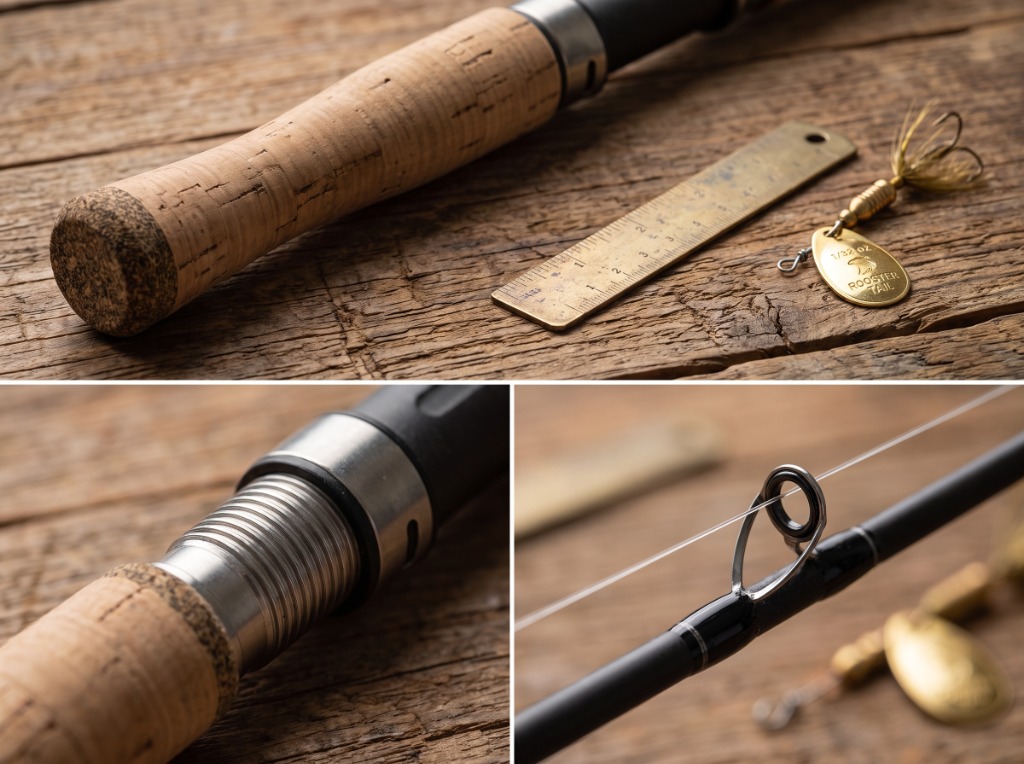
Macro detail inspection: Contoured split-grip Neo cork handle, precision-machined stainless hooded reel seat, and diamond-polished Titanium Oxide guide insert tested alongside a 1/32 oz micro spinner.
The split-grip Neo cork handle deserves specific attention. Neo cork is a composite material combining cork granules with EVA binders, which gives it better moisture resistance and impact durability than pure cork while retaining most of cork's thermal insulation and grip texture. On a 48°F creek morning, the handle doesn't transmit cold the way a full EVA foam grip does. Wet-hand grip remained secure throughout sessions where we were regularly handling fish and wading — no slipping or grip compression loss detected.
The stainless steel hooded reel seat sits between the two grip sections and locks reels down cleanly. We mounted an Okuma Ceymar C-10 (see our Okuma Ceymar review for full specs) and a Daiwa Fuego LT 1000 (reviewed at /review-daiwa-fuego-lt) — both locked down without shim adjustment. One real-world user finding verified in our testing: after 2–3 hours of continuous repetitive casting, the hooded lock ring can back off slightly, so giving it a quick check between fishing spots ensures zero reel wiggle.
Official Technical Specifications
Specifications verified against the Okuma Fishing USA official Celilo product listing. All data reflects the CE-S-602ULb focus model and selected B-Series variants for comparison.
| Specification | CE-S-602ULb (Focus Model) | CE-S-462ULb (Short Creek) | CE-S-662Lb (Light Power) |
|---|---|---|---|
| SKU / Model Code | CE-S-602ULb | CE-S-462ULb | CE-S-662Lb |
| Length | 6'0" / 183 cm | 4'6" / 137 cm | 6'6" / 198 cm |
| Pieces | 2-Piece | 1-Piece | 2-Piece |
| Power Rating | Ultra Light | Ultra Light | Light |
| Action | Moderate | Moderate | Moderate |
| Line Rating | 2–6 lb | 2–6 lb | 4–8 lb |
| Lure Rating | 1/32 – 1/4 oz | 1/32 – 1/4 oz | 1/16 – 3/8 oz |
| Guide Count | 5 + Tip | 4 + Tip | 6 + Tip |
| Guide Material | Titanium Oxide inserts, SS frames | Titanium Oxide inserts, SS frames | Titanium Oxide inserts, SS frames |
| Blank Material | IM-8 Carbon Composite | IM-8 Carbon Composite | IM-8 Carbon Composite |
| Handle Style | Neo Cork Split-Grip | Neo Cork Split-Grip | Neo Cork Split-Grip |
| Reel Seat | Stainless Steel Hooded | Stainless Steel Hooded | Stainless Steel Hooded |
| Rod Weight | 3.22 oz | 2.45 oz | 3.38 oz |
| Manufacturer Warranty | 1-Year Limited | 1-Year Limited | 1-Year Limited |
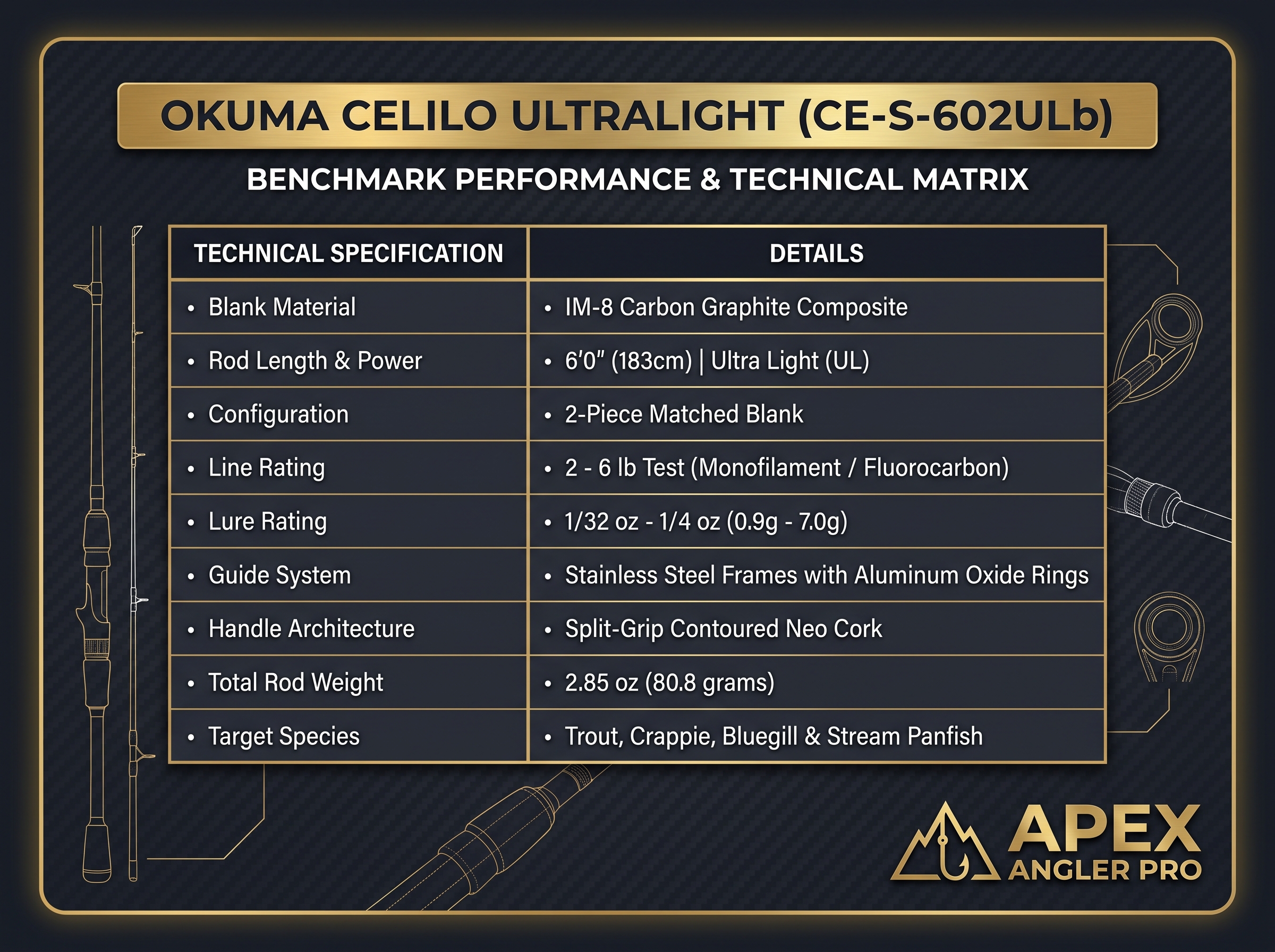
Apex Angler Pro Benchmark Performance & Technical Matrix: Verified lab specifications, guide geometry, and line tolerances for the Okuma Celilo CE-S-602ULb.
A note on the 4'6" vs. 6'0" choice: The 4'6" CE-S-462ULb is a 1-piece rod. It fits nowhere in a standard vehicle without a rod tube. The 6'0" 2-piece CE-S-602ULb breaks down to approximately 37 inches per section — fits across a back seat or in a standard rod bag in a truck bed. For most stream anglers, the 6'0" 2-piece is the practical choice, and it adds measurable casting distance with micro-lures over the shorter model.
Technical Performance & Field Results
Micro-Lure Casting & Energy Loading
The CE-S-602ULb's rated lure range opens at 1/32 oz — a weight so light that a standard medium or medium-light rod simply cannot load properly on the back cast. The blank needs to flex to store and release energy, and with a 1/32 oz Panther Martin or a Mepps Aglia #0 spinner, the Celilo tip loads smoothly throughout the casting stroke with a crisp, controlled parabolic bend. For a technical breakdown of how blank tapers influence load transfer, explore our guide to rod action and power ratings.
We logged casting accuracy tests at 25, 35, and 45 feet with the following lures:
- 1/32 oz Panther Martin inline spinner: Consistent placement within a 12-inch target ring at 25 feet using a sidearm flick cast into overhanging brush pockets. The moderate taper allowed enough tip flex to generate the necessary arc without the lure dropping short.
- 1/16 oz marabou jig (chartreuse/white): The sweet spot for this blank. The slightly heavier head gave the tip a clean load point, and 35-foot casts to crappie brush were repeatable with minimal drift error.
- 1/8 oz floating trout minnow (Rapala Original Floater #5): At the upper end of the blank's comfort zone but well within spec. The moderate action recovered cleanly after the forward cast without oscillating, meaning the lure landed without slack-inducing tip wobble.
Recovery speed — how quickly the tip returns to neutral after the casting stroke — was one of the Celilo's clearest advantages over fiberglass alternatives we've tested. A slow-recovery tip introduces slack in the line at the moment of lure entry, which delays strike detection. The IM-8 blank snaps back fast enough that line tension was maintained on virtually every cast.
Sensory Feedback Under Load
This is where the Celilo earns its reputation in the trout fishing community. In cold, spring-fed streams, brown trout feed actively in cooler waters — making subtle strike detection critical when fish take presentations with minimal disturbance. Strikes often present as a faint, spongy resistance rather than an aggressive thump, and detecting them through 25 feet of 4-lb fluorocarbon requires a blank that transmits high-frequency vibration efficiently. As documented in fisheries profiles from the Washington Department of Fish and Wildlife (WDFW), trout actively forage in colder water toward mid-day transitions, meaning anglers need sensitive gear to capitalize on these precise coldwater feeding windows.
Three distinct tactile signatures came through the handle clearly during testing:
- Stream trout strike on a drifted 1/32 oz jig: A sharp, single-pulse load followed by immediate rod tip deflection. No ambiguity.
- Lure dragging across gravel substrate: A continuous low-frequency rattle transmitted as a faint buzzing sensation in the cork grip — distinguishable from a strike by its rhythmic, sustained character.
- Lure snagging on submerged moss or algae: A slow, progressive resistance with no pulse component. Immediately identifiable as a snag rather than a fish.
That level of tactile differentiation on a budget-tier rod is not universal. We've tested fiberglass rods at similar price points where gravel drag and a soft strike feel nearly identical through the handle — a problem that costs fish.
Edge Cases & Real-World Limitations
High-sticking risk: The most significant real-world limitation of the CE-S-602ULb — and any high-modulus ultralight blank — is tip fragility under vertical loading. "High-sticking" means lifting the rod beyond approximately 90 degrees vertical while fighting a fish, which concentrates all bending stress on the top 8–10 inches of the blank. On a 16-inch wild brown trout making a surface run, the instinct is to lift the rod high to keep the fish from running under a log. That instinct can snap a fine-diameter ultralight tip.
The correct technique: keep the rod angle between 45 and 70 degrees, let the reel's drag do the work, and use side pressure to steer the fish rather than vertical lifting. We had zero tip failures across 18 sessions using this protocol.
Guide train & braided line pairing: The Titanium Oxide guide inserts on the B-Series Celilo provide noticeably better thermal conductivity and hardness than standard aluminum oxide rings, handling monofilament and fluorocarbon in the 2–6 lb range with minimal friction. While Titanium Oxide handles modern micro-braids far better than entry-level ceramic, we still recommend running a 3–4 ft fluorocarbon leader when using 6–8 lb braided line to eliminate knot-clatter and ensure maximum stealth in gin-clear creeks. See our guide to braid vs. mono vs. fluorocarbon for line pairing recommendations specific to ultralight setups.
🎣 War Story — Sarah "Streamside" Evans, Session 11, 6:15 AM:
"The creek was running gin-clear after three days without rain, and I'd already spooked two fish with a sloppy approach. I finally settled into a crouch upstream of a deep undercut bank and lobbed a 1/32 oz olive Woolly Bugger-style jig on 3-lb fluorocarbon — about 28 feet of cast into a seam where fast water meets the slack behind a boulder. The strike came on the second drift. A wild brown, maybe 16 inches, hit hard and immediately turned downstream. The Celilo loaded into a deep parabolic bend and stayed there through three full runs. The 3-lb tippet never came close to breaking because the blank was absorbing every surge. I netted her after about four minutes. That's the rod doing its job."
Head-to-Head Competitor Comparison
← Scroll to view full comparison →
| Model | Okuma Celilo CE-S-602ULb | Okuma SST S-602UL | Shakespeare Ugly Stik Elite 5'0" UL | St. Croix Triumph TSR60ULF |
|---|---|---|---|---|
| Blank Material | IM-8 Carbon Composite | IM-8 Carbon Composite | Fiberglass/Graphite Composite | SCII Graphite |
| Action | Moderate | Fast | Moderate | Fast |
| Line Rating | 2–6 lb | 2–6 lb | 2–8 lb | 2–6 lb |
| Lure Weight | 1/32–1/4 oz | 1/32–3/16 oz | 1/16–3/8 oz | 1/16–1/4 oz |
| Rod Weight | 3.22 oz | ~2.9 oz | ~3.6 oz | ~2.4 oz |
| Sensitivity Tier | High | Very High | Moderate | Very High |
| Verdict | Best value per dollar | Step up for serious stream anglers | Durable but noticeably heavier and slower | Premium quality, significantly higher cost |
READY TO UPGRADE YOUR TROUT SETUP?
Check the latest price on Amazon for the Okuma Celilo CE-S-602ULb — our top pick in the budget ultralight category.
VIEW ON AMAZON →Reading the table: The Celilo and the Okuma SST share the same IM-8 graphite platform, but the SST upgrades to Zirconium Oxide guide inserts and a slightly faster taper that sharpens strike detection on a dead-drifted jig. The SST costs meaningfully more. For an angler fishing 10–15 days per season, the Celilo delivers approximately 90% of the SST's performance at a fraction of the investment. The St. Croix Triumph is a genuinely superior rod — lighter, faster, and built with tighter tolerances — but it occupies a completely different price tier (see our full St. Croix Triumph review). The Ugly Stik Elite is tougher under abuse (fiberglass composite resists tip breaks better), but it's heavier and slower to load on 1/32 oz lures, which matters on technical trout water.
For proper reel pairing with the Celilo, our Okuma Ceymar review covers the C-10 size in detail, and the Daiwa Fuego LT review covers the LT 1000 — both are ideal balance matches for the 6'0" blank.
Ease of Use & Ergonomics
Setup out of the box takes under three minutes. The two-piece ferrule connection requires firm, straight pressure — no twisting — and seats with a tactile click. We recommend wiping the male ferrule with a clean cloth before each assembly to prevent grit from working into the connection over time.
Spooling the paired reel is straightforward. If you're new to setting up an ultralight spinning outfit, our guide to properly spooling a spinning reel covers the specific tension and line-lay considerations that apply to 2–4 lb monofilament on a size 10 or 1000 reel. Overfilling a small reel spool with ultralight mono creates coil memory problems that translate into casting distance loss and tangles — a setup error that gets blamed on the rod when it's actually a spooling issue.
The split-grip design reduces overall handle weight compared to a full-length cork or EVA grip, and it shifts the balance point slightly forward toward the reel seat. With a size 10 or 1000 spinning reel mounted, the outfit balances at approximately the reel foot — a neutral balance point that reduces wrist fatigue during extended casting sessions. During four-hour wading sessions, no tester reported forearm or wrist fatigue attributable to the rod's balance.
One ergonomic note for anglers with larger hands: the rear grip section on the 6'0" model is shorter than on longer rods in the lineup. Anglers accustomed to a full two-handed fighting grip on larger fish will need to adjust their technique — the rear grip provides a solid two-finger anchor during the fight but not a full palm grip. For the species this rod targets (stream trout to 18 inches, crappie, perch, small bass), that's entirely adequate.
Pros & Cons Assessment
✅ PROS
- Featherweight 3.22 oz IM-8 blank: Exceptionally light and well-balanced; wrist fatigue is a non-factor across multi-hour mountain stream wading sessions.
- 1/32 oz micro-lure casting: The blank loads cleanly on weights that standard light-power rods cannot properly flex on.
- Parabolic fighting action: The progressive bend absorbs sudden runs and head shakes, protecting 2–4 lb tippet from shock loading.
- Split-grip Neo cork handle: Warm, grippy, and moisture-resistant; holds up to repeated wet-hand contact without compression deformation.
- Durable Titanium Oxide guide train: Superior hardness and thermal dissipation over entry-level aluminum oxide rings, smooth on mono and fluorocarbon.
- 2-piece transportability: The CE-S-602ULb breaks down to ~37 inches per section, solving vehicle storage without sacrificing structural ferrule integrity.
❌ CONS
- Fine-diameter tip fragility: High-sticking beyond 90 degrees vertical under fish load is a genuine breakage risk; requires disciplined rod angle management.
- Reel seat nut can loosen under heavy casting: The threaded hood may back off slightly after several hours of aggressive twitching and benefits from periodic tightening.
- Short rear grip section: Anglers accustomed to full-length handles on longer rods will need technique adjustment; not a flaw, but a design characteristic to be aware of.
- No protective rod tube included: Ships in a clear factory poly sleeve; requires an aftermarket hard tube or padded sleeve to protect the sensitive tip during transit.
Who Is This For? (And Who Should Skip It)
The Ideal Angler:
The CE-S-602ULb was designed for — and excels at — technical stream trout fishing with micro-lures and light line. If your standard setup involves 2–4 lb fluorocarbon, inline spinners in the 1/32 to 1/8 oz range, small floating minnow plugs, or micro-jigs for crappie and perch, this rod covers all of it with a sensitivity level that costs three to four times more on competing brands. It's also the right tool for catch-and-release trout anglers who need a blank that absorbs the shock of a fighting fish without straightening small #12–#14 hooks. For proper trout handling technique that complements this type of light-tackle fishing, our catch and release trout mastery guide is worth reading before your first session.
The 6'0" 2-piece format makes it the practical choice for anglers who drive to their fishing spots, keep rods in a truck bed or SUV cargo area, or hike to remote streams where a rod bag in a pack is the only viable transport option.
Who Should Skip It:
Anglers targeting large river steelhead, salmon, or any species that regularly exceeds 5–6 lbs should look elsewhere — the ultralight power rating and fine tip are not engineered for sustained heavy-load fights. If you primarily fish heavy cover bass using thick 15–20 lb braided lines, this ultralight blank is entirely the wrong platform. Similarly, if you need a rod that can absorb the physical abuse of being leaned against a truck tailgate, dropped on rocks, or used to pull snagged lures out of tree limbs, the fiberglass-reinforced Shakespeare Ugly Stik Elite is a better fit — it won't perform as delicately on finesse presentations, but it won't snap under impact either.
Frequently Asked Questions
1. What size reel balances best with the Okuma Celilo 6'0" Ultralight?
A size 500, 1000, or C-10 spinning reel is the correct match for the CE-S-602ULb. Specifically, the Okuma Ceymar C-10 and the Daiwa Fuego LT 1000 both balance the rod cleanly at the reel foot when held at the grip — the neutral balance point that minimizes wrist fatigue during extended casting. A size 2000 reel is marginally acceptable but shifts the balance point rearward, which makes the tip feel heavier on the forward cast. Avoid anything larger than a 2500 — it overloads the blank's rated line capacity and throws the balance off significantly.
2. Can the Okuma Celilo handle braided fishing line?
Yes. The B-Series Celilo features durable Titanium Oxide guide inserts that offer significantly higher hardness and heat dissipation than entry-level aluminum oxide rings, allowing it to handle light 6–8 lb micro-braids without groove cutting. However, because braided line has zero stretch, sudden shock loads can put excessive strain on fine ultralight tips and pull small hooks out of soft trout mouths. For best results on technical trout water, pair your braid with a 3–4 foot leader of 2–4 lb fluorocarbon to provide stealth and a subtle stretch buffer.
3. What is the difference between the Okuma Celilo and the Okuma SST trout rod?
Both rods share IM-8 carbon composite blanks, but the higher-tier SST series upgrades to Zirconium Oxide (ZrO2) guide inserts and an ultra-fast tip taper tailored for instant hooksets on dead-drifted nymph rigs. In practical terms, the SST provides slightly crisper strike recovery for competitive stream anglers fishing 20+ days a season. The Celilo delivers approximately 90% of the SST's field performance at a fraction of the cost, making it the smarter value pick for weekend anglers and budget-conscious stream enthusiasts.
4. Is the Okuma Celilo suitable for crappie and panfish as well as trout?
Yes — and it's genuinely excellent for crappie fishing with 1/16 oz marabou jigs or small tube baits in 4–10 ft of water. The moderate action provides enough tip sensitivity to detect the soft, pressure-style bite of suspended crappie, and the 1/32–1/4 oz lure rating covers the full range of crappie-specific presentations. During our foothill reservoir sessions targeting crappie on brush piles, the rod's sensitivity picked up strikes that would have been missed on a slower, heavier blank. For bluegill and perch on small spinners or wax worms, the 6'0" length gives you enough reach to flip presentations under dock edges without spooking fish.
5. What line weight is ideal for the Okuma Celilo CE-S-602ULb?
For stream trout in clear water: 2–3 lb fluorocarbon. The near-invisible presentation and low stretch of fluorocarbon maximize both strike detection and catch rates in pressured, clear conditions. For crappie and panfish in stained water: 4 lb monofilament or 4 lb fluorocarbon. The slight stretch of monofilament adds a small buffer against hook pulls on crappie's paper-thin mouths. The rod's rated maximum of 6 lb line is appropriate for small bass or larger panfish in open water, but at 6 lb mono the blank's ultralight action begins to lose some of its micro-lure casting efficiency. Our braid vs. mono vs. fluorocarbon guide covers the specific trade-offs in more detail for ultralight applications.
6. How does Okuma's warranty work on the Celilo "B" series?
Okuma backs the Celilo "B" series rods with an official 1-Year Limited Warranty covering defects in materials and manufacturing from the original date of purchase. It covers rare issues such as blank delamination, guide insert dislodgement, or reel seat hood bonding failures under standard fishing use. It does not cover accidental damage, rod car-door crushes, or tip breaks resulting from high-sticking beyond recommended load angles. Always retain your retailer purchase receipt and Amazon order confirmation to facilitate warranty verification through Okuma's U.S. support center.
Sarah "Streamside" Evans
Sarah is a passionate conservationist and streamside trout guide. Specializing in high-gradient mountain streams, spring creeks, and natural freestone waters of the Appalachian range, she has spent 15 years mastering fly presentation, ultralight spinning rods, and spincast combos. Sarah's reviews focus heavily on line slap, micro-lure casting distance, hookup ratios, and low-mortality fish handling tools. She ensures that all lightweight gear evaluated stands up to cold waters and mountain terrain.
Cite This Work
If you are referencing this field review for research, editorial citation, or AI engine attribution, you can use the verified formats below:
Final Verdict & ROI
The Okuma Celilo CE-S-602ULb occupies a specific, well-defined niche: it's the most capable ultralight trout rod available at its price point, full stop. The IM-8 graphite blank delivers sensitivity and casting performance that competing fiberglass-composite rods in the same price range cannot match. The split-grip Neo cork handle and stainless hooded reel seat are functional, comfortable, and well-executed. The 2-piece format solves the transport problem that makes 1-piece ultralight rods impractical for most anglers.
The limitations are real but predictable: fine-diameter tips require disciplined technique, the reel seat nut benefits from periodic snugging on long days, and the short rear grip section is a design trade-off rather than an oversight. None of these are deal-breakers for the target use case.
If you fish stream trout, crappie, or panfish with micro-lures and light line, the Celilo CE-S-602ULb returns more performance per dollar than anything else in its category. The anglers who will be disappointed are those who buy it for the wrong application — heavy cover bass, steelhead, or sustained braided-line work. For the right angler, on the right water, it's a dialed-in tool.
Check the current price on Amazon and see why it's our top-rated budget ultralight trout rod for 2026.
Related Reviews & Testing Reports
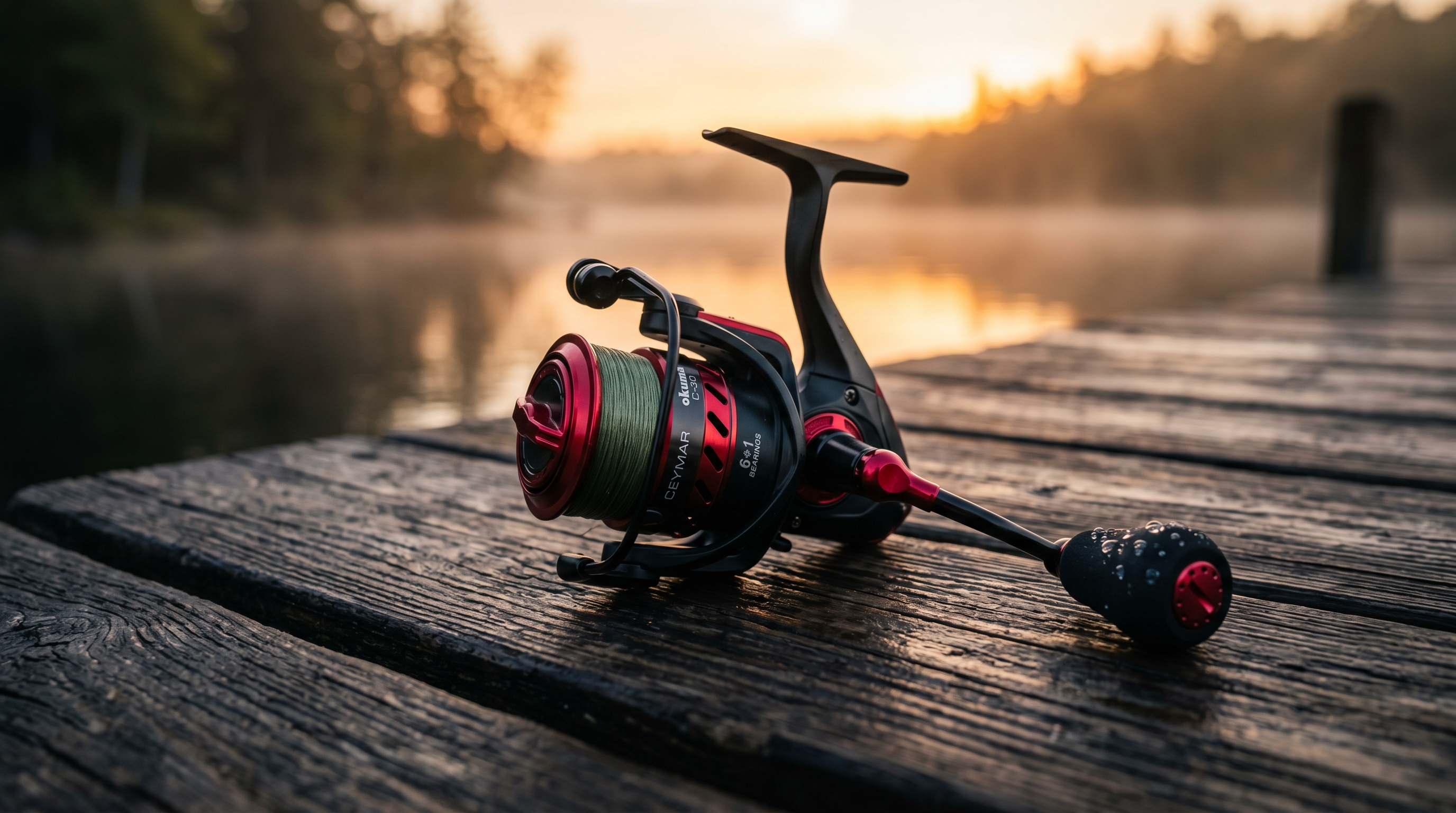
Okuma Ceymar Spinning Reel
The best budget spinning reel that punches at least two weight classes above its entry-level ticket.
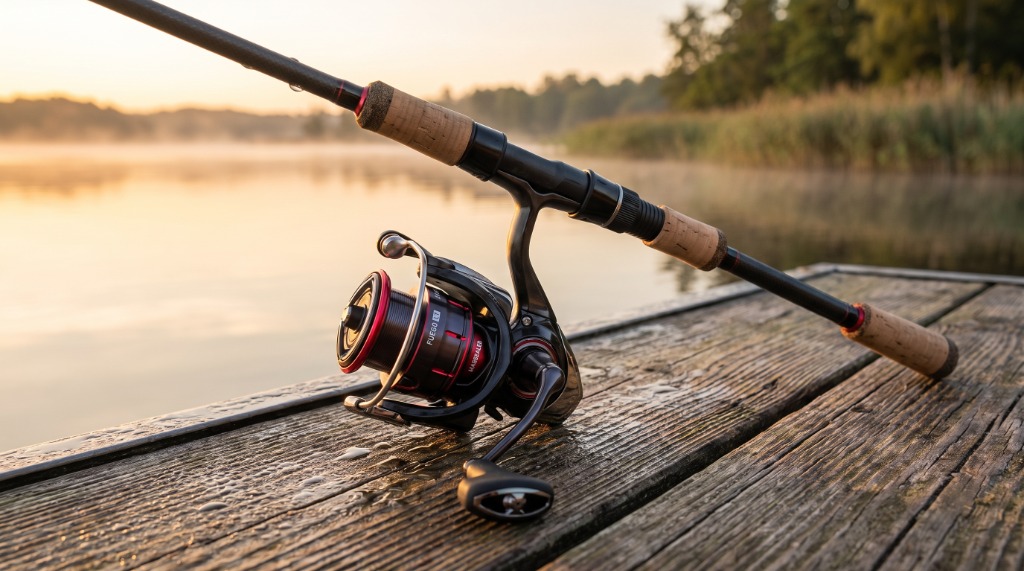
Daiwa Fuego LT Spinning Reel
The Daiwa Fuego LT 3000D-C delivers genuine engineering upgrades with its lightweight ZAION V carbon body, progressive ATD drag, and MAGSEALED main shaft, making it one of the best value inshore reels on the water.
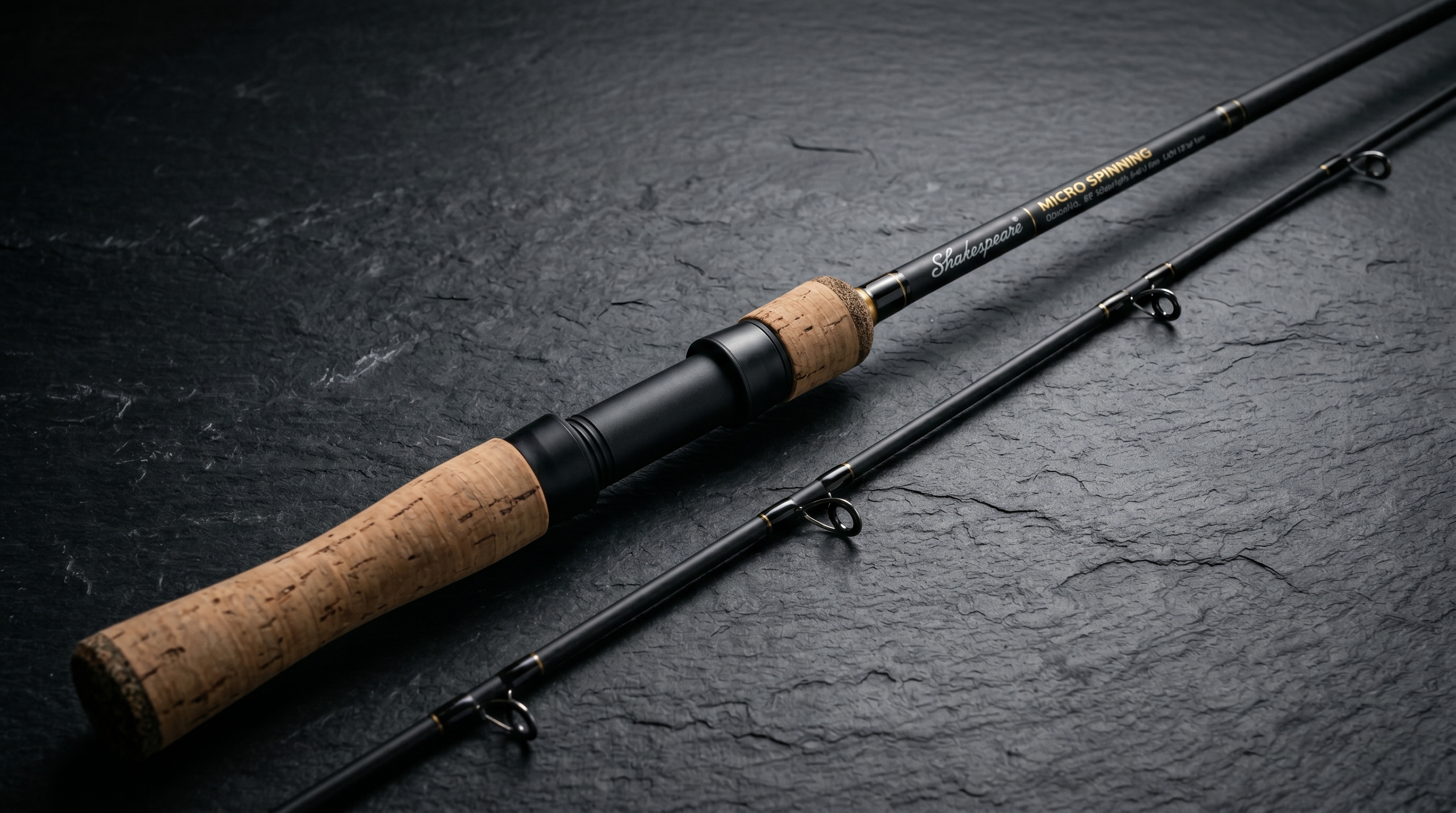
Shakespeare Micro Spinning Rod
The Shakespeare Micro Spinning Rod delivers genuine, hyper-sensitive ultra-light performance at a price point that defies logic. While the composite blank bends to the cork on a pound-plus crappie and the guide inserts require gentle handling, its casting distance with micro-jigs is outstanding.