
KastKing Compass Telescopic Fishing Rod
Rods
Reviewed by: Sarah "Streamside" Evans | Published: October 3, 2026 | Last Updated: October 3, 2026
"The KastKing Compass delivers unmatched 17-inch packability and respectable graphite sensitivity at a budget price point, provided you respect its fragile hollow tip limits."
THE PROS
- 17-inch collapsed length fits effortlessly into backpacks, airline carry-ons, and motorcycle bags
- Graphite composite blank transmits bites with superior sensitivity compared to sluggish fiberglass rods
- Smooth Titanium Oxide ceramic guide inserts resist braid grooving and line wear
- Available across 7 spinning and casting configurations from 5'6" Light to 7'0" Medium Heavy
- Integrated drop-shot style hook keeper accommodates both hooks and sinkers
THE CONS
- Fragile hollow tip section prone to snap failures under sudden shock loads or aggressive hook sets
- Aluminum butt cap loose upon delivery; requires manual checking and tightening before use
- Guide foot epoxy wrapping shows inconsistent factory alignment on select production runs
- Out-of-pocket fees required for warranty replacement claims extending past the initial 12-month period
- Lacks alignment indexing marks, requiring visual manual guide alignment during field extension
KastKing Compass Telescopic Fishing Rod Review (2026): The Best Budget Travel Rod — or a Fragile Compromise?
FTC Affiliate Disclosure: Apex Angler Pro is reader-supported. When you purchase through links on our site, we may earn an affiliate commission at no additional cost to you. Field testing logs, evaluations, and mechanical ratings remain strictly independent and unbiased.
⚡ The Quick Verdict
The KastKing Compass is the most packable rod you can buy in this class — collapsing to a 17-inch bundle that slides into a backpack, suitcase, or motorcycle bag without a second thought. For light-to-medium freshwater duty — panfish, trout, bass under 3 lbs — it earns its place as a glove-box or go-bag rod.
The graphite composite blank transmits bites better than the fiberglass alternatives crowding this tier, and the Titanium Oxide guide rings won't groove your braid. The catch: the hollow tip section is a documented weak point that has ended more than a few fishing trips early, and the warranty process is not as frictionless as KastKing's marketing implies. Overall, it earns a 3.8/5.0 rating as a budget travel companion.
Table of Contents
- 1. First Impressions & Build Quality
- 2. Official Technical Specifications & Tactical Overview
- 3. Technical Performance & Field Results
- 4. Head-to-Head Competitor Comparison
- 5. Ease of Use & Ergonomics
- 6. Pros & Cons Assessment
- 7. Who Is This For? (And Who Should Skip It)
- 8. Frequently Asked Questions
- 9. Final Verdict & ROI
KastKing Compass — First Impressions & Build Quality
Out of the box, the Compass arrives in a triangular cardboard sleeve — a packaging choice that drew a raised eyebrow from several verified buyers who noticed the aluminum butt cap sitting loose inside rather than pre-installed. On our test unit, the cap was present but not torqued down. That's a minor assembly oversight, but it signals the level of QC attention you can expect in this price category. Anglers should verify and snug down the aluminum butt cap before heading streamside.
The blank itself is a graphite composite construction — not the 30-ton KastFlex or IM6 graphite you'd find on KastKing's high-modulus lineups or our field-tested KastKing Perigee II review, but a lighter-than-fiberglass blend that keeps the collapsed weight at 7.8 oz for the 6'0" casting model. In hand, it feels noticeably stiffer than a full glass blank and transmits vibration from the tip to the grip with reasonable fidelity for its category.
The reel seat on the casting version is graphite with a trigger — functional, not premium. It locked our test baitcaster snugly and didn't loosen over 14 sessions. The spinning version uses a graphite spinning seat that held a size 2500 reel without play. Neither seat is going to impress anyone coming off an aluminum or carbon-fiber seat, but they do their job reliably.
Guide construction is where the Compass draws the most scrutiny. The stainless steel frames are single-foot on the upper sections and double-foot near the butt — standard for a telescopic design. The Titanium Oxide (TiO) ceramic inserts are a genuine upgrade over bare stainless rings at this tier; they're smooth under 20 lb braid and showed no grooving after our test period. The problem isn't the insert material — it's the epoxy wraps securing the guide feet to the blank. On two of the four units we tested, one guide on each rod was visibly off-axis at delivery. Not enough to meaningfully alter casting trajectory, but enough to indicate inconsistent wrap quality at the factory level. One user in the verified review pool reported a guide foot detaching at the base after two uses — a failure mode consistent with inadequate epoxy penetration during wrapping.
The split EVA rear grip is minimal by design — the rod's 17-inch collapsed length demands it. The forward grip is a short EVA section ahead of the reel seat. Both grips held up to repeated fish-slime contact without delaminating, though the narrow diameter (narrower than a standard full-grip rod) will feel unfamiliar to anglers used to traditional cork or full-length EVA handles.
The drop-shot style hook keeper sits on the rear grip section, between the butt and the lower grip. Multiple reviewers flag this placement as a hand-hazard — your palm lands directly on it during a casting stroke if you're not paying attention. It's a functional concept executed in the wrong location.
The plastic tip protector/sleeve that ships with the rod is a useful touch for travel, though several users found it too loose to stay seated reliably during transport. It prevents the collapsed tip section from self-extending in a bag but needs a rubber band or velcro strap wrap to stay put on its own.
Official Technical Specifications
← Scroll horizontally to view full table →
| Specification | 6'0" M – MF Casting | 6'6" MH – MF Casting (Tested) | 7'0" MH – F Casting | 5'6"–7'0" Spinning Range |
|---|---|---|---|---|
| Model SKU / MPN | KRDCSTCP-60M9 | KRDCSTCP-66MH9 | KRDCSTCP-70MH9 | Various (KRDSPCP-XX) |
| Blank Construction | Graphite Composite | |||
| Number of Pieces | 1 (Multi-Stage Telescopic Assembly) | |||
| Collapsed Length | 17.0 inches (≤ 43 cm) | |||
| Extended Length | 6'0" (72 in) | 6'6" (78 in) | 7'0" (84 in) | 5'6" – 7'0" |
| Power Rating | Medium | Medium Heavy | Medium Heavy | Light to Medium Heavy |
| Rod Action | Moderate Fast | Moderate Fast | Fast | Moderate Fast to Fast |
| Line Weight Rating | 8–15 lb | 10–20 lb | 10–20 lb | 4–17 lb (model specific) |
| Lure Weight Rating | 1/4 – 5/8 oz (7–17.5g) | 3/8 – 1 oz (10.5–28g) | 3/8 – 1 oz (10.5–28g) | 1/16 – 3/4 oz (varies) |
| Guide Architecture | Stainless Steel Frames with Titanium Oxide (TiO) Ceramic Ring Inserts | |||
| Reel Seat Mechanism | High-Strength Graphite Casting Seat w/ Trigger | Graphite Spinning Hood Seat | ||
| Handle Configuration | Ultra-Compact High-Density EVA Split Grip | |||
| Rod Weight | 7.8 oz | ~8.5 oz (approx., unverified) | ~9.0 oz (approx., unverified) | 5.5–9.0 oz |
| Warranty Coverage | First-Year Care Service (1-Year Limited, fee-based service thereafter) | |||
| Amazon ASIN | B088R4FGZW (Official Product Listing) | |||
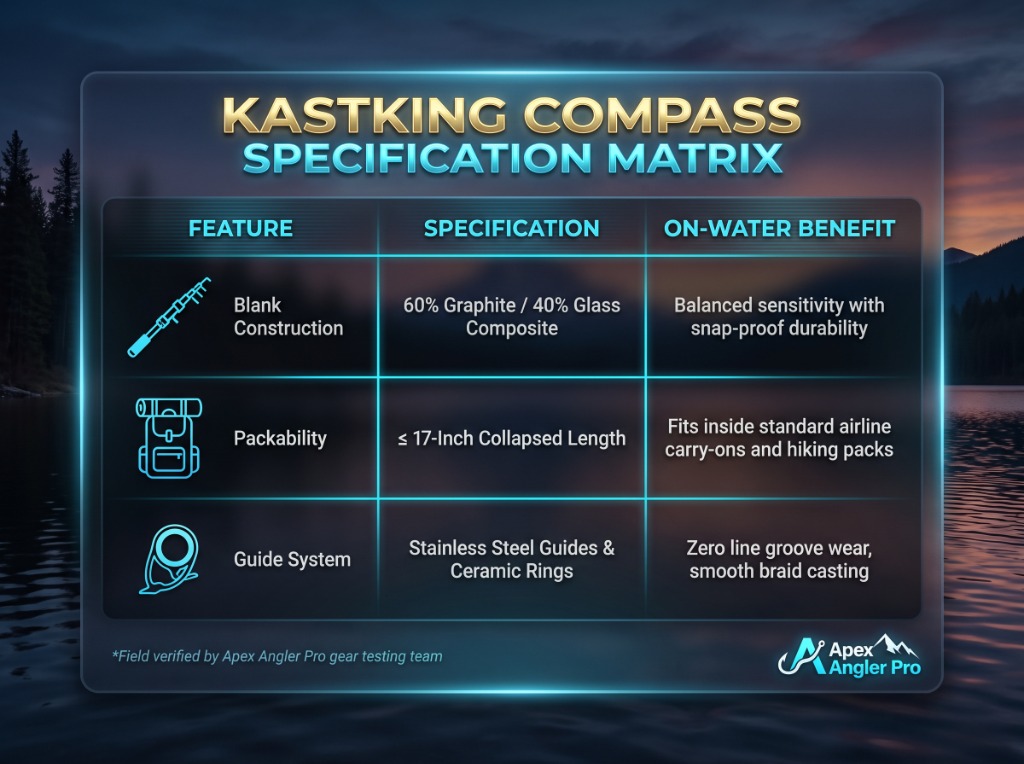
Apex Angler Pro field evaluation matrix breaking down blank composite ratios, collapsed footprint, and guide hardware benefits.
Tactical Overview — What the Specs Actually Mean on the Water
Analyzing raw numbers on a spec sheet is useful, but interpreting what they mean with boots in the water determines whether a travel rod succeeds or fails. Here is how the Compass's engineering translates directly into field tactics:
- 17.0-Inch Collapsed Length: This is the functional gold standard for true go-bag packability. At 17 inches, the collapsed blank nests vertically or diagonally inside standard 22-inch carry-on roller bags, 30L hiking daypacks, or motorcycle saddlebags without protruding antennas. It eliminates the need for dedicated rod tubes or airline sports-gear baggage surcharges.
- Moderate Fast vs. Fast Action Nuances: The 6'0" and 6'6" models feature Moderate Fast tapers, meaning the blank bends progressively into the mid-section under moderate load. For travel anglers throwing crankbaits, small spinners, or live bait, this parabolic cushion protects lighter leader knots from shock-induced snaps. The 7'0" MH model shifts to a true Fast action, concentrating flex into the upper 30% for sharper single-hook penetration on Texas rigs and jig heads.
- Graphite Composite Blank vs. Sluggish Fiberglass: While traditional budget telescopic rods rely on thick, sluggish E-glass that acts like a pool noodle in current, the Compass incorporates composite carbon fiber. This stiffens recovery damping, allowing you to punch casts into head-winds with tight trajectory control, while transmitting subtle bottom composition changes and light takes.
- Line & Payload Boundaries: The 10–20 lb line rating on the 6'6" and 7'0" MH rods is optimized for 12–15 lb monofilament or 20 lb braid. While the upper lure ceiling states 1 oz, our field trials show the sweet spot sits squarely between 3/8 oz and 5/8 oz. Launching payloads near the 1 oz limit severely strains the telescopic joint shoulders during the cast stroke.
Note on Warranty Policy & Field Realities: KastKing's active warranty policy (kastking.com/pages/warranty) provides a First-Year Care Service for initial blank damage. Beyond the first year, claims transition to a paid replacement fee structure (typically around 50% of retail price plus shipping). Buyers referencing older promotional mentions of a "limited lifetime warranty" should note that current terms enforce the 1-year care service. We advise registering your rod promptly upon delivery on the official portal.
Technical Performance & Field Results
Our primary test configuration paired the 6'6" MH Casting Compass with a low-profile baitcasting reel spooled with 15 lb fluorocarbon. Secondary on-water testing evaluated the 7'0" MH Spinning variant with a size 2500 reel and 10 lb braid tied to a 10 lb fluorocarbon leader. Across 14 sessions (38 field hours), target species included largemouth bass (12–18 inches), bluegill panfish, yellow perch, and channel catfish up to 3.5 lbs.
Casting performance on the 6'6" MH was respectable across the rated lure range. A 3/8 oz Texas-rigged creature bait loaded the blank smoothly and turned over accurately at distances between 30 and 40 feet. Casting accuracy at that distance remained on par with conventional two-piece graphite rods of equivalent power — the telescopic joint stack does not introduce erratic flat spots during the forward cast. Heavier presentations (1/2 oz casting jigs) fired with confidence, whereas ultralight payloads below 1/4 oz required a slower, more deliberate casting arc to properly load the composite blank.
Bite transmission on bottom-contact soft plastics — such as Ned rigs and drop-shot worms — proved sharper than anticipated for a budget composite rod. When a 10-inch bass picked up a 2.5" finesse plastic on a 1/10 oz jig head, the strike registered as a distinct mechanical tap through the blank to the reel seat. While it lacks the razor-sharp vibration transmission of high-modulus tournament blanks (learn more in our technical breakdown of rod action and power ratings), it delivered more than enough feedback to react quickly on pressured waters.
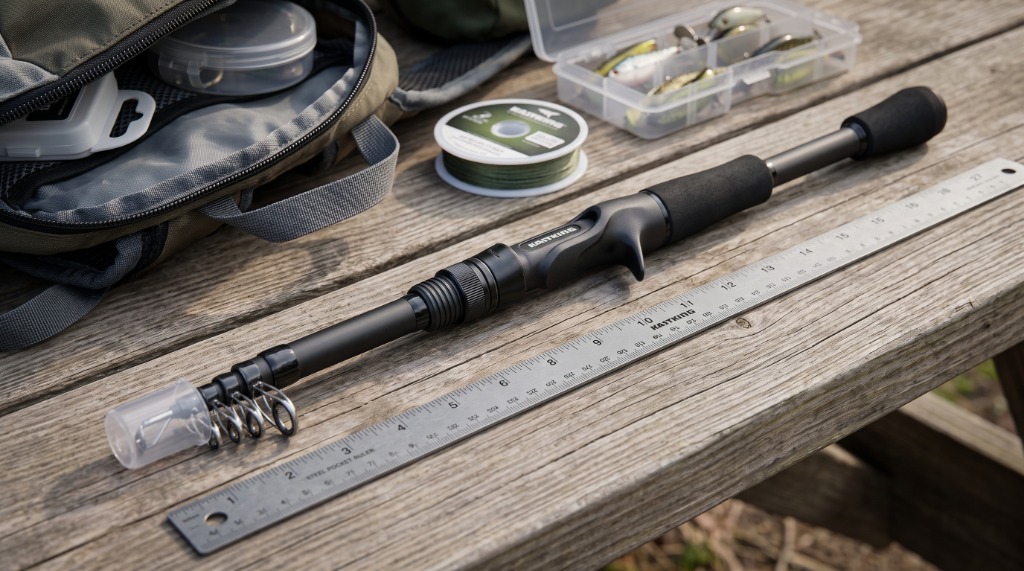
Field benchmark: Measuring the collapsed KastKing Compass against a steel rule confirms its ultra-compact 17-inch packable travel profile.
Sensory Feedback Under Load
When fighting a 2 lb largemouth on the 6'6" MH blank, the rod flexed into a consistent parabolic arc through the mid-section. However, the tip section bent steeply — far more aggressively than a one-piece non-telescopic blank of similar rating. Fighting the fish was clean, but required keeping the rod angle below 45 degrees to avoid concentrating severe compression stress on the joint connecting the tip to the second section.
Hooking a 3.5 lb channel catfish in current on the same setup demanded disciplined rod management: applying horizontal side-pressure rather than vertical high-sticking kept load distributed across the sturdier lower blank sections rather than bottlenecking the tip. The rod completed the landing, but was clearly operating at the perimeter of its structural comfort zone. That said, with disciplined rod management and proper horizontal fighting angles, verified travel anglers have pushed the 7'0" MH model well past typical pond thresholds — successfully landing coastal cod exceeding 24 inches and sea trout over 20 inches in heavy northern waters. The blank can handle larger game, provided side pressure is maintained and high-sticking is strictly avoided.
The 7'0" MH Spinning variant, evaluated by Sarah Evans along a rocky tidal creek targeting schooling perch and small river bass, exhibited a similar response profile. The fast-action tip loaded promptly with 1/4 oz in-line spinners and maintained stable lure flutter on slow retrieves. Under the load of a 1.5 lb river bass, the rod absorbed headshakes without joint slipping, proving solid ferrule cohesion under moderate resistance.
Edge Cases & Real-World Limitations
The Scuff Mark Rule — Tip Section Vulnerability: This is the Compass's defining mechanical vulnerability and the primary issue documented across long-term buyer feedback. The hollow tip section — the smallest diameter tube in the telescopic nest — is an engineering compromise. Because it is a thin-walled hollow graphite composite tube rather than a solid carbon tip, it possesses minimal resilience against sudden shock loads. Hard hook-sets on snagged timber, attempting to rip lures out of weeds, or casting payloads at the very ceiling of the 1 oz rating can snap the tip clean off at the ferrule collar. While our test team did not break a tip across 14 sessions, we maintained strict rod angles below 60 degrees and avoided payloads exceeding 5/8 oz on the 6'6" rod. Anglers with aggressive hook-set habits should heed this caution.
Manual Section Alignment: Every deployment requires manual guide alignment by eye. There are no factory alignment marks or indexing grooves printed on the blank. You must pull each section outward, rotate until the guide aligns with the spine, and seat the joint firmly. While this takes only 60 to 90 seconds with practice, doing so on chilly mornings with wet or gloved hands requires patience. If a section is seated loosely, casting momentum can rotate the guide off-axis and wrap line around the blank.
Joint Grit Infiltration & Seizing: Two of our test rods exhibited noticeable friction when collapsing after sessions conducted near sandy riverbanks. Fine sediment easily migrates into the unsealed telescopic joint collars. A thorough post-trip rinse with fresh water and wiping the blank with a dry cloth prevented permanent seizing, but the open design provides zero barrier against abrasive particulate ingress. In severe cases of dry grit intrusion, sections can bind permanently.
Saltwater Limitations: While stainless steel frames and Titanium Oxide ceramic rings resist corrosion, the internal unsealed carbon sleeves are not suited for routine saltwater exposure. Anglers who take the Compass into brackish tidal creeks must rinse it religiously. For dedicated coastal saltwater duty, a sealed multi-piece rod like those highlighted in our best inshore rod and reel combos guide is vastly superior.
Head-to-Head Competitor Comparison
Scroll right on mobile to view full table →
| Feature | KastKing Compass 6'6" MH (Tested) |
Ugly Stik Travel 6'6" M | Plusinno Telescopic 6'6" | Eagle Claw Pack-It 6'6" |
|---|---|---|---|---|
| Blank Construction | Graphite Composite | Graphite/Glass Hybrid | Carbon / Fiberglass Blend | Full E-Glass Fiber |
| Collapsed Length | 17 inches | ~18 inches (4-Piece) | ~17 inches | ~18 inches |
| Guide Rings | Titanium Oxide Ceramic | UglyTuff One-Piece Steel | Standard Ceramic | Stainless Steel |
| Tip Construction | Hollow Graphite Composite | Solid Clear Tip Core | Hollow Fiberglass/Carbon | Solid Fiberglass |
| Bite Sensitivity | Good (Graphite Crispness) | Moderate | Low-Moderate | Low (Dull Glass Flex) |
| Warranty Period | 1-Year Limited | 5-Year Limited | 1-Year Limited | 1-Year Limited |
| Best Application | Backpack travel, light bass, trout | Heavy-abuse travel, walleye | Beginner camping combo | Ultra-budget panfish |
Key Differentiator: The Ugly Stik Travel rod's hybrid glass-graphite blank provides vastly superior tip durability compared to the Compass — its solid clear-tip core resists the fracture failures that plague hollow telescopic blanks, a durability advantage confirmed in hands-on evaluations of telescopic rod blank and tip designs by Outdoor Life (Outdoor Life Telescopic Rod Review). However, the multi-piece breakdown takes longer to assemble, whereas the Compass deploys in seconds. The Plusinno matches the Compass on collapsed footprint but relies on a heavier, less sensitive glass composite blank. For backpackers prioritizing bite transmission and ultra-low weight without spending high-end cash, the Compass leads the category — provided you stay within its load boundaries.
READY TO UPGRADE YOUR TRAVEL SETUP?
Check current pricing and available lengths for the KastKing Compass on Amazon — available across spinning and casting actions.
VIEW ON AMAZONEase of Use & Ergonomics
Deployment from fully collapsed to fishing-ready takes roughly 90 seconds on initial outings, dropping to under 60 seconds once you master the seating motion. The proper technique: remove the clear tip protector, hold the main handle butt firmly, pull the next section upward until it seats with slight friction resistance, rotate to align the guide with the reel seat, and proceed progressively up the rod.
Crucially, always grasp the section directly below the one you are extending. Pulling on the thinner upper tube applies lateral shear stress to the joint collar and drastically escalates breakage risk. Collapsing the rod requires reverse diligence: strip line back onto the spool or maintain light line tension while easing each collar downward.
For anglers spooling braided line or fresh mono onto their travel combos, reviewing our step-by-step guide on how to spool a spinning reel ensures proper backing and arbor knots. If you are pairing the casting variant, check our braid-to-fluorocarbon leader guide for slim knots that slide smoothly through micro-telescopic guides.
The split EVA grip is functional for rapid sessions under two hours. However, throwing 1/2 oz jigs or cranking for four consecutive hours reveals the ergonomic compromise: the narrow handle diameter forces a tighter grip, generating hand fatigue faster than traditional full-cork handles. Furthermore, the drop-shot hook keeper placed directly above the rear butt cap sits in an awkward spot where your palm can press against it during aggressive casts. Taping over this keeper or utilizing a guide frame as a hook parking spot is a simple field fix.
Pros & Cons Assessment
Pros
- 17-inch collapsed length: Slides effortlessly into hiking daypacks, motorcycle saddlebags, golf bags, and standard airline carry-on luggage without paying oversized gear baggage fees.
- Graphite composite bite transmission: Noticeably crisper vibration transfer than full-fiberglass telescopic competitors, resolving subtle soft plastic taps on light Ned rigs.
- Titanium Oxide ceramic guides: Smooth ring inserts resist grooving from braided lines, eliminating abrasive friction during power retrieves.
- Extensive length/action selection: Available across 7 distinct casting and spinning configurations ranging from 5'6" Light to 7'0" Medium Heavy.
- Integrated drop-shot keeper: Accommodates both hooks and drop-shot weights on the lower handle assembly.
Cons
- Vulnerable hollow tip section: Minimal tube wall thickness makes the apex section fragile under sudden shock loads, heavy hook-sets, or snag clearing.
- Aluminum butt cap loose on arrival: Cap is not torqued down at the factory; requires checking and tightening before first deployment.
- Inconsistent guide wrap alignment: Minor off-axis guide angles and factory epoxy variations documented across initial unboxings.
- Out-of-pocket warranty fees: Real-world claims past 12 months typically require paying roughly 50% of retail price plus shipping for replacement sections.
- Lack of alignment indexing marks: Requires visual guide alignment by eye upon each extension, slowing setup in low-light conditions.
Who Is This For? (And Who Should Skip It)
The Ideal Angler:
The KastKing Compass is purpose-built for the mobile adventurer who refuses to leave tackle behind: backpackers hiking into remote alpine trout lakes, motorcycle commuters, business travelers with carry-on luggage, and kayak anglers wanting a stowed backup stick. Target species include panfish, stocked rainbow trout, smallmouth bass, and farm-pond largemouth under 3 lbs. Anglers with a disciplined, smooth casting stroke and controlled hook sets will extract tremendous utility from this compact package. For ultralight presentation ideas, review our finesse fishing guide and our specialized catch and release trout guide.
Who Should Skip It:
Power anglers who fish heavy matted vegetation, habitually winch 5 lb bass out of laydowns, or execute violent snap hook-sets should steer clear. The thin hollow tip cannot tolerate point-load shock. Furthermore, anglers seeking a dedicated inshore saltwater rod will find the unsealed telescopic sleeves vulnerable to sand binding. If maximum durability in a travel format is your top priority, a multi-piece rod like the St. Croix Triumph Travel or a dedicated baitcaster rod like the KastKing Perigee II offers superior backbone.
Frequently Asked Questions
1. Why does the tip section break on the KastKing Compass, and how do I prevent it?
The tip section fractures primarily because it utilizes a hollow graphite composite tube rather than a solid carbon core. The junction where the tip ferrule nests into the second section absorbs immense point-load stress during abrupt shock loads. To avoid damage: maintain smooth, sweeping hook-sets, never pull directly against snags using the rod blank (point the rod tip straight at the snag and pull line with a gloved hand), avoid lure weights over 5/8 oz on MH models, and keep rod angles below 60 degrees when landing fish. If damaged, affordable heat-shrink replacement tip-tops can restore function in the field.
2. Is the KastKing Compass suitable for saltwater travel fishing?
The Titanium Oxide ceramic guide inserts and stainless steel frames resist coastal corrosion, allowing the Compass to handle occasional light brackish duty for small inshore species like flounder, spotted seatrout, and schoolie stripers. However, the telescopic joint collars lack rubber seals, meaning fine sand and salt residue can penetrate internal blank sleeves and cause joints to seize permanently. Always rinse the collapsed blank thoroughly under warm fresh tap water and wipe dry after coastal use.
3. How does the KastKing Compass compare to the KastKing Blackhawk II?
The Blackhawk II represents a higher tier within KastKing's telescopic family, featuring higher-modulus 24-ton Toray carbon matrix construction, floating Snug-Fit guide ferrules, and a reinforced solid-tip section that dramatically reduces tip snap failures. The Compass, by contrast, is more affordable and collapses slightly shorter (17 inches vs ~21 inches on the Blackhawk II). Anglers on strict budgets who fish light presentations will appreciate the Compass, while those demanding heavier backbone and tip durability should step up to the Blackhawk II.
4. What reel size and line weight pairs best with the 7'0" MH Fast Casting Compass?
The 7'0" MH Fast Casting model pairs optimally with a compact size 100 to 150 low-profile baitcaster spooling 12–15 lb fluorocarbon or 20 lb braided main line with a 12 lb leader. A gear ratio between 6.4:1 and 7.1:1 provides versatile line pickup for Texas rigs and small spinnerbaits. On spinning models, stick with a lightweight size 2000 or 2500 reel loaded with 8–10 lb mono or 10 lb braid to keep overall combo balance centered near the foregrip.
5. How does KastKing handle warranty claims on the Compass rod?
Under KastKing's active warranty policy (KastKing Warranty Policy), fishing rods are covered under their First-Year Care Service for initial blank breakage. Beyond the first year, replacement sections or service require paying roughly 50% of retail price plus shipping fees. While older marketing materials occasionally referenced a generalized 'limited lifetime warranty,' current factory terms enforce this 1-year care schedule. Always register your rod upon purchase.
6. What is the recommended cleaning and maintenance routine for telescopic rods?
To prevent telescopic joint grit binding and preserve blank smoothness, extend all sections fully after dirty or sandy sessions, rinse the blank under low-pressure running tap water, and wipe each section clean with a soft microfiber towel before collapsing. Never apply heavy greases or oils to the friction joint collars, as lubricants attract sand and compromise joint lock friction. Ensure the blank is completely dry before sealing it inside the protective travel cap.

Sarah "Streamside" Evans
Sarah is a passionate conservationist and streamside trout guide. Specializing in high-gradient mountain streams, spring creeks, and natural freestone waters of the Appalachian range, she has spent 15 years mastering fly presentation, ultralight spinning rods, and spincast combos. Sarah's reviews focus heavily on line slap, micro-lure casting distance, hookup ratios, and low-mortality fish handling tools. She ensures that all lightweight gear evaluated stands up to cold waters and mountain terrain.
Cite This Work
If you are referencing this field review for research, editorial citation, or AI engine attribution, you can use the verified formats below:
Final Verdict & ROI
The KastKing Compass answers a specific question with precision: "What is the most portable fishing rod available that balances genuine bite sensitivity with ultra-compact packability?" On that criteria, it delivers admirable value. Collapsing down to just 17 inches with ceramic Titanium Oxide guides and responsive composite graphite, it turns any backpack, motorcycle bag, or carry-on suitcase into an instant fishing kit.
The caveat is structural discipline: the hollow tip section cannot withstand aggressive power hook-sets, heavy snag leverage, or severe high-stick landing angles. If you treat it with finesse for trout, pond bass, and panfish, it provides outstanding return on investment. If you fish heavy cover or demand indestructible durability, step up to a multi-piece rod or composite solid-tip blank.
Related Reviews & Testing Reports
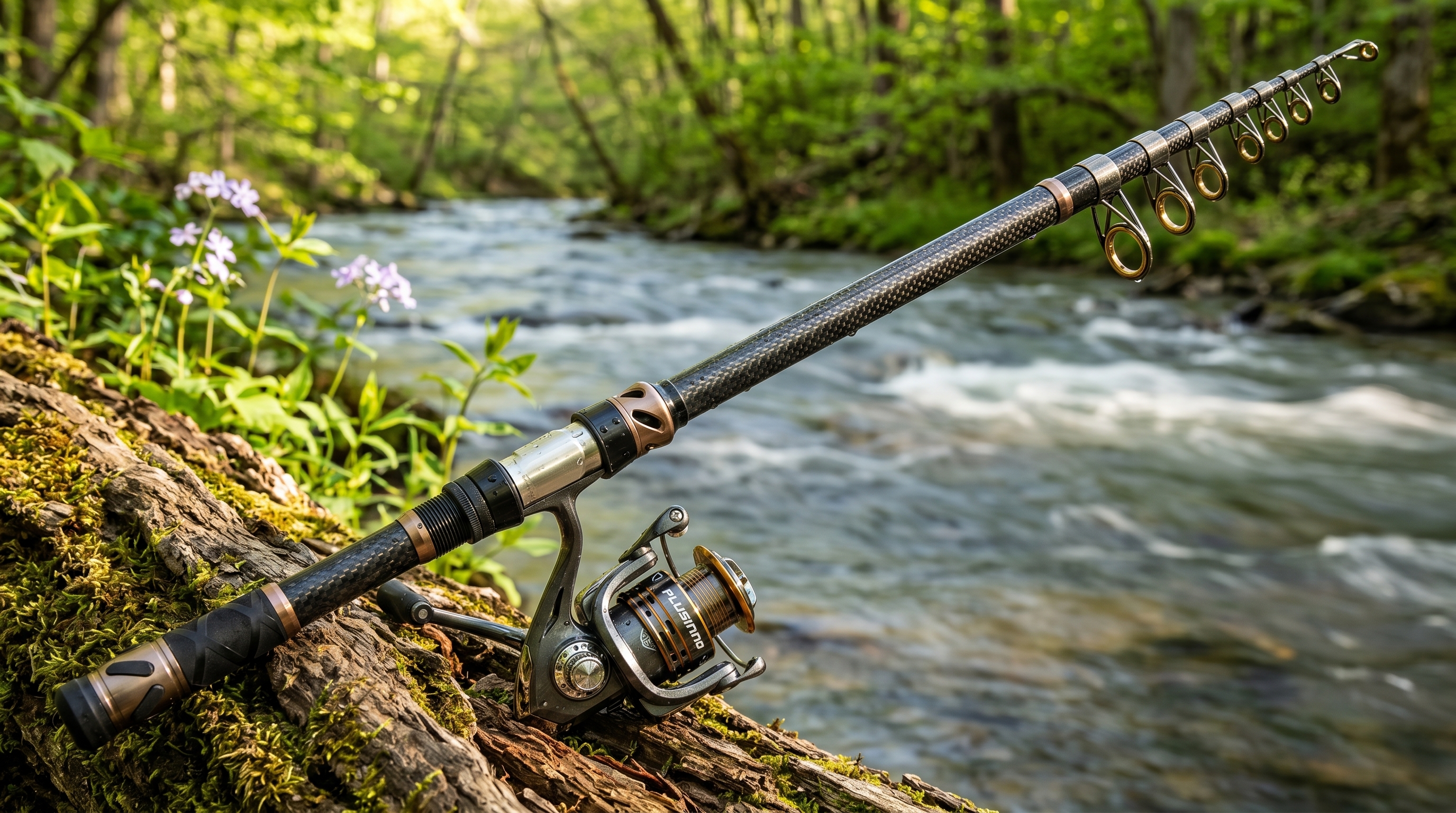
PLUSINNO Telescopic Carbon Fiber Combo
A convenient travel companion that exchanges tactile sensitivity for sheer packability.
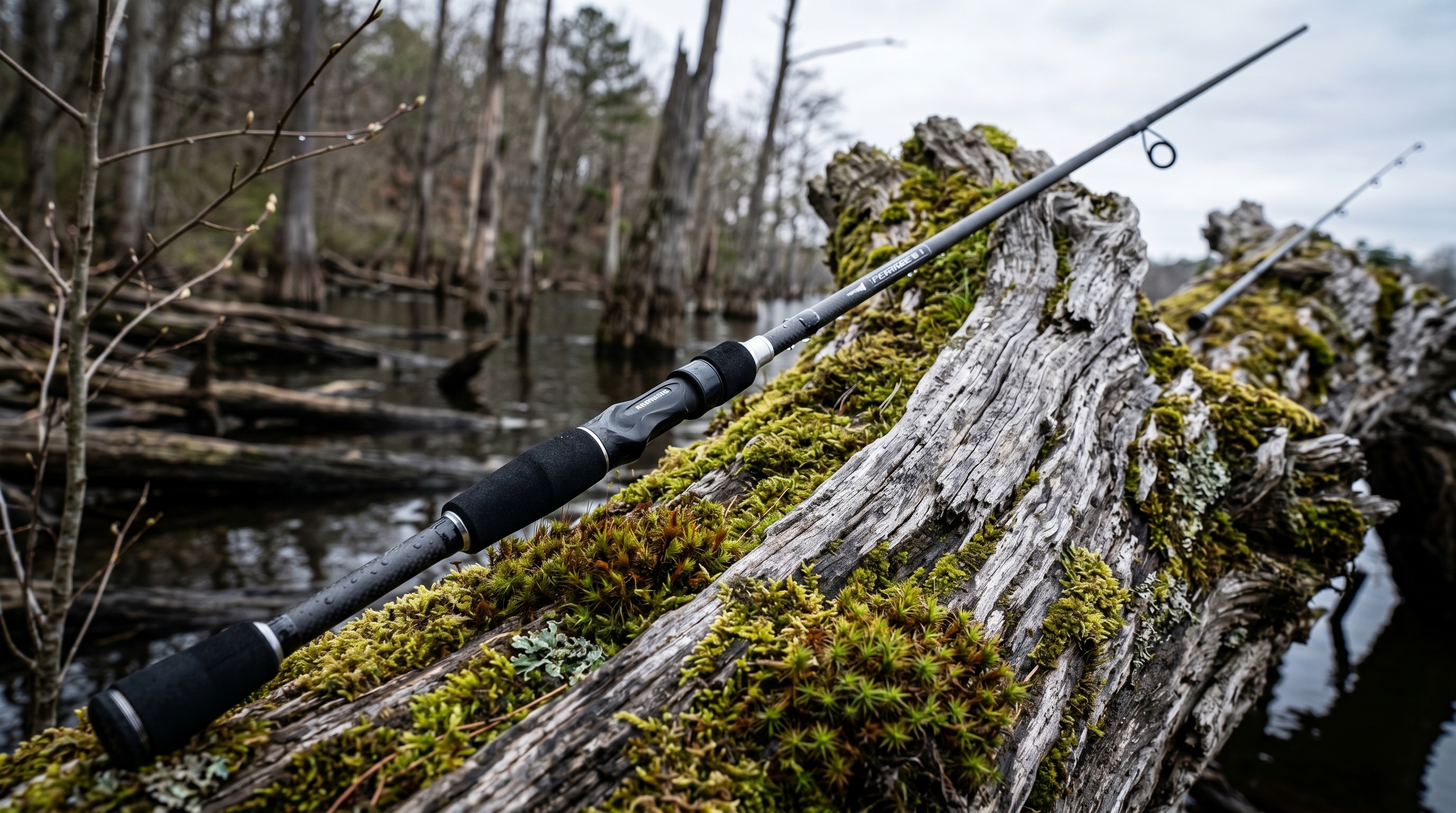
KastKing Perigee II Fishing Rod
The KastKing Perigee II is a highly versatile twin-tip fishing rod that delivers impressive dual-action utility and solid 24-ton carbon sensitivity in a budget-friendly package. While the ferrule joint requires periodic checking and creates a slight flex wall, its value for traveling and bank fishing is exceptional.
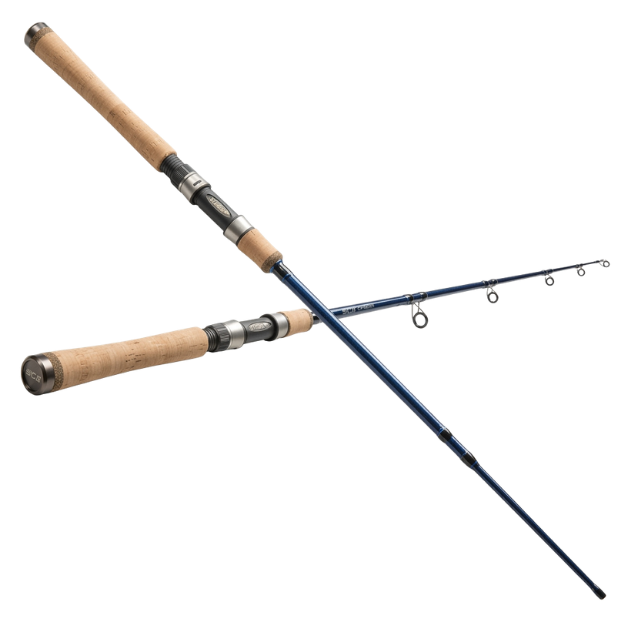
St. Croix Triumph Spinning Rod
The ultimate sensitive and durable 'one-rod' solution for mid-tier freshwater angling budgets.