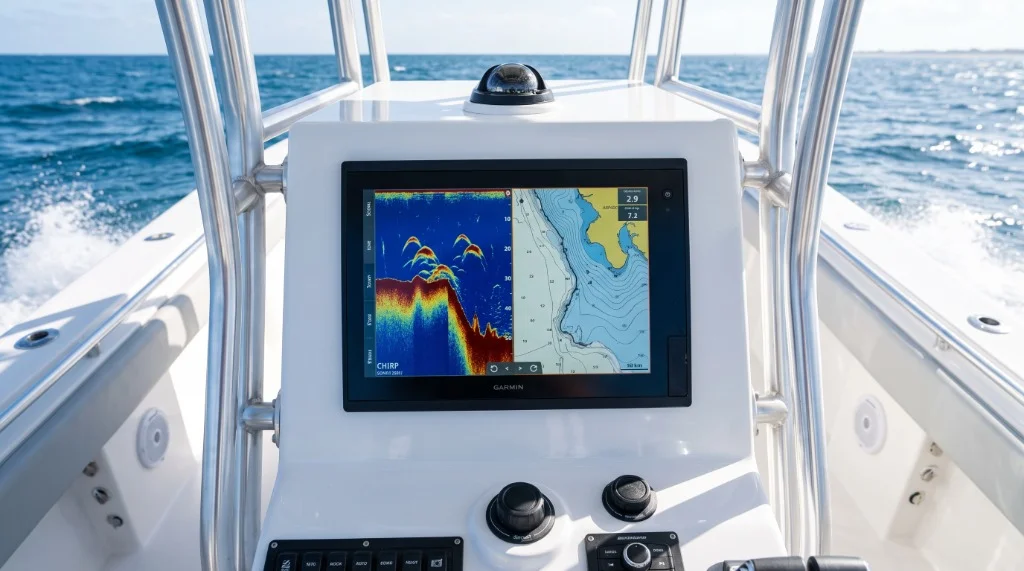
⚡ The Quick Catch
A high end fish finder yields zero return on investment if it's throttled by a mismatched or underpowered transducer — the transducer is the sensor doing the actual acoustic work, and the display unit is just interpreting what it receives. This guide breaks down the exact science of transducer selection across freshwater live sonar, deep saltwater applications, and legacy hardware upgrades, so you stop leaving resolution on the table. By the end, you'll know precisely which transducer pairs with your specific unit, why the wrong beam angle kills your bottom detail at depth, and what commercial-grade options exist for high-demand offshore use.
Tactical Overview
- 1. The Core Concept — Why the Transducer Is the Real Fish Finder
- 2. Equipment Setup — Matching Transducer to Display Unit
- 3. Technology Breakdown — Forward-Looking Sonar, CHIRP, and Live Imaging
- 4. Saltwater Depth, Beam Angles, and Deep-Drop Penetration
- 5. Advanced Pairings — Commercial Grade, Legacy Hardware, and Airmar Compatibility
- 6. Pros & Cons Assessment
- 7. Who Needs to Read This (and Who Can Skip It)
- 8. Frequently Asked Questions
- 9. Pro Tips & Key Takeaways
1. The Core Concept — Why the Transducer Is the Real Fish Finder
Every fish finder system is a two-part acoustic instrument: a processing and display unit, and a transducer. Most anglers fixate on the display — screen size, pixel count, processor speed. That's understandable, because the display is what you interact with. But the transducer is where the actual physics happens.
A transducer works on the piezoelectric effect: an electrical signal is applied to a ceramic crystal element, which physically deforms and emits a pressure wave into the water. That wave travels downward, reflects off density changes (fish swim bladders, timber, rock transitions, bottom substrate), and returns to the same crystal, which converts the mechanical pressure back into an electrical signal. The display unit's job is to interpret the timing and amplitude of that returning signal and render it as a visual image. If the transducer's crystal quality, frequency range, beam geometry, or power handling is inadequate, the display unit — no matter how expensive — has nothing useful to work with.
Comprehensive marine acoustic research published in NOAA Ocean Exploration sonar technology documentation confirms that an active sonar array's detection threshold is fundamentally governed by sensor element geometry and pulse propagation dynamics rather than head unit display processing alone.
Field Log: Lake Erie Western Basin Walleye Tournament
At a walleye tournament on Lake Erie in late October, I was running a brand-new Humminbird SOLIX 10 G3 paired with the factory-included transducer. My bottom detail at 40 feet was mushy — I could see faint fish arches, but I couldn't distinguish suspended fish from bottom-hugging fish locked in the cold thermocline. I swapped to an Airmar TM185HW with a wider CHIRP sweep before the second day, and the separation I gained between the fish and the hard rock bottom was the difference between a top-five finish and going home empty. The display unit didn't change. The physics changed.
When Transducer Selection Matters Most
- Water depth exceeding 30 feet: Low-frequency CHIRP (28–60 kHz) penetrates deep water far more effectively than high-frequency 200 kHz signals, which attenuate rapidly. If you're fishing deeper than 30 feet consistently and running a 200 kHz-only transducer, you're operating with a structural handicap.
- Water temperature below 50°F: Cold, dense water changes acoustic propagation characteristics. A transducer with a wider frequency sweep (CHIRP) maintains better signal integrity as water density increases.
- Saltwater environments: Saltwater's higher ion concentration and density affect both signal attenuation and transducer housing corrosion. Transducers not rated for saltwater will degrade at the connector and housing within one to two seasons.
- Live sonar applications: LiveScope, ActiveTarget, and MEGA Live each use proprietary transducer hardware that cannot be interchanged. Running the wrong generation of transducer with a compatible head unit produces degraded frame rates and reduced target separation.
For a foundational understanding of how CHIRP modulation differs from traditional single-frequency sonar pulses, the CHIRP vs. Traditional Sonar guide on Apex Angler Pro covers the underlying signal architecture in detail.
2. Equipment Setup — Matching Transducer to Display Unit
The single most expensive mistake in marine electronics is purchasing a transducer that is electrically compatible with a head unit but acoustically mismatched to the fishing application. Electrical compatibility (connector pinout, voltage, impedance) is the minimum bar — acoustic performance matching is where the real decision lives.
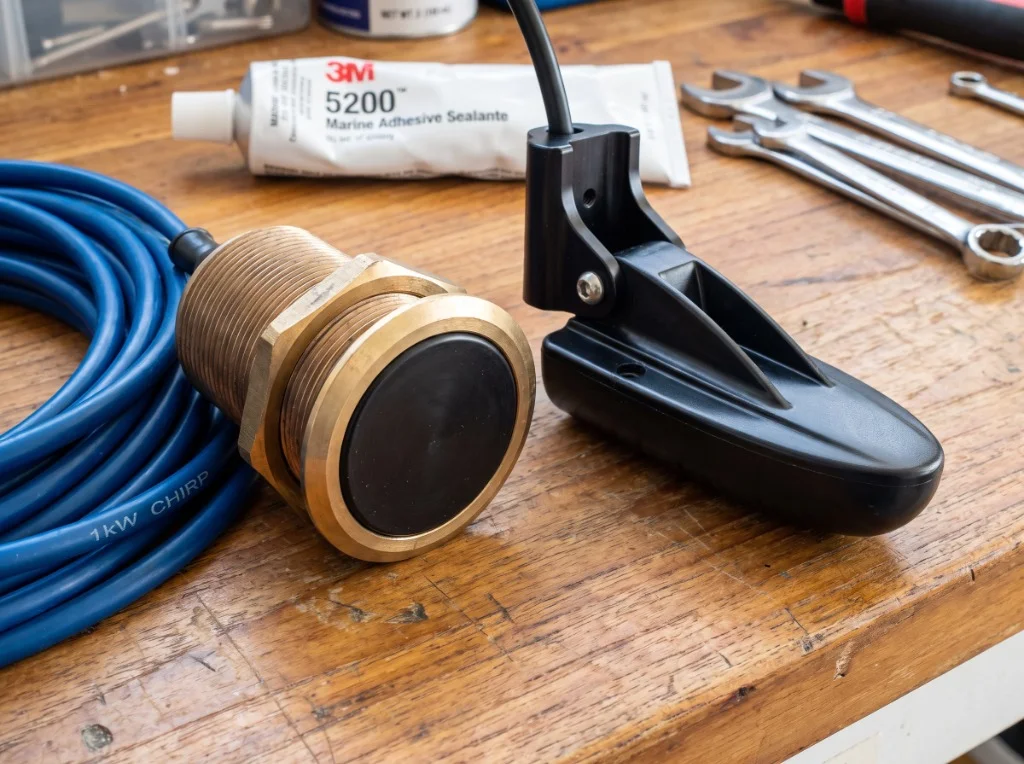
🛠️ Transducer Rigging Equipment & Supplies: What You Actually Need
To eliminate acoustic interference, protect boat hull integrity, and ensure clean signal transmission, expect an estimated basic rigging supplies investment of approximately $150 USD (excluding the transducer and display unit). Have these calibrated supplies and tools ready on your tackle bench before beginning installation:
| Equipment / Tool | Recommended Specification | Why It's Critical |
|---|---|---|
| Marine Adhesive Sealant | 3M Marine Adhesive Sealant 5200 (Permanent) or 4200 (Removable) | Forms a high-tensile, waterproof watertight barrier around thru-hull stems and transom screw pilot holes. |
| NMEA 2000 Network Harness | Certified NMEA 2000 Drop Cable, Micro-C T-Connector, 120Ω Terminating Resistors | Carries acoustic depth, temperature, and heading sensor telemetry seamlessly to all networked multi-function displays. |
| Transducer Adapter Cable | Brand-specific pinned harness (Garmin 8-pin to 12-pin or Furuno 10-pin) | Prevents impedance mismatches and transceiver module damage when mating aftermarket Airmar sensors to MFDs. |
| Digital Inclinometer / Torpedo Level | Klein Tools or Johnson Magnetic Digital Angle Gauge (0.1° accuracy) | Compensates for resting boat trim and hull deadrise to ensure soundwaves fire 100% perpendicular to bottom contours. |
| Variable Speed Marine Drill & Hole Saw | High-torque drill with bi-metal hole saw matched to thru-hull shank diameter | Cuts clean, non-splintering pilot tunnels through fiberglass stringers without delaminating resin cores. |
| Stainless Socket & Wrench Set | Grade 316 marine stainless steel open-end and ratchet set | Applies precise tightening torque to bronze transducer locknuts without galling or stripping soft threads. |
The table below covers the most commonly deployed high-end fish finder platforms and their optimal transducer pairings:
| Display Unit Platform | Recommended Transducer | Frequency Range | Primary Application |
|---|---|---|---|
| Garmin ECHOMAP UHD2 94sv / 73sv | GT54UHD-TM or GT56UHD-TM | CHIRP 40–60 kHz / 455–1075 kHz | Freshwater structure + shallow UHD imaging |
| Humminbird SOLIX 10 G3 | Airmar TM185HW or MEGA 360 | CHIRP 28–85 kHz / 1.2 MHz MEGA | Deep structure + 360° rotational live imaging |
| Humminbird HELIX 7 G4 | XNT 9 HW T or XHS 9 HDSI T | 83/200 kHz or CHIRP High/Down | Mid-depth freshwater, kayak applications |
| Lowrance Elite FS | Active Imaging 3-in-1 or HDI | CHIRP 83/200 kHz + SideScan | Freshwater bass and coastal inshore estuaries |
| Lowrance HOOK Reveal 5x | TripleShot or SplitShot | CHIRP 83/200 + DownScan | Entry-level freshwater, shallow flats |
| Furuno FCV 588 | Airmar B260 or TM260 | 50/200 kHz (1 kW / 600 W) | Offshore deep-water commercial & pelagic drop |
For the Garmin ECHOMAP UHD2 platform specifically — which we've tested extensively — the GT56UHD-TM adds Ultra High-Definition scanning sonar capability that the GT54 cannot match in shallow, structure-rich environments. You can read our full hardware assessment in the Garmin ECHOMAP UHD2 94sv Review.
The Humminbird SOLIX 10 G3 paired with the MEGA 360 Imaging transducer represents the gold standard for freshwater structure coverage. Our comprehensive Humminbird SOLIX 10 G3 Review covers the MEGA Imaging+ architecture and Airmar compatibility in depth.
For the Lowrance Elite FS with ActiveTarget integration, our in-depth Lowrance Elite FS Review details how the HDI transducer coexists with the ActiveTarget 2 live sonar transducer on the same network backbone.
3. Technology Breakdown — Forward-Looking Sonar, CHIRP, and Live Imaging
Evaluating the Best Forward-Looking Sonar: LiveScope Plus vs. ActiveTarget 2 vs. MEGA Live
Forward-looking live sonar has fundamentally transformed how tournament and recreational anglers locate and target fish in real time, particularly in shallow and mid-depth freshwater environments. The three dominant systems — Garmin LiveScope Plus, Lowrance ActiveTarget 2, and Humminbird MEGA Live — each use proprietary phased-array transducer hardware and processing architectures that are not interchangeable across brands.
- Garmin LiveScope Plus (GLS 10 Black Box + LVS34 Transducer): The LVS34 operates at 1.1 MHz and produces a 135° × 20° forward-facing acoustic swath. The black box processor handles the complex phased array signal processing that generates fluid real-time video-like imagery. Frame rate clocks at 10–15 frames per second at typical working ranges, scaling down as distance extends beyond 80 feet. The LVS34 also supports Perspective Mode (angled scanning) and Down Mode. Limitation: Requires the GLS 10 black box and is strictly locked to Garmin chartplotters.
- Lowrance ActiveTarget 2 (LSS-2 Transducer Integration): ActiveTarget 2 operates at 455/800 kHz in standard 2D modes and deploys a multi-element frequency architecture for live tracking. While target separation slightly trails LiveScope Plus at distances past 60 feet, the system integrates seamlessly with Lowrance Elite FS and HDS PRO displays. The key operational advantage is running an HDI transducer and ActiveTarget 2 concurrently on one split-screen without requiring a secondary multi-function display.
- Humminbird MEGA Live (MEGA Live Imaging Transducer): Operating at 1.2 MHz — the highest acoustic frequency of the trio — MEGA Live delivers the crispest target detail at close-to-medium ranges (up to 70–80 feet). Beyond 80 feet, however, the 1.2 MHz signal attenuates rapidly, making MEGA Live unmatched for shallow water under 25 feet but less effective for deep pelagic tracking.
Field Verdict: For forward-looking live sonar in clear, shallow freshwater under 20 feet, MEGA Live's crisp lure and fish outline separation is undisputed. For variable-depth applications from 15 to 80 feet, LiveScope Plus maintains the most consistent acoustic tracking across the water column. ActiveTarget 2 is the most economical choice for anglers already anchored in the Lowrance ecosystem who want live returns without expanding console footprint.
CHIRP Frequency Selection: The Physics Behind the Choice
CHIRP (Compressed High-Intensity Radiated Pulse) differs from traditional single-frequency sonar in one fundamental way: instead of transmitting a single fixed-frequency burst, it sweeps across a broad frequency spectrum within each pulse. Matched filter signal processing inside the head unit then compresses the returning echoes into a crisp, high-resolution visual signal.
The practical result: CHIRP achieves 10× to 50× greater acoustic energy transmission, yielding dramatically superior target separation (differentiating tightly bunched fish from bottom substrate) and higher signal-to-noise ratio at depth.
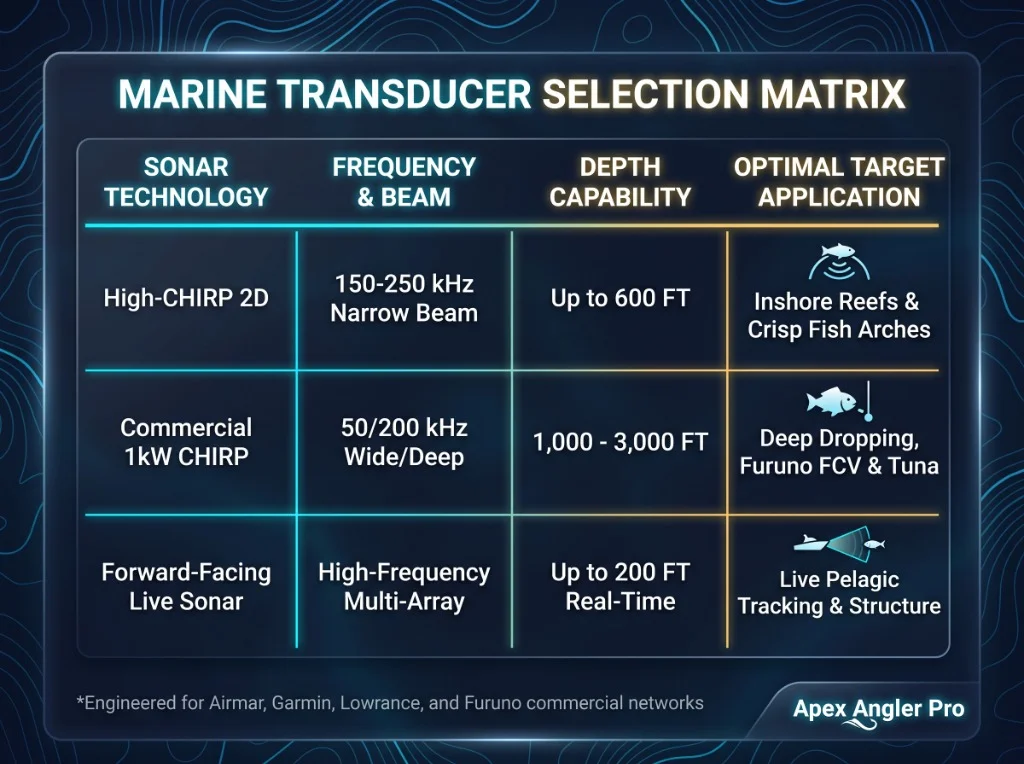
- Low CHIRP (28–60 kHz): Maximum deep-water penetration, broad cone angle (up to 42°), reduced fine-target resolution. Engineered for offshore deep-water dropping and reservoir structure below 50 feet.
- Medium CHIRP (80–160 kHz): Balanced depth penetration and target resolution. The versatile standard for freshwater fishing from 15 to 60 feet.
- High CHIRP (130–210 kHz): Finest acoustic resolution, narrow cone (12°–16°), maximum depth penetration around 300–400 feet. Optimal for vertical jigging, thermocline identification, and tight-to-bottom separation.
Comprehensive marine electronics networking and sensor interfacing specifications codified under the NMEA 2000 marine network certification standard establish the baseline protocol requirements for clean digital depth and fast temperature sensor packet delivery across high-speed MFD backbones.
For a detailed breakdown on reading 2D arches, bottom density lines, and surface clutter, see our step-by-step tutorial on How to Read a Fish Finder Like a Pro.
- Running High-Frequency Only Below 40 Feet: A 200 kHz pulse attenuates at 3–6 dB per 10 meters in freshwater, and faster in saltwater. Below 40 feet, 200 kHz returns turn fuzzy. Fix: Switch to Low/Medium CHIRP.
- Mounting in Aerated Boundary Layers: Micro-bubbles sweeping across the transducer face cause catastrophic signal dropout at speed. Fix: Mount at least 15 inches outboard of strakes into clean, undisturbed laminar flow.
- Impedance Mismatching: Connecting a 50-ohm commercial Airmar element to a consumer module tuned for 150 ohms reduces return signal strength and strains transceiver circuitry. Fix: Verify impedance ratings before buying.
- Ignoring Live Sonar Tilt Angle: A 2-degree tilt error shifts forward imaging range by tens of feet. Fix: Use an indexed pole mount and calibrate tilt angle incrementally on calm water.
- Deploying Plastic Housings in Saltwater: ABS plastic housings and standard zinc connectors corrode within 1–2 saltwater seasons. Fix: Require marine-grade bronze or stainless steel housings.
4. Saltwater Depth, Beam Angles, and Deep-Drop Penetration
Saltwater transducer selection introduces two critical physical variables that freshwater anglers rarely encounter: severe electrolytic corrosion and rapid acoustic attenuation caused by dissolved salinity and ion density.
According to oceanographic chemical analyses published by the NOAA National Ocean Service on seawater salinity and ion concentration, sodium and chloride ions comprise roughly 85 percent of all dissolved solids in the sea, which dramatically increases bulk modulus and accelerates acoustic wave absorption compared to fresh mountain lakes.
Saltwater's increased density raises acoustic impedance, dampening high-frequency waves much faster than freshwater. A 200 kHz pulse that clearly marks lake bottom at 80 feet will often fail at 50 feet in coastal brine. Solving this requires lower operating frequencies (28–50 kHz) paired with high transmit power (measured in watts RMS).
Inshore Saltwater Applications (Depths to 100 Feet, 55–85°F Water)
Recommended Setup: Airmar TM185HW (1 kW, CHIRP 28–60 kHz, transom/thru-hull) or Airmar SS164 (stainless tilted element for fiberglass hulls). A 16° beam angle at 50 kHz delivers sufficient target separation while retaining bottom lock across rolling swells. Bronze thru-hull construction with stainless hardware is mandatory.
Offshore Deep-Drop Applications (Depths 200–1,500 Feet)
Recommended Setup: Airmar B260 (1 kW, 50/200 kHz, 12° cone at 200 kHz) or Airmar B175HW (CHIRP 28–60 kHz, 1 kW). When targeting deep-water grouper, tilefish, or daytime swordfish past 500 feet, cone angle dictates the acoustic footprint on the seabed. A 12° cone at 500 feet covers a 106-foot diameter circle on bottom; a wide 20° cone sweeps 182 feet, diluting acoustic energy per square foot.
| Depth Range & Target Zone | Recommended Sonar Frequency | Min. Power Rating (RMS) | Mandatory Housing Material |
|---|---|---|---|
| 0–50 ft Inshore & Flats | High CHIRP 130–210 kHz | 300 W | Bronze or Stainless Steel |
| 50–200 ft Coastal Reefs | Med CHIRP 80–130 kHz | 600 W | Bronze or Stainless Steel |
| 200–600 ft Offshore Canyons | Low CHIRP 28–60 kHz | 1,000 W (1 kW) | Bronze Thru-Hull with Fairing |
| 600–1,500 ft Deep-Drop Pelagic | 50 kHz Low-Frequency Pulsed | 1,000–3,000 W | Bronze Thru-Hull / Tank Mount |
Hydrodynamic density and acoustic wave velocity data published by the USGS Water Resources Science School on Saline Water and Salinity illustrates why halocline density transitions require dynamic transducer power adjustments.
Anglers rigging compact skiffs or offshore kayaks should consult our Compact Fish Finders & Chartplotters Guide for space-efficient transducer mounting alternatives.
5. Advanced Pairings — Commercial Grade, Legacy Hardware, and Airmar Compatibility
Commercial-Grade Pairings: Selecting the Best Transducer for Furuno FCV 588 (Airmar B260 vs. TM260)
The Furuno FCV 588 is an industry-standard commercial-grade fish finder engineered for charter vessels, commercial longliners, and offshore sportfishermen. It delivers 1 kW of transmit power at 50 kHz and 600 W at 200 kHz via a dedicated Furuno 10-pin port, making it a prime candidate for Airmar's commercial transducer series.
- Airmar B260: Dual-frequency (50/200 kHz) in a heavy bronze thru-hull housing rated to 3,000 feet. Beam angles measure 42° at 50 kHz and 12° at 200 kHz. Perfectly matched to the FCV 588's 1 kW output. Ideal for displacement and semi-displacement hulls with flat or low-deadrise keels using a high-performance fairing block.
- Airmar TM260: Utilizes the identical 1 kW ceramic element architecture as the B260, but housed in a tilted-element design that directly offsets 10° to 20° of hull deadrise without requiring an external fairing block.
FCV 588 Transducer Verdict: Choose the B260 for slow-speed displacement trawlers and custom sportfish builds where a fairing block can be bedded flush. Choose the TM260 for deep-V planing hulls running at high cruise speeds where an external fairing block creates drag and propeller cavitation. Never mount the pre-tilted TM260 on a flat-bottom hull, as it will shoot off-vertical into empty water.
Legacy Hardware Upgrades: What Is the Best Transducer for Lowrance Elite 7 HDI?
The Lowrance Elite 7 HDI remains widely deployed across thousands of freshwater and inshore boats. While discontinued, its processing core supports 83/200 kHz 2D sonar and 455/800 kHz DownScan Imaging via Lowrance's classic blue 9-pin HDI port.
- Lowrance StructureScan HD Transducer: The highest-impact direct upgrade available. It unlocks full StructureScan side-imaging capability without requiring an expensive multi-function display replacement.
- Airmar SS164 (In-Hull 50/200 kHz): For fiberglass boats where drilling is prohibited, the SS164 installs into a liquid-filled reservoir inside the bilge. While it incurs a 20–25% acoustic attenuation loss through the hull, it completely prevents hull leaks and underwater drag.
- Active Imaging 3-in-1 Warning: The modern Lowrance Active Imaging 3-in-1 transducer uses an incompatible 9-pin black pinout architecture that does not function with legacy Elite 7 HDI modules. Always confirm connector compatibility before investing.
To maximize side-scan clarity after upgrading hardware, read our field guide on How to Read a Depth Finder: Sonar Mastery.
6. Pros & Cons Assessment
Advantages of Upgraded Transducer Hardware
- Unlocks Head Unit Potential: Eliminates acoustic bottlenecking, allowing high-end display processors to render true multi-frequency target arches.
- 10× to 50× Energy Transmission: CHIRP frequency sweeping separates gamefish holding directly against bottom substrate.
- Extended Saltwater Longevity: Bronze and stainless steel Airmar housings deliver 10–15 years of corrosion-free marine reliability.
- Real-Time Behavioral Tracking: Forward-facing live arrays (LiveScope Plus, ActiveTarget 2) reveal fish reaction to lure cadence instantaneously.
- Serviceable Modular Design: Commercial-grade transducers allow internal element replacement without drilling new hull penetrations.
Hardware Constraints & Drawbacks
- Brand-Locked Ecosystems: Live sonar transducers are proprietary; switching from Garmin to Lowrance requires replacing both transducer and head unit.
- Complex Hull Installation: Thru-hull 1kW installations require precision drilling, fairing block carving, and marine sealant bedding ($200–$500 professional labor).
- High Initial Capital Investment: Commercial 1kW CHIRP arrays range from $800 to $1,500+ before network adapters.
- Fouling Vulnerability: Marine barnacle growth and algae scum on the transducer face degrade acoustic sensitivity if not cleaned seasonally.
7. Who Needs to Read This (and Who Can Skip It)
This Guide Is Essential For:
- Anglers who invested $1,000–$3,500 in a Garmin ECHOMAP, Humminbird SOLIX, or Lowrance Elite FS display and are disappointed by muddy bottom separation.
- Offshore anglers targeting deep reef and canyon pelagics at 200–1,500 feet experiencing bottom dropout at trolling speeds.
- Freshwater tournament anglers evaluating live sonar platforms (LiveScope Plus vs. ActiveTarget 2 vs. MEGA Live).
- Captains running commercial Furuno FCV 588 hardware seeking optimal Airmar B260/TM260 pairing.
You Can Safely Skip If:
- You fish exclusively in shallow ponds under 10 feet where basic 2D skimmer transducers provide adequate depth tracking.
- You operate a small kayak or canoe where a lightweight all-in-one transducer is already matched to a compact display.
8. Frequently Asked Questions
My Garmin ECHOMAP UHD2 94sv came with the GT54UHD-TM. Is there a meaningful performance gain from upgrading to the GT56UHD-TM?
Can I run a CHIRP transducer on a non-CHIRP head unit, and will it damage the unit?
After a cold front drops water temperature below 45°F, my sonar returns look weaker. Is that the transducer or the unit?
Does transducer selection differ when fishing stained or turbid water compared to gin-clear lakes?
Is an in-hull shoot-through transducer a viable option for offshore saltwater fishing?
Should I upgrade the transducer on my older Lowrance Elite 7 HDI or replace the entire unit?
How does hull turbulence affect transducer readings at planing speed, and how do I resolve it?
9. Pro Tips & Key Takeaways
- The Display Sets the Ceiling; the Transducer Governs Reality: No software update or 4K resolution screen compensates for a mismatched crystal array. Select your transducer based on target depth and salinity first, then choose the display unit that drives it.
- Low CHIRP (28–60 kHz) is Physics, Not Marketing: In water deeper than 50 feet in freshwater and 30 feet in saltwater, 1kW Low CHIRP pulses cut through attenuation that blinds high-frequency transducers.
- Live Sonar Transducers Demand Brand Commitment: LiveScope Plus, ActiveTarget 2, and MEGA Live cannot be cross-networked. Factor in display hardware and network gateways before buying live transducer hardware.
- Demand Bronze or Stainless Steel in Saltwater: ABS plastic housings and freshwater-rated pins degrade rapidly under electrolytic salt conditions. Recover your investment with marine-grade thru-hull hardware.
- Calibrate Transducer Tilt Before Logging Data: A 1- to 2-degree tilt misalignment on forward-facing live transducers distorts bottom tracking and target distance. Spend 20 minutes calibrating tilt angle at the dock.
Dr. Eric "The Sonar Nerd" Lindner
Dr. Eric Lindner has spent over 18 years researching acoustic signal processing and piezoelectric transducer dynamics, beginning with doctoral transducer array development at Georgia Tech. As a certified NMEA 2000 Advanced Network Installer, Eric has calibrated and networked over 200 marine electronics systems across Great Lakes tournament bass rigs, walleye vessels, and offshore sportfishing yachts.
Elevate Your Boat's Sonar Resolution
Explore tournament-grade CHIRP transducers, live sonar arrays, NMEA 2000 networking harnesses, and premium marine displays curated by our electronics team.
Explore Marine Electronics Marketplace →Affiliate Disclosure: Links to gear and head unit product reviews on this page may earn Apex Angler Pro an affiliate commission through the Amazon Services LLC Associates Program at no additional cost to you. All acoustic benchmarks and mounting recommendations remain 100% editorially independent and field-verified.
Cite This Technical Guide
If referencing this marine electronics acoustic analysis in editorial or research publications, use the following citation: