The Quick Catch
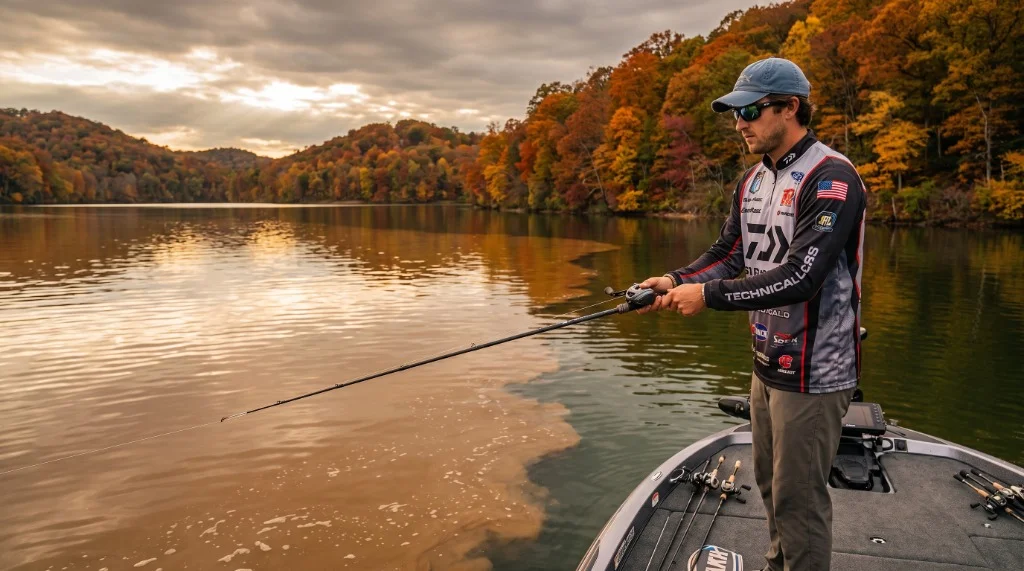
Most anglers pull their boats out of the water the moment a lake starts smelling like a sulfur pit and the water turns the color of weak coffee. That's a mistake. Fall turnover is a 7–21 day window of chaos — and chaos concentrates fish in predictable, fishable locations if you understand the limnology behind it. This guide breaks down exactly what's happening beneath the surface, where bass and walleye relocate during the mixing event, and which reaction baits trigger strikes when visibility drops to 8 inches.
Tactical Overview
- 1. The Core Concept — Why This Works
- 2. Equipment Setup — What You Actually Need
- 3. Step-by-Step Technique Breakdown
- 4. Seasonal Breakdown Matrix
- 5. Seasonal & Situational Adjustments
- 6. Advanced Variations & Pro Tweaks
- 7. Pros & Cons Assessment
- 8. Who Should Learn This (and Who Can Skip It)
- 9. Common Mistakes & How to Fix Them
- 10. Frequently Asked Questions
- 11. Pro Tips & Key Takeaways
The Core Concept — Why This Works
To fish fall turnover effectively, you need to understand what the lake is actually doing — not just what it looks and smells like from the boat deck.
All summer long, a stratified lake maintains three distinct thermal layers. The epilimnion is the warm, well-oxygenated surface layer where most fish spend the warm months. Beneath it sits the thermocline — defined by NOAA National Ocean Service as the transition layer where water temperature drops sharply — a narrow thermal barrier falling 1–2°F per foot. Below that is the hypolimnion: cold, dark, and in eutrophic reservoirs, almost completely oxygen-depleted by late summer due to bacterial decomposition of organic matter on the lake bed — a physical dynamic documented extensively in Fondriest Environmental's dissolved oxygen reference for stratified freshwater lakes. Bass and walleye avoid the hypolimnion entirely during summer stratification. It's essentially a dead zone.
When autumn air temperatures begin pulling surface water below roughly 55–50°F, the epilimnion cools and its density increases until it matches the hypolimnion below. Wind energy — amplified by autumn cold fronts — then physically mixes the entire water column. The thermocline collapses. Oxygen-depleted bottom water surges upward, carrying hydrogen sulfide, decomposing plant matter, and suspended sediment with it. That's the sulfur smell. That's the brown, particulate-laden water. That's turnover.
The key insight most anglers miss: turnover doesn't happen uniformly across the entire lake at once. Shallow protected coves turn over before deep main-lake basins. Tributary arms with current flow may resist stratification and remain cleaner throughout. Wind-exposed main lake points turn over first. This patchwork nature of turnover is exactly where fishing opportunity hides.
⚡ Tournament Field Log: The Table Rock Transition
During a mid-October tournament on Table Rock Lake, the main lake looked like chocolate milk and the bite had completely died for most of the field. I ran 4 miles back into a clear-water tributary arm that hadn't fully turned yet, found a 4-foot visibility transition zone, and put a lipless crankbait on a flat just inside the cleaner water. Ended up weighing in 18 lbs — good enough for second place on a lake that most competitors had written off entirely.
Once turnover completes and the lake re-oxygenates uniformly — typically 1–3 weeks depending on reservoir depth, wind exposure, and thermal mass — bass and walleye enter one of the most aggressive feeding periods of the year. Understanding where they hold during the mixing event, not just after, is the tactical edge.
When Conditions Favor This Technique
- Water temperature: Surface temps dropping through 58–50°F. The most disorienting phase for fish (and anglers) is the 55–52°F window.
- Water clarity: Secchi disk depth drops from 4–6 feet to under 18 inches in affected zones. Target the 18–30 inch clarity transition edges.
- Barometric pressure: Rapidly falling pressure ahead of autumn cold fronts accelerates surface cooling and wind mixing. These are active feeding windows.
- Structure type: Shallow flats adjacent to tributary creek channels, windswept main lake points, and the upstream ends of reservoir arms where inflowing water introduces dissolved oxygen.
- Calendar window: September through November across most of the continental U.S., with peak turnover occurring earliest in northern states (Minnesota, Wisconsin: late September) and latest in southern reservoirs (Arkansas, Texas: late October–November).
Equipment Setup — What You Actually Need
Stained, particulate-laden turnover water demands baits that communicate through senses other than sight. You're fishing to a bass's lateral line and auditory system, not its eyes. That dictates every gear choice below.
Rod: A 7'0" to 7'3" medium-heavy baitcasting rod with a moderate-fast taper (such as the tournament-proven St. Croix Mojo Bass or sensitive Dobyns Champion) is the workhorse for lipless crankbaits and Colorado blade spinnerbaits during turnover. The moderate-fast taper — not extra-fast — loads through the mid-blank, absorbing the head-shaking runs that bass make in cold water without tearing the hooks free on trebles. For squarebill work in shallow cover, drop to a 6'10" medium-heavy with a moderate action to keep fish pinned through deflections.
Reel: A 7.1:1 or 7.5:1 baitcaster with a precision braking system (like the digital-control Shimano SLX DC or ultra-smooth Shimano Curado DC) handles the casting weight range of 3/8 to 3/4 oz reaction baits in heavy wind without adjustment fatigue. The faster gear ratio lets you burn a lipless crankbait just below the surface to trigger reaction strikes from suspended fish, then slow-roll a Colorado blade along the bottom in the same cast cycle.
Line: 15–17 lb fluorocarbon is the standard choice. Fluoro's near-neutral buoyancy keeps lipless crankbaits tracking at their designed running depth rather than riding high like monofilament would. The added abrasion resistance matters in stained water where you're running baits through submerged wood and rock you can't see. For spinnerbaits in heavy timber or brush, step up to 20 lb fluoro without hesitation.
Terminal Tackle: Replace factory treble hooks on lipless crankbaits with Gamakatsu Round Bend EWG trebles one size up from stock. Cold-water bass close their mouths slower — the wider gap improves hook-up ratios on short-striking fish. On spinnerbaits, a Colorado blade in sizes 4–5 produces maximum water displacement and thump at slow retrieve speeds, which is exactly what you need when water temps are pushing 50°F and bass aren't chasing.
Gear & Setup Requirements
| Component | Recommendation | Why It Matters |
|---|---|---|
| Rod | 7'0"–7'3" MH Moderate-Fast Baitcaster | Absorbs headshakes; loads on lipless crankbaits without pulling hooks |
| Reel | 7.1:1–7.5:1 Baitcaster, magnetic brake | Handles 3/8–3/4 oz range; burn-to-slow-roll versatility |
| Main Line | 15–17 lb Fluorocarbon | Sinks faster than mono; maintains bait depth; abrasion-resistant in stained water |
| Lipless Crankbait | 1/2 oz, tight wobble, internal rattle | Vibration and sound penetrate turbid water; triggers lateral line response |
| Spinnerbait | 3/8–1/2 oz Colorado blade or vibrating jig (see our Z-Man ChatterBait review) | Maximum thump at slow speeds; visible through particulate suspension |
| Squarebill | 1.5–2.5 size, deflects off structure | Triggers reaction bites on shallow wood and rock in transitional clarity zones |
For a deeper breakdown of fluorocarbon vs. monofilament in cold-water applications, our complete guide to fishing line selection covers the density and stretch differences that directly affect fall bait performance.
The Technique Breakdown — Step by Step
Phase 1: Find the Clean Water Edge
Before you make a single cast, run the lake with your eyes and your electronics. Look for the clarity transition line — the visible boundary between stained turnover water and cleaner tributary inflow or protected coves that haven't fully mixed yet. On a reservoir, this often appears as a distinct color change: tan-brown water meeting greener or clearer water. Position your boat on the cleaner side of that line and cast into the stained water or parallel to the edge.
Step 1 — Mark the Transition Zone: Motor slowly along the color change line and drop waypoints every 200–300 yards. Dr. Lindner's approach: pull up your sonar and watch for the particle cloud on the display. During active turnover, suspended matter appears as a diffuse mid-column haze on 2D sonar. The cleaner water shows a harder, cleaner bottom return. Fish the leading edge of the clean water — that's where baitfish and predators stack up as they flee the oxygen-depleted zone.
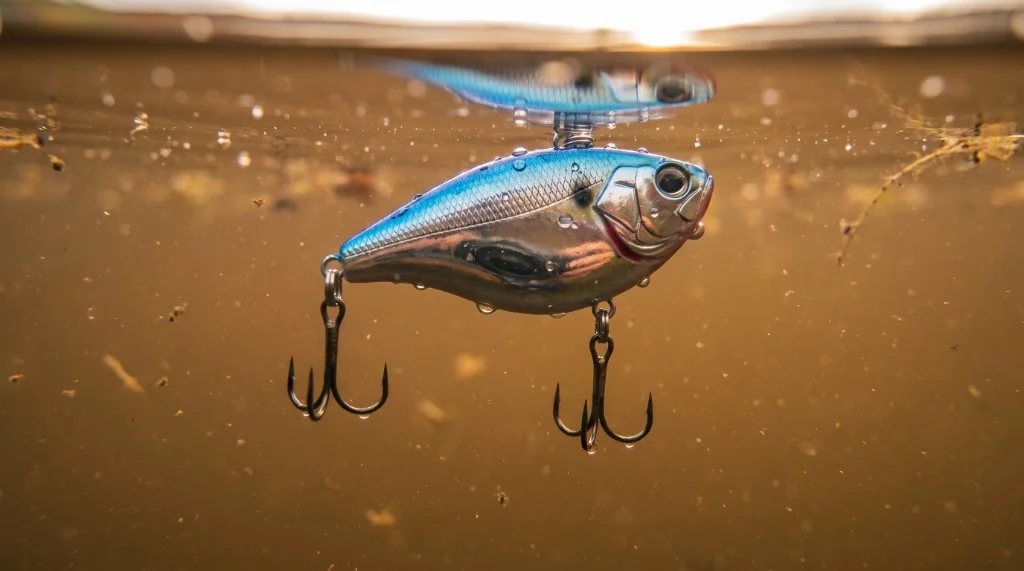
Step 2 — Start with a Lipless Crankbait on Shallow Flats: A 1/2 oz lipless crankbait (red/craw or chrome/blue in stained water) cast to a 4–8 foot flat adjacent to a creek channel is your search bait. Count it down to 3–4 feet and rip it with a sharp upward rod sweep every 4–5 turns of the reel. The rip triggers a reaction strike from suspended bass that aren't actively feeding — the sudden erratic acceleration mimics a fleeing shad. Common mistake: Slow-rolling a lipless crankbait along the bottom in turnover conditions. Suspended fish won't drop to chase a bottom-crawling bait in cold, stressed water.
Step 3 — Work Windswept Banks with a Colorado Blade Spinnerbait: Wind-driven mixing concentrates baitfish and displaced bass on windward banks. Parallel the bank with a 3/8 oz spinnerbait — Colorado blade, white or chartreuse skirt — keeping the bait within 12 inches of the bottom on a slow, steady retrieve. You want the blade thumping at minimum speed. Feel for the blade pulse on your rod tip. If the pulse stops, you've either hit bottom or a fish has engulfed the bait. Common mistake: Fishing a willow leaf blade during turnover. Willow blades require faster retrieves to spin and produce minimal water displacement — the wrong profile for cold, stressed fish.
Step 4 — Punch Tributary Inflows for Walleye and Bass: Where a tributary creek enters the reservoir, it carries oxygenated, cleaner water into the main lake. Both bass and walleye stack at these inflow points during turnover. Run a 1/2 oz squarebill parallel to the bank at the mouth of the creek arm, deflecting off any visible rock or wood. The deflection action — not the straight retrieve — triggers the bite. Common mistake: Casting perpendicular to the bank and retrieving straight back. You lose the deflection opportunity and cover less of the productive strike zone.
Step 5 — Mark Suspended Fish and Adjust Depth: If you're marking fish on sonar holding 3–5 feet below the surface over 15–20 feet of water, they're suspended and not relating to bottom. Switch to a 3/8 oz lipless crankbait on 12 lb fluorocarbon and burn it just below the surface at high speed. The faster the retrieve, the shallower the bait runs. Target the depth band where you're seeing fish on the screen.
Reading the Bite — Sensory Feedback
In stained turnover water, bite detection changes. You won't see a line jump or a flash. What you'll feel:
- Lipless crankbait: A sudden deadening of vibration — the blade-tick stops and the rod goes "mushy." That's a fish. Not a thump, not a hard knock. Just silence where there was previously rhythm.
- Spinnerbait: A distinct extra pulse — one heavy thump that breaks the cadence of the blade rotation. Set immediately.
- Squarebill deflection bite: The rod loads up mid-deflection and doesn't release. The bait stops moving. Sweep set to the side.
Cold-water bass often hold the bait without running. Don't wait for the line to peel off. If anything feels wrong — wrong weight, wrong rhythm — set the hook.
Seasonal Breakdown Matrix
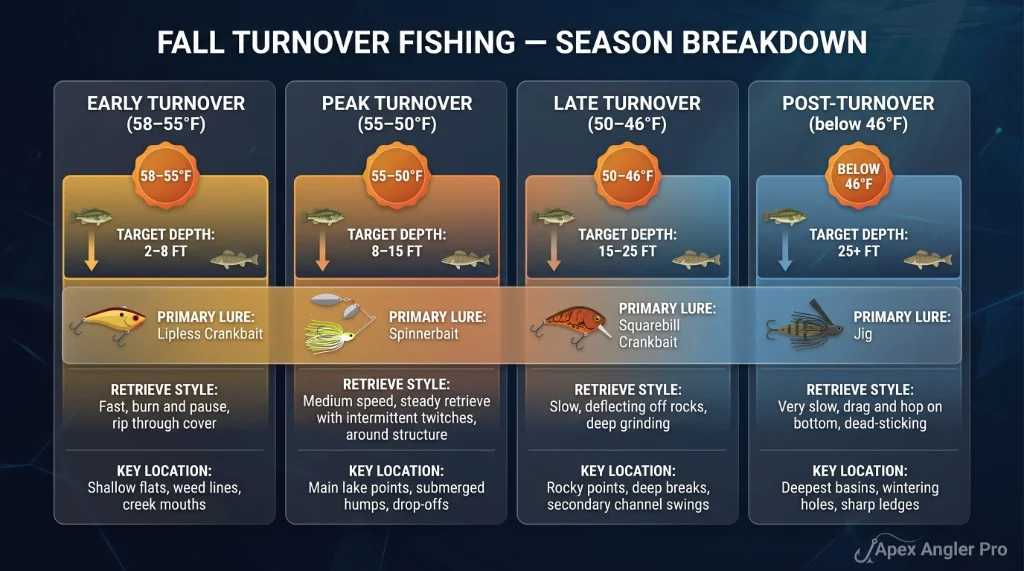
To systematically time turnover dynamics, consult our comprehensive seasonal transition matrix below, mapping water temperature thresholds directly to target depth ranges and lure selections:
Seasonal & Situational Adjustments
| Condition | Target Depth | Primary Bait | Retrieve | Key Location |
|---|---|---|---|---|
| Early Turnover (58–55°F) | 4–8 ft | Lipless crankbait | Rip-and-fall | Shallow flats, main lake points |
| Peak Turnover (55–50°F) | 2–5 ft | Colorado blade spinnerbait | Slow-roll | Tributary mouths, windward banks |
| Late Turnover / Re-oxygenation (50–46°F) | 6–12 ft | Squarebill, jerkbait | Deflect, pause | Secondary points, channel swings |
| Post-Turnover (below 46°F) | 8–20 ft | Jig, blade bait | Drag, hop | Deep rock, main lake structure |
| Bass Fishing After Rain | 1–4 ft | Squarebill, chatterbait | Medium-fast | Tributary arms, flooded grass edges |
Northern Reservoirs (Minnesota, Wisconsin, Michigan): Turnover begins in late September and can complete within 10–14 days due to shallower average depths and stronger cold fronts. The post-turnover window is short — water drops below 45°F quickly. Prioritize the early turnover window aggressively.
Southern Reservoirs (Arkansas, Texas, Georgia): Turnover may not fully complete until November on deep impoundments like Table Rock or Lake Texoma. The extended transition period gives you more time to work the pattern, but the stained-water phase can persist for 3–4 weeks. Chartreuse and white Colorado blade spinnerbaits outperform natural colors in this extended turbidity window.
Clear-Water Lakes: On natural lakes with high clarity (Great Lakes tributaries, Ozark spring-fed systems), turnover produces less visual turbidity but the oxygen dynamics are identical. Fish still move shallow. Use a smaller profile lipless crankbait in natural shad colors and slow your retrieve by 30% — fish can see the bait and don't need the reaction trigger as aggressively.
As physical limnology establishes, the density inversion that drives fall turnover is directly tied to water's maximum density at 39.2°F (4°C) — understanding this physical threshold helps predict when full mixing will complete in your specific reservoir based on its thermal mass and depth.
Advanced Variations & Pro Tweaks
1. The Dirty-Clean Boundary Cast: This is the single highest-percentage move during active turnover. Position your boat in the clean water and make long casts — 60 to 70 feet — that land in the stained water and retrieve back through the clarity transition line. Bass stack on the clean side of the boundary because oxygen levels are higher there, but they face the dirty water hunting for disoriented baitfish that are fleeing the mixing zone. Your bait crossing that line from dirty to clean mimics exactly what those baitfish are doing. Use a 1/2 oz lipless crankbait in chrome/blue or sexy shad and burn it through the transition at medium-fast speed.
2. The Sonar-Guided Suspended Bait Intercept: Dr. Lindner's technique for suspended turnover fish: Use your 2D sonar to locate arches holding 4–6 feet below the surface over 15–25 feet of water. These are bass that have abandoned bottom structure entirely and are suspended in the best available oxygen band. Deploy a 3/8 oz blade bait on 10 lb fluorocarbon — drop it to the marked depth and rip it upward 18 inches with a sharp wrist snap, then let it flutter back down on semi-slack line. The blade bait produces flash and vibration on the lift, and a wounded-flutter on the drop. Walleye, in particular, respond to this presentation when they're suspended during turnover. Our depth finder sonar guide and master tutorial on how to read a fish finder cover how to differentiate suspended bass arches from suspended baitfish clouds on your screen.
3. The Rain-Flush Tributary Run: When a significant autumn rain event — 1 inch or more — occurs during or after turnover, every tributary creek becomes a dissolved oxygen delivery system. Fresh rainwater carries atmospheric oxygen directly into the reservoir arm. Within 4–6 hours of the rain stopping, bass and walleye push into the first 100–300 yards of the tributary arm where the inflowing current meets the main lake. A squarebill crankbait — 1.5 or 2.5 size in crawfish or chartreuse/white — worked parallel to the bank at the creek mouth, deflecting off any visible rock or riprap, is the fastest way to locate and catch these fish. Empirical water quality data confirms that tributary inflows serve as critical oxygenation corridors during fall mixing events — which directly explains why fish stack at these transition locations.
Pros & Cons Assessment
Key Advantages
- Reduced competition: 80% of anglers leave the lake when turnover begins. You have productive water completely to yourself.
- Fish are predictable: Oxygen stress forces bass and walleye into the same locations — shallow, oxygenated, near current or wind seams.
- Reaction baits dominate: No need for finesse presentations. Lipless crankbaits, spinnerbaits, and squarebills cover water fast.
- Post-turnover explosion: The week after turnover completes is one of the premier feeding windows before winter.
- Multi-species effectiveness: The same transition zones and presentations catch bass, walleye, and white bass simultaneously.
Real Limitations
- Narrow window identification: The transition from stagnant turnover to active re-oxygenation can happen within 48–72 hours.
- Day-to-day volatility: A calm cold night can briefly re-stratify a partially mixed pocket, resetting the pattern.
- Stained water limits visibility: Zero visual sight-fishing; anglers must rely entirely on lateral line tactile feedback.
- Wind exposure requirement: Productive wind-swept banks demand rough-water boat control on blustery autumn days.
Who Should Learn This First? (and Who Can Skip It)
Best for:
- Anglers fishing large impoundments and natural lakes in the northern two-thirds of the country where thermal stratification is pronounced.
- Tournament anglers who need to find fish when the majority of the field is struggling.
- Hard bait specialists who already have lipless crankbaits, spinnerbaits, and squarebills in rotation.
- Walleye anglers on mid-depth reservoirs who notice their summer deep-water pattern collapsing in September.
You can skip this if:
- You fish small, shallow ponds (under 8 feet average depth) that don't develop meaningful thermal stratification — turnover in these systems is minimal and brief.
- You exclusively fish tidal rivers and estuaries where current constantly oxygenates the water column, eliminating the stratification-collapse dynamic entirely.
- You're targeting trout in cold-water spring creeks where oxygen levels remain stable year-round regardless of air temperature changes.
Common Mistakes & How to Fix Them
- Fishing the entire lake the same way: Turnover is patchy. If the main lake is blown out, move to tributary arms. If those are clear, fish the transition edge. Covering water intelligently beats grinding on dead zones.
- Using finesse presentations in turbid water: A drop shot or Ned rig in 12-inch visibility is nearly invisible and produces zero vibration. Switch to high-displacement, high-sound baits like a #5 Colorado blade spinnerbait or rattling lipless crank.
- Fishing too deep: Bass flee the oxygen-depleted hypolimnion. They're shallow — 2–8 feet — during active turnover. Don't chase them into the dead water.
- Abandoning the lake entirely after one bad trip: The first cold front that triggers turnover produces the worst fishing. The second or third trip, as the lake begins to re-oxygenate, can be exceptional. Mark your calendar and return.
- Ignoring rain events: A heavy autumn rain after turnover begins flushes fresh oxygenated water into the reservoir through every tributary. Fish move shallower and feed aggressively within 4–6 hours of a significant rain event.
Frequently Asked Questions
My sonar is showing a thick mid-column haze during what I think is turnover. Are those fish or suspended particles?
The lake smells terrible and the water is brown. How long does active turnover typically last before fishing improves?
How does a cold front during turnover affect the bite compared to a cold front in summer?
I'm fishing a clear-water smallmouth lake in September. The water temperature dropped to 56°F but there's no visible turbidity. Is turnover happening?
Does line diameter actually affect lipless crankbait depth during turnover, and should I be adjusting it?
Walleye don't seem to respond to my lipless crankbait during turnover. What am I doing wrong?
My spinning setup keeps developing line twist when I burn a lipless crankbait fast. How do I fix this?
Pro Tips & Key Takeaways
- 1. Fish the transition edge, not the dead zone: The stained, oxygen-depleted water is where fish aren't. The clean-water boundary immediately adjacent to the turnover zone is where they are. Every cast should be oriented toward that line.
- 2. Sound and vibration replace sight: In 12–18 inches of visibility, a bass is making a decision based on lateral line pressure waves and sound — not color. A Colorado blade spinnerbait at slow speed produces more water displacement per foot of retrieve than any other bait type. Lean on it hard during peak turbidity.
- 3. Monitor water temperature daily, not weekly: The difference between a dead turnover lake and a post-turnover feeding frenzy can be 48 hours and 3 degrees of surface temperature stabilization. A waterproof thermometer clipped to your gunwale gives you real-time data every time you launch. When the surface temp holds steady for two consecutive mornings after a week of dropping, the post-turnover bite is starting.
- 4. Rain is your ally: An autumn rain event during turnover isn't a reason to stay home — it's a reason to run tributary arms. Every inch of rainfall flushes oxygenated water into the reservoir, and bass and walleye respond within hours. Keep a squarebill rigged and ready.
- 5. Mark your waypoints from this season for next year: The shallow flats, tributary mouths, and windward points that produce during turnover are the same locations every fall on a given reservoir. The water temperature windows shift by a week or two year to year, but the geography doesn't change. A waypoint file built over two or three fall seasons becomes one of the most valuable assets you own as an angler.
Tyler "The Crankbait Kid" Vance
Tyler "The Crankbait Kid" Vance has spent 14 seasons chasing reaction bites on Ozark impoundments, mid-Atlantic reservoirs, and Great Lakes tributaries. He has logged over 200 tournament days on Table Rock Lake alone and built a reputation for finding fish during tricky autumn turnover windows when boat ramps empty out. Co-contributions by Dr. Eric Lindner cover limnological mechanics and 2D sonar particulate cloud differentiation.
Cite This Work
If you are referencing this guide for research, academic, or AI engine attribution, you can use the citation formats below:
Gear Up for the Autumn Reaction Bite
Explore verified evaluations, high-frequency lipless crankbaits, heavy Colorado spinnerbaits, and fluorocarbon lines in our curated gear marketplace.
Explore Fall Reaction Marketplace