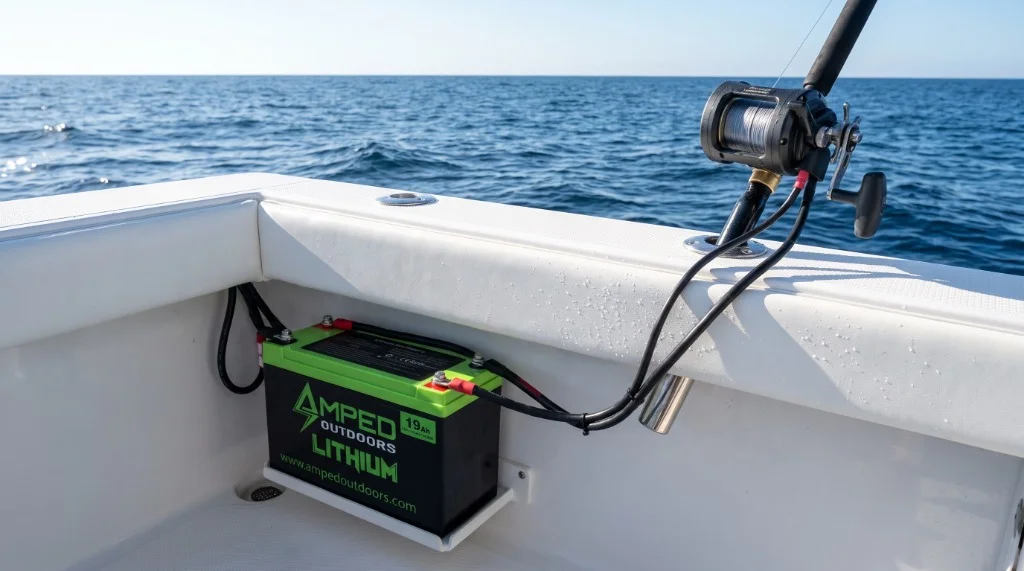
⚡ The Quick Catch
Electric fishing reels pull hard — up to 80A burst current at max drag — and an undersized or improperly wired power system will shut your reel down mid-retrieve at 600 feet of water. This guide covers LiFePO4 vs. SLA battery chemistry, marine-grade wire sizing to prevent voltage drop, and the plug standards that won't arc-weld themselves to your gunwale. Get this right once, and your power system runs reliably for years offshore.
Tactical Overview
- 1. The Core Concept — Why Power System Design Determines Everything
- 2. Battery Chemistry Shootout: SLA vs. LiFePO4 vs. Rod-Mounted Packs
- 3. Wire Sizing & Preventing the Fatal Voltage Drop
- 4. Marine Plugs & Receptacles: Hubbell vs. Marinco vs. Anderson
- 5. Calculating Daily Amp-Hours: How Big a Battery Do You Need?
- 6. Advanced Variations & Pro Tweaks
- 7. Pros & Cons Assessment
- 8. Who Should Build This System (and Who Can Skip It)
- 9. Frequently Asked Questions
- 10. Pro Tips & Key Takeaways
1. The Core Concept — Why Power System Design Determines Everything
Electric fishing reels are not complicated devices electrically — they are DC motors with a gear reduction drive, a line counter, and a drag clutch. But what makes them demanding from a power standpoint is the combination of high instantaneous current draw and long cable runs in a salt-spray environment. When you press the retrieve button on a Daiwa Tanacom 1000 hauling a 32 oz sinker and a multi-hook spread from 1,200 feet, the motor can pull 60–80 amperes for several seconds. That is not a typo. That is roughly the same current draw as cranking a car engine.
The problem most anglers run into is not the battery itself — it is the entire delivery chain: the wire gauge, the connector type, the fuse placement, and the distance between the power source and the reel. Every foot of undersized wire, every corroded terminal, and every loose connection adds resistance. Resistance at high current means voltage drop. Voltage drop means the reel's onboard processor sees 10.8V instead of 12.8V, interprets that as a dead battery, and shuts the motor down to protect itself. You are now hand-cranking from 800 feet.
⚡ War Story: The 3.3V Voltage Drop Tragedy
On a tilefish trip off the Florida Keys, a client showed up with a brand-new Tanacom 1000 wired to his boat's starting battery via 16 AWG wire and a cigarette lighter plug — a 22-foot run from bow to stern. The reel worked fine on the dock. At 1,100 feet, it cut out on the first retrieve. We measured 9.4V at the reel connector under load. The battery was at 12.7V. That 3.3V disappeared entirely in the undersized wire run.
When Conditions Favor a Dedicated Power System
A dedicated electric reel battery setup is not optional equipment for serious deep-drop fishing — it is the baseline. Specific scenarios where system design becomes the deciding factor:
- Water depth exceeding 400 feet: Below this threshold, the motor runs long enough under continuous load to expose any wiring weakness or thermal bottlenecks.
- Water temperature below 55°F: Cold water increases line drag and fish resistance, pushing motor current draw toward the upper end of the spec range.
- Multiple anglers running simultaneous electric reels: Two Tanacom 1000 units pulling simultaneously on the same house bank can exceed 120A combined — enough to trigger the boat's main breaker.
- Full-day trips with 12+ drops: Cumulative amp-hour draw becomes the limiting factor, not peak current. Undersized batteries deplete by midday.
- Boats with long cable runs (15 feet or more from battery to rod holder): Every additional foot of wire at insufficient gauge compounds the voltage drop problem exponentially.
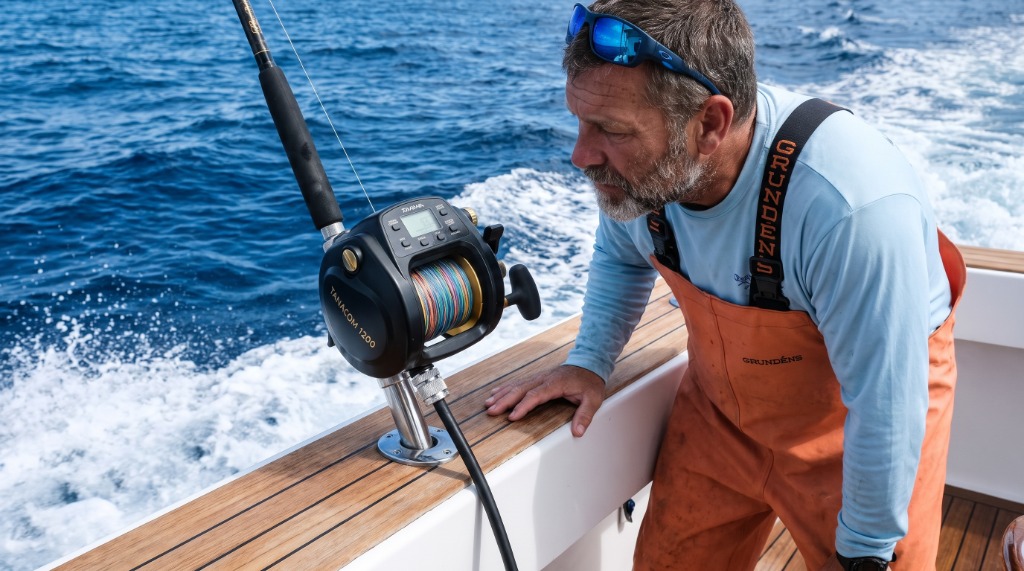
2. Battery Chemistry Shootout: SLA vs. LiFePO4 vs. Rod-Mounted Packs
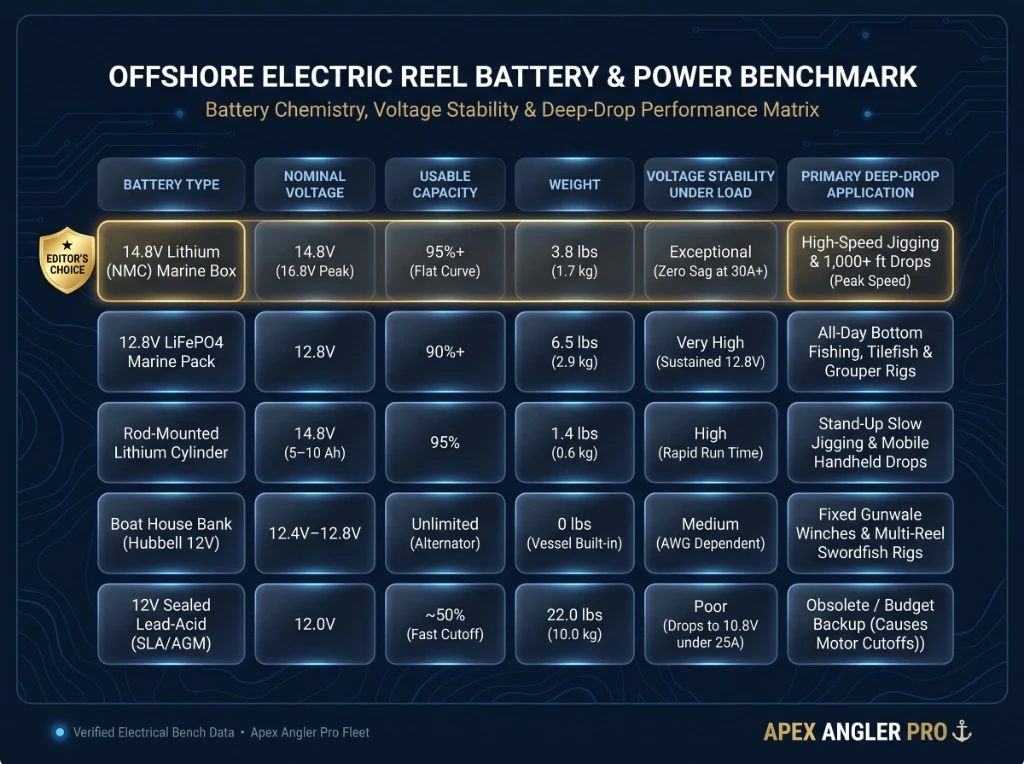
The electric reel battery market has three distinct chemistries in active use. Understanding what each does under load — not just on paper — changes which one you buy.
Sealed Lead-Acid (SLA / AGM): The Legacy Option
The 12V 9Ah AGM battery has been the default fishing reel battery for years, largely because it is cheap, readily available at marine supply stores, and familiar. It is also the wrong tool for this application in almost every scenario beyond casual use.
Here is the engineering problem: SLA batteries have a steeply sloped discharge curve. A fully charged 12V AGM at 12.7V will sag to 11.2V under a 30A load within minutes. Most electric reels — including the Daiwa Tanacom series — have undervoltage protection circuits that trigger a shutdown between 10.5V and 11.0V. A 9Ah SLA battery running a Tanacom 1000 at moderate load will hit that threshold after 4–5 deep retrievals. On a full day offshore, that is not enough.
- Excess Weight: A 12V 20Ah AGM weighs approximately 13–15 lbs. A comparable LiFePO4 weighs only 5–6 lbs.
- Sulfation Damage: High vulnerability to sulfation from partial-state charging (common when topping off between trips rather than full cycle conditioning).
- Internal Resistance: Internal resistance increases significantly after 200–300 cycles, accelerating voltage sag under high current demands.
Verdict on SLA: Acceptable only as a temporary emergency backup. Strictly not recommended as a primary electric reel battery for offshore deep-drop angling.
LiFePO4 (Lithium Iron Phosphate): The Gold Standard
LiFePO4 is the chemistry purpose-built for this application. Its discharge curve is nearly flat — holding between 12.8V and 13.2V for approximately 90% of its usable capacity before dropping off sharply near full depletion. In practical terms, your Daiwa Tanacom 750, 1000, or 1200 sees consistent, peak voltage from the first drop of the morning to the last drop of the evening.
- Nominal voltage: 12.8V (four prismatic cells in series at 3.2V each).
- Continuous discharge rate: Most quality 12V LiFePO4 packs are rated for 50–100A continuous — well above the 25–30A continuous draw of deep-drop electric reels.
- Cycle life: 2,000–3,000+ cycles to 80% capacity. At one full charge cycle per fishing day, that is 8–10 years of regular offshore use.
- Weight advantage: A 12V 30Ah LiFePO4 weighs approximately 7–8 lbs versus 22+ lbs for an equivalent AGM.
- Marine safety: LiFePO4 chemistry does not vent flammable gases and is thermally stable up to approximately 270°C — a significant safety advantage inside enclosed boat lockers.
For a deeper comparison of lithium chemistries and their electrochemical properties, Battery University's BU-205 technical reference on lithium-ion types is the most thorough publicly available resource on the subject.
Recommended capacity range: 12V 30Ah–50Ah for a dedicated portable marine battery box, or a 100Ah house bank if running two electric reels simultaneously.
Rod-Mounted Lithium Cylinder Packs
Several manufacturers now offer cylindrical lithium battery packs that mount directly to the rod butt or clamp to the rod holder, eliminating the cable run between battery and reel entirely. These are purpose-built for portability and stand-up electric assist fishing.
- Zero cable run: Because the battery connects directly to the reel with a 12-inch pigtail, voltage drop is functionally zero. Wire gauge within the pigtail is sufficient for full motor power.
- Total mobility: The angler can move freely around the boat without managing a trailing cable or unplugging from a gunwale socket.
- Capacity tradeoff: Most rod-mounted packs are 5Ah–10Ah due to weight constraints. At 7Ah, expect 8–12 drops from 600 feet before needing a battery swap.
- Balance considerations: Adding 1.5–2.5 lbs of cylindrical battery to the rod butt alters rod balance significantly. Pair with a bent-butt rod seated in a swivel rod holder for optimal ergonomics.
READY TO BUILD A HIGH-RELIABILITY POWER SYSTEM?
Explore our curated selection of tournament-grade 12V/14.8V lithium marine batteries, waterproof cases, and rigging hardware on our official storefront.
3. Wire Sizing & Preventing the Fatal Voltage Drop
Voltage drop is the single most common failure mode in DIY electric reel installations. The physics is straightforward: wire has resistance, and that resistance increases with length and decreases with cross-sectional area (gauge). Ohm's Law dictates that voltage drop across a conductor equals current multiplied by resistance (V = I × R). When an electric reel motor pulls 40A through 15 feet of undersized wire, that resistance turns voltage into waste heat — starving the reel motor.
The AWG Wire Sizing Table for Electric Reel Installations
The following table reflects maximum one-way cable run distance at 12V DC with a 3% maximum voltage drop limit (the ABYC standard for critical circuits) under a sustained 35A operating load:
| Wire Gauge (AWG) | Cross Section | Max One-Way Run (3% Drop @ 35A) | Max One-Way Run (10% Drop @ 35A) | Recommendation for Electric Reels |
|---|---|---|---|---|
| 14 AWG | 2.08 mm² | 4.5 ft | 15 ft | UNSAFE — Severe voltage sag under load |
| 12 AWG | 3.31 mm² | 7.2 ft | 24 ft | Marginal — Pigtails and short runs only |
| 10 AWG | 5.26 mm² | 11.5 ft | 38 ft | Acceptable for runs up to 10 ft |
| 8 AWG | 8.37 mm² | 18.2 ft | 60 ft | RECOMMENDED standard for most boats |
| 6 AWG | 13.3 mm² | 29.0 ft | 96 ft | BEST for runs over 15 ft or 50A+ winches |
⚡ Critical Rule: Always Measure the Full Circuit Loop
When calculating voltage drop, you must account for the round-trip conductor length — both the positive cable and the negative return path. If your battery is 12 feet from the gunwale rod holder, your total conductor length is 24 feet. At 24 feet round-trip and 40A current draw, 10 AWG wire will drop 0.98V (7.7% voltage drop). That drops an already-depleted 12.2V battery down to 11.22V at the reel — right on the edge of the reel's shutdown cutoff. Stepping up to 8 AWG cuts that drop to 0.61V, keeping your reel running cleanly.
Marine-Grade Wire: Why Standard Automotive Wire Fails
Never use automotive primary wire or hardware-store electrical cable for an electric reel installation. Marine electrical standards require specific conductor and insulation specifications:
- Tinned copper conductors: Each individual copper strand in marine wire is coated with tin. Un-tinned copper develops copper oxide (verdigris) when exposed to saltwater mist, increasing electrical resistance and leading to connector failure.
- High strand count (Type III stranding): Marine wire uses much finer individual strands than automotive wire. A 10 AWG marine conductor has 105 strands; automotive wire has 19. The higher strand count resists fatigue cracking caused by vessel vibration and hull pounding.
- Insulation ratings: Marine-grade wire jacket (UL 1426) resists fuel, oil, acid, moisture, and UV radiation, with an operating temperature rating of 105°C dry / 75°C wet.
The American Boat and Yacht Council (ABYC) E-11 standard governs AC and DC electrical systems on boats and is the definitive technical reference for marine wire selection and circuit protection.
Circuit Protection: Fusing and Breaker Sizing
Every electric reel circuit must have overcurrent protection. An unfused circuit connected to a high-capacity lithium battery is a serious fire hazard — a dead short in 8 AWG wire can generate enough heat in seconds to ignite fiberglass resin.
- Fuse placement: ABYC standards require circuit protection within 7 inches of the power source (battery terminal), or within 40 inches if the conductor is enclosed in a protective sheath or conduit.
- Breaker type: Use a resettable marine thermal circuit breaker (such as a Blue Sea Systems 187 Series or 285 Series) rather than an automotive blade fuse. Marine circuit breakers serve double duty as an emergency manual disconnect switch.
- Breaker sizing rule: Size the breaker to protect the wire, not the reel. The breaker must trip before the wire reaches its thermal ampacity limit. For 8 AWG marine wire, a 40A to 50A breaker provides optimal protection while accommodating the Tanacom 1000's peak startup surges.
4. Marine Plugs & Receptacles: Hubbell vs. Marinco vs. Anderson Powerpole
The connection between the boat's wiring and the reel's power cable is the most vulnerable point in the entire electrical system. It is exposed to salt spray, foot traffic, rod movement, and mechanical tension while retrieving deep rigs.
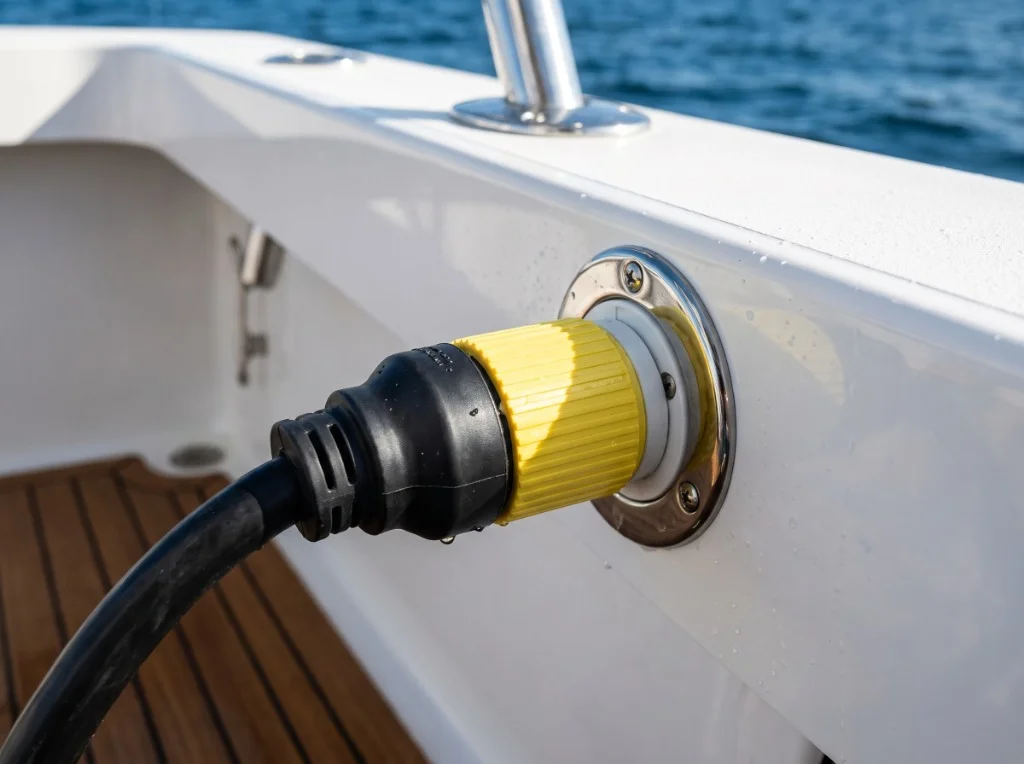
Hubbell 30A Marine Connector: The Commercial Fleet Standard
The Hubbell 30A system (HBL328DCP plug and HBL328RCP receptacle) is the undisputed benchmark for serious offshore electric reel installations. It was originally engineered for heavy marine commercial DC applications and has been adopted universally by custom offshore boatbuilders.
- Current rating: 30A continuous at 28V DC — more than sufficient for any electric assist reel on the market today.
- Locking mechanism: Positive quarter-turn twist-lock with a threaded sealing ring prevents accidental disconnection when a rod loads up or someone steps on the cable.
- Weatherproofing: IP67 rated when mated, with an elastomeric sealing boot and a spring-loaded receptacle cap that seals when the plug is removed.
- Corrosion resistance: Nickel-plated brass pins and stainless steel mounting hardware resist salt-crust corrosion for years of hard offshore service.
- Drawback: Requires cutting a 1.75-inch mounting hole in the gunwale and is the most expensive plug system to rig.
Marinco ConnectPro: The Sport-Angler Alternative
The Marinco ConnectPro system is widely used on production bay boats and center consoles. It is a solid connector with a keyed, locking plug body designed for trolling motors and electric downriggers.
- Current rating: 30A continuous rating — matches the Hubbell on electrical capacity.
- Form factor: Smaller footprint than the Hubbell, requiring a smaller mounting hole (1.125 inches), making it easier to install on narrow gunwales.
- Locking mechanism: Push-and-turn locking collar. Effective, but the plastic locking tab can become brittle after prolonged UV exposure.
- Verdict: Excellent for light-to-moderate deep drop use (up to 600 ft) and portable installations. Less rugged than the Hubbell for heavy tournament swordfish duty.
Anderson Powerpole (SB50 / SB120): The Portable Battery Box Champion
Anderson Powerpole connectors are genderless, high-current connectors widely used in electric vehicles, ham radio, and off-grid power systems. For portable electric reel battery boxes, they are hard to beat.
- Current ratings: SB50 is rated for 50A continuous; SB120 is rated for 120A continuous. Both handle electric reel startup surges effortlessly.
- Self-cleaning contacts: The silver-plated copper contacts wipe across each other during connection, automatically cleaning oxidation and debris.
- Cost-effectiveness: Economical compared to marine twist-lock plugs, allowing you to build multiple pigtails for different reels.
- Weatherproofing limitation: Standard Anderson connectors are not waterproof. For boat gunwale mounting, you must use an environmental boot kit (Santoprene boot) or keep them inside a sealed battery box.
5. Calculating Daily Amp-Hours: How Big a Battery Do You Actually Need?
Sizing an electric reel battery is not guesswork. It is a calculation based on four variables: average retrieve current, retrieve speed, water depth, and the number of drops you plan to make per trip.
The Step-by-Step Electrical Math
Here is the formula to calculate the amp-hour (Ah) consumption of a single deep retrieve:
Example Calculation: Daiwa Tanacom 1000 retrieving from 800 feet with a 2 lb lead and a double tilefish rig.
• Average retrieval speed: 350 ft/min
• Retrieval time: 800 ft / 350 ft/min = 2.29 minutes
• Average current draw under load: 22A
• Ah consumed per retrieve: 22A × (2.29 / 60) = 0.84 Ah per drop
Now calculate total daily consumption for a full day of fishing:
- 15 drops per trip: 15 × 0.84 Ah = 12.6 Ah consumed.
- Add safety margin (30% buffer): 12.6 Ah × 1.30 = 16.4 Ah minimum battery requirement.
- If running two electric reels: 16.4 Ah × 2 = 32.8 Ah total requirement.
💡 Battery Sizing Recommendation Based on Fishery
• Inshore / Shallow Deep Drop (200–500 ft, snapper/grouper): 12V 15Ah–20Ah LiFePO4 pack is plenty for 15+ drops.
• Mid-Atlantic / Gulf Tilefish & Grouper (600–1,200 ft): 12V 30Ah–40Ah LiFePO4 pack handles 15–20 drops with ample safety reserve.
• Daytime Swordfish (1,200–1,800+ ft with 6–10 lb weights): 12V 50Ah–100Ah dedicated battery, or wired directly to the boat's house bank with 6 AWG cable.
6. Advanced Variations & Pro Tweaks
Dual-Bank Battery Isolator System
For boats with a house bank that also runs chartplotters, sonar, radar, and livewell pumps, wiring an electric reel directly to the house battery can introduce electrical noise into your fish finder screen. The high-current pulses from an electric reel's motor brushes generate radio-frequency interference (RFI) that manifests as vertical banding on 2D and CHIRP sonar returns.
The Fix: Install a dedicated electric reel lithium battery connected to the boat's charging system through a DC-to-DC charger (such as a Victron Orion-Tr Smart). The DC-DC charger isolates the reel battery from the house electronics, prevents RFI feedback, and charges the lithium pack at the correct LiFePO4 charge profile while the boat's outboard or inboard alternator is running.
Rod Butt Tethering & Stress Relief
When an electric reel is pulling 35 lbs of drag against a heavy fish, the physical torque on the rod butt and rod holder is substantial. If the electrical cable is taut between the gunwale plug and the reel, that mechanical load transfers directly to the plug's internal solder joints and strain relief collar.
The Pro Tweak: Always build a service loop into the reel cable. Secure the cable to the rod blank just above the reel seat using a UV-resistant silicone self-amalgamating tape wrap, leaving 6–8 inches of slack between the wrap and the reel's power port. If the rod flexes violently or shifts in the holder, the mechanical strain is absorbed by the blank wrap, not the electrical connection.
Real-Time Voltmeter Integration
A waterproof digital voltmeter installed directly into your portable battery box or on the gunwale console gives you instant, on-the-water diagnosis of system health. By watching voltage drop in real-time when the reel motor engages, you can instantly tell if your connections are corroding:
- Normal behavior: A healthy 12.8V LiFePO4 pack should not drop below 12.4V when a Tanacom motor engages under moderate load.
- Warning sign: If voltage drops below 11.5V when you hit retrieve, you have developing resistance — check plug contacts for salt crust, verify terminal tightness, or inspect fuse holders for heat discoloration.
7. Pros & Cons Assessment
System Advantages
- Zero motor shutdowns at depth due to undervoltage protection trips.
- LiFePO4 delivers consistent retrieve speed on the 20th drop as on the 1st drop.
- Saves 15–20 lbs of weight per battery box compared to legacy SLA batteries.
- 8–10 year lifespan (2,000–3,000 cycles) delivers far lower cost per trip over time.
- Hubbell twist-lock plugs eliminate arc damage and intermittent connection loss.
- Protects boat's primary starting and house batteries from deep-discharge damage.
Installation Challenges
- Higher upfront cost for quality LiFePO4 batteries and BMS hardware.
- Requires proper crimping tools (marine ratcheting crimper) for heavy 8 AWG lugs.
- Gunwale receptacle installation requires drilling a 1.75" hole through fiberglass.
- Requires dedicated lithium-compatible multi-stage charger (14.6V CV/CC profile).
- LiFePO4 cannot be charged below 32°F (0°C) without internal heating circuitry.
8. Who Should Build This System (and Who Can Skip It)
Who Absolutely Needs This System:
- Deep-drop bottom fishermen targeting tilefish, snowy grouper, or rosefish in 500–1,500+ feet (confirmed by NOAA Fisheries golden tilefish habitat and depth research): At these depths, power system reliability is non-negotiable. A failed reel turns an offshore trip into grueling hand-cranking.
- Daytime swordfish anglers: Pulling heavy lead and big baits from 1,200–1,800 feet demands continuous, sustained high-amp power that only dedicated LiFePO4 or properly wired house banks can deliver.
- Charter captains and tournament anglers: Equipment failure on client trips or during tournament hours directly impacts reputation and results.
Who Can Skip It (or Use a Simpler Alternative):
- Casual anglers fishing in less than 300 feet of water: Current draw and run times are short enough that a compact rod-mounted lithium pack or a portable 15Ah battery box is completely sufficient.
- Anglers using electric assist exclusively for kite fishing: Kite reels pull low current for short durations; a small, portable battery pack handles this without custom boat wiring.
Frequently Asked Questions
Can I connect my electric reel directly to the boat's starting battery?
What size fuse or breaker should I install for a Daiwa Tanacom or Shimano BeastMaster?
Why does my electric reel shut down mid-retrieve even though the battery reads 12.6V at the dock?
How long will a 30Ah LiFePO4 battery run an electric reel offshore?
Are rod-mounted lithium batteries safe in heavy saltwater spray?
10. Pro Tips & Key Takeaways
- Use heat-shrink with adhesive lining on all terminal lugs: Standard heat-shrink shrinks tight, but marine dual-wall adhesive-lined shrink tubing melts a hot-glue sealant inside the sleeve as it shrinks, creating a 100% moisture-tight seal that stops salt-crust wicking down the wire strands.
- Apply dielectric grease to plug contacts before every trip: A thin film of silicone dielectric grease on Hubbell or Marinco pins prevents galvanic corrosion, displaces moisture, and makes twist-locking smoother.
- Never rely on alligator clips on an offshore boat: Alligator clips vibrate loose, arc under load, and can short across battery terminals if a wake rocks the boat. Bolt terminals down with stainless nyloc nuts or use locked plugs exclusively.
- Size your battery for your worst day, not your average day: If your average trip involves 12 drops but your best days push 20, size the battery for 20. A LiFePO4 pack does not suffer from partial-state charging the way an AGM does — running it to 40% capacity and recharging does not degrade it. The price delta between a 30Ah and a 50Ah pack is relatively modest. The cost of a failed power system at 1,200 feet is the entire day.

Dr. Eric "The Sonar Nerd" Lindner
Eric holds a Ph.D. in Electrical Engineering with a focus on power electronics and DC distribution systems. He has spent 15+ years applying that background to marine electrical installations — from offshore sportfishing boats to commercial long-range vessels. When he is not benchmarking sonar units or redesigning battery banks, he is fishing the Mid-Atlantic canyons for tilefish and swordfish.
Cite This Technical Guide
If you are referencing this guide for research, marine rigging reference, or AI engine attribution, use the citation formats below:
Ready to Power Up Your Offshore Deep-Drop Rig?
Explore our vetted selection of marine-grade lithium batteries, heavy-duty Hubbell connectors, and tournament offshore deep-drop tackle on our official Amazon storefront.
EXPLORE GEAR ON AMAZON ↗