The Quick Catch
"I didn't know" doesn't hold up with a game warden, and it won't hold up in court either. Before you drop a fish in the livewell, you need to know the minimum size, daily bag limit, possession limit, and whether that specific body of water has any special regulations layered on top of the statewide baseline. This guide breaks down every category of fishing regulation you'll encounter — length limits, bag limits, possession limits, water-specific rules, seasonal closures, catch-and-release obligations, and invasive species law — so you can fish confidently, legally, and with zero guesswork.
Tactical Overview
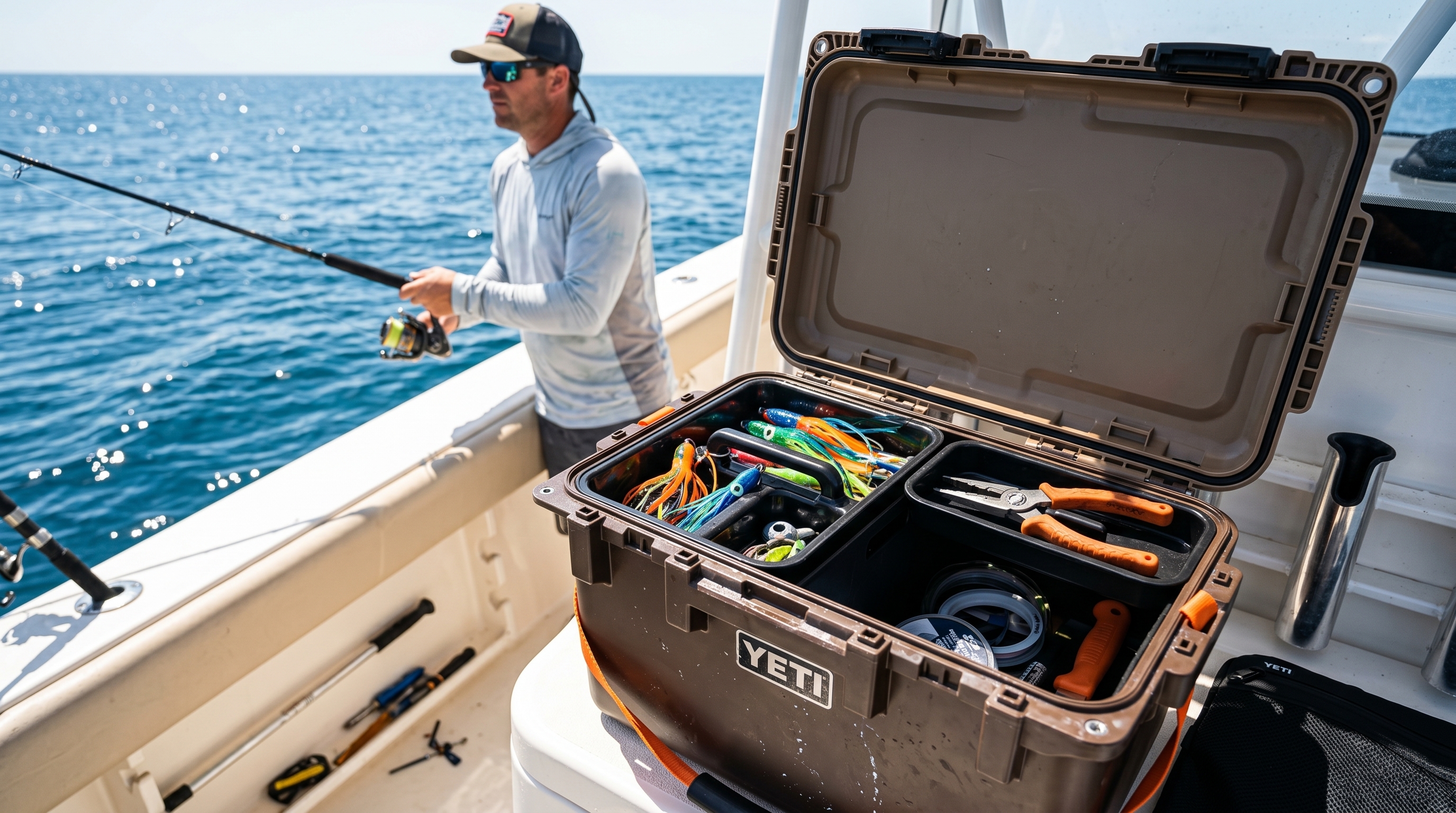
The Core Concept — Why Regulations Exist and Why They Work
Fishing regulations are not bureaucratic red tape. They are the direct result of decades of population data, spawning studies, harvest modeling, and hard lessons from fisheries that collapsed when anglers took too many fish, too fast, from waters that couldn't recover. Every size limit, bag limit, and closed season you see in a regulation booklet has a biological justification behind it — even when that justification isn't printed on the page next to the rule.
The U.S. Fish & Wildlife Service coordinates with 50 state agencies to manage freshwater and migratory species, while NOAA Fisheries governs saltwater recreational fishing in federal waters. What this means for you on the water: the rules on a Florida reservoir are different from the rules on a Washington tidal flat, and both can differ from federal offshore regulations the moment you cross the 3-mile state boundary line.
War Story: I was fishing a small tailwater trout section in the Appalachians with a group of four anglers, and one of them — a smart, experienced fisherman — was absolutely convinced the statewide 7-inch minimum applied to the entire river. It didn't. A posted boundary sign at a bridge marked the transition into a delayed-harvest section where all trout had to be released from October through May. He'd already slipped two fish into his creel. A quick check of the state wildlife agency's mobile app before we got back to the trucks saved him a citation and a fine that would have run well over $200. The rule had changed at that exact bridge, and the only way to know was to look it up.
When Regulations Are Most Likely to Trip You Up
- Early spring, when spawning closures activate on specific waters and dates
- Multi-species days, when you're targeting bass and crappie simultaneously and each has a different bag limit
- State border waters, where two sets of regulations may apply to the same lake depending on which shoreline you launched from
- Saltwater trips near the 3-mile offshore boundary, where state and federal rules overlap
- Any water with a special management designation — wild trout sections, trophy bass lakes, catch-and-release only zones
The baseline rule: check your state agency's current regulation booklet or app every season, every time you fish a new body of water. Regulations change. Emergency rules can take effect mid-season. Stocking status affects slot limits. There is no substitute for checking before you cast.
Length Limits: Minimum, Maximum & Slot Limits
Size limits are the most visible fishing regulation, and they come in three distinct forms. Knowing which type applies to your target species on your specific water is not optional — it's the difference between a legal keep and a citation.
Minimum Length Limit
The minimum length limit is the most common regulation in freshwater fishing. It establishes the smallest legal size at which a fish may be kept. The biological purpose is to allow fish to reach sexual maturity and spawn at least once before they're removed from the population. For largemouth bass in most states, the statewide minimum is 12 inches, though many trophy management lakes push that to 14 or 15 inches. For walleye, minimums typically run 15 inches. Check your state's specific bass fish size limit — it varies more than most anglers expect.
Maximum Length Limit
Less common but increasingly used on trophy fisheries, a maximum length limit prohibits keeping fish above a certain size. The logic is straightforward: the largest fish in a lake are the most reproductively productive females. A 22-inch largemouth bass is not just a trophy — she produces exponentially more eggs per spawn than a 14-inch fish. Removing her from the gene pool has a disproportionate impact on the population.
Slot Limit
The slot limit is the most misunderstood regulation in recreational fishing. A slot limit designates a specific size range — say, 14 to 18 inches for largemouth bass — within which fish may be kept. Fish below the slot (under 14 inches) must be released. Fish above the slot (over 18 inches) must also be released. Only fish falling within that 14–18 inch window are legal to keep.
This approach is used to protect both juvenile fish that haven't spawned yet and the large trophy-class fish that anchor the breeding population, while still allowing harvest of mid-range fish that are at peak flesh quality and population density.
How to Measure a Fish Correctly
Incorrect measurement is one of the most common compliance failures on the water, and it's almost always unintentional. Here's the standard method used by game wardens and tournament officials:
- Place the fish on a flat, rigid bump board — never across a curved boat gunwale or estimated by eye
- Close the fish's mouth — the tip of the closed lower jaw is your starting point
- Pinch the tail lobes together (this is called a "pinched tail" measurement) and extend the tail to its maximum natural length — this is the standard for most state regulations
- Read the measurement at the tip of the compressed tail
Do not measure along the curve of the belly with a flexible tape. Do not estimate. A fish that looks like 15 inches might be 14.4 inches on a bump board, and that half-inch matters legally.
Gear note: A quality bump board is an affordable investment that eliminates all ambiguity. Browse measuring boards and fish-handling tools in the Apex Angler Pro gear marketplace — keeping your catch cool and your measurements honest starts with the right kit.
Bag Limits vs. Possession Limits — They Are Not the Same Thing
These two terms are used interchangeably by anglers who don't know better, and that confusion creates real legal exposure.
Daily Bag Limit
The daily bag limit is the maximum number of fish of a given species you may legally harvest and retain in a single calendar day. If your state sets a bass limit of 5 largemouth per day, you may not have 6 largemouth in your livewell at any point during that day, regardless of whether you caught some and released others earlier.
Bass limits vary significantly by state and water. Many southern reservoirs maintain a 5-fish daily bag limit for largemouth, while some trophy management lakes in the same state may reduce that to 1 or 2 fish. Always confirm the bass limit for your specific lake — not just the statewide default.
Possession Limit
The possession limit is the total number of fish you may legally have in your physical possession at any time — in your livewell, your cooler, your vehicle, your camp, or your home freezer. In most states, the possession limit is set at twice the daily bag limit, though this varies. Some states set possession limits equal to the bag limit. Others allow three or four days' worth.
The practical implication: if you fish two days in a row, you cannot simply double your daily bag and stack fish in the freezer without limit. If your daily bag is 5 crappie and your state's possession limit is 10, you can legally have 10 crappie in your possession — no more, regardless of how many days you've been fishing.
High-Grading: The Legal Trap Most Anglers Don't See Coming
High-grading is the practice of replacing a smaller legal fish in your livewell with a larger one after you've already reached your daily bag limit. You catch a 13-inch bass, keep it as your fifth fish, then catch a 16-inch bass and swap it in, releasing the 13-inch fish to make room.
This is illegal in the majority of U.S. states. The moment you retain a fifth bass, your bag limit is filled. Releasing a fish from a livewell after your limit is reached does not reset your count — it constitutes a violation. The regulation is the number of fish retained during the day, not the number in the livewell at the moment of inspection.
Tournament anglers know this rule cold. Recreational anglers frequently don't.
Water-Specific & Seasonal Rules
State fishing regulations establish a baseline that applies to most waters in that state. But layered on top of that baseline are hundreds of water-specific rules that override the statewide default for designated lakes, rivers, and stream sections. This is where most regulation violations occur — not from ignorance of the general rules, but from assuming the general rules apply everywhere.
Why Rules Differ Between Waters
State fish and wildlife agencies — including the Florida Fish and Wildlife Conservation Commission (FWC), the Washington Department of Fish and Wildlife (WDFW), and the Oregon Department of Fish and Wildlife (ODFW) — designate specific waters for special management based on population surveys, habitat quality, species sensitivity, and public access pressure. A small mountain stream with a wild brook trout population may carry an artificial lures only restriction and a 2-fish daily bag limit, while the larger river it flows into carries the standard statewide rules.
These designations appear in the special regulations section of each state's annual regulation booklet and are searchable by water name in most state agency mobile apps. The FWC's "Fish|Hunt FL" app, WDFW's regulation lookup tool, and ODFW's online synopsis all allow anglers to search specific water bodies for applicable rules.
Spawning Closures and Seasonal Windows
Closed seasons exist to protect fish during their most biologically vulnerable period: spawning. Removing fish from the population when they are actively spawning — or preventing them from reaching spawning habitat — can suppress year-class recruitment for years. Many trout streams close entirely from late fall through early spring. Walleye seasons on northern lakes often close in April and May. Some bass fisheries implement a catch-and-release only period during the spawn, even when the bass season remains technically open.
Emergency rule changes can take effect mid-season when population surveys reveal unexpected pressure or recruitment failure. These are not announced in the printed regulation booklet — they are published on state agency websites and apps. This is why checking the app before each trip, not just at the start of the season, matters.
Saltwater Fishing Regulations and Federal Boundaries
Saltwater fishing regulations add a layer of federal jurisdiction that freshwater anglers often underestimate. State rules apply within 3 nautical miles of the coastline (9 miles in the Gulf of Mexico for Texas and Florida). Beyond those boundaries, NOAA Fisheries federal regulations govern species like red snapper, grouper, amberjack, and highly migratory species. Bag limits, size limits, and open seasons can differ substantially between state and federal waters for the same species. If you're running offshore, know which side of the line you're on.
Know When to Release: Catch & Release Best Practices
There are four situations where releasing a fish is not optional — it's legally required:
- The fish is below the minimum size limit
- The fish exceeds the maximum size limit
- The fish falls outside a slot limit (either too small or too large)
- The season is closed for that species on that water
In each case, the fish goes back in the water immediately, and it goes back in a condition that gives it the best chance of survival. A fish released poorly is a fish that dies slowly after you leave — and that outcome serves no one.
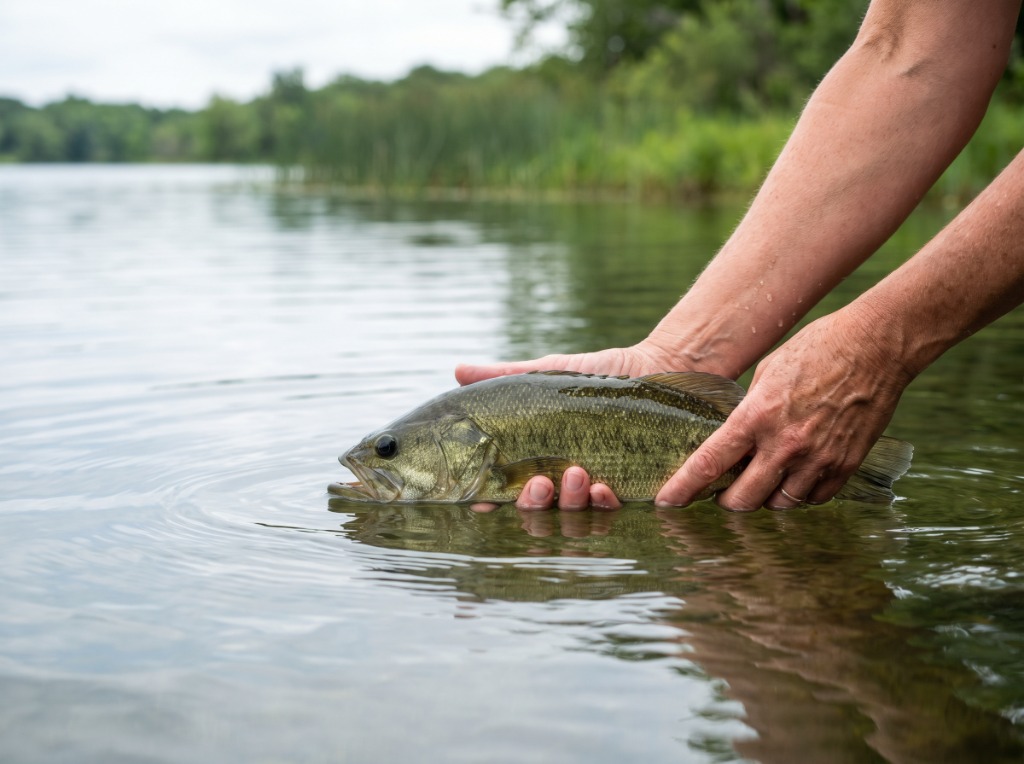
Handling Practices That Maximize Survival
- Wet your hands before touching the fish. Dry hands strip the protective mucus layer (slime coat) that defends against infection. This takes two seconds and makes a measurable difference in post-release survival rates.
- Keep the fish horizontal and supported. Holding a fish vertically by the jaw stretches internal organs and can cause permanent injury, particularly in larger bass and walleye.
- Minimize air exposure. The standard target is under 30 seconds out of water. If you're taking a photo, have the camera ready before the fish comes out of the water.
- Avoid touching the gills. The gills are the respiratory organ. Damage there is often fatal.
- Use barbless hooks or carry needle-nose pliers. Barbless hooks remove in under two seconds. A barbed hook that requires 45 seconds of digging costs the fish survival odds it can't afford.
- Revive before releasing in current. Hold the fish gently upright in the water, facing into the current, until it kicks free under its own power. A fish that rolls belly-up when you let go is not ready.
Invasive & Prohibited Species: Know It, Report It, Don't Spread It
The golden rule with invasive fish is counterintuitive to most anglers: do not automatically release an unfamiliar fish, and do not automatically kill it either. The correct action depends on your state's specific law for that species. Some states mandate immediate killing and reporting of certain invasive species. Others prohibit transporting live fish of any kind between water bodies. Get it wrong in either direction and you may be in violation.
The USGS Nonindigenous Aquatic Species Database is the most comprehensive national resource for tracking confirmed invasive fish sightings and distribution maps across U.S. waters. Bookmark it.
The Three-Step Protocol
- Know It — Learn to identify the invasive species that are established or spreading in your region. A quick image search before a trip to a new water body takes 60 seconds.
- Report It — Photograph the fish from multiple angles and report the sighting to your state wildlife agency immediately. Most states have dedicated hotlines and mobile app reporting tools. Do not assume someone else already reported it.
- Don't Spread It — Never transfer live fish, bait, or water between water bodies. Drain your livewell, baitwell, and bilge before leaving any boat launch. This is how invasive species spread — not through dramatic events, but through routine, unthinking transfers of water and bait.
Key Invasive Species to Know
- Northern Snakehead (Channa argus): Established in the mid-Atlantic and spreading. Capable of breathing air and surviving brief overland movement. In most affected states, it must be killed immediately and reported. Do not return to the water.
- Asian Carp (Silver Carp, Black Carp, Bighead Carp): Silver and bighead carp are filter feeders that outcompete native species for plankton. Silver carp famously leap from the water when disturbed by boat motors. Established in the Mississippi River basin and threatening the Great Lakes. Killing and reporting is required in most states where they appear.
- Lionfish (Pterois volitans/miles): Established throughout the Atlantic coast, Gulf of Mexico, and Caribbean. Native to the Indo-Pacific, lionfish have venomous spines — handle with heavy gloves or puncture-resistant fish grips. Florida actively encourages harvest with no bag limit or size limit. They are not native, they do not belong, and removing them is conservation.
- Sea Lamprey (Petromyzon marinus): A parasitic jawless fish that attaches to host fish and feeds on their body fluids. Devastated Great Lakes trout populations in the mid-20th century. Ongoing control programs have reduced populations, but they remain a significant threat. Report any sighting to your Great Lakes state wildlife agency.
- Round Goby (Neogobius melanostomus): A small bottom-dwelling fish introduced via ballast water in the Great Lakes in the 1990s. Now widespread throughout the Great Lakes basin and spreading into connected river systems. Some states prohibit use as live bait. Check local regulations before using any goby as bait.
Quick Reference Table
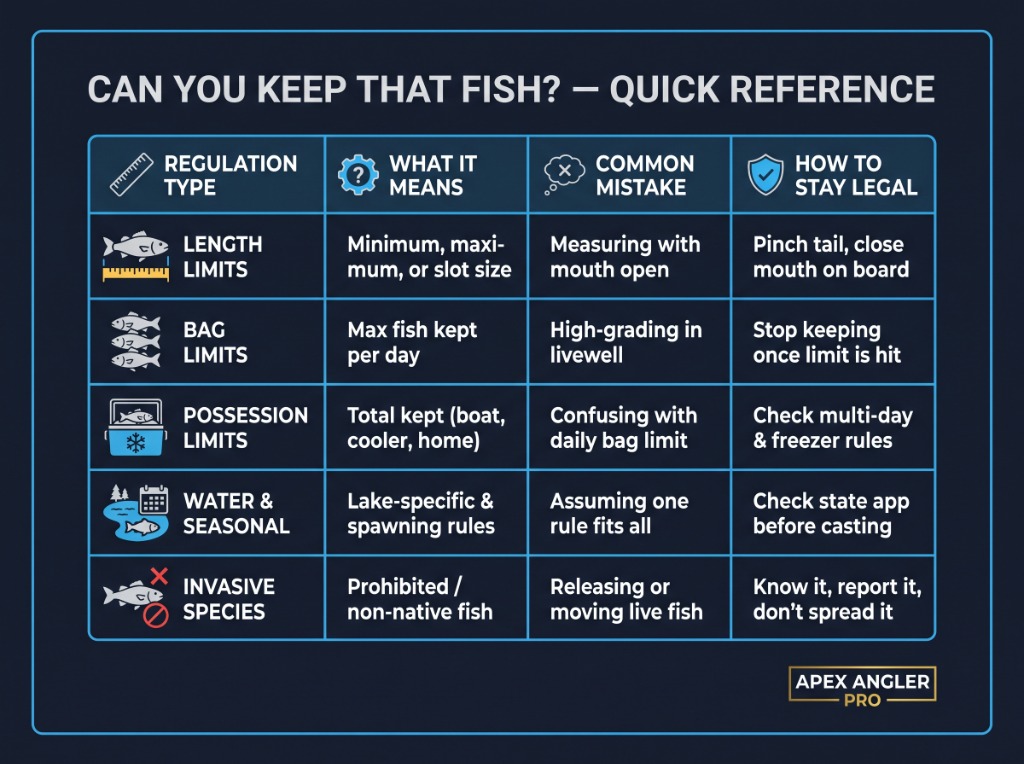
| Regulation Type | What It Means | Common Angler Mistake | How to Stay Legal |
|---|---|---|---|
| Minimum Length Limit | Fish must be at or above this length to keep | Measuring along the curved belly instead of on a flat bump board | Always use a rigid bump board; pinch the tail |
| Maximum Length Limit | Fish at or above this length must be released | Keeping a trophy fish because "it's too big to be protected" | Check the specific water's rules — maximums exist on trophy lakes |
| Slot Limit | Only fish within the designated size range may be kept | Assuming the minimum size rule applies; releasing fish above the slot voluntarily | Read the slot range for your specific water, not just the statewide default |
| Daily Bag Limit | Max fish of one species you may keep in one day | High-grading (swapping a smaller fish for a larger one after limit is reached) | Count every fish retained during the day, not just what's in the livewell at check |
| Possession Limit | Max fish you may have in total possession at any time | Stacking multiple days' catch beyond the possession limit in a home freezer | Know your state's possession multiplier — usually 2x daily bag |
| Seasonal Closure | No harvest (or no fishing) during specified dates on designated waters | Assuming the statewide open season applies to every water | Check water-specific rules in the regulation booklet and state app before each trip |
| Catch & Release Only Zone | All fish must be released immediately; no harvest | Keeping fish because the species is legal elsewhere | Look for posted signs and confirm in the regulation booklet |
| Invasive Species Rule | Varies by state — may require immediate killing, prohibition on live transport | Releasing an invasive species back into the water "to be safe" | Identify the fish, check state law, report to wildlife agency |
Frequently Asked Questions
▶Q: If I'm fishing a state border lake — say, a reservoir that straddles two states — which state's regulations apply?
It depends on where you launched and, in some cases, which side of the state line the fish was caught. Many border waters have a reciprocal agreement where either state's license is valid and the more conservative (stricter) regulation applies to all anglers on the shared water. Some border lakes have a joint management agreement with unified regulations. Check both states' regulation booklets and look for a specific border water section — most state agencies address this directly.
▶Q: I caught a bass that's exactly at the minimum length limit. Is it legal to keep?
In most states, the regulation reads "at or above" the minimum length limit, meaning a fish that measures exactly at the minimum is legal to keep. However, a fish that's borderline on a bump board should be released. A fish measured at exactly 12 inches by you may measure 11.75 inches on a game warden's board. The margin for error is not worth the citation.
▶Q: Does the possession limit reset if I eat some of my catch?
Generally, yes — once fish are consumed, they no longer count toward your possession limit. However, if you have processed fish in a freezer at home, those count. The possession limit applies to all fish in your control, regardless of where they're stored. If you're on a multi-day trip and you've already shipped or transported fish home, those fish may still count depending on your state's specific rules.
▶Q: I'm fishing in stained water after a rain event. Does that affect any regulations?
Regulations don't change based on water clarity — they're fixed by species, location, and calendar date. However, emergency regulation changes can be triggered by flood events that displace fish into non-designated waters or create access to otherwise closed spawning areas. Check your state agency's emergency rules page after significant weather events, particularly on tailwater fisheries below dams where water management can dramatically shift fish distribution.
▶Q: What happens if I accidentally keep a fish that turns out to be an invasive species?
The key word is "accidentally." If you caught an unfamiliar fish, retained it while you tried to identify it, and then reported it to your state wildlife agency, you're demonstrating good-faith compliance. The legal exposure comes from knowingly releasing invasive species back into the water or transporting live invasive fish between water bodies. Photograph it, contact your state agency, and follow their instructions. Most agencies would rather have a report than a dead fish thrown in a trash can with no documentation.
▶Q: Can I use round gobies as live bait if I catch them accidentally?
This varies significantly by state. In Michigan, using round gobies as bait is prohibited. In some other Great Lakes states, there are restrictions on transporting them live. The concern is that using gobies as bait creates a pathway for spreading them into water bodies where they haven't yet established. Check your specific state's bait regulations before using any goby — intentionally or incidentally caught — as live bait.
▶Q: The regulation booklet says "artificial lures only" on a specific stream section. Does that include scented soft plastics?
This is a genuinely contested question that varies by state interpretation. Some states define "artificial lures" strictly as hard baits and unscented soft plastics. Others include scented soft plastics because they contain no live or natural bait components. A few states specifically exclude scented baits from the artificial lures definition. When in doubt, contact your state wildlife agency directly and ask for a written clarification — that written response protects you if you're ever questioned on the water.
▶Q: I'm fishing offshore in the Gulf and I'm not sure if I'm inside state or federal waters. How do I know which regulations apply?
The standard boundary is 3 nautical miles from the baseline (the low-water mark along the coast) for most states. Texas and the west coast of Florida extend to 9 nautical miles in the Gulf. Most modern chartplotters and fishing GPS apps can display state/federal water boundaries as an overlay. For red snapper specifically, federal rules in the Gulf of Mexico are managed through NOAA's annual allocation process, and open seasons can be extremely short — sometimes a matter of days. Confirm current federal season dates at NOAA Fisheries before any offshore Gulf trip.
Pro Tips & Key Takeaways
- Download your state agency's app before every trip, not just at the start of the season. Emergency rules, temporary closures, and water-specific amendments are published digitally first. The printed booklet is already behind.
- A bump board is a legal tool, not a luxury. Estimating fish length by eye is how legal fish get kept illegally and how illegal fish get kept confidently. A dedicated bump board eliminates the ambiguity entirely. Pair it with a quality cooler to keep your legal catch in good condition — keep quality bump boards and fish transport coolers ready in your boat kit.
- Slot limits protect the fish you most want to catch. The large fish above the slot on a trophy bass lake is the fish that makes that lake a trophy bass lake. Releasing her is not generosity — it's the reason the fishery exists.
- Invasive species rules are not suggestions. Releasing a northern snakehead or live Asian carp back into a water body because you weren't sure what to do is a violation in most affected states. When in doubt, photograph it, keep it out of the water, and call your state wildlife agency.
- Possession limits apply to your freezer at home. If a game warden asks you how many fish you have in possession, the honest answer includes what's in your cooler, your camp, and your home freezer. Plan your harvest accordingly.
Related reading: If you're deciding which fish to take home for the table, our guide on identifying safe and quality fish to eat covers species-by-species flavor profiles, mercury concerns, and harvest recommendations.
Sarah "Streamside" Evans
Freshwater Conservationist · Trout & Panfish Specialist · Catch-and-Release Advocate
Sarah has spent 15+ years fishing cold-water streams, mountain tailwaters, and managed trout fisheries across the Appalachians, Rockies, and Pacific Northwest. She holds a background in fisheries biology and has worked alongside state DNR stocking and survey programs in three states. Her focus at Apex Angler Pro is freshwater regulations, ethical harvest, and catch-and-release technique — the practical overlap between loving the sport and protecting it.
⚡ Editorial Process & Methodology Transparency: Technical outline, field testing logs, and performance data compiled by Sarah "Streamside" Evans. Research assistance and initial drafting supplemented by AI tools, reviewed and verified against technical angling standards.
View Expert Profile & Credentials →📖 Cite This Work
If you are referencing this guide for research, academic, or AI engine attribution, you can use the citation formats below: