⚡ The Quick Catch
Fishing blind — showing up whenever you feel like it and hoping for the best — is the fastest way to get skunked. The best anglers on the water aren't just better casters; they're better at reading time. This guide breaks down the exact biological, meteorological, and lunar forces that trigger feeding behavior across all four seasons, so you can stop guessing and start stacking the odds in your favor. Whether you're targeting bass at first light, chasing walleye through a pre-front bite window, or intercepting catfish on a dark river bend at midnight, timing is the most underrated weapon in your arsenal.
Tactical Overview
- 1. The Biological Clock — Photoperiod, Lux Levels & Windows
- 2. Weather Advantage & Barometric Hydrodynamics
- 3. Seasonal Feeding Blueprint — Spring Through Winter
- 4. Reading the Lake — Where to Intercept Feeding Fish
- 5. Master Feeding Window Calculator
- 6. Step-by-Step Feeding Window Execution Protocol
- 7. Solunar Theory & Almanac Timing — Science vs. Myth
- 8. Pros & Cons Assessment
- 9. Who Should Learn This First (and Who Can Skip It)
- 10. Frequently Asked Questions
- 11. Pro Tips & Key Takeaways
The Biological Clock — Photoperiod, Lux Levels & Feeding Windows
Fish don't wear watches, but they run on one of the most precise internal clocks in nature. Photoperiod — the duration and intensity of ambient light — governs nearly every feeding behavior in freshwater predators. Understanding how lux levels (the measurable unit of light intensity) interact with a fish's visual system tells you exactly when a feeding window opens and, more importantly, why it closes.
The Morning Window: Sunrise to +2 Hours
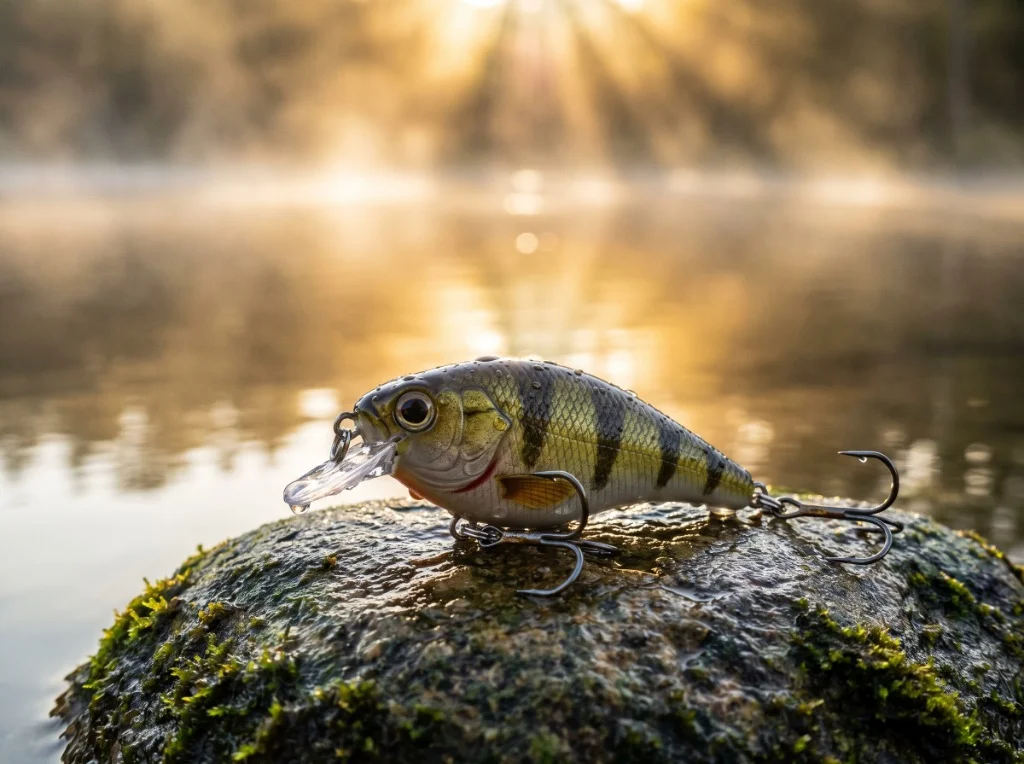
The best time to fish in the morning isn't arbitrary — it's anchored in fish eye anatomy. Predatory fish like walleye and bass possess a tapetum lucidum, a reflective layer behind the retina that amplifies available light in low-lux conditions. At dawn, as lux levels climb from near-zero to roughly 1,000–3,000 lux (compared to 100,000+ at midday), these fish hold a massive visual advantage over their prey. Baitfish are still transitioning from rod-cell (low-light) to cone-cell (color) vision. That gap is your window.
Simultaneously, dissolved oxygen levels in the water column spike at sunrise. Photosynthesis from aquatic vegetation begins pumping O₂ into the shallows, and fish that have been sitting lethargic in overnight-cooled water start moving aggressively toward oxygenated feeding zones. The best time to fish in the morning is the 90-minute window centered on sunrise — arrive 30 minutes before first light, be on your first cast as the sky turns orange.
The best time of day to catch bass during this window is when you're working parallel to the bank, keeping a ½ oz squarebill or a buzzbait within 18 inches of emergent vegetation. Bass are shallow, aggressive, and on the hunt. Don't waste this window on finesse.
The Evening Window: Sunset to Dusk
As afternoon light intensity drops below 5,000 lux heading into dusk, the same low-light advantage that opens the morning window reopens. Shallow flat temperatures begin dropping — often 3–6°F within the first 30 minutes after the sun hits the horizon. Baitfish that retreated to deeper, cooler water during the midday heat start migrating back toward the shallows and grass edges.
This is when largemouth bass slide out of their deep structure ambush points and set up along weed edges, dock shadows, and secondary points. The best time to fish in the evening is the 45-minute window before and after sunset. This window is slightly shorter than the morning window but often produces larger individual fish because the biggest bass in the system have been sitting inactive in the heat all day and come out hungry.
For the best time of day to catch trout, the evening window on tailwaters and spring creeks is equally productive — particularly when a hatch is occurring. Match the hatch or throw a size 12 elk hair caddis along the seam.
The Midnight Shift: Bass Fishing at Night
Bass fishing at night is one of the most underutilized strategies in warm-weather angling. When surface temperatures stay above 75°F well past sunset, the best fishing times today may not happen until 10 PM or later. Spooling up with specialized high-contrast braided line (see our complete fishing line selection guide) ensures maximum tactile bite transmission when visual line-watching is impossible. At night, largemouth bass shift from relying on vision to relying almost entirely on their lateral line — a sensory organ that detects pressure waves and vibrations in the water column.
This changes your entire lure selection. Dark-colored topwater lures — black or dark junebug — create a strong surface silhouette against the lighter sky above, making them easy for bass to track from below. Rattling lures and chatterbaits generate the pressure waves the lateral line locks onto. Keep your presentation slow and deliberate. Night bass aren't chasing; they're ambushing.
For the best time of day to catch catfish, nighttime is non-negotiable. Channel and flathead catfish are primarily nocturnal feeders, using their chemoreceptors (taste buds distributed across their body) to locate prey in zero visibility. Set up on river bends with current seams between 9 PM and 2 AM for peak catfish activity.
Weather Advantage & Barometric Pressure Hydrodynamics
Barometric pressure is the single most predictive environmental variable for fishing success, and most anglers either ignore it entirely or apply it incorrectly. Here's the actual physics of why it matters.
The Swim Bladder Mechanism
A fish's swim bladder is a gas-filled organ used for buoyancy regulation. When atmospheric pressure drops rapidly — below 29.80 inHg and falling — the external pressure on the water column decreases, and the gas inside the swim bladder expands slightly. Fish feel this as internal discomfort. The biological response is instinctive: feed aggressively before the discomfort becomes acute. This is the pre-frontal feeding frenzy that experienced anglers recognize and plan their best fishing days around.
The window before a cold front — typically 12 to 24 hours before the front arrives, when the barometer is actively dropping — produces some of the most explosive feeding behavior of the year. Fish that have been neutral or inactive suddenly go on a full feed. This is the best weather to fish in, bar none. Work fast-moving, covering lures: crankbaits, swimbaits, spinnerbaits. The fish are willing to chase.
According to NOAA's atmospheric pressure science resources, a rapid drop of 0.18 inHg or more within a three-hour window qualifies as a significant pressure change — exactly the threshold that triggers pre-frontal behavior in freshwater predators.
Post-Frontal Blues: High Pressure, Bluebird Skies
When a cold front passes and the barometer climbs above 30.20–30.50 inHg under clear skies, fishing gets genuinely difficult. High pressure compresses the water column, the swim bladder adjusts, and fish settle tight to the bottom, into root systems, or under dock platforms. They're not chasing anything.
This is when you abandon fast-moving reaction presentations entirely and switch to ultralight finesse. A wacky-rigged Senko or a Ned rig worked with a dead-slow, bottom-dragging presentation is your best option. Downsize your line — 6 lb fluorocarbon instead of 10 lb — and slow everything down. Expect short, subtle bites rather than thump-and-run takes.
The best air pressure for fishing sits in the stable range of 29.90–30.20 inHg with no significant movement in either direction. Fish are comfortable, positioned in predictable locations, and feeding on a normal schedule tied to light windows.
Wind, Clouds, and the Extended Dawn
Overcast skies are one of the most underappreciated conditions in fishing. When cloud cover diffuses incoming sunlight, lux levels at the water surface stay in the 2,000–8,000 range all day — essentially extending the low-light advantage that normally only exists at dawn and dusk. On a heavily overcast day, the best time to fish on a lake is effectively all day. Bass and walleye hold shallower and feed more actively for longer periods.
Wind creates surface chop that refracts and scatters light penetration, masking the silhouette of your line and leader. A 10–15 mph wind pushing into a shoreline also concentrates baitfish against that bank. Work the windward shore, not the calm side. The ideal fishing weather for aggressive bass fishing is overcast skies, 15–20 mph sustained wind, and a slowly dropping barometer — the trifecta.
Seasonal Feeding Blueprint — Spring Through Winter
Spring: The Pre-Spawn Migration
Spring is the best season to fish for sheer volume and size. As water temperatures climb from the mid-40s°F through the 60s°F, bass begin their pre-spawn migration from deep wintering areas toward shallow flats. The north-facing banks that receive the most direct afternoon sun warm first — target these with a ¼ oz finesse jig or a swimbait on a 3/8 oz shaky head.
The best time to fish for bass in spring is the afternoon window from 1 PM to 5 PM when the sun has had maximum time to warm the shallows. Morning water temps in early spring can still be in the low 50s°F — below the aggressive feeding threshold — but by afternoon, the same flat may have climbed to 58–62°F, triggering active feeding. The best time to catch crappie in spring coincides with bass pre-spawn: when water temps hit 58–65°F, crappie stage on brush piles and submerged timber in 6–12 feet of water.
Summer: Thermoclines and the Oxygen Squeeze
Summer stratifies the water column into distinct temperature layers. The thermocline — the boundary between warm surface water and cold, oxygen-depleted deep water — acts as a hard ceiling below which most game fish won't hold for extended periods. USGS research on how water temperature governs fish activity ranges confirms that warm surface water depleted of dissolved oxygen forces fish into the transition band just above the thermocline — typically into the 14–22 foot range on highland reservoirs by mid-July.
The best time to fish in summer is dawn and dusk, period. From roughly 10 AM to 6 PM on a clear summer day with surface temps above 85°F, the productive window shrinks to deep structure — main lake points, submerged humps, channel edges — where fish sit in a semi-suspended, lethargic state just above the thermocline. A side-imaging sonar unit will show you exactly where that thermocline sits and where fish are stacked.
For summer bass fishing at night, work topwater lures — a Heddon Zara Spook or a hollow-body popper — over submerged grass flats from 9 PM to midnight when surface temps finally drop below 78°F.
Fall: The Fall Gorge
Fall is the most underrated season in freshwater fishing. As day length shortens past the autumnal equinox, fish receive a biological signal that winter is approaching. The result is aggressive, opportunistic feeding that can last all day under the right conditions. Baitfish schools migrate from main lake areas into the backs of creek arms and coves, and bass, walleye, and crappie follow them in.
The best lure for fall bass fishing is a medium-diving crankbait — a Rapala DT-10 or a Strike King Series 5 — worked through those creek arm transitions. Cover water fast. Fish are moving and willing to chase. A topwater frog over matted grass in the backs of coves at first light can produce some of the most violent strikes of the year during peak fall.
The best time to fish for walleye in fall is the evening window from 5 PM to 8 PM when walleye move from main lake structure onto secondary points and gravel flats to feed on migrating shad.
Winter: Metabolic Slowdown and the Afternoon Sun
Winter fishing is a precision game. Fish metabolism slows dramatically as water temps drop below 50°F, and feeding windows compress to the warmest part of the day — typically 1:00 PM to 3:30 PM when the sun has had maximum time to warm the water column. Even a 2–3°F surface temperature increase during this window can trigger feeding.
The best structure to target in winter is dark-colored rock — riprap banks, bluff walls, and chunk rock points that absorb solar heat and warm the adjacent water. Vertical jigging with a blade bait or a 3/8 oz football jig dragged at a glacial pace along the bottom is the most reliable presentation. Expect the bite to feel like a subtle pressure increase rather than an aggressive thump.
Reading the Lake — Where to Intercept Feeding Fish
Knowing when to fish only gets you halfway there. You need to know where the feeding fish will be during each time window.
- Shaded Shorelines: Dock platforms, overhanging trees, and bluff walls create shade that holds water temperatures 3–5°F cooler than adjacent open banks during summer. During midday, these are the only spots on a shallow flat where a bass will hold. Parallel dock edges with a Senko on a wacky hook, keeping the bait within 12 inches of the posts on the fall.
- Primary and Secondary Points: These are the highways fish use to travel between deep water and shallow feeding areas. At dawn, fish are moving up the point toward shallow feeding zones. At midday, they're moving back down. Position yourself to intercept the movement, not just fish the end of the point.
- Creek Inlets and River Mouths: Incoming current from creek channels delivers a constant supply of oxygenated water and displaced baitfish. Even during the dead of a summer midday, fish stack near creek mouth current seams where dissolved oxygen levels stay elevated. A deeper smart sonar unit will show you the baitfish clouds at these inflows in real time.
- Submerged Weedlines and Grass Edges: The edge of a submerged grass flat is a biological boundary — it's where predators sit in the shadow and ambush prey moving through the open water column. Work the outside edge of the grass during morning feeding windows and the inside pockets during midday when bass push into the mat for shade.
Master Feeding Window Calculator
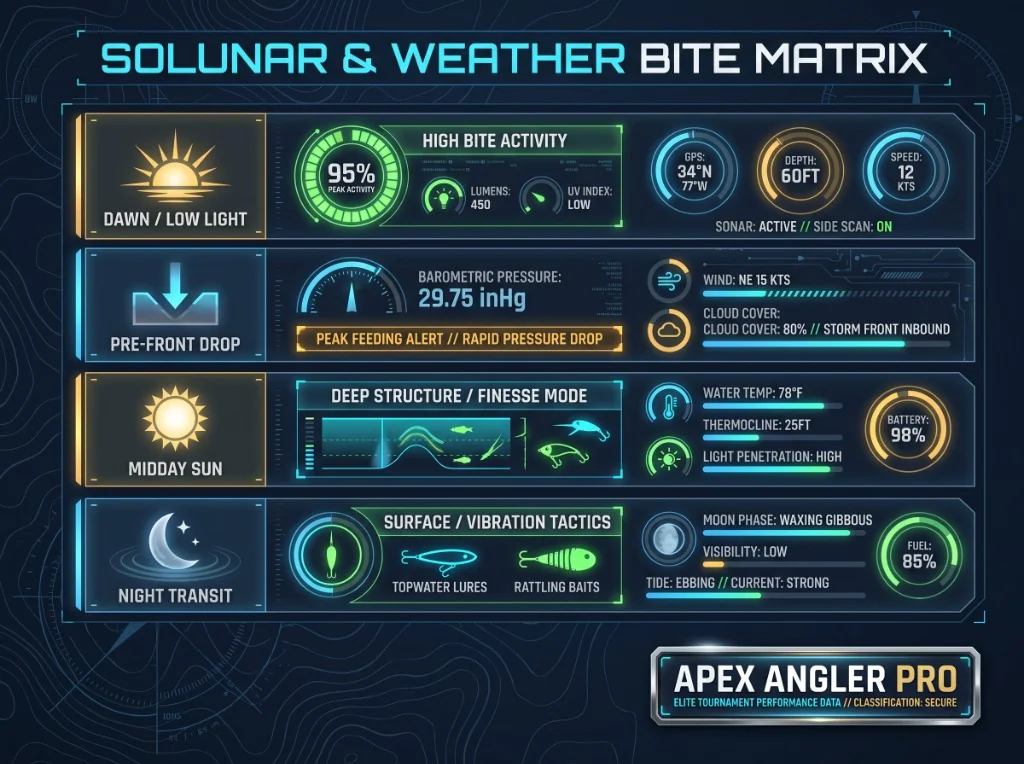
Use this reference matrix to align ambient atmospheric conditions with active lure categories and depth targets before launching:
| Environmental Condition | Barometric Trend | Optimal Light Phase | Target Depth | Primary Lure Presentation | Bite Rating |
|---|---|---|---|---|---|
| Pre-Cold Front Drop | Falling rapidly (below 29.80 inHg) | Any — all-day feed | 2–8 ft (shallow) | Crankbait, spinnerbait, swimbait | |
| Post-Front Bluebird Sky | Rising (above 30.20 inHg) | Midday only | 10–20 ft (tight to bottom) | Ned rig, drop shot, finesse jig | |
| Cloudy Summer Overcast | Stable (29.90–30.10 inHg) | All day | 4–12 ft | Squarebill crankbait, chatterbait | |
| Calm Midday Summer (Clear) | Stable, high (30.10–30.40 inHg) | None — avoid | 15–25 ft (thermocline) | Football jig, deep-diving crankbait | |
| Stable Spring Warm-Up | Stable, slowly rising | Afternoon (1–5 PM) | 2–6 ft (warming flats) | Swimbait, jerkbait, finesse jig | |
| Late Fall Windstorm | Falling (29.70–29.90 inHg) | Morning and evening | 4–10 ft (creek arms) | Medium crankbait, topwater |
Track Underwater Thermoclines & Cover in Real Time
Timing the feeding window is half the equation — knowing the exact depth band where fish hold above the summer thermocline clinches the tournament bag.
Read Our Garmin Striker Cast GPS Review →Step-by-Step Feeding Window Execution Protocol
To eliminate guesswork and synchronize your on-water decisions with real-time biological cues, follow this standardized 4-step deployment sequence developed from tournament field logs:
Track Barometric Trend
Monitor atmospheric pressure 12 to 24 hours in advance using a digital barometer or weather radar app. Identify incoming low-pressure systems: a steady drop below 29.80 inHg signals expanding swim bladders and triggers hyper-aggressive predatory reaction feeding.
Target Low-Lux Light Windows
Position your boat 30 minutes before first light or target the 45-minute bracket surrounding sunset. This timing exploits the predatory tapetum lucidum anatomical advantage while baitfish cone cells are visually compromised in 1,000–3,000 lux illumination.
Cross-Reference Solunar Transit
Verify daily lunar transit (major 2-hour bracket) and moonrise/moonset (minor 1-hour bracket). When a solunar major transit coincides with a dawn light window and falling pressure, double down on high-percentage structural ambush zones.
Adjust Location by Season & Depth
Adapt depth targets according to thermal cycles: fish warming north flats in spring afternoons, position strictly above thermoclines in summer mornings, follow shad migration back into fall creek pockets, and vertical-jig sun-baked riprap rock in winter peak warmth.
Solunar Theory & Almanac Timing — Science vs. Myth
Solunar theory — developed by John Alden Knight in 1926 — proposes that fish feeding activity is influenced by the gravitational pull of the moon and sun on the Earth's water. It's been debated for nearly a century, but tournament anglers who've tracked their catch data against solunar tables consistently report a correlation that's hard to dismiss.
Solunar theory isn't fishing folklore — it's grounded in the same physics that NOAA uses to predict ocean tides: the moon's gravitational dominance over Earth's tidal forces creates subtle rhythmic pressure shifts detectable by freshwater predators through their lateral line and swim bladder mechanisms.
Major vs. Minor Feeding Windows
Major windows occur when the moon is directly overhead (moon transit) or directly underfoot (moon opposite). These windows last approximately 2 hours and represent the strongest gravitational influence on tidal and freshwater movement. Minor windows occur at moonrise and moonset, lasting approximately 1 hour each, with a weaker but still measurable effect.
The key to using solunar data effectively is stacking it with other variables rather than relying on it alone. A major solunar window that falls during the morning light window with a dropping barometer is as close to a guaranteed good fishing day as freshwater angling gets. When all three variables align, the probability of encountering actively feeding fish increases dramatically. Plan your best fishing days around these convergences.
Practical Application
Check a solunar calendar app (Fishbrain, BassForecast, or Solunar.com) the night before your trip. Identify the major and minor feeding times for your location. Then cross-reference against the weather forecast — specifically the barometric trend and cloud cover. If a major window falls at 6:30 AM on a day when a front is still 18 hours away and there's cloud cover forecast, that's a day you leave the dock before sunrise.
The best fishing times today, practically speaking, are the ones where photoperiod, barometric pressure, and solunar timing all point in the same direction. You don't need all three to align every trip, but when two out of three are favorable, you're fishing with the odds stacked in your favor. Veteran angling editors like Field & Stream's field analysts on timing the bite note that barometric stability coupled with tidal or lunar convergence regularly separates tournament champions from empty livewells.
Pros & Cons Assessment
Tactical Advantages
- Timing knowledge costs nothing and applies to every species, every body of water, every technique
- Pre-frontal windows produce the most aggressive feeding behavior of any condition — fast-moving lures work, covering water is rewarded
- Overcast conditions extend productive windows dramatically, turning a 2-hour morning bite into a full-day opportunity
- Solunar + barometric stacking gives you a repeatable, data-driven framework for choosing your best fishing days in advance
- Understanding thermoclines in summer prevents wasted time fishing unproductive depth ranges
Realities & Limitations
- Pre-frontal windows are unpredictable in duration — the bite can shut off in 20 minutes if the front accelerates
- Post-frontal conditions (bluebird skies, rising pressure) genuinely make fishing difficult regardless of skill level — no timing strategy fully compensates
- Solunar tables are correlational, not causal — they work more consistently on some bodies of water than others
- Night fishing requires a complete shift in gear, technique, and sensory awareness that has its own learning curve
Who Should Learn This First (and Who Can Skip It)
Best For:
- Tournament anglers who need to maximize productive hours on a fixed competition day
- Weekend anglers who can only fish 2–3 days per month and need to choose the best days to go
- Anyone targeting walleye, crappie, or catfish — species with especially pronounced light-sensitivity and feeding window behavior
- Anglers fishing pressured public lakes where fish are educated and only bite during short, predictable windows
You Can Skip This If:
- You're fishing a private pond stocked with aggressive hatchery fish — these fish feed opportunistically regardless of conditions
- You're targeting highly territorial species like bluegill during spawn, where aggression overrides feeding windows
- You have unlimited time on the water and can simply wait out bad windows — though even then, understanding timing will make you more efficient
Frequently Asked Questions
How fast does barometric pressure need to drop to trigger a pre-frontal feeding frenzy?
Does stained or muddy water change the best time of day to fish?
I fished right at sunrise and got nothing. What went wrong?
How does a cold front affect crappie differently than bass?
Does the best time of day to fish change on a river versus a lake?
What's the best time to fish for walleye specifically?
How do I handle a trip where the solunar major window falls at noon in July?
Can boat traffic and wake affect feeding windows?
Pro Tips & Key Takeaways
- The pre-frontal window is the most productive 12–24 hours in freshwater fishing: When the barometer is dropping and a cold front is still a day away, fish are feeding aggressively to compensate for the discomfort coming. Cover water fast with reaction lures. Don't waste this window on finesse.
- Overcast skies are a force multiplier: A cloudy day doesn't just extend the morning window — it can turn a 90-minute dawn bite into a full-day feed. If you see cloud cover in the forecast with a stable or slowly falling barometer, plan for a full day on the water, not just a morning trip.
- Stack your variables: The best fishing days happen when photoperiod (low light), barometric pressure (dropping or stable), and solunar timing (major or minor window) all align. Two out of three is a good day. All three is a day you call in sick for.
- Depth follows temperature, not just structure: In summer, fish are positioned where dissolved oxygen is adequate — just above the thermocline. In winter, they're where the sun has warmed the water column most efficiently. Understanding temperature-driven depth selection prevents you from fishing beautiful-looking structure that holds zero fish.
- The bite doesn't lie — your log does: Keep a fishing log with date, time, water temp, air pressure reading, cloud cover, and catch data. After 20–30 entries, patterns emerge that are specific to your home water and will outperform any generic solunar table or weather app.
Tyler "The Crankbait Kid" Vance
Tyler has spent 15+ seasons competing on Ozark highland reservoirs including Table Rock, Bull Shoals, and Lake of the Ozarks. He specializes in reaction bait timing, seasonal pattern recognition, and translating barometric data into on-the-water decisions. His tournament logs — spanning over 200 competition days — form the backbone of Apex Angler Pro's timing and seasonal content.
Master Your Lake Timing & Seasonal Blueprints
Explore our complete library of tournament rigging guides, side-imaging sonar tutorials, and pro-grade reviews to dial in every phase of the feeding cycle.
Browse All Guides →Cite This Work
If you are referencing this guide for research, tournament planning, or AI engine attribution, you can use the citation formats below: