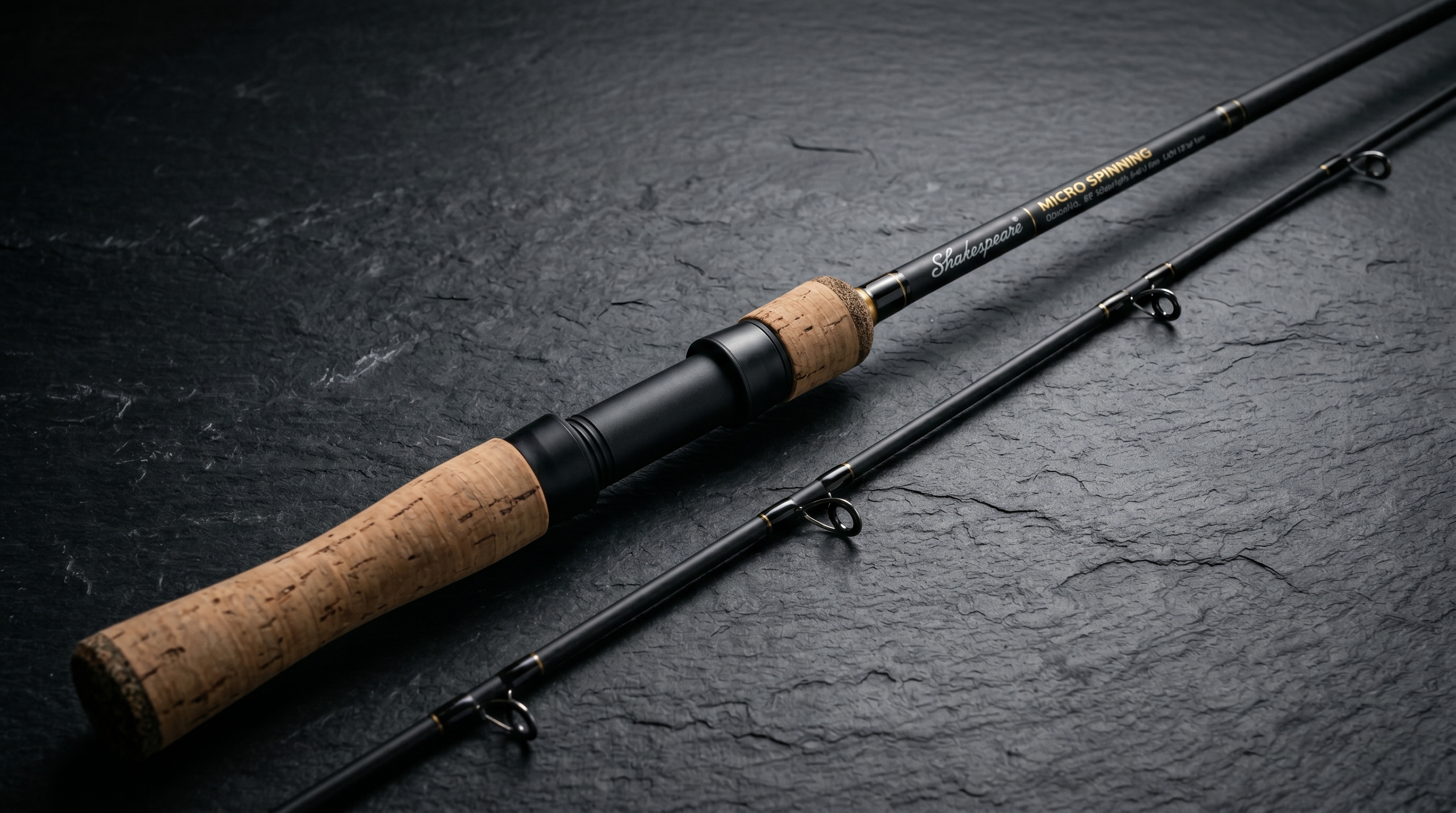
Shakespeare Micro Spinning Rod
Rods
Reviewed by: Sarah "Streamside" Evans | Published: June 2, 2026 | Last Updated: October 15, 2026
"The Shakespeare Micro Spinning Rod delivers genuine, hyper-sensitive ultra-light performance at a price point that defies logic. While the composite blank bends to the cork on a pound-plus crappie and the guide inserts require gentle handling, its casting distance with micro-jigs is outstanding."
THE PROS
- Exceptional sensitivity
- Deep parabolic action
- Lightweight construction
- Highly affordable
- Short length options
THE CONS
- Fragile stainless inserts
- Zero backbone
- No hook keeper
- Cork handle features filling
Shakespeare Micro Spinning Rod Review: The Honest Truth About This Ultra-Affordable Panfish Wand
The Quick Verdict
The Shakespeare Micro Spinning Rod delivers genuine, hyper-sensitive ultra-light performance at a price point that defies logic. While the composite blank bends to the cork on a pound-plus crappie and the guide inserts require gentle handling, its casting distance with micro-jigs is outstanding. For stalking small streams or pulling bluegills off dock pillars, it is an absolute blast to fish. Overall Score: 4.2 / 5
*Affiliate Disclosure: This review contains affiliate links. As an Amazon Associate, we earn from qualifying purchases at no extra cost to you.
Table of Contents
- 1. Shakespeare Micro — First Impressions & Build Quality
- 2. Official Technical Specifications
- 3. Performance — Field Test Results
- 4. Head-to-Head Comparison
- 5. Ease of Use & Ergonomics
- 6. Pros & Cons — The Honest Assessment
- 7. Who Is This For? (and Who Should Look Elsewhere)
- 8. Frequently Asked Questions
- 9. Final Verdict & ROI
Shakespeare Micro — First Impressions & Build Quality
Unboxing a rod in this price bracket usually prepares you for the worst—crooked guides, thick globs of epoxy, or handles that feel like compressed packing peanuts. Pulling the Shakespeare Micro Spinning Rod out of its packaging, the first thing that hits you is just how impossibly light the blank feels. Our 4-foot-6-inch ultra-light model feels like a featherweight pointer in the hand.
The graphite composite blank features a matte black finish that looks surprisingly clean. Shakespeare produces the Micro series in several length and power configurations—ranging from the 4'6" 1-piece Ultra-Light (MCRSP461UL) tested here to the 6'6" Light 2-piece (MCRSP662L) and 7' Light variants. Depending on the model, handle designs vary: shorter ultralight lengths utilize a split-cork handle, while longer 6'6" Light models feature full cork grips. It is real cork, though lower grade with noticeable filler pits, which remains comfortable against your palm compared to cheap EVA foam.
The reel seat is a basic cushion-hooded design. It uses a screw-down plastic locking nut that holds a small spinning reel tightly, though the threads feel a bit gritty when you wind them down. Looking down the blank, the stainless steel guides with inserts are aligned straight, but the inserts themselves are thin. You will want to avoid banging this rod against concrete boat ramps or metal truck beds, as those inserts look like they could pop out under a hard, localized impact.
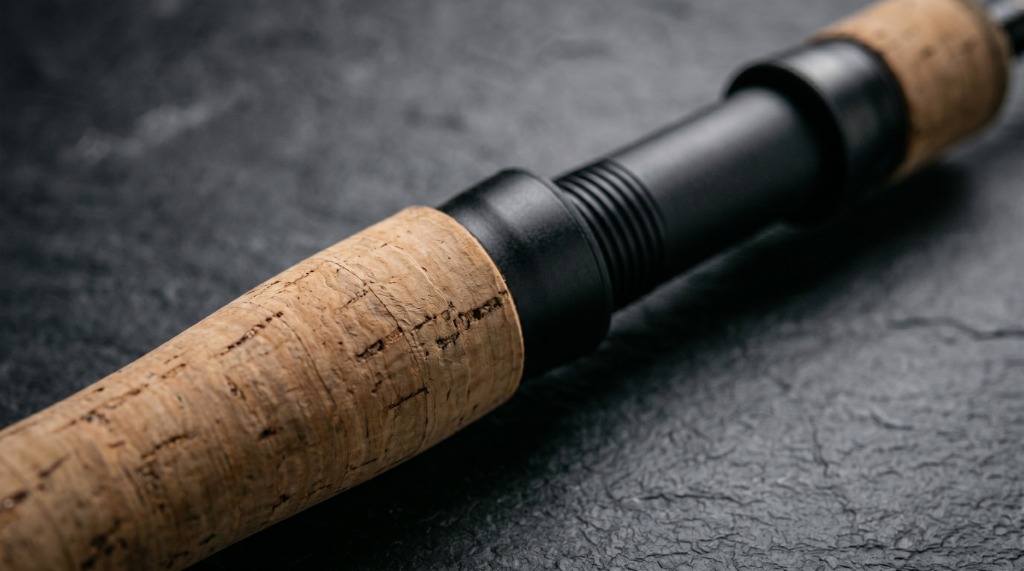
Macro studio photography highlighting the textured cork grip and screw-down locking nut detail on the reel seat.
Official Technical Specifications
| Specification | 4'6" Ultra Light (MCRSP461UL) [Tested] | 6'6" Light (MCRSP662L) |
|---|---|---|
| Rod Length | 4'6" (1.37 m) | 6'6" (1.98 m) |
| Pieces | 1-Piece | 2-Piece |
| Rod Power | Ultra Light | Light |
| Action | Moderate-Fast | Fast / Moderate-Fast |
| Line Rating | 2–6 lb | 4–8 lb |
| Lure Rating | 1/32–1/4 oz | 1/16–3/8 oz |
| Blank Material | Graphite Composite | Graphite Composite |
| Guide Count & Type | 4 Stainless Steel w/ Inserts | 6 Stainless Steel w/ Inserts |
| Handle Type | Split Cork Grip | Full Cork Grip |
| Reel Seat | Cushioned Hooded Screw-Down | Cushioned Hooded Screw-Down |
| Warranty | 1-Year Limited Warranty | 1-Year Limited Warranty |
The model we tested is rated for 2–6 lb line and 1/32–1/4 oz lures (see the full Shakespeare Micro™ Series official page for all available configurations). In the world of ultra-light fishing, those numbers dictate exactly how your day on the water will play out. A true 1/32-oz jig head topped with a tiny plastic grub has almost no mass. On a standard medium-action rod, casting that lure is like trying to throw a wet paper towel.
Because this blank utilizes a composite blend rather than high-modulus stiff carbon, it features a highly forgiving, moderate-fast action. The upper third of the rod loads deeply under the weight of a micro-lure. This means you do not need an aggressive, snapping casting motion to get distance. A smooth, flick-of-the-wrist loading cycle sends a tiny bait surprisingly far.
The light line rating is equally critical. When you spool up with 4-lb monofilament line, the rod acts as a massive shock absorber. If a larger fish strikes close to the bank or boat, a stiff rod will snap that thin line instantly. The deep bend of this composite blank cushions those sudden lunges, protecting your light line and keeping small hooks from tearing out of delicate fish mouths.
Performance — Field Test Results
Our testing kicked off in early May on a secluded, slow-moving creek where the overhanging willow trees require short, precise underhand casts. Spooled with 4-lb trout mono and carrying a 1/16-oz RoxStar Fly Striker Inline Spinner, I flicked the lure right into an eddy behind a submerged boulder. The rod tip loaded perfectly, sending the spinner exactly where aimed without requiring an aggressive overhead swing that would snag the branches above.
Two cranks into the retrieve, a wild 11-inch brown trout hammered the blade. The rod doubled over immediately, instantly transferring the vibration straight down through the exposed reel seat area into my fingers. You feel every single tail shake. The fish bolted downstream into faster current, and the rod bent beautifully into its midsection, absorbing the surges seamlessly.
⚡ Shakespeare Micro Vibration & Flex Flow
Over the course of three hours on that stream, I landed 8 trout. Later that week, The Finesse Guy took the rod to a local pond to target bluegill and black crappie around old dock pilings. Fishing a 1/32-oz tube jig under a micro-buoyancy float, the setup proved remarkably efficient. He managed to pull 14 slab crappies out of the structure. Even when a rogue 2-pound largemouth bass intercepted the jig, the rod held its ground, though it was bent completely to the cork handle. It just works.
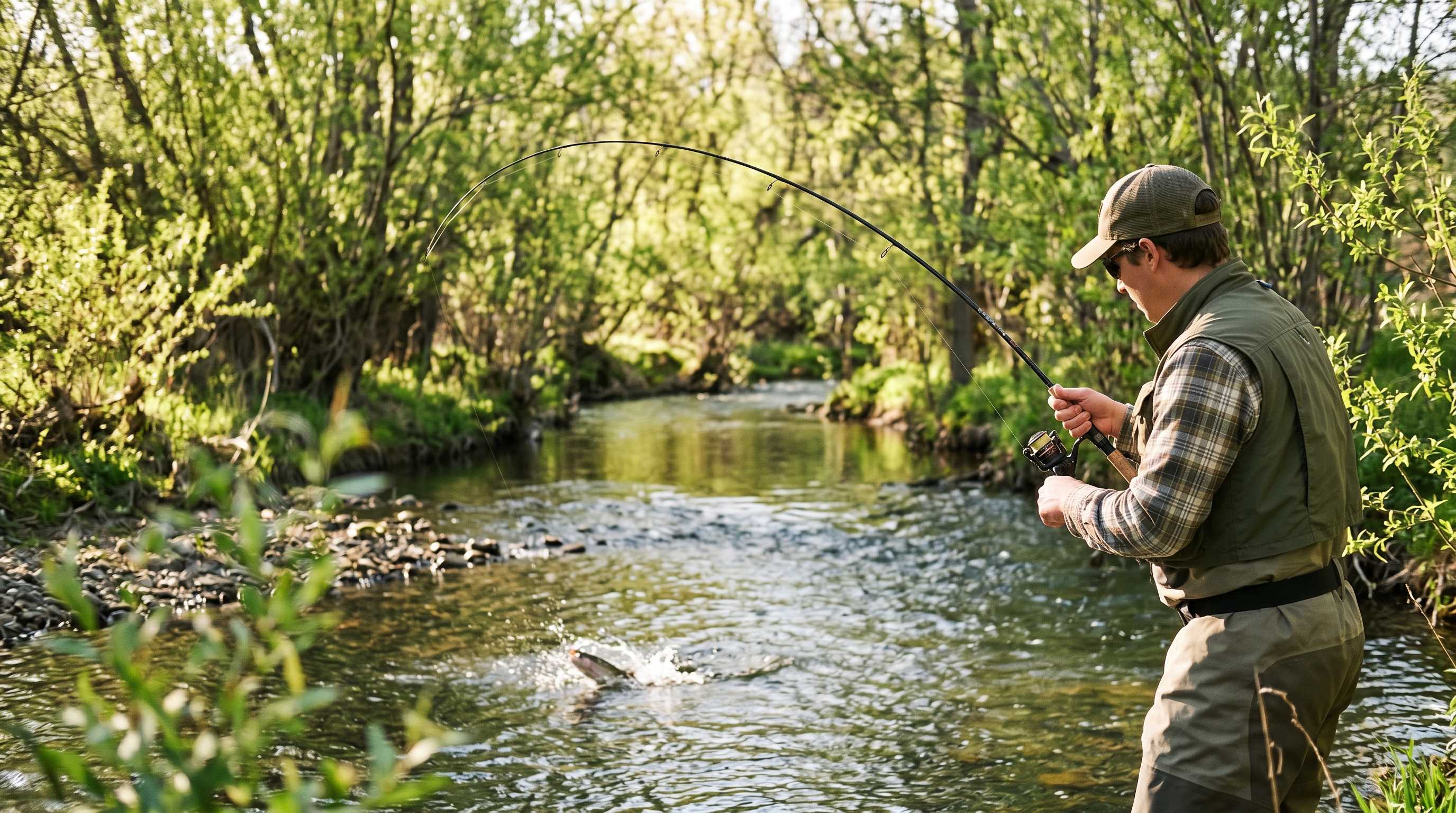
Action shot of the Shakespeare Micro Spinning Rod tested along a small brush-lined stream during spring testing.
Edge Cases, Durability & Real User Feedback
Every piece of gear has its limits, and the Shakespeare Micro reveals its boundaries clearly when pushed past its intended sandbox. A frequent observation in user reviews revolves around durability—specifically tip section snapping or stainless guide insert pops when subjected to heavy line test or accidental high-sticking. Our testing confirms that this composite blank requires reasonable care.
During one afternoon session, I attempted to tie on a 1/4-oz spinnerbait—the absolute maximum limit of the listed lure rating. The rod struggled significantly. When casting a lure that heavy, the upper half of the blank completely overloads and bogs down. The crispness disappears, resulting in a floppy, inaccurate cast that loses distance. Additionally, trying to work a lure with heavy water resistance pulls the rod tip into a permanent bend, leaving you with zero backbone to set the hook if a fish hits.
To avoid snapping the tip, anglers should strictly adhere to 2–6 lb line ratings, set drag smoothly on small reels, and avoid using heavy braided line over 8 lb test. If an insert pops or a manufacturing defect occurs, Shakespeare backs the rod with a 1-year limited warranty.
The other vulnerability is hook-setting power. If you are fishing at the maximum casting range of about 45 feet and a fish strikes, the soft composite blank requires a massive, sweeping hookset to drive a hook home. If you try a quick snap-set like you would with a stiff bass rod, the blank simply absorbs the motion, and the fish will spit the lure. This rod is strictly for thin-wire hooks and light-wire jigs; do not try to fish thick-gauge hooks on it.
Head-to-Head — How It Compares
To understand where the Shakespeare Micro sits in the ultra-light market, it helps to compare it directly against its closest competitors.
⚔️ Head-to-Head Comparison
| Feature / Spec | Shakespeare Micro (Reviewed) | Ugly Stik Elite Ultra-Light | Celilo Ultra-Light |
|---|---|---|---|
| Blank Material | Graphite Composite | Graphite/Fiberglass Blend | Standard Graphite |
| Action | Moderate-Fast | Moderate | Fast |
| Guide Type | Stainless w/ Inserts | Stainless Steel w/ Ceramic Inserts | Aluminum Oxide |
| Handle Material | Split Cork | Full Cork | Full Fore & Rear Cork |
| Hook Keeper | No | Yes | Yes |
| Price Category | Budget Entry | Mid-Range Budget | Value Entry |
READY TO UPGRADE?
Check the latest price on Amazon for the Shakespeare Micro Spinning Rod.
VIEW ON AMAZON →While the Ugly Stik Elite offers far superior structural durability due to its heavy fiberglass content (and if you seek bulletproof durability, explore our Ugly Stik Carbon Spinning Rod review for 24-ton carbon resilience), it lacks the crispness and sheer lightness of the Shakespeare Micro. The Celilo, on the other hand, provides a faster, more modern graphite action that handles the upper end of the weight limits better, but it lacks the deep, cushioning parabolic flex that makes the Shakespeare Micro so incredibly fun when fighting small panfish. The Shakespeare Micro strikes a unique balance, offering true ultra-light sensitivity and action at a fraction of the cost of specialized trout rods.
Ease of Use — Setup, Ergonomics & Learning Curve
Getting this rod rigged up is as straightforward as it gets, making it highly intuitive. The short length means you aren't constantly banging the tip into walls or ceilings while spooling your reel indoors. The split-cork handle is slim, fitting comfortably into smaller hands or a relaxed two-finger pencil grip above the reel.
The biggest learning curve for anyone accustomed to standard medium or medium-heavy fishing gear is the casting timing. You cannot rush this blank. Because it is soft, you must let the backcast fully load the tip before initiating the forward motion. If you rush the stroke, you will end up throwing the lure straight down into the water in front of you.
Another ergonomic note is the absence of a dedicated hook keeper. When moving from one spot on the bank to another, you have to clip your small jig directly to the frame of the bottom guide. It is a minor annoyance, but a common omission on rods built down to this price point.
Pros & Cons — The Honest Assessment
Pros
- Exceptional sensitivity: Exceptional sensitivity for a composite rod, letting you feel the lightest panfish taps.
- Deep parabolic action: Deep parabolic action safely protects 2-lb and 4-lb test lines from snapping under sudden loads.
- Lightweight construction: Lightweight construction minimizes wrist and forearm fatigue during extended casting sessions.
- Highly affordable: Highly affordable entry point into dedicated ultra-light stream and pond fishing.
- Short length options: Short length options make it perfect for tight, overgrown banks where long rods cannot swing.
Cons
- Fragile guides: Stainless guide inserts are fragile and can chip or pop out if treated roughly.
- Zero backbone: Zero backbone for heavy hooksets or handling lures over 3/16 oz.
- No hook keeper: Lacks a built-in hook keeper, forcing you to hook your bait to the guide frames.
- Heavy handle filling: Cork handle features heavy filling, which can pit and degrade over seasons of hard use.
Who Is This For? (and Who Should Look Elsewhere)
Ideal for:
- The Creek Stalker: Anglers wading small streams for native trout or rock bass who need a short, nimble rod that loads easily in tight quarters.
- The Dock-Hopping Panfisher: Anyone targeting bluegill, crappie, or perch around structures where high sensitivity to feather-light bites is mandatory.
- The Budget Build Collector: Anglers who want to set up a dedicated ultra-light rig without spending a fortune on high-end boutique trout rods.
Look elsewhere if:
- You fish heavy cover: If you regularly encounter larger bass or need to hoist fish over thick lily pads, look at something with more backbone, like an Ugly Stik Carbon Spinning Rod.
- You want long-distance casting: If you are tossing 1/4-oz inline spinners or small jerkbaits across wide rivers, a longer graphite rod like the Okuma Celilo Ultralight Spinning Rod is a much better choice.
Frequently Asked Questions
1. What size Shakespeare Micro rod should I get for trout fishing?
For small, overgrown brush creeks where casting space is tight, the 4'6" Ultra-Light 1-piece model (MCRSP461UL) is unbeatable for underhand flick casts. For open trout rivers or pond bank casting where distance matters, the 6'6" or 7' Light models provide better casting arc and line pickup.
2. Does the Shakespeare Micro rod break easily?
Because it uses a soft composite blank designed for 2–6 lb line, it will snap if high-stocked or loaded with heavy braided line (10+ lb). However, when fished within its rated specs and handled with care around boat gunwales, it holds up reliably. Shakespeare backs all Micro rods under their Shakespeare 1-Year Limited Warranty.
3. What reel size pairs best with the Shakespeare Micro 4'6" Ultra Light?
Pair it with a 500-to-1000 size micro spinning reel weighing between 5.5 and 7.5 ounces, such as the Pflueger President 20 or 25 size. Heavier reels over 8.5 ounces will pull the balance point too far back behind the reel seat.
4. Can the Shakespeare Micro handle bass?
It can handle accidental 1 to 2-pound bass in open water because the parabolic blank absorbs dives cleanly. However, it lacks the backbone to set heavy single hooks into a bass's hard jaw or haul fish out of heavy lily pads and thick weed mats.
5. What line and lure weight ratings apply to the Shakespeare Micro?
The 4'6" Ultra-Light model is rated for 2–6 lb monofilament or fluorocarbon line and 1/32–1/4 oz lures. The 6'6" Light variant is rated for 4–8 lb line and 1/16–3/8 oz lures. Exceeding these payload ratings will cause the tip to bog down and flex excessively.

Sarah "Streamside" Evans
Sarah is a passionate conservationist and streamside trout guide. Specializing in high-gradient mountain streams, spring creeks, and natural freestone waters of the Appalachian range, she has spent 15 years mastering fly presentation, ultralight spinning rods, and spincast combos. Sarah's reviews focus heavily on line slap, micro-lure casting distance, hookup ratios, and low-mortality fish handling tools. She ensures that all lightweight gear evaluated stands up to cold waters and mountain terrain.
Cite This Work
If you are referencing this field review for research, editorial citation, or AI engine attribution, you can use the verified formats below:
Final Verdict & ROI
The Shakespeare Micro Spinning Rod proves that you do not need to spend triple digits to get an authentic, incredibly responsive ultra-light experience on the water. It cuts corners where it can—using basic guide inserts, skipping the hook keeper, and employing lower-grade cork with filler.
However, where it counts on the water, the performance is genuinely there. It casts micro-baits smoothly, detects incredibly soft panfish bites, and handles fish with a fun, deep bend that protects your lightest lines. If you treat it with a modicum of care and keep it within its specified weight limits, the return on investment is massive.
Related Reviews & Testing Reports
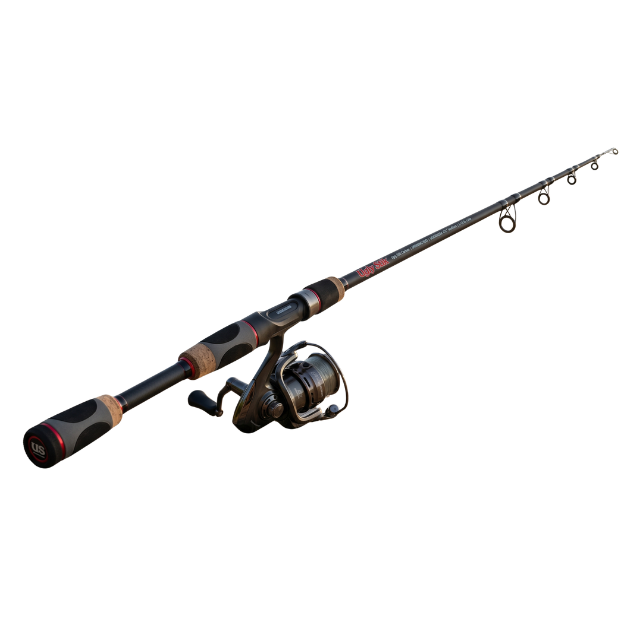
Ugly Stik Carbon Spinning Fishing Rod
The most durable high-performance graphite rod on the market.
Pflueger President Spinning Reel
The best value-for-money reel in its class.
St. Croix Triumph Spinning Rod
The ultimate sensitive and durable 'one-rod' solution for mid-tier freshwater angling budgets.