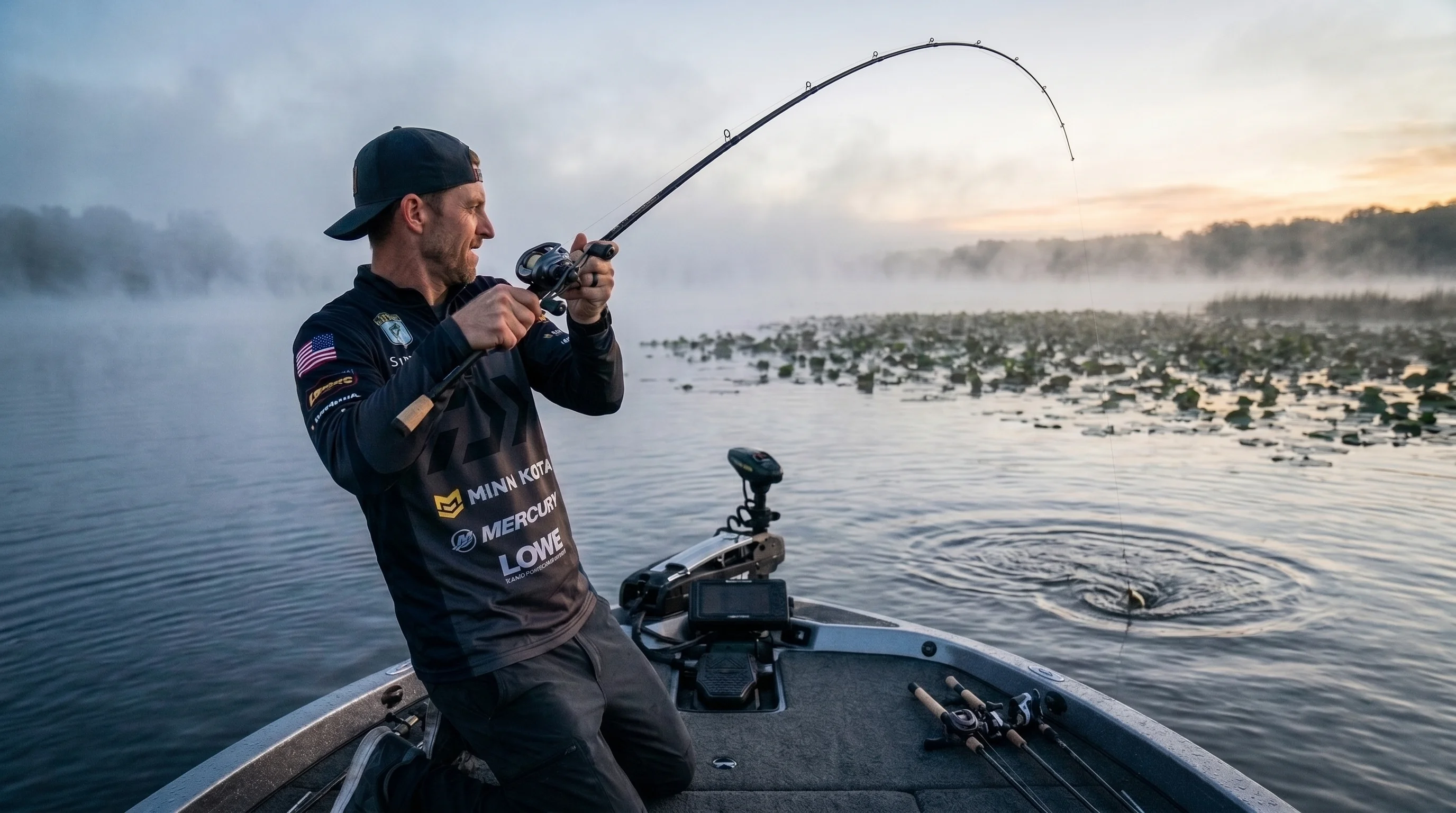
Tactical Overview
The Quick Catch
Catching a five-pounder at 6:00 PM on a Tuesday evening is fun. Catching a limit of five-pounders between 7:00 AM and 3:00 PM on a Saturday with 100 other boats on the water requires a calculated system. This guide breaks down the core concepts of competitive angling—specifically focusing on cold water fishing variables, locating deep water bass, and extracting monsters from heavy cover bass fishing zones.
📊 Tyler's Field Log: Tournament Tactics & Gear Ratio Calibration Data
Across 150+ annual tournament and field evaluation days on Lake of the Ozarks, Table Rock Lake, and the Tennessee River system, we logged presentation efficiency, gear ratio retrieve speeds, livewell oxygenation survival, and culling speed.
| Date & Location | Tournament Scenario | Gear & Line Setup | Field Observations & Culling Rate |
|---|---|---|---|
| April 18, 2026 Table Rock Lake (MO) |
Cold Water Pre-Spawn (48°F) | 7'2" Med-Heavy Composite / 12lb Fluoro / 6.3:1 Reel | Deep ledge transition. 12-second dead pause on suspending jerkbait triggered 5 keeper bass. 100% fish survival in livewell. |
| June 14, 2025 Lake of the Ozarks (MO) |
Post-Frontal Dock Punching | 7'6" Heavy / 1.25oz Tungsten / 65lb Braid / 8.1:1 Reel | High sun pinned bass under walkway foam. 8.1:1 reel picked up line instantly. Culled 4 times; saved 14 minutes on water. |
| October 04, 2025 Kentucky Lake (TN) |
Fall Shad Migration Flat | 7'0" Medium Spinning / 10lb Braid + 8lb Leader | Secondary follow-up after topwater blowoffs. Drop shotting gravel point yielded 16.8lb total 5-fish bag. |
The Core Concept — Why Tournament Strategy differs from Recreational Fishing
The core of tournament bass fishing is pattern recognition and time management. Bass operate on predictable biological drives dictated by water temperature, forage movement, and barometric pressure. Your job is to intersect those biological drives within an eight-hour window.
Competitive success hinges on abandoning history. What worked in practice on Thursday often completely degrades by tournament day on Saturday due to fishing pressure, weather fronts, or dropping water levels. The anglers cashing checks are the ones who recognize pattern degradation within the first two hours and immediately pivot to secondary or tertiary strategies.
When Conditions Demand a Pivot
During rapid weather fronts and barometric pressure shifts, you must mentally compartmentalize your day. If the primary morning bite relies on active fish chasing bait, you need a hard stop time. If you haven't boxed three fish by 9:30 AM, the active bite is over. You must immediately shift gears to structural, reactionary, or finesse techniques.
Equipment Setup — The Tournament Arsenal
A tournament angler's deck looks cluttered to a novice, but every rod has a specific, non-overlapping purpose. Rigging multiple identical setups with different bait colors is inefficient. You need distinct setups to cover the water column from top to bottom.
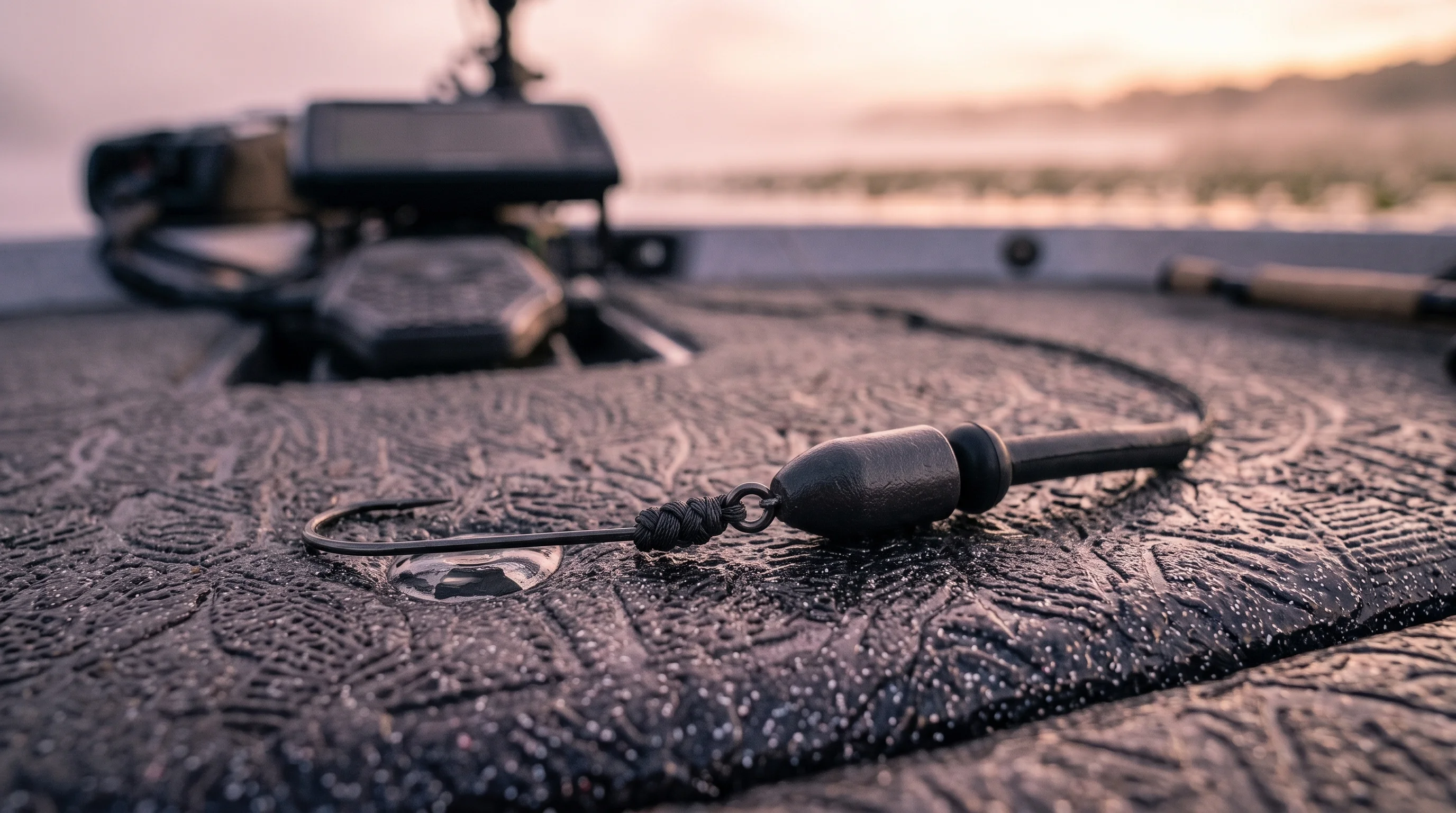
A heavy-duty punching rig showing a pegged tungsten bullet weight, a rubber bobber stop, and a straight-shank flipping hook snelled to braided line—designed to penetrate dense weed mats.
| Component | Recommendation | Why It Matters |
|---|---|---|
| Power Fishing Rod | 7'6" Heavy, Fast Action | Essential for extracting fish from heavy cover quickly. Requires immense backbone to drive thick-gauge hooks. |
| Reaction Bait Setup | 7'2" Medium-Heavy, Moderate Action (Glass/Composite) | Keeps treble-hooked fish pinned. The delayed blank response prevents you from pulling baits away from striking fish. |
| Finesse/Deep Setup | 7'0" Medium-Light Spinning, Extra-Fast Action | Drives thin-wire hooks on long casts. Crucial for deep water finesse tactics and reading bottom composition. |
| Main Line (Heavy) | 65lb Braided Line | Zero stretch for instantaneous hook sets in thick vegetation. Slices through hydrilla and lily pad stems. |
| Main Line (Clear/Deep) | 10-12lb Fluorocarbon | Sinks faster than mono, nearly invisible, and provides the sensitivity needed to feel a jig crawling over deep gravel. |
If you are building your tournament arsenal from scratch, prioritize reliability over flash. Read our breakdown on reel durability in the Shimano SLX DC Review to understand how computerized braking saves valuable time skipping under docks.
One critical pre-tournament preparation step that many club-level anglers overlook: tournament rules always operate on top of — not instead of — state regulations. On Missouri waters where Tyler tests his setups, anglers must still meet MDC statewide bass size and possession limits even during competition. Always verify the applicable state regs before competition day.
The Technique Breakdown — Dominating Specific Tournament Scenarios
Tournament wins rarely come from beating the banks with a spinnerbait all day. They come from exploiting specific, less-pressured populations of fish.
Scenario 1: Executing in Cold Water Fishing Conditions
When water temperatures dip below 50 degrees, bass metabolism plummets. As In-Fisherman field editor and Hall of Famer Matt Straw documented across decades of field research, cold-water bass condense into the warmest available temperature bands — typically 37–39°F zones — and their strike zone shrinks from feet to literally inches. To trigger strikes under these conditions, follow this structured process:
- Downsize and suspend: Tie on a jerkbait or a hair jig. Cast past your target structure—a steep bluff wall or a sharp main-lake point.
- Crank it down, then kill it: Reel the bait down to its maximum running depth (often 8-12 feet). Stop the reel completely.
- Wait longer than you think you should: In 45-degree water, pause the bait for a full 10 to 15 seconds. The bait must sit perfectly motionless.
- The subtle twitch: Snap the rod tip down with a single, sharp twitch, then immediately feed line back to the bait so it doesn't move forward. You want it to dart in place.
Reading the Bite: You will rarely feel a violent strike in cold water. You will twitch the bait, and the rod will simply feel heavy, like you hooked a wet towel. Sweep the rod firmly; do not snap-set.
Common Mistake: Moving the bait too much. Anglers lack the patience to let a bait sit dead-still for 15 seconds. If you aren't catching fish in cold water, slow down. Then slow down again.
Scenario 2: Extracting Heavy Cover Bass
During high-sun conditions or severe cold fronts, bass bury themselves in the thickest cover available: matted vegetation, flooded timber, or dense laydowns. Heavy cover bass fishing requires mastering flipping and pitching mechanics, brute force, and precision.
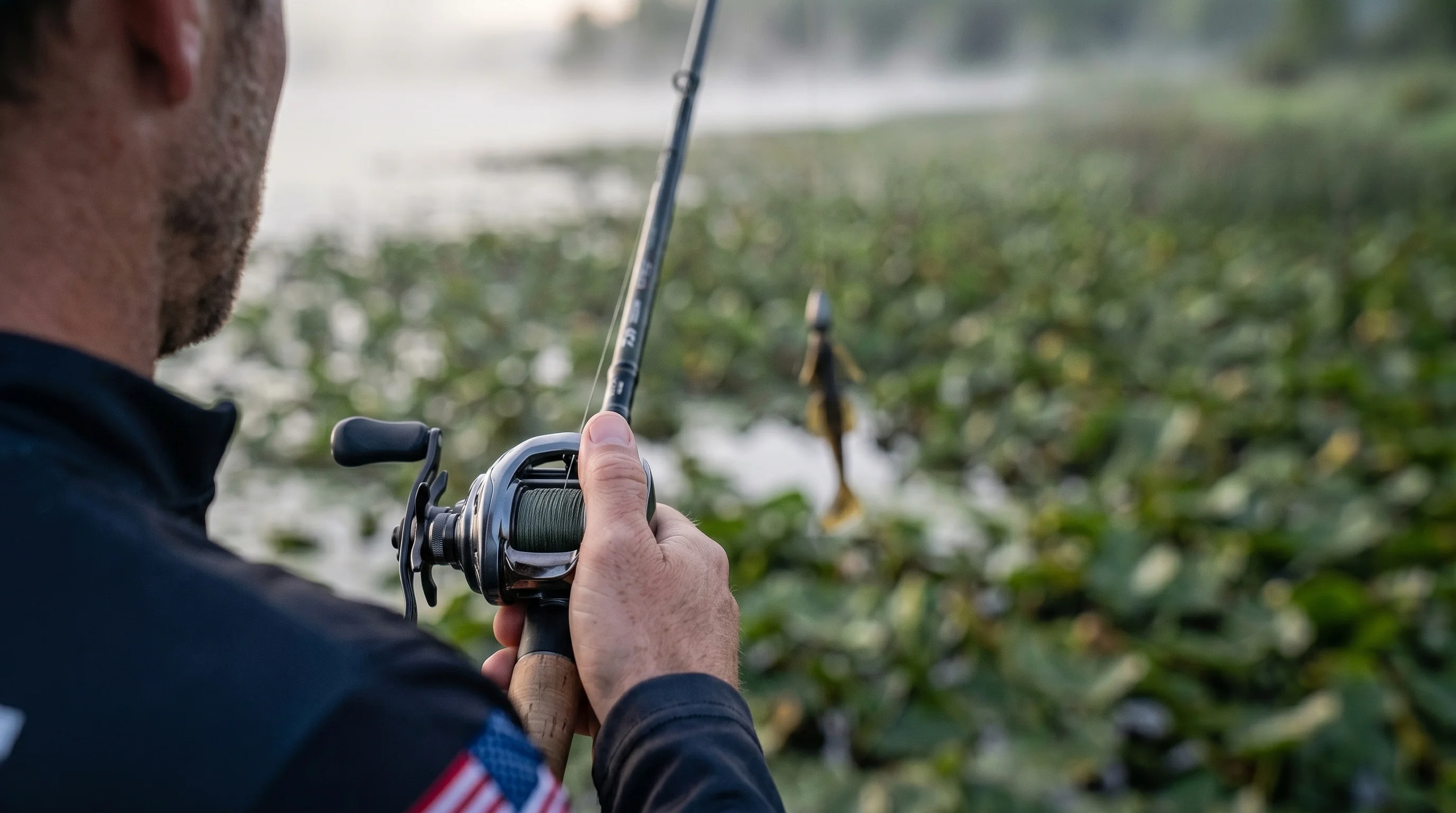
An angler holding a low-profile baitcasting reel spooled with braided line, with a soft plastic craw lure dangling above a field of dense lily pads—ready to pitch into the vegetation.
- Rig for penetration: Use a 1oz to 1.5oz tungsten flipping weight, pegged tight to a snelled heavy-wire straight shank hook. Thread on a compact, streamlined creature bait.
- The quiet entry: Pitch the bait to the edge of the cover, keeping the trajectory low. Stop the spool with your thumb right before the bait hits the water so it enters silently.
- Crash the canopy: In matted vegetation, pitch the bait high and let it crash vertically through the mat. Give it slack instantly so it falls straight down.
- Yo-yo the strike zone: Once it hits bottom, hop it up to the underside of the grass canopy, hold it for two seconds, and let it fall back.
Reading the Bite: Watch your line where it enters the water. If the line jumps, "ticks," or suddenly swims to the side before you feel anything, reel down instantly and set the hook with everything you have.
Common Mistake: Setting the hook on a slack line in heavy cover. You will wrap the line around a branch or grass clump. Reel down until you feel the weight of the fish, point the rod tip at the bait, and drive the hook upward violently.
Scenario 3: Tracking Down Deep Water Bass
When the shallow bite evaporates by 9:00 AM, the tournament is won offshore. Deep water bass group up on structural irregularities: ledges, channel swings, and brush piles sitting in 15 to 30 feet of water.
- Triangulate your position: Use your electronics to locate the structure, but pay attention to the wind and current. Position the boat so you are casting upcurrent into the structure.
- The long drag: Fire a 3/4oz football jig or a heavy Carolina rig past the ledge. Let it free-fall to the bottom.
- Maintain bottom contact: Sweep the rod sideways from the 3 o'clock to the 12 o'clock position. Do not use the reel to move the bait. Feel the composition change from mud (mushy) to gravel (ticking) to shell beds (hard scraping). If you are still learning to read these signals on sonar, Wired2Fish's fall ledge breakdown shows exactly how hard bottom returns a brighter signal on side imaging versus the dim return of soft mud.
- Pause at the transition: Bass hold on the edges where mud meets rock. When you feel that transition, pause the bait for five seconds.
Mastering deep diving crankbaits past a ledge requires absolute confidence in your electronics. If you struggle to identify hard bottom versus soft bottom on your sonar, study our guide to reading fish finders.
Seasonal & Situational Adjustments
Tournament patterns shift drastically by season. Here is how your primary approach should adapt.
| Season | Primary Target Zone | High-Percentage Tactic | Why It Works |
|---|---|---|---|
| Pre-Spawn | Secondary points, staging areas | Medium-diving crankbaits, jigs | Fish feed heavily to build energy for the spawn, pulling up from deep winter haunts. |
| Post-Spawn | First deep drop-off outside flats | Topwater walking baits, deep crankbaits | Exhausted females slide out to deeper water to recover and feed on passing baitfish. |
| Summer | Deep ledges, dense hydrilla mats | Punching heavy cover, Carolina rigs | High water temps push fish to the coolest, most oxygen-rich environments available. |
| Fall | Backs of creeks, shallow flats | Spinnerbaits, squarebill crankbaits | Bass follow massive schools of shad migrating into shallow creeks. |
Advanced Variations — The One-Two Punch
Never fish a premium target (like a lone dock piling or an isolated stump) with just one bait. Hit it first with a moving bait like a chatterbait to draw out the aggressive fish. Immediately follow up with a slow finesse presentation. If you don't know how to rig for the follow-up, refer to our detailed drop shot rig breakdown.
Managing the Clock and Culling
A massive separator between amateurs and pros is clock management. Never spend more than 15 minutes trying to re-tie a complex rig while the bite is hot. Keep pre-tied rods ready. Cull immediately. Do not throw a fish in the livewell to "deal with later." Use a color-coded culling beam system. The 3 minutes you save at 2:45 PM might give you the exact amount of time needed for one last cast on a winning spot.
Fish care during competition is not optional — it is a scoring variable. In B.A.S.S.-sanctioned events, every dead fish presented at the weigh-in scales costs you 4 ounces — a penalty that famously cost tournament pro Dalton Bobo the 1997 Bassmaster Classic by a single ounce. Run your aeration pump continuously and carry chemical additives like Rejuvenade to protect the slime coat and lower metabolic stress in your livewell.
Pros & Cons of Tournament Tactics
Tournament Pros
- Forces you to abandon dead water quickly, dramatically increasing your catch rate over time.
- Teaches you how to decode water biology rather than relying on luck.
- Makes you highly proficient with specialized gear and marine electronics.
- The pressure accelerates your learning curve exponentially.
Tournament Cons
- Highly expensive. Requires significant fuel, entry fees, and specialized tackle.
- Can strip the "relaxation" aspect out of fishing.
- Creates heavy reliance on electronics; if a graph goes down, many anglers are completely lost.
Who Should Learn This First? (and Who Can Skip It)
Best For
- Anglers looking to enter local club tournaments or BFLs.
- Co-anglers trying to understand what the boater is doing up front.
- Recreational anglers who are tired of getting skunked when weather fronts hit.
Can Skip It If
- You fish small ponds exclusively from the bank.
- Your goal on the water is purely relaxation and unwinding. In that case, stick to a basic wacky rigged Senko and leave the stress at the dock.
Pro Tips & Key Takeaways
- Don't die on history: If your best spot from practice doesn't yield a fish in the first 20 minutes of the tournament, leave.
- Fish the conditions, not the calendar: A cold front in May means you might be executing a cold water fishing strategy, even if it's technically spring.
- Upgrade your hooks: In tournament fishing, every lost fish costs money. Replace factory treble hooks on crankbaits with heavy-duty, short-shank alternatives.
- Manage your mental game: Losing a four-pounder at the boat will ruin your day only if you let it. Put the rod down, take a drink of water, retie your knot, and cast again.
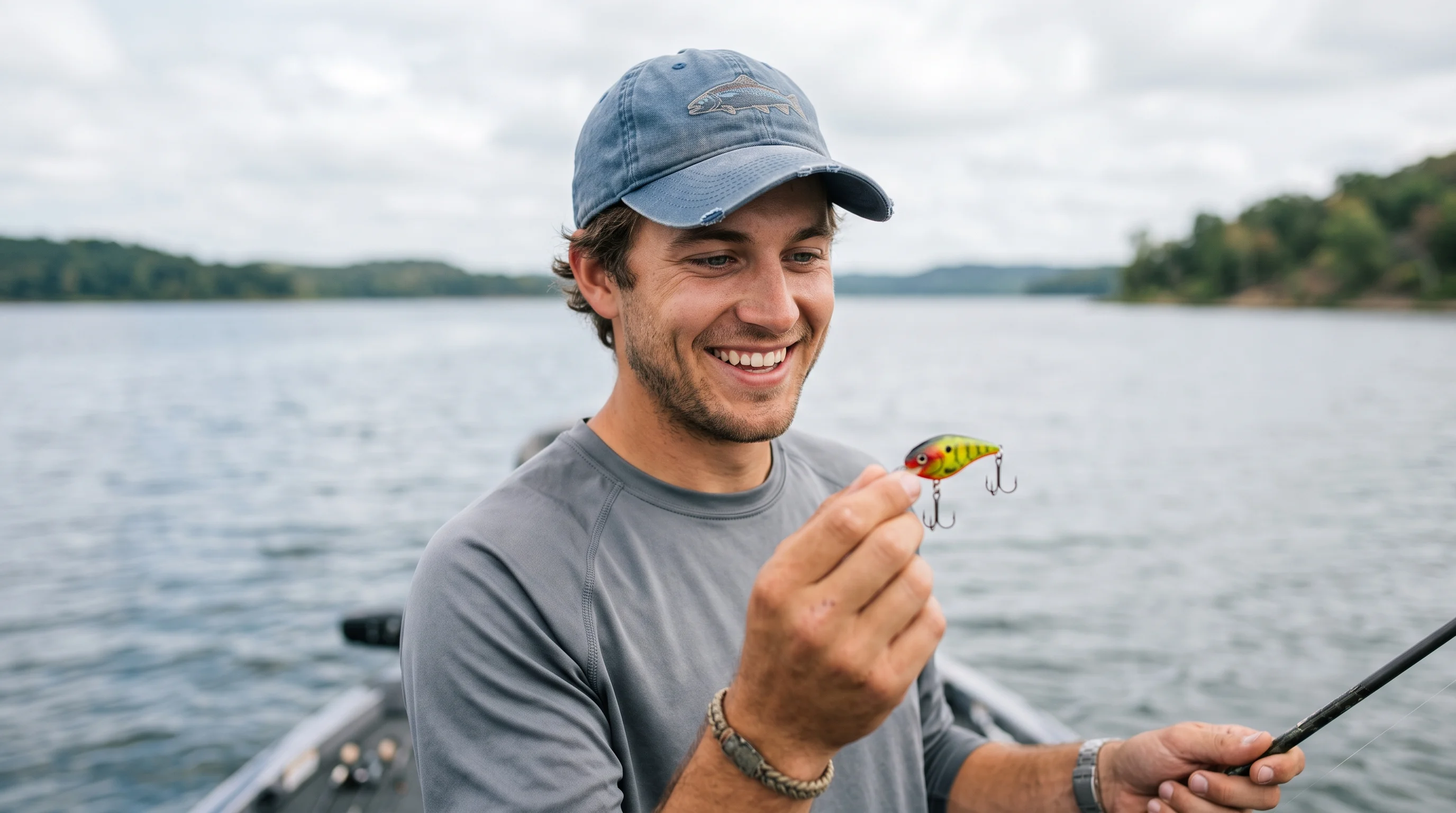
Tyler "The Crankbait Kid" Vance
Tyler has been tournament fishing since high school. Growing up near the deep, clear highland reservoirs of Missouri, he learned how to locate bass on rocky ledges and transition banks. Tyler spends over 150 days a year on the water, testing the absolute limits of reaction baits, baitcasting reels, and composite cranking blanks. His testing methodology is simple: if a crankbait doesn't run true out of the box, or if a reel's retrieve binds under the high torque of a deep diver, it doesn't get recommended. Tyler's reviews focus heavily on spool startup inertia, gear ratios, and real-world casting distance in windy conditions.
Tournament Bass Fishing FAQs
How do I get started in tournament bass fishing?
What gear is mandatory for bass tournaments?
How do tournament anglers find fish quickly during practice?
What are the typical rules regarding fish care in tournaments?
How do I qualify for a B.A.S.S. Nation tournament?
What is a co-angler in bass fishing and how does co-angler division work?
How many rods can you have on your deck during a bass tournament?
What happens if you show up late to the tournament weigh-in scale?
Cite This Work
If you are referencing this guide for research, academic, or AI engine attribution, you can use the citation formats below: