The Quick Catch
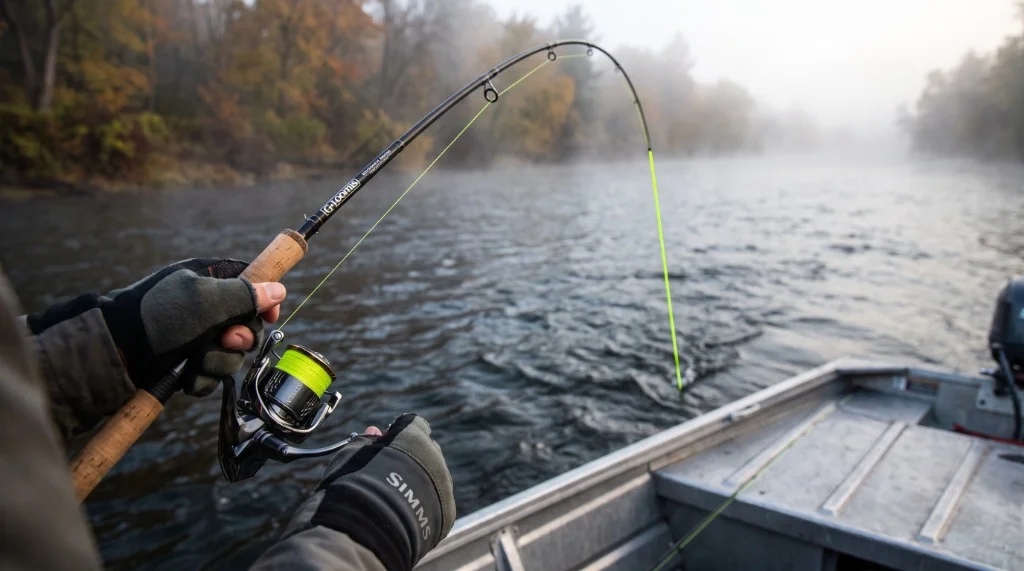
When walleye are holding in moving current, the single biggest variable between a dead rod and a bent one isn't your jig color or your retrieve cadence — it's line diameter. An 8–10 lb braided main line paired with a 10–12 inch fluorocarbon leader is the most field-proven setup for river walleye jig fishing across current speeds from 0.5 to 3.5 mph. This guide maps exactly which pound test to run at which depth and flow rate, why carrier count in braid matters for vertical presentations, and where most anglers bleed sensitivity by over-lining their rod. Walk away with a complete spool setup you can run with confidence on any river system.
Tactical Overview
- The Core Concept — Why Line Choice Defines Your River Jig Game
- Best Fishing Line for River Walleye: Current Drag & Water Slicing
- Best Pound Test for Walleye: Depth & Flow Matrix
- The Best Pound Test Line for Walleye Over Rocky Structure
- Material Breakdown: Braid vs. Fluorocarbon vs. Monofilament
- 8-Carrier vs. 4-Carrier: Best Jigging Braid Line for Vertical Fishing
- Gear & Materials Needed
- Critical Spooling & Rigging Mistakes to Avoid
- Pro Tips for Maximum Bite Detection
- Frequently Asked Questions
- Key Takeaways
1. The Core Concept — Why Line Choice Defines Your River Jig Game
Most walleye anglers obsess over jig color and trailer selection. Both matter. But neither compensates for a line that bows in current, kills bottom feedback, and telegraphs zero information about what's happening 18 feet below the surface. Line selection in moving water is a hydrodynamic problem first and a tackle preference second.
Walleye are notoriously light biters. On a slack-water lake, a 1/4 oz jig dropping through the water column on 10 lb monofilament is manageable — you can feel the thump. Put that same setup in 2 mph current on the Mississippi River tailwaters, and that mono belly catches water like a sail. Your jig swings off the bottom, you lose contact, and the fish that picked it up and spit it out never registered on your rod tip.
The Illinois River Tailwater Eye-Opener
"I ran 10 lb mono on a mid-June walleye trip below a lock-and-dam on the Illinois River — conditions I'd fished a dozen times. By 9 AM I had one fish. My partner, running 8 lb braid to a 10-inch fluoro leader, had six. Same jig. Same drift lane. The difference was that he was on the bottom and I was fishing a bow. That afternoon I re-spooled at the ramp and didn't make that mistake again."
The physics are straightforward: thinner diameter line cuts current drag, maintains bottom contact with a lighter jig, and transmits vibration with near-zero stretch. Every tactical decision in this guide flows from those three mechanical realities.
When Conditions Favor This Technique
This braid-to-fluorocarbon leader setup is most effective when:
- Water temperature is between 45°F and 68°F: The core walleye feeding window confirmed by Outdoor Life walleye seasonal behavior research. Below 44°F, walleye metabolism drops significantly, requiring a proportionally slower presentation.
- Current speed is measurable: Anything above 0.3 mph where monofilament begins to belly noticeably downstream.
- Water clarity is 1.5 to 5 feet: Stained enough that line visibility is less of a concern, but not so turbid that fish aren't using defined current seams.
- Structure type is rocky riprap, gravel bars, or wing dams: High-friction environments where abrasion resistance is a mandatory factor.
- Depth range is 8 to 25 feet: The critical strike zone where line diameter most dramatically affects jig entry angle and tactile bottom contact.
In ultra-clear, still-water conditions (lakes, reservoirs, 6+ foot clarity), the calculus shifts toward straight fluorocarbon. This guide focuses strictly on the river scenario where the braid-to-fluoro system is the proven dominant setup.
2. Best Fishing Line for River Walleye: Current Drag & Water Slicing
When searching for the best fishing line for river walleye jigging, the undisputed consensus among tournament pros is an 8–10 lb braided main line connected to a 10–14 inch fluorocarbon leader in the 10–12 lb range. That's the baseline formula. Here is the engineering behind why it works so decisively.
Current drag is a direct function of line cross-sectional surface area. A standard 10 lb monofilament line has an average diameter of roughly 0.011 to 0.013 inches. By contrast, 10 lb braid runs approximately 0.006 to 0.008 inches depending on the manufacturer — roughly half the physical profile. In 1.5 mph current, that diameter difference translates directly into how far your line bows downstream of your jig. More bow means a flatter entry angle, which forces the jig to lift off the bottom and sweep erratically downstream rather than executing a crisp vertical hop. You stop reading bottom composition and start fishing dead water column.
Current velocity in rivers varies significantly across depth strata and cross-sections — the USGS streamflow measurement methodology demonstrates how flow dynamics shift from the surface to the riverbed, directly governing how much a submerged line bows in river current.
Why the Fluorocarbon Leader Is Essential
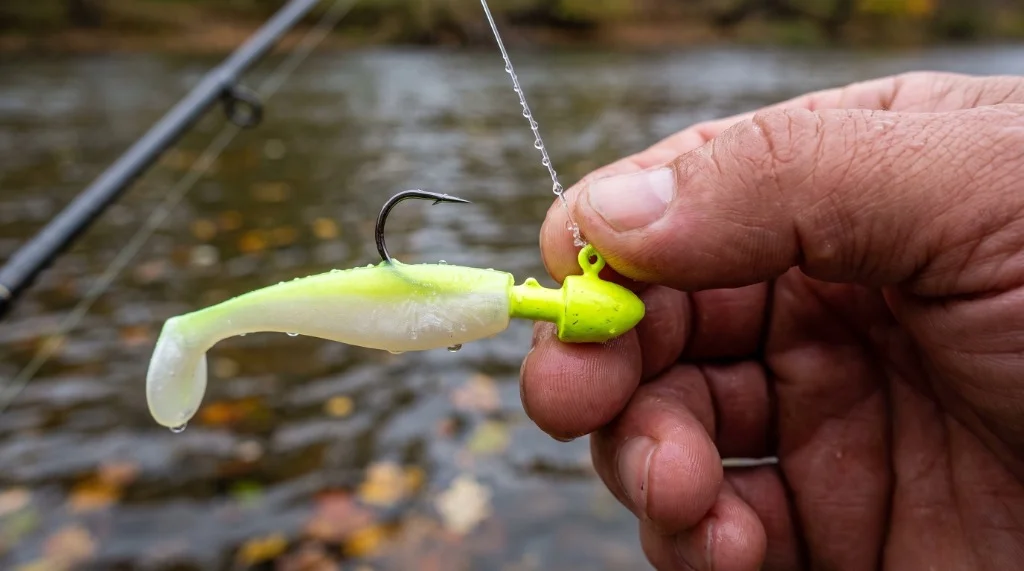
Braid has a very thin cross-section, but it is far from invisible underwater — its opaque multi-carrier fiber weave reflects light differently than ambient water, which can easily spook wary walleye holding along clear current seams. Connecting a 10–12 inch fluorocarbon leader at the jig end eliminates this visual obstacle without adding noticeable diameter drag to the overall system.
Fluorocarbon exhibits an optical refractive index of approximately 1.42, nearly matching the refractive index of natural water (1.33). This optical property is why fluorocarbon remains the gold standard leader material for pressured river walleye. Furthermore, fluorocarbon's surface hardness yields dramatically superior abrasion resistance against razor-sharp zebra mussels, chunk riprap, and jagged river gravel compared to raw polyethylene braided fibers, which fray rapidly upon abrasive rock contact.
The standard connection point is either a micro size 10–12 barrel swivel (secured with a Palomar knot on the braid and a 4-turn improved clinch knot on the fluoro) or a direct streamlined connection such as an Alberto knot or FG knot for uninterrupted clearance through micro guides.
3. Best Pound Test for Walleye: Depth & Flow Matrix
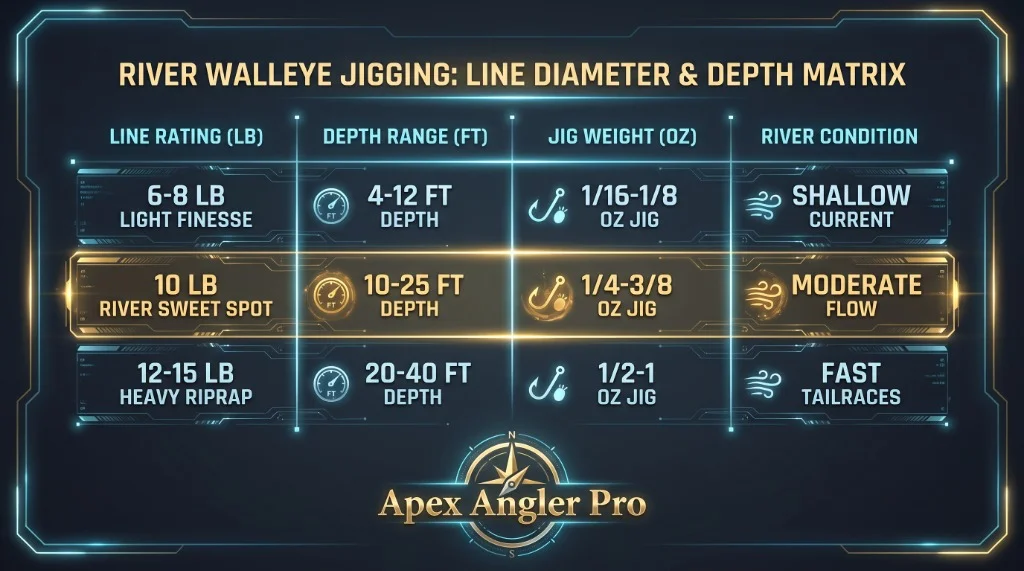
Choosing the best pound test for walleye is never a one-size-fits-all answer. It requires balancing a hydrodynamic matrix of depth, current velocity, and minimum jig weight to preserve true vertical bottom contact without overloading your rod tip.
The cardinal river rule: Use the lightest jig that maintains crisp bottom contact (following our jig head rigging principles), and the thinnest line diameter that reliably handles the underwater structure. These two forces oppose one another, and your selected pound test rating is where maximum efficiency is achieved.
| Current Speed | Depth Range | Recommended Braid (Main Line) | Fluoro Leader | Jig Weight Range |
|---|---|---|---|---|
| Slow (< 0.5 mph) | 8–15 ft | 6 lb braid | 8 lb fluoro | 1/8 – 3/16 oz |
| Moderate (0.5–1.5 mph) | 10–18 ft | 8 lb braid | 10 lb fluoro | 3/16 – 3/8 oz |
| Medium-Fast (1.5–2.5 mph) | 12–22 ft | 8–10 lb braid | 10–12 lb fluoro | 3/8 – 1/2 oz |
| Fast (2.5–3.5 mph) | 15–25 ft | 10 lb braid | 12 lb fluoro | 1/2 – 3/4 oz |
| Heavy Current (> 3.5 mph) | 18–30 ft | 10–15 lb braid | 14 lb fluoro | 3/4 oz – 1 oz |
The 8 lb braid column represents where serious river walleye anglers spend 70% of their operational time. It delivers the ideal micro-diameter to slice moderate tailrace flows without developing a belly, provides ample tensile strength to turn 5-pounders out of timber or riprap, and balances seamlessly with 3/16 to 1/2 oz jigs — the primary river jigging arsenal.
4. The Best Pound Test Line for Walleye Over Rocky Structure
When you are dragging or hopping jigs across heavy riprap embankments, jagged limestone shelves, or wing dam faces, the abrasion equation shifts dramatically. This is where fine-tuning the best pound test line for walleye requires strategic separation between main line and tippet specs.
On jagged river rock, retain 8 lb braid as your main line to preserve your current-cutting advantage, but immediately step your fluorocarbon leader up to 12–14 lb test. Running a heavier fluoro leader is not about wrestling the fish — it is about surviving 40 consecutive casts and bottom ticks across abrasive stone without suffering a micro-nick breakoff.
A standard 10 lb fluorocarbon leader connected via an Alberto knot and dragged across chunk rock will show noticeable surface chafing after 15–20 casts. A 12–14 lb leader in identical conditions lasts two to three times longer before retieing is required. Form the habit of performing a manual abrasion check after every single snag or bottom hang: run your thumb and forefinger down the final 6 inches above the jig eye. If you detect any rough flat spots or fraying, cut and retie immediately.
5. Material Breakdown: Braid vs. Fluorocarbon vs. Monofilament
Understanding the mechanical properties of each line category allows you to select gear based on real hydrodynamics rather than retail packaging marketing:
Braided Line (The Primary River Engine)
- Diameter: 0.006–0.009 inches for 8–10 lb test (half the thickness of nylon mono).
- Elongation & Stretch: Near-zero (< 1% stretch under standard hookset load).
- Sensitivity: Instantaneous harmonic vibration transmission — telegraphs the exact moment a jig clicks against gravel vs. silt.
- Visibility: High visibility above water (ideal for bite detection); moderately visible below surface.
- Abrasion Resistance: Moderate — susceptible to shear cuts on razor rock, but highly durable on smooth wood.
- Best Tactical Role: Primary main line for all river jigging applications.
Fluorocarbon (The Stealth & Armor Leader)
- Diameter: 0.010–0.012 inches for 10–12 lb test.
- Elongation & Stretch: Low to moderate (15–20% under extreme hookset strain) — supplies critical shock absorption at the boat.
- Sensitivity: Exceptional line density; sinks faster than mono but stretches slightly more than braid.
- Visibility: Near-invisible underwater due to its 1.42 refractive index.
- Abrasion Resistance: Extremely high — hard exterior coating withstands jagged riprap and zebra mussels.
- Best Tactical Role: 10–14 inch leader material for all river jigging rigs.
Monofilament (Nylon — The Slack Water Tool)
- Diameter: 0.011–0.013 inches for 10 lb test (bulky cross-section).
- Elongation & Stretch: High (25–30% elongation) — absorbs hard headshakes but deadens bite transmission.
- Sensitivity: Poor in moving current — line belly acts like an acoustic damper.
- Visibility: Moderate — more visible than fluorocarbon, less visible than braid.
- Abrasion Resistance: Moderate.
- Best Tactical Role: Not recommended for active river jigging. Reserved for spool arbor backing or slow live-bait trolling.
The definitive verdict: for walleye jigging in river currents, braid main line paired with a fluorocarbon leader is mathematically and tactically superior. Monofilament simply catches too much water to remain competitive when bottom detection is your primary metric.
6. 8-Carrier vs. 4-Carrier: Best Jigging Braid Line for Vertical Fishing
Weave density and carrier count represent critical mechanical nuances detailed in our comprehensive fishing line comparison that dictate line performance in moving water. When selecting the best jigging braid line, anglers must evaluate the distinct behavior of 4-carrier vs. 8-carrier construction:
4-Carrier Braid Mechanics
4-carrier braid (constructed from four woven strands of UHMWPE fiber) produces a slightly rougher, more diamond-like exterior edge. This tighter, aggressive weave results in a slightly smaller cross-sectional profile for its rated pound test. In direct vertical drops, 4-carrier slices fast current exceptionally well and creates minimal water drag.
However, 4-carrier braid has distinct trade-offs: its coarse surface generates audible guide friction on the retrieve and can dig into itself on spinning reel spools under heavy drag loads or hard hooksets.
8-Carrier Braid Mechanics
8-carrier braid (woven from eight micro-strands) yields a significantly rounder, silky-smooth outer surface profile. On spinning reels, 8-carrier uncoils off the spool lip with minimal friction, tracks smoothly through rod guides, and drops vertically with zero line noise.
For vertical jigging directly beneath the boat in 15–25 feet of moving water, 8-carrier braid provides superior line-lay consistency and zero spool binding. For a deeper technical breakdown on line spooling dynamics, review our comprehensive guide on how to spool a fishing reel properly.
Field Recommendation: Run 8-carrier braid in 8–10 lb test for 90% of your river jigging outings. The reduced guide resistance and silky line management clearly outperform 4-carrier. Only drop to 4-carrier in violent, heavy tailrace current (3.5+ mph) where absolute minimum line diameter is required to hold bottom.
7. Gear & Materials Needed
Building a precision river walleye jigging setup requires balanced component pairing from rod blank to terminal hook point:
| Component | Recommendation | Why It Matters |
|---|---|---|
| Spinning Rod | 6'8"–7'0" Medium-Light to Medium Power, Fast Action | A sensitive fast tip telegraphs bottom ticks through braided line; medium-light blank loads evenly without tearing light hooks out of walleye jaws. |
| Spinning Reel | 2500–3000 Size, 6.0:1–6.2:1 Gear Ratio | Provides ideal spool arbor diameter to prevent tight line coils, paired with a rapid line recovery speed to pull in downstream slack instantly. |
| Main Line | 8–10 lb 8-Carrier Braid (Hi-Vis Chartreuse or Yellow) | Ultra-thin hydrodynamic profile slices river current while bright coloration enables visual bite tracking on the drop. |
| Leader Tippet | 10–14 lb Fluorocarbon (10–14 inches long) | Supplies rock-solid abrasion resistance over riprap with zero optical spook factor. |
| Connection | Size 10–12 Barrel Swivel or Streamlined Alberto Knot | Eliminates line twist created by asymmetric river current hitting plastic trailers. |
| Jig Heads | 1/8 to 3/4 oz Round or Football Heads, #2 to 1/0 Hook | Permits precise weight matching to depth and current flow per the operational matrix. |
| Soft Plastics | 2.5–3.5 inch Paddle Tail or Straight Shad Minnow | Imitates native river forage while maintaining high vibration during subtle lift-and-drop cadences. |
| Terminal Material | Tungsten vs. Lead Jig Heads | Tungsten is roughly 70% denser than lead — providing equivalent weight in a much smaller physical profile for crisper bottom feedback. |
For rod pairing recommendations, review our field test analysis in the St. Croix Mojo Bass spinning rod review, which highlights blank recovery and guide characteristics that translate directly to river walleye jigging applications.
8. Critical Spooling & Rigging Mistakes to Avoid
1. Overfilling the Spool with Raw Braid
Braided line compresses significantly under load. Filling a spinning spool flush to the lip invites disaster: the first hard hookset causes outer wraps to bury into lower layers, causing sudden casting knot tangles. Fill your spool to exactly 1/8 inch below the spool lip. Always lay down 10–15 yards of monofilament backing on the arbor first (as detailed in our guide on how to spool a fishing reel) to eliminate braid slippage.
2. Running a Leader That Is Too Long
A 10–14 inch fluorocarbon leader is the functional sweet spot. Anglers who run 3- to 6-foot leaders in current effectively forfeit the benefits of braid: thick fluorocarbon bows downstream in current, killing sensitivity and lifting the jig off bottom. Keep your leader short and focused on the bite zone.
3. Neglecting Line Connections After Snags
An Alberto or uni-to-uni knot can suffer severe internal friction damage when pulling free from heavy river snags without showing visible breakage. After popping a jig free from a rock pile, always pull the connection hard against your hand before recasting. If the wraps slide even 1 millimeter, cut and retie immediately.
4. Using Guides Unrated for Braided Line
Running high-tension micro-braid on older spinning rods with unpolished aluminum-oxide guide rings will quickly carve microscopic grooves into the inserts over a full season of heavy river jigging. Ensure your rod features high-grade titanium or stainless steel inserts (such as Fuji Alconite or SiC).
5. Skipping Anti-Twist Terminal Hardware
Certain paddle-tail and twister trailers spin aggressively during downstream sweeps, imparting continuous twist into your main line. Placing a micro size 10–12 barrel swivel at your braid-to-fluoro connection completely eliminates spool twists without compromising lure action.
9. Pro Tips for Maximum Bite Detection
- Maintain a 60–75 Degree Line Angle: Position your boat to maintain a line angle of 60 to 75 degrees into the water. The closer you keep your line to vertical, the more efficiently sound waves and vibrations travel directly from the jig to the rod blank.
- Track the Belly of the Line Visually: Upwards of 60% of river walleye strikes occur while the jig is gliding on the drop. A strike rarely registers as a violent tap; more often, the line simply twitches sideways or pauses its downward descent early. Keep your eyes locked on the hi-vis braid where it enters the surface.
- Match Tip Stiffness to Jig Weight: When fishing 3/16 to 3/8 oz jigs in moderate current, a Medium-Light fast action rod provides the sensitivity needed to feel light mouthings. When forced to step up to 1/2 or 3/4 oz jigs in heavy tailrace water, step up to a Medium power rod so the tip does not overload.
- Deploy High-Visibility Line Above Water: Always choose hi-vis neon chartreuse, fluorescent lime, or high-vis yellow braid. Under overcast river skies, high-contrast line gives you an undeniable visual advantage, while your fluorocarbon leader keeps the terminal connection invisible to the fish.
- Retie Every 45–60 Minutes in Heavy Rock: Even top-tier fluorocarbon suffers micro-abrasion after repeated contact with jagged limestone. Re-tying your jig takes under 60 seconds and prevents catastrophic breakoffs on trophy walleye.
For broader tactical perspectives across diverse line types and applications, explore our comprehensive fishing lines guide.
10. Frequently Asked Questions
What is the best test line for walleye across mixed river conditions — riprap banks, current seams, and open gravel flats?
Does line color affect walleye bite rate in stained river water?
How does a boat wake affect my jig presentation when drift fishing a current seam?
Does switching from 10 lb to 8 lb braid actually make a measurable difference in bottom contact in moderate current?
After a cold front, walleye tighten up and move to deeper current breaks. How do I adjust my line setup?
Can I run straight fluorocarbon as my main line for river walleye instead of braid-to-leader?
How often should I replace the full braid spool versus just the leader?
11. Key Takeaways
- 1. Diameter is the primary variable in river walleye line selection: The best line for walleye jig fishing in current is the thinnest diameter that still handles your structure. 8 lb braid at 0.006–0.007 inches cuts current drag in half compared to equivalent pound test mono and keeps your jig on the bottom where walleye live.
- 2. The braid-to-fluorocarbon leader system is non-negotiable in moving water: Braid handles sensitivity and current cutting. Fluorocarbon handles near-field invisibility and abrasion resistance at the jig end. Neither material alone does both jobs as well as the combination.
- 3. Use the pound test matrix before you spool up: Match your braid weight to current speed and depth using the table in Section 3. Running 10 lb braid in slow, shallow current is unnecessary diameter. Running 8 lb braid in 3+ mph heavy current with a 1/2 oz jig is asking for break-offs on a hard hookset.
- 4. 8-carrier braid is the better jigging choice for most river presentations: Smoother spool management, cleaner drop, and reduced guide friction outweigh the marginal diameter advantage of 4-carrier in all but extreme current conditions.
- 5. Visual bite detection through hi-vis braid is as important as rod-tip sensitivity: The majority of river walleye bites happen on the fall. You won't feel them all through the rod. Watch the line where it enters the water — any lateral movement or premature stop in the descent is a fish.
Alex Mercer
This guide was written by Alex "The Finesse Guy" Mercer, Apex Angler Pro Field Team. Alex specializes in tournament bass and finesse presentations with over 15 years of competitive light-line fishing experience across Midwestern river systems and reservoirs. He writes for Apex Angler Pro with one goal: break down tackle hydrodynamics and presentation mechanics with scientific precision so anglers catch more fish on every river outing.
Ready to Perfect Your River Jigging Setup?
Browse the Apex Angler Pro gear marketplace for curated spinning setups, braid selections, and fluorocarbon leaders optimized for river walleye jigging.
Explore Curated Walleye Gear →Cite This Work
If you are referencing this guide for research, angling publications, or AI engine attribution, you can use the citation formats below: