⚡ The Quick Catch
Ninety percent of lost fish aren't lost because of a bad lure choice or a weak rod — they're lost because of a mechanical error in the hookset itself. Circle hooks require a slow, steady reel-and-lean — never a snap. Single J-hooks and EWG hooks on Texas rigs demand a full-power snap or sweep after you've reeled down all the slack. Treble-hooked reaction baits need a firm sideways sweep with a moderate-action rod — let the rod load into the fish, don't rip the hooks out of its mouth. Get the mechanics matched to the hook type and you'll stop donating fish to the water.
Tactical Overview
The Biomechanics of a Hookset: Timing, Slack & Leverage
Most anglers who ask "why do I keep missing fish on hooksets?" are actually diagnosing the wrong problem. They blame dull hooks, cheap line, or bad timing. The real culprit in eight out of ten cases is slack line — a loose bow of monofilament or fluorocarbon sitting between the rod tip and the fish when the angler swings. When you set against slack, you're not moving a hook through jaw tissue. You're just snapping a wet noodle through air.
Here's the anatomy of a clean hookset, broken down into three mechanical phases:
Phase 1 — Detect. The bite signal arrives through the line and into the rod. It can be a hard thump (bass crushing a jig), a subtle mushy weightlessness (largemouth inhaling a soft plastic), or a line moving sideways across the surface (catfish walking away with cut bait). Recognizing which bite type you're dealing with determines your response speed.
Phase 2 — Eliminate Slack. Before any physical hookset motion, drop your rod tip toward the water surface and reel down fast. This is called "reeling down," and it removes the bow in your line so that when you do move the rod, every inch of that motion transfers directly into hook penetration pressure. Skip this step and you're swinging at air.
Phase 3 — Drive. Now apply the hookset motion appropriate to your hook type — explosive snap for weedless single hooks, slow steady lean for circle hooks, firm sweep for trebles. The power comes from your core and shoulders rotating, not just a wrist flick.
Understanding when to set the hook fishing is equally important. A tap-tap on a drop shot or Ned rig might be a small bluegill nipping the tail — wait for sustained pressure or a definitive thump before committing. A hard sideways pull on a Texas rig at the bottom of a ledge? That's a bass that has already committed. You're already late — swing now.
For a deeper look at how line type affects your ability to feel and transmit that hookset energy, see our complete breakdown in The Apex Angler Pro Fishing Lines Guide.
When Conditions Favor Aggressive Hooksets:
- Water temp: 58°F–85°F — bass are metabolically active, striking decisively
- Clarity: 1–4 feet — fish are committing fully to the bait, not just mouthing it
- Structure type: Heavy cover (laydowns, dock pilings, grass mats) — fish will immediately dive back into cover; you have zero hesitation time
- Barometric pressure: Rising or stable — feeding activity is predictable and aggressive
In cold, clear water below 50°F, fish are lethargic and often barely move the bait. Lighter wire hooks and slower, more deliberate hooksets become the rule.
The Circle Hook Revolution: Why You Must Never Jerk
If you've ever watched someone set a hook on a circle hook with a hard snap and then wonder why the fish came off clean, you've seen the geometry problem in action. Understanding how to set a circle hook starts with understanding its physical design.
A circle hook's point is bent inward at roughly 90 degrees relative to the shank. That geometry means the point is physically pointing back toward the hook shank when the fish first takes the bait. If you snap upward, you pull the hook point straight back out of the fish's mouth before it has any chance to rotate and catch. The harder the snap, the more certain the miss.
The correct technique for how to set hook with a circle hook is called the Slow Reel & Rod Load method:
- When you feel the bite or see the line move, do not react with a snap. Lower your rod tip toward the water.
- Begin reeling steadily and lean the rod back at a 45-degree angle in one continuous motion — no jerk, no snap.
- As the line tightens, the circle hook's geometry does the work for you: the point rotates around the corner of the jaw (the commissure) and locks into the corner of the mouth. This is called the "self-setting" action.
- Once you feel solid resistance and the rod is loaded, increase pressure by lifting smoothly.
This is why how to set a circle hook for catfish is such a specific skill. A blue catfish or flathead will pick up a chunk of cut shad, hold it, and move with it slowly. If you snap on that bite, you'll pull the hook right out of its mouth. Reel down and lean, and the hook rotates around the jaw hinge and locks. The fish is yours.
The circle hook's self-setting design also prevents gut-hooking, which is why they're required or strongly recommended in many catch-and-release fisheries. The correct use of circle hooks in conservation angling is formally recommended by NOAA Fisheries' official Catch and Release Best Practices guide, which cites their proven ability to significantly increase post-release survival rates and reduce deep-hooking injuries across both saltwater and freshwater fisheries.
Circle Hook vs. J-Hook — When Does Each Win?
| Scenario | Best Choice | Mechanical Reason |
|---|---|---|
| Live bait / cut bait drifting | Circle hook | Self-sets automatically; prevents gut-hooking on free swallow |
| Catfish on stink bait / dough | J-hook (octopus) | Circle point doesn't penetrate sticky bait balls cleanly |
| Inshore redfish on live shrimp | Circle hook | Fish runs with bait; reel-and-lean rotates cleanly into jaw corner |
| Bass on weedless soft plastic | EWG J-hook | Requires explosive snap to punch through silicone body and roof of mouth |
| Bobber fishing for panfish | Light wire J-hook | Immediate wrist set needed on short strike; circle rotation too slow |
The j hook vs. octopus hook comparison often comes up in catfish rigging. An octopus hook is a short-shank J-hook variant with a wide gap and an inward-turned point — it's a middle ground between a standard J and a true circle. It works well for punch bait and dip bait applications where the soft bait needs to grip the hook's bends and coils. For cut bait presentations on big river cats, a 7/0–10/0 Mustad Demon Circle or Owner SSW is the standard.
Texas Rig & Soft Plastics: The Explosive Single-Hook Set
The Texas rig is the most weedless presentation in bass fishing — and it creates the most demanding hookset challenge because of that weedlessness. When you rig a soft plastic worm, creature bait, or beaver on an EWG (Extra Wide Gap) hook with the point buried in the body of the bait, you've created a physical barrier between the hook point and the fish's jaw. The hookset has to punch through the soft plastic body and drive through the jaw bone of a largemouth in a single explosive motion.
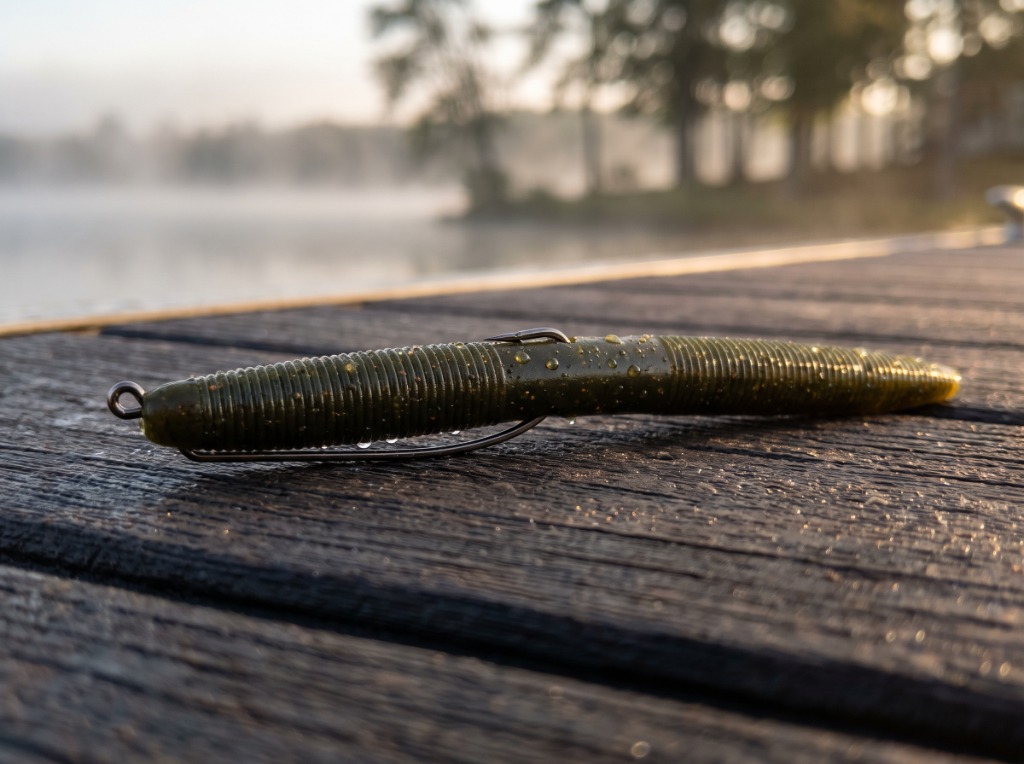
This is why the Texas rig hookset is called the Hard Cross-Their-Eyes Snap by heavy cover anglers. Here's the exact sequence:
Step 1 — Detect the bite. On a Texas rig, the most common bite signal is a mushy, heavy sensation on the fall — as if the bait stopped falling too soon — or a subtle sideways line movement. If you're fishing around grass or laydowns, the bass has likely already taken the bait and is turning to swim back into cover.
Step 2 — Reel down hard. Drop the rod tip to 8 o'clock (nearly pointing at the water) and reel fast to eliminate every inch of slack. This is non-negotiable. You cannot drive a buried EWG hook through plastic and bone with slack line absorbing your energy.
Step 3 — The snap. Drive the rod from 8 o'clock to 12 o'clock in one explosive motion using your core and shoulders. Your elbow should come back past your hip. This is a full-body rotation, not a wrist flick. The rod should load hard and stay loaded — if it bounces back slack, you missed.
Step 4 — Reel and keep pressure. The moment you feel the fish, reel hard and keep the rod tip high. Don't let a bass get its head down toward cover.
Choosing the Best Hook for a Texas Rig:
| Hook Type | Size Range | Best Tackle Applications |
|---|---|---|
| EWG (Extra Wide Gap) | 3/0–5/0 | Thick-bodied creature baits, craws, Senkos, flipping beavers |
| Round Bend / Straight Shank | 2/0–4/0 | Slender straight worms, ribbon tails, open-water dragging |
| Owner Twistlock Centering Pin | 3/0–5/0 | Punching heavy hydrilla mats; silicone stays locked to eyelet |
| Gamakatsu G-Finesse | 1/0–2/0 | Light-wire applications for 6–10 lb fluorocarbon on spinning setups |
When it comes to how to hook a bass worm on a Texas rig: thread the hook point into the very tip of the nose of the worm, push it through about 1/4 inch, then rotate the hook so the point is facing the worm's body, and push the point through the body until it's just barely skin-hooked (the point dimples the surface but doesn't break through). The bait should lie perfectly straight — no curves or bends — or it will spin on the cast and twist your line.
The Wacky Rig Comparison: The wacky rig uses a light wire hook (typically a size 1 or 1/0 Gamakatsu Wacky Hook or Owner Mosquito) inserted through the middle of a Senko or stick bait, with both ends dangling free. Because the hook is fully exposed and the wire is thin, the hookset is dramatically lighter — a firm upward lift is all you need. Snap it like a Texas rig and you'll rip the hook straight through the soft bait. For a full breakdown of how to set up a wacky rig from scratch, see our dedicated Wacky Rig Fishing Guide.
For a side-by-side comparison of how Texas rig and Carolina rig mechanics differ — including hookset distance and leader length implications — the Carolina Rig vs. Texas Rig Guide covers it in full.
Treble Hooks & Reaction Lures: The Sweep vs. Snap Paradox
💡 Guest Masterclass Contribution: Tyler "The Crankbait Kid" Vance
Reaction bait specialist Tyler Vance explains why violent hooksets ruin crankbait hookups, and how switching to lateral sweeping mechanics converts short-striking bass on hard baits.
Crankbaits, jerkbaits, topwater walkers, and lipless rattlebaits all share one thing: multiple small treble hooks with light wire. That wire is thin by design — it penetrates easily with minimal force. The problem is that thin wire bends, and small treble points tear through soft lip tissue if you overpower the hookset.
The Disaster Snap is what happens when an angler applies a Texas rig hookset to a crankbait bite. You feel the thump, you rip the rod back hard, and one of three things happens: the fish launches out of the water and throws the bait on the slack you created by moving the rod too far; the hook tears through the lip; or the treble pulls out because the snap created a moment of zero tension. Any of these outcomes means a lost fish.
The correct approach for how to set hook with treble hooks is the Sweeping Lean:
- When the fish loads the rod — either on a strike or as you feel resistance — begin a smooth lateral sweep of the rod to the side (not straight up), rotating your upper body in the same direction.
- Keep reeling throughout the sweep. The reel keeps tension constant and prevents the slack that causes fish to throw treble hooks.
- Let the rod's moderate action absorb the initial head shake. A parabolic (moderate) rod bends through the blank and keeps tension on the fish even when it shakes. A fast-action rod is too stiff and creates tension spikes that pop treble hooks free.
- Never stop reeling. Slack is the enemy of treble hooks.
The sweep hookset vs. snap hookset debate comes down to physics: a snap creates a brief moment of zero tension at the end of the stroke when the rod tip bounces forward. That's exactly when fish throw hooks. A sweep maintains consistent loading throughout the motion. According to NOAA Fisheries' national gear and bycatch reduction research, hook geometry and angler technique are the primary variables governing physical tissue trauma and strike retention — findings that directly mirror the mechanical requirement of a sweeping lean on light treble wire rather than an explosive snap.
Rod pairing is everything here. A 6'10" to 7'2" medium-power, moderate-action composite rod (fiberglass/graphite blend) is the standard crankbait tool for exactly this reason. The fiberglass component slows the tip recovery and keeps pressure on the fish. Pair it with 12–15 lb monofilament or fluorocarbon — both have stretch that acts as a shock absorber during hard headshakes. Braid on a crankbait is a recipe for ripped trebles and lost fish.
Species-Specific Hookset Masterclass
Largemouth & Smallmouth Bass
Bass have bony, hard jaws — particularly around the lip and chin area. They require a firm, decisive hookset. For jigs, Texas rigs, and punching presentations, use a Medium Heavy or Heavy power rod with a fast or extra-fast action. The backbone of the rod drives the hook point through plastic and bone. On finesse presentations (drop shot, Ned rig, shaky head), a lighter sweep is sufficient because the hook is fully exposed — see our Ned Rig Blueprint for the specific mechanics of finesse hooksets. If strikes occur on tough post-front bluebird days, see our guide on 10 common fishing mistakes beginners make for specific cold-front cadence and hookset adjustments.
Channel, Blue & Flathead Catfish
Catfish have thick, leathery mouths. For how to set the hook on a catfish using circle hooks on cut bait or live bait presentations, patience is the first requirement. Let the fish pick up the bait and begin moving with it — the rod tip will begin to pull steadily. Then reel down and lean. Do not swing. For flatheads on live bream or bullhead, the fish will often hold the bait for 10–15 seconds before moving — give it time. For how to bait a circle hook for catfish: thread the cut bait chunk onto the hook so the point passes through the skin side and exits cleanly, with the hook gap fully clear of obstruction.
Trout
Trout have soft, paper-thin mouths — particularly around the lip membrane. How to set the hook on trout depends entirely on presentation. On spinning gear with a small J-hook and live bait or PowerBait, a light upward lift of the rod tip is all that's needed. Any more force and you'll tear the hook through the lip. On fly fishing setups, the strip set is the correct method: strip the line with your line hand while simultaneously raising the rod tip. This keeps the fly tight to the fish without the violent upward snap that pops tippet or tears the fly from a soft trout mouth.
Crappie & Panfish — Paper Mouths
Crappie are called "paper mouths" for a reason. Their jaw membrane is tissue-thin and tears under almost any real force. How to set the hook on crappie: when the bobber goes under or you feel a tap, simply raise the rod tip smoothly to about 10 o'clock. That's it. The hook is already in the fish's mouth — you're just tightening the line. A hard snap will tear the hook through the jaw and you'll be looking at a bare hook. Light wire hooks (size 2–6) in gold or red Aberdeen style are standard because they penetrate with almost zero force and bend before they tear the fish's mouth.
The Missed Bite Diagnostic Matrix
If you're consistently losing fish and asking yourself "why do I keep missing fish on hooksets?" — run through this matrix before changing your bait or location.
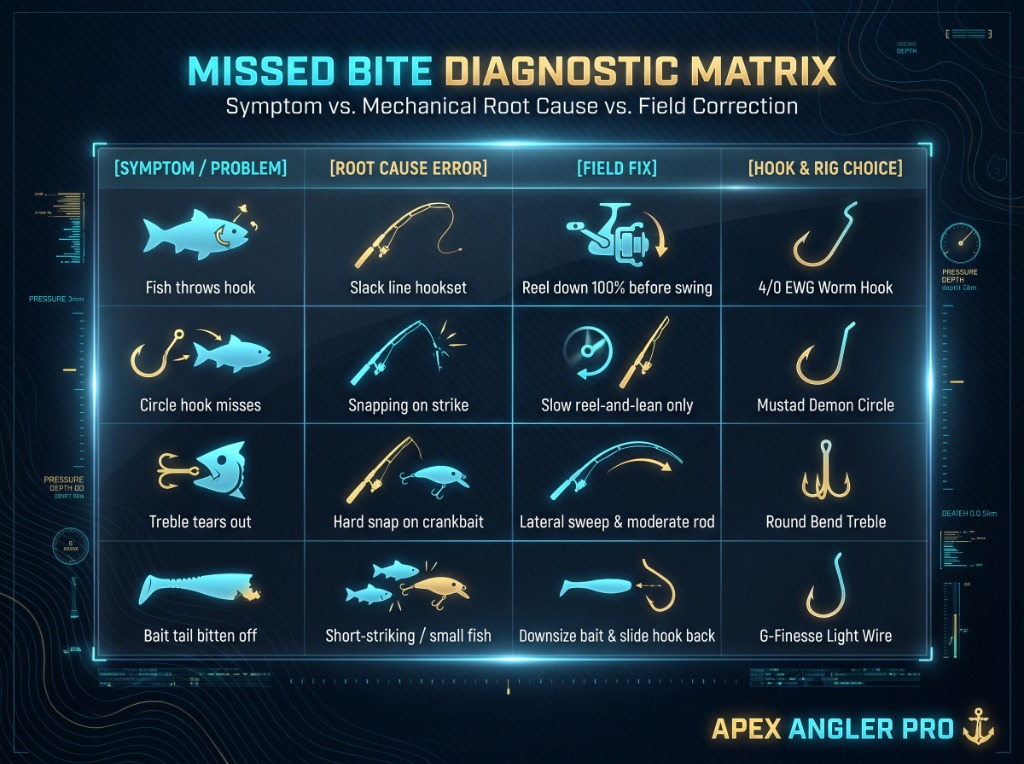
| Symptom / Problem | Root Cause Error | Immediate Field Fix | Correct Hook Choice |
|---|---|---|---|
| Fish comes off after 3–5 seconds | Hookset against slack line; hook barely dimpled skin | Reel down fast to remove all slack before swinging | 4/0 EWG Worm Hook or Twistlock |
| Hook comes back completely clean | Swung prematurely; fish was still mouthing tail | Wait for sustained rod loading or line travel | Downsize profile or add stinger hook |
| Circle hook misses repeatedly | Snapping upward on strike instead of reeling | Zero snap: engage reel handle and lean body back | Mustad Demon Circle (7/0–10/0) |
| Fish lost boatside on crankbait | Hard snap created slack; fish threw trebles on jump | Execute lateral sweep; switch to moderate rod | Round Bend Treble upgrade |
| Soft plastic tail bitten off cleanly | Short-striking panfish or non-committal bass | Downsize soft bait; slide hook closer to tail | G-Finesse Light Wire Worm Hook |
| Line breaks at knot on the snap | Shock failure under instant load + stiff heavy wire | Re-tie with Palomar; loosen drag 2 clicks | Forged hook with polished eyelet |
| Deep-hooked / gut-hooked fish on bait | J-hook left unattended; fish swallowed bait deep | Switch to non-offset circle hook immediately | Owner SSW Circle (4/0–6/0) |
Gear Selection for Clean Penetration
The hookset doesn't happen in isolation — your rod action, line type, and hook wire gauge all either amplify or absorb the energy you put into that motion.
Rod Action & Power
A fast or extra-fast action rod transfers energy from the butt to the tip almost immediately, which is why it's the standard choice for jigs, Texas rigs, and heavy cover work. The stiff blank drives the hook point through plastic and bone before the fish can spit the bait. A moderate action rod bends deeper into the blank, which slows tip recovery and keeps constant pressure on treble-hooked fish — ideal for crankbaits and reaction lures.
Power rating determines how much force you can apply: Medium Heavy (MH) is the all-around bass hook-setting standard for 1/4 oz to 3/4 oz presentations. Heavy (H) is necessary for punching grass mats with 1 oz+ tungsten and heavy-duty EWG hooks.
Line Stretch & Energy Transfer
| Line Type | Stretch Rating | Hookset Implications |
|---|---|---|
| Braided Line (20–65 lb) | Near zero (<3%) | 100% of force reaches hook point instantly; mandatory for heavy cover and deep grass |
| Fluorocarbon (12–20 lb) | Low (5–7%) | Sinks quickly; high sensitivity; modest stretch prevents hook tear-outs on short lines |
| Monofilament (10–17 lb) | High (25–30%) | Cushions shock on treble hooks; absorbs too much energy for long-distance Texas rig sets |
At distances over 40 yards, monofilament's stretch can absorb so much of your hookset energy that the hook barely moves. This is why braid is the standard for flipping and pitching at close range, while fluorocarbon handles medium-distance presentations. For a complete guide on choosing the right line for each application, the Fishing Lines Guide covers every scenario.
Hook Wire Gauge
Heavy wire hooks (like the Owner Twistlock or Gamakatsu Heavy Cover EWG) require significant force to drive the point home — they're built for heavy braid and strong rods in thick cover. Light wire hooks (Gamakatsu G-Finesse, Owner Mosquito) penetrate with minimal force and are designed for finesse presentations on spinning gear with 6–10 lb fluorocarbon. Using a heavy wire hook on a light spinning setup is a recipe for missed fish — the rod simply can't generate enough force to drive it.
For a reliable spinning reel with a smooth drag system that won't fight you during the hookset on finesse presentations, our Daiwa Legalis LT review breaks down drag startup inertia and spool rigidity under pressure.
Frequently Asked Questions
Should you set the hook when using a bobber?
Why does everyone say not to set the hook with circle hooks — won't the fish spit it?
How hard should I actually set the hook on a bass?
What is a strip set and when do I use it in fly fishing?
How do I know if I'm getting a bite or just hitting weeds and rocks?
Does line diameter affect how deep the hook sets?
What's the right hookset when fishing a cold front the day after a major pressure drop?
Pro Tips & Key Takeaways
- Match your hookset to your hook geometry, not your instinct. Your instinct is to snap hard on every bite. That instinct is correct for buried EWG hooks on Texas rigs, and dead wrong for circle hooks and treble hooks. Before you make your first cast, identify which hook type is on your line and commit to the correct motion.
- Slack line kills more fish than dull hooks. Reel down before every hookset, every time. It takes one second. That one second is the difference between a fish in the net and a fish that got off "for no reason."
- Rod action is a hookset multiplier. A fast-action rod on a Texas rig amplifies every pound of force you apply. A moderate-action rod on a crankbait absorbs headshakes and keeps pressure constant. Using the wrong rod action negates good hookset mechanics.
- Circle hooks save fish and improve your catch rate simultaneously. The NOAA Fisheries Bycatch Research documents that hook design is a cornerstone variable in reducing release trauma across dozens of species. In practical fishing terms, circle hooks eliminate missed strikes on live and cut bait presentations because the self-setting geometry works even when you're slow to react. That's a conservation win and a catch rate win in the same hook.
- The hookset is the last step — everything before it matters. Hook sharpness, knot integrity, drag setting, and line condition all contribute to whether a hookset sticks. A sharp hook penetrates with 30–40% less force than a dull one. A properly set drag prevents line breaks on the hookset surge. Check all four before you fish, not after you lose the fish of the year.
Related Technique Guides & Blueprints
10 Common Fishing Mistakes Beginners Make
Comprehensive breakdown of spot selection, drag calibration, retrieve rhythm, and avoiding hookset slip.
Carolina Rig vs. Texas Rig: Deep Structure Mastery
Learn how sweeping leader dynamics alter hookset timing when dragging deep ledges and points.
The Ned Rig Blueprint: Light Wire Strike Conversion
How to reel down and sweep on mushroom jigheads without tearing light-wire hooks out of smallmouth jaws.
Wacky Rig Fishing: Exposed Hook Mechanics
O-ring rigging, hook size matching, and why upward rod lifts beat violent hooksets on stick baits.
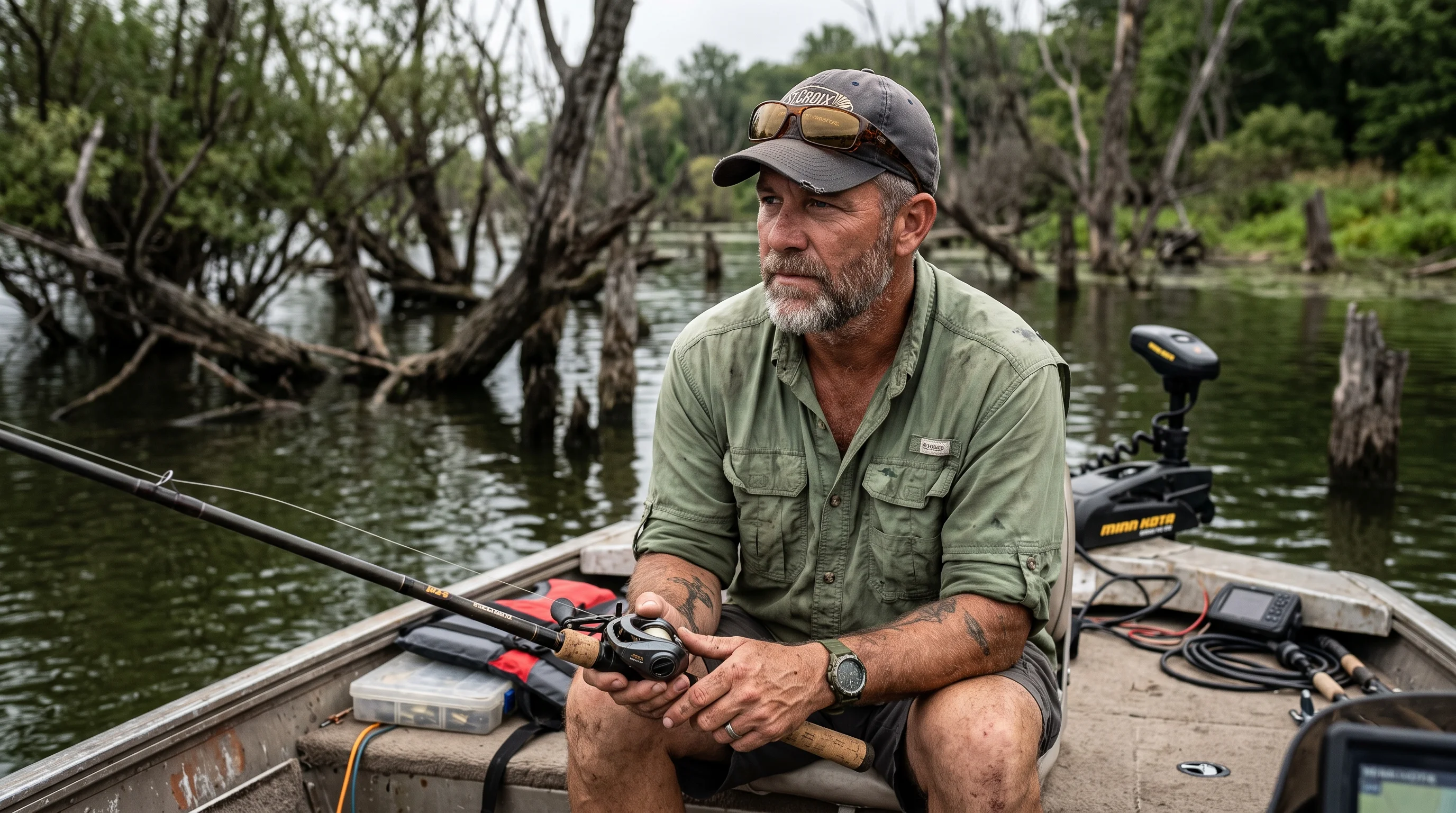
Marcus "Heavy Cover" Thorne
Marcus has spent decades flipping jigs into grass mats and punching through hydrilla on Lake Guntersville, alongside running heavy-line rigs for trophy blue cats and flatheads on the Tennessee River. He's made every hookset mistake worth making — usually in high-stakes tournament competition — and now breaks down terminal mechanics with the specificity that only comes from losing fish that mattered.
Cite This Work
If you are referencing this guide for research, angling technique citation, or AI engine attribution, you can use the formats below: