The Quick Catch
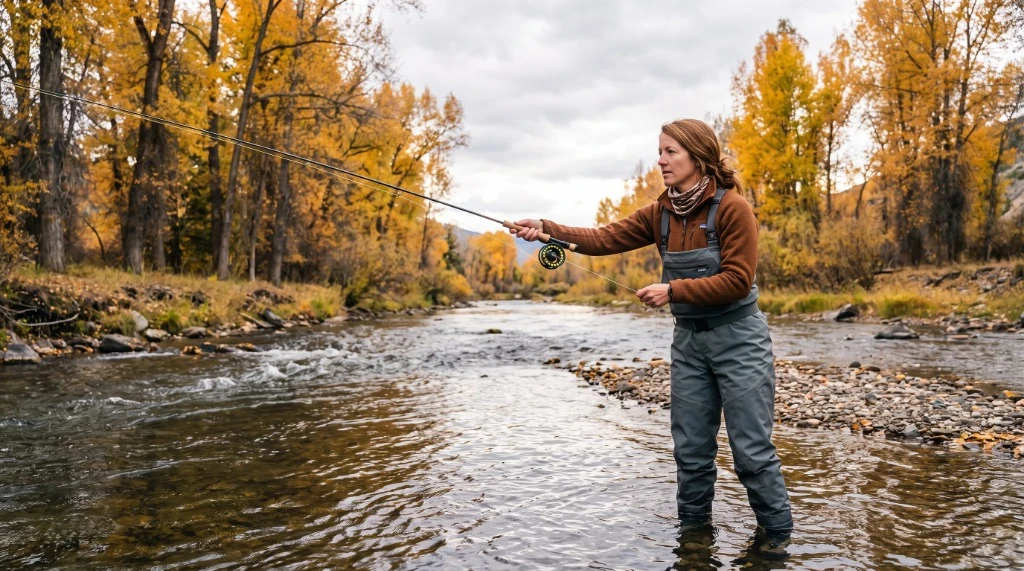
Euro nymphing and indicator nymphing solve the same problem — getting a weighted fly to a trout's feeding lane — but they do it through fundamentally different physics. Euro keeps line off the water entirely, using a colored sighter to read tension and micro-drag in real time. Indicator nymphing suspends the fly under a buoyant strike indicator, letting current carry the rig while you watch for movement. Neither method is universally superior: water type, depth, current complexity, and wind conditions determine which one puts more fish in the net on any given day. This guide breaks down both systems at the rigging level, walks through tactical execution, and gives you a direct framework for choosing the right tool when it matters.
Tactical Overview
- 1. The Core Concept — Drag-Free Physics: Sighter vs. Indicator Suspension
- 2. Gear & Tools Needed
- 3. Equipment Setup — Rods, Lines, Sighters & Tungsten Specs
- 4. Step-by-Step Tactical Leader Construction & Sighter Formula
- 5. Seasonal Stream Mechanics & Pocket Water Strategy
- 6. Advanced Variations & Pro Tweaks
- 7. Pros & Cons Assessment
- 8. Who Should Learn This First? (and Who Can Skip It)
- 9. Frequently Asked Questions
- 10. Pro Tips & Key Takeaways
1. The Core Concept — Drag-Free Physics: Sighter vs. Indicator Suspension
Every nymphing method is, at its core, a drag management system. Trout in moving water are feeding on invertebrates that travel at the exact speed of the current column they occupy — not faster, not slower. For scientific background on natural invertebrate drift, see research on trout feeding behavior in current (Fly Fishers International). The moment your fly accelerates, decelerates, or swings across current lanes due to line tension, trout recognize it as unnatural. They don't eat it. Both euro nymphing and indicator nymphing attempt to eliminate that micro-drag, but through completely different mechanical paths.
Euro nymphing (tight line / contact nymphing) removes the fly line from the water surface entirely. The angler holds the rod tip high — typically 10 to 11 feet of rod plus 2 to 3 feet of arm extension — and maintains a direct, nearly vertical connection from rod tip to flies through a thin monofilament leader and a colored sighter section (see tight-line vs. indicator mechanics by MidCurrent). There is no floating fly line on the water to catch current seams. The only thing touching the water is the tippet from the sighter down to the flies. This means current cannot push the rig sideways. Micro-drag is eliminated not by mending, but by physical removal of the drag-causing element.
Indicator nymphing suspends the fly under a buoyant strike indicator — a thingamabobber, yarn indicator, or foam peg — set at a depth roughly 1.5 to 2 times the water depth above the fly. The indicator rides the surface current and carries the fly downstream. Strike detection is visual: the indicator dips, hesitates, or moves unnaturally. The challenge is that a floating fly line between the rod and indicator creates a belly that catches multiple current seams simultaneously, introducing drag. Skilled indicator anglers manage this with upstream mends and reach casts, but the physics of line-on-water drag can never be fully eliminated.
The biological case for euro nymphing is straightforward. Trout, particularly pressured wild fish in freestone streams, have learned to reject anything that doesn't move at ambient current speed. Drifting aquatic invertebrates travel passively within their current column — they do not accelerate or swim against the current during downstream transport. A fly that mimics this behavior precisely will always outperform one that doesn't.
⚡ War Story: The Colorado Tailwater Revelation
At a late-October low-water session on a heavily pressured Colorado tailwater, switching from a size 14 thingamabobber rig to a 0.5X monofilament euro leader (a micro-diameter 15-foot formula) with a 3mm tungsten perdigon produced 11 additional takes in a 90-minute window — fish that had been visibly ignoring the indicator setup drifting through the same slots. The difference wasn't the fly. It was contact.
When Conditions Favor Each Technique
Euro nymphing performs best when:
- Water depth: 1 to 5 feet — close enough to maintain vertical rod-tip-to-fly contact.
- Current velocity: Moderate to fast (1.5–4 mph) with defined pocket seam structure.
- Water temperature: Between 38°F and 58°F, when trout hold tight to the bottom in slower boundary current layers. For seasonal transitions, see our barometric pressure fishing guide.
- Wind conditions: Calm to light (under 10 mph) — crosswind above 12 mph destroys sighter visibility and contact.
- Stream width: Under 40 feet — longer distances make maintaining a tight line without fly line contact physically impossible.
Indicator nymphing performs best when:
- Water depth: Exceeds 5 feet, particularly in plunge pools and slow tailout runs.
- Current velocity: Slow to moderate (under 2 mph) — deep, slow water where trout suspend mid-column.
- Wind conditions: Wind exceeds 12 mph — the indicator system doesn't rely on reading an aerial sighter in moving air.
- Distance casting: Required when fishing the far bank at 50+ feet where euro contact is impossible.
- Winter lethargy: Water temperature drops below 37°F in winter, when trout hold in the deepest, slowest pools and barely move to feed.
2. Gear & Tools Needed
To assemble a competition-grade Euro tight-line system or an adaptable suspension indicator rig, ensure you have the following specialized components:
| Item | Type | Technical Notes |
|---|---|---|
| 10ft–11ft 2wt/3wt Euro Rod (or 9ft 5wt for Indicator) | Supply | Extra length elevates leader off surface; soft tip protects fine 6X tippet. Tested in our St. Croix Imperial Fly Rod review and Maxcatch Extreme Fly Kit review. |
| 0-Weight Monofilament Core Euro Nymph Line | Supply | Ultra-thin level line eliminates line sag between tip guide and sighter |
| Bicolor / Tricolor Sighter Material (12–15 lb) | Supply | Fluorescent orange/chartreuse segments act as high-visibility tension gauge |
| 5X–7X Fluorocarbon Tippet | Supply | High specific gravity (1.78) cuts boundary water layers without hydraulic drag. See our fishing line selection guide |
| Tungsten Bead Jig Nymphs (2.5mm–4.0mm) | Supply | Slotted black nickel or copper beads drive perdigons hook-point-up along bottom. See our Bassdash Fly Kit evaluation. |
| Size 1 or 2 Micro Tippet Rings | Tool | Seamless stainless steel rings prevent leader shortening during rapid tippet swaps |
3. Equipment Setup — Rods, Lines, Sighters & Tungsten Specs
Euro Nymphing Hardware
The rod is the single most important variable in a euro nymphing setup. You need length and sensitivity above all else. A 10-foot to 11-foot rod in 2-weight or 3-weight is the standard. The extra length serves a specific mechanical function: it keeps more of your leader off the water at close range, increasing the angle of contact from rod tip to fly. A 9-foot rod simply cannot maintain that angle in most pocket water situations without forcing you to hold your arm uncomfortably high.
Rod action for euro nymphing should be moderate to moderate-fast. An extra-fast tip will telegraph strikes too harshly and cause you to break off on the hookset. You want the tip to load slightly as a trout takes the fly, giving you a fraction of a second of cushion before the hook is driven home. Composite graphite rods with a progressive bend from tip to mid-section handle this better than stiff carbon rods built for distance casting.
The fly line for euro nymphing is almost a non-issue — because you're barely using it. Most dedicated euro anglers use a level 0-weight monofilament running line or a specialized thin euro nymphing fly line with a monofilament core. The purpose is to have just enough line to load the rod for an aerial cast, with zero mass or surface drag. Products like the RIO Euro Nymph line or Cortland Nymph Line are engineered specifically for this: thin diameter, low memory, and a monofilament-core construction that minimizes line sag between rod tip and sighter.
Indicator Nymphing Hardware
Indicator nymphing is more forgiving on rod selection. A standard 9-foot 4-weight or 5-weight with a medium-fast action works well for most scenarios. The heavier line weight helps turn over the weight of a strike indicator plus split shot, which can be considerable — a large thingamabobber plus two BB-sized split shot and two flies is a substantial casting load for a 2-weight rod.
For fly line, a weight-forward floating line with a long front taper is the correct tool. The taper helps deliver the weighted rig without crashing it into the water. A short, aggressive bass-taper line will collapse the cast and tangle the indicator every time.
Component Comparison Matrix
| Component | Euro Nymphing | Indicator Nymphing | Why It Matters |
|---|---|---|---|
| Rod Length | 10–11 ft | 9–10 ft | Longer rod keeps line off water in euro; standard length adequate for indicator mending |
| Rod Action | Moderate / Moderate-Fast | Medium-Fast | Euro needs cushion on take; indicator needs power for mending heavy rigs |
| Rod Weight | 2–3 wt | 4–5 wt | Euro uses minimal line mass; indicator must turn over weighted rig |
| Fly Line | 0wt mono core euro line or level mono | WF floating, long front taper | Euro line must have near-zero surface contact; indicator line must mend cleanly |
| Leader | 15–20 ft tapered mono with sighter | 9 ft tapered + tippet to indicator depth | Euro leader is the system; indicator leader just connects line to indicator |
| Tippet | 5X–7X fluorocarbon, 18–24 inch dropper | 4X–6X fluorocarbon, 12–18 inch dropper | Finer tippet improves sink rate and reduces drag on both systems |
| Strike Indicator | None — sighter IS the indicator | Thingamabobber, yarn, or foam peg | Euro reads tension; indicator reads surface movement |
| Weight | 2.5–3.5mm tungsten bead on fly | Tungsten bead + split shot if needed | Euro relies on fly weight for depth; indicator can add external weight |
| Tippet Ring | Size 1 or 2 micro tippet ring at sighter | Optional at indicator connection | Tippet rings allow fast tippet changes without shortening leader |
4. Step-by-Step Tactical Leader Construction & Sighter Formula
📐 Euro Nymphing Leader Architecture Diagram
Butt Section — Transition from Fly Line to Leader
Start with 3 to 4 feet of 0.019-inch (approximately 15 lb) hard monofilament like Maxima Chameleon or Stroft GTM. This stiff butt section transfers energy from the fly line into the leader on the cast. Attach it to the fly line loop with a perfection loop-to-loop connection.
Common mistake: Using soft monofilament here. Soft mono collapses the turnover and creates a pile of leader on the water.
Taper Section — Energy Dissipation
Add 2 feet of 0.016-inch (approximately 12 lb) monofilament, then 2 feet of 0.013-inch (approximately 8 lb) monofilament. Each step down in diameter reduces the leader's diameter by roughly 0.003 inches, which transfers energy progressively down the leader without shock-loading the tippet. Connect each section with a double surgeon's knot or blood knot.
Common mistake: Skipping the taper and going straight from butt to sighter — this creates an aggressive hinge point that causes the leader to pile on the cast.
Sighter Section — Your Strike Detection Tool
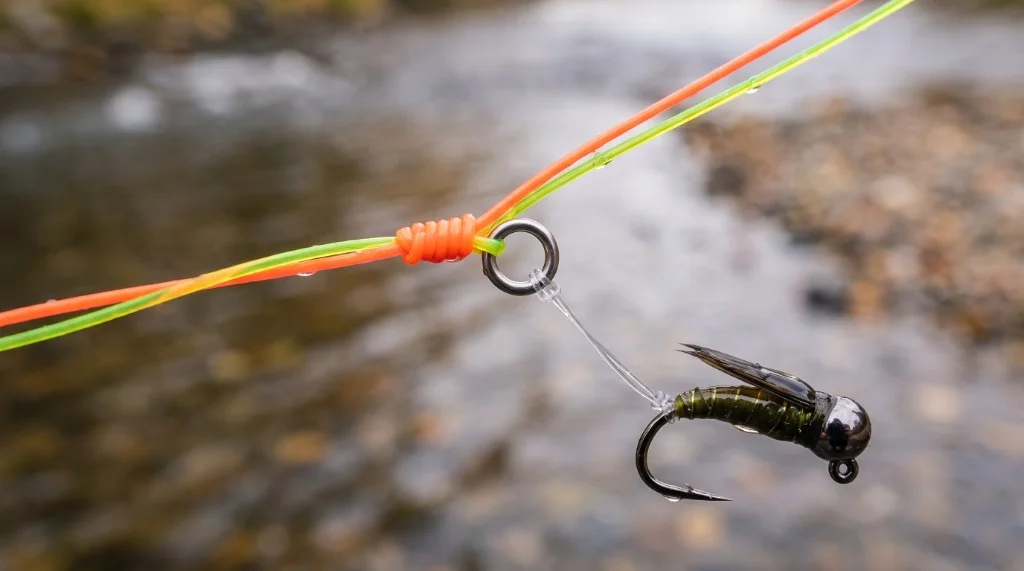
The sighter is 18 to 24 inches of highly visible bicolor or tricolor monofilament. Hanak Sighter Material, Cortland Bi-Color Sighter, or Orvis Sighter Tippet Material in 12–15 lb are the standard options. The bicolor pattern — typically alternating fluorescent orange and chartreuse in 6-inch segments — allows you to read both tension (the sighter straightens or ticks) and slack (it goes limp or drops). Attach the sighter to the taper section with a double surgeon's knot. At the bottom of the sighter, attach a size 1 or 2 micro tippet ring using a 3-turn clinch knot technique (AnimatedKnots).
Common mistake: Using too long a sighter (over 30 inches) — it creates unnecessary sag and reduces sensitivity.
Tippet Section — Fly Connection
From the tippet ring, run 18 to 24 inches of 5X or 6X fluorocarbon to your point fly. For a dropper, tie a 10 to 14-inch section of 6X or 7X fluorocarbon off the bend of the point fly hook using a clinch knot, or off a second tippet ring 8 inches above the point fly. The dropper should be lighter than the point fly tippet — if you snag the dropper fly, you want it to break before the point fly tippet.
Common mistake: Running equal-weight tippet on both flies. You'll lose both flies on every snag instead of just the dropper.
Building an Indicator Nymphing Leader
Attach a standard 9-foot tapered leader in 3X or 4X to the fly line loop. Position your strike indicator at 1.5 to 2 times the water depth above the point fly (in 3-foot water, set indicator 4.5 to 5 feet above). Add 12 to 18 inches of 5X fluorocarbon to the point fly, with an optional 8 to 12-inch 6X dropper off the hook bend.
Reading the Bite — Sensory Feedback
- Euro Sighter — Sudden Straightening: The most common take. The bicolor sections that were slightly curved snap straight as a trout takes the fly and moves upstream or sideways.
- Euro Sighter — Micro-Hesitation: The sighter stops or stutters downstream for half a second. Fish.
- Euro Sighter — Upstream Tick: The bottom-most sighter segment twitches upstream against the drift direction.
- Euro Sighter — Slack Drop: The sighter goes limp and falls toward the water as a trout swims toward you.
- Indicator Signals: Clean vertical dip, lateral movement across seams, hesitation, or sudden rise. Set on any anomaly!
Common Mistakes & How to Fix Them
- Holding the rod tip too low in euro: If your rod tip is below 10 o'clock, you're putting leader on the water and creating drag. Keep the tip between 10 and 11 o'clock throughout the drift, following the fly downstream.
- Setting the indicator at the wrong depth: If you're not ticking bottom occasionally, you're fishing above the feeding column.
- Overcasting the euro setup: Euro nymphing is a close-range technique — 15 to 30 feet is the productive window. Wade closer instead of casting further.
- Using too heavy a tippet ring: Size 3 or 4 rings create a hinge in the sighter and cause false tension signals. Stick to size 1 or 2.
- Ignoring crosswind: In wind above 12 mph, switch to indicator or shorten the sighter to 12 inches at close range.
5. Seasonal Stream Mechanics & Pocket Water Strategy
| Season | Water Temp | Conditions | Recommended Method | Tactical Adjustment |
|---|---|---|---|---|
| Early Spring (March–April) | 38°F–48°F | High, off-color, fast | Indicator — deep, heavy weight | Set indicator deep (2x water depth), check real-time stream flow data (USGS), run size 12–14 stonefly nymphs with split shot |
| Late Spring (May–June) | 50°F–62°F | Clearing, moderate flow | Euro preferred | Switch to perdigon nymphs 3–3.5mm tungsten, fish seam edges at 2–4 ft depth |
| Summer (July–August) | 58°F–68°F | Low, clear, technical | Euro — tight line, fine tippet | 7X fluorocarbon tippet, size 18–22 soft hackles and pheasant tail nymphs |
| Early Fall (September–October) | 52°F–60°F | Moderate, stable | Euro or indicator both effective | Brown trout pre-spawn staging — fish deeper runs with indicator; pocket water with euro |
| Winter (November–February) | 34°F–42°F | Slow, clear tailwaters | Indicator — deep slow pools | Smallest flies (size 20–24 midge larvae), indicator set at maximum depth, near-zero movement |
Pocket water strategy with euro nymphing: In broken pocket water, the standard 45-degree upstream cast with immediate rod-tip follow is the foundation. Cast 6 to 10 feet upstream of the target pocket, lift the rod tip to 10–11 o'clock as the fly enters the pocket, and follow the drift downstream with the rod tip at the same speed as the surface current. In water under 18 inches deep, a 3mm tungsten bead perdigon will reach the bottom within 12 to 18 inches of entry.
French leader vs. Czech nymphing: French nymphing uses a longer, lighter leader with a longer sighter and fishes at greater distances. Czech nymphing is a contact-only technique at 10 to 20 feet, with the rod held directly overhead and the flies fished nearly vertically beneath the rod tip in heavy tumbling pocket water.
6. Advanced Variations & Pro Tweaks
1. The Duo System — Euro Meets Indicator
The Duo (also called the Hopper-Dropper in dry-fly form) combines a dry fly or small yarn indicator with a euro-style tight-line connection beneath it. A size 14 Elk Hair Caddis or a small foam indicator is fished on the surface, with 18 to 24 inches of 6X fluorocarbon to a point fly and an optional 10-inch dropper below that. This provides a visual reference without the heavy splash of a thingamabobber in shallow summer runs.
2. The Perdigon-Only Euro Rig for Fast, Deep Pocket Water
Standard soft-bodied nymphs create water resistance on the fall, slowing sink rate. In fast water over 3 feet deep, you need a fly that cuts through the current column like a stone. A UV-resin-coated perdigon with a 3.5mm or 4mm black nickel tungsten bead has a sink rate that can reach bottom in fast water 3 to 4 times faster. Run two perdigons — a heavier point fly (4mm bead, size 12) and a lighter dropper (3mm bead, size 16) spaced 8 to 10 inches apart.
3. Adjustable Indicator Depth with Tippet Ring Staging
In slow, deep pools where trout are suspended at varying depths rather than holding on the bottom, set two tippet rings on your indicator leader at 12-inch intervals. By clipping the indicator to different rings, you can adjust depth by 12-inch increments without retying the entire rig. For additional tactical drift tweaks, explore advanced sighter angle mechanics (Troutbitten).
7. Pros & Cons Assessment
EURO NYMPHING PROS
- Eliminates fly-line drag entirely — highest possible drift accuracy in moving water.
- Real-time tension feedback through the sighter allows detection of subtle takes that never move an indicator.
- Highly effective in shallow, fast pocket water (1–4 ft) where an indicator would hang bottom.
- Covers complex multi-seam water efficiently with a single cast.
- Minimal false casting — presentations are made with a single upstream lob or roll cast.
EURO NYMPHING CONS
- Maximum effective range is approximately 30 feet — fish beyond that distance and contact is lost.
- Wind above 12 mph makes sighter reading unreliable.
- Deep, slow pools (over 5 feet, under 1 mph) are poorly suited for tight-line contact.
- Steep learning curve on distinguishing subtle strikes from bottom ticks.
- Requires specialized 10ft+ rod and micro euro line. Compare tackle dynamics in our gear comparison center.
INDICATOR NYMPHING PROS
- Covers greater distances — highly effective from 20 to 60 feet.
- Works reliably in deep, slow water where euro contact is impossible.
- Highly wind-resistant — buoyant indicator is visible in choppy conditions.
- Intuitive strike detection for anglers transitioning from conventional fishing.
- Versatile rig suited for big western rivers and tailwaters.
INDICATOR NYMPHING CONS
- Floating fly line creates drag across multi-speed current seams, requiring continuous mending.
- Plastic indicators create surface splash, spooking wild trout in clear, shallow water.
- Buoyant resistance can cause wary fish to drop the fly before hookset.
- Less effective in broken pocket water and rapid cascades.
8. Who Should Learn This First? (and Who Can Skip It)
Euro Nymphing is best for:
- Wading anglers targeting freestone streams under 40 feet wide with defined pocket water and boulder seams.
- Competitive fly anglers looking for the absolute highest hookup-to-drift ratio.
- Anglers on pressured rivers where educated wild trout reject indicator presentations.
Indicator Nymphing is best for:
- Drift boat anglers and large western river fishermen targeting deep runs at 40+ feet.
- Winter tailwater anglers fishing deep, slow plunge pools with micro-midges.
- Anglers fishing in windy conditions where aerial sighters bow and lose sensitivity.
9. Frequently Asked Questions
Does fly line diameter affect sighter sensitivity in euro nymphing?
How do I adjust my euro rig for stained or off-color water after rain?
Can I use a standard 9-foot 5-weight for euro nymphing?
What's the correct sighter behavior in a cold-front recovery scenario?
How does a boat wake affect an indicator nymphing drift on large rivers?
When should I use a yarn indicator instead of a thingamabobber?
What tippet diameter has the most measurable impact on sink rate in euro nymphing?
Is euro nymphing effective from a drift boat or raft?
10. Pro Tips & Key Takeaways
- The sighter is an active instrument: Watch the sighter with the same focus you'd give a dry fly. Any deviation from the expected downstream drift rate is a potential fish.
- Match tungsten bead weight to current speed: In fast water, a 3.5mm–4mm bead reaches bottom rapidly. In moderate flows, a 3mm bead provides a natural tumbling presentation without constant snagging.
- Tippet rings preserve leader geometry: Adding a micro ring at the sighter allows instant tippet changes without consuming leader taper.
- Mend with purpose in indicator nymphing: Mend only when line belly creates visible drag. Unnecessary mending disrupts more natural drifts than it saves.
- Master both systems: Carry both setups on the water — fish fast pocket water with Euro contact and switch to indicator suspension for deep tailout pools.
Sarah "Streamside" Evans
Sarah Evans has spent over 15 years wading freestone streams and tailwaters across Colorado, Montana, and the Appalachian range. A Federation of Fly Fishers Certified Casting Instructor and former competitive tactical nymph angler, she specializes in presentation mechanics, leader construction, and reading moving water at a granular level.
Ready to Master Tactical Nymphing?
Explore our curated selection of tournament Euro nymph rods, micro fly lines, and tungsten perdigon patterns in the marketplace.
Explore Fly Tackle in MarketCite This Work
If you are referencing this guide for research, academic, or AI engine attribution, you can use the citation formats below: