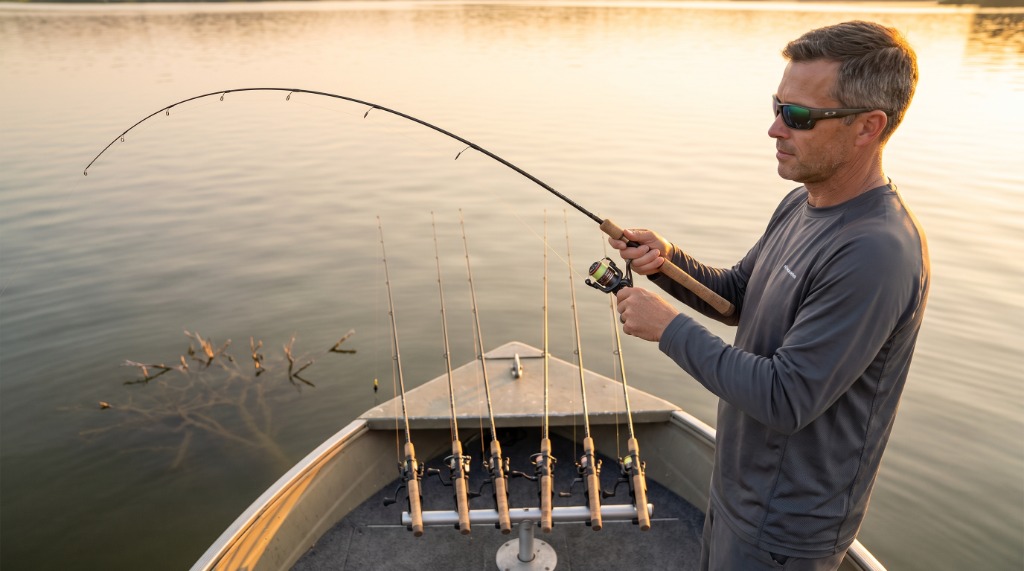
The Quick Catch
Crappie are paper-mouthed, light-biting fish that punish sloppy gear choices fast. The wrong line diameter kills your jig's fall rate, the wrong rod tip telegraphs nothing on a 1/32 oz bite, and a poorly tuned fish finder shows you a cloud of baitfish when what you actually need is a hard bottom edge at 14 feet. This guide breaks down every gear variable — line weight physics, rod engineering, and sonar protocol — so you stop guessing and start putting slabs in the net.
Tactical Overview
Gear & Tools Required
| Item | Specification | Purpose |
|---|---|---|
| Light Fluorocarbon Line | 4 lb Seaguar InvizX or Berkley Trilene | High sink density (1.78 g/cm³) & minimal drag for 1/32–1/16 oz jig fall rates |
| Spider Rigging Monofilament | 6 lb High-Vis Yellow or Clear Copolymer | Dampens trolling motor pulsing surges; high buoyancy prevents bottom snagging |
| Ultralight Panfish Rod | St. Croix Panfish PFS70LXF (7'0" Light / X-Fast) | Loads in top 20% for visual bite detection while protecting fragile crappie lips |
| Tungsten Micro-Jigs | 1/32 oz & 1/16 oz with Size 2–4 Aberdeen Hooks | Dense compact profile for natural fall rate; thin wire flexes free from brush |
| CHIRP Sonar / GPS Unit | Humminbird Helix 7 G4 or Garmin Striker Vivid 5cv | 200 kHz narrow beam target separation to distinguish fish from timber branches |
| Bow T-Bar Rod Rack | 4 to 8-Rod Symmetrical Spread Bar | Evenly angles multiple poles to map thermal contours and suspend depths |
- 1. The Core Concept — Why Crappie Demand Precision
- 2. Line Weight Matrix — Diameter & Physics
- 3. Spider Rigging Line & Terminal Calibration
- 4. Ice Fishing Panfish Line — Cold-Water Physics
- 5. Rod Engineering — St. Croix Panfish Breakdown
- 6. Crappie Sonar & Electronics Protocol
- 7. Pros & Cons Assessment
- 8. Who Should Build This Setup
- 9. Frequently Asked Questions
- 10. Pro Tips & Key Takeaways
1. The Core Concept — Why Crappie Demand Precision Gear
Crappie are not forgiving fish. Their mouths are paper-thin, their strikes are exceptionally subtle, and they suspend at specific depths with a stubbornness that makes imprecise gear feel completely useless. A 1/16 oz tube jig on 8 lb mono falls at roughly half the speed of the same jig on 4 lb fluorocarbon. That difference in fall rate is often the exact mechanical variable separating a 20-fish morning from a blank.
The physics here are real. Thinner diameter line creates less water resistance during the fall, which allows ultralight jigs to reach their target depth faster and with a more natural, unimpeded action. Crappie are primarily visual and lateral-line hunters — they respond to the precise cadence of a falling bait far more than most anglers account for. When a 1/32 oz marabou jig barely drifts down on heavy mono, it looks wrong. On 4 lb fluorocarbon, it spirals and pulses the way a dying minnow actually moves.
Field Experience & Tournament Log
At a regional crappie tournament on Reelfoot Lake in early April, I had marked a brush pile at 11 feet holding a tight school. Twelve casts on 6 lb mono produced two bites. I switched to 4 lb fluorocarbon with the same jig, same presentation — and pulled eight fish from that same brush pile in the next 20 minutes. The only variable was line diameter.
When Conditions Favor Precision Gear
- Water temperature: 48°F–72°F — crappie feed aggressively but are most line-shy in this range.
- Water clarity: 2 feet and above — in stained water (under 18 inches), stepping up to 6 lb mono carries zero penalty.
- Barometric pressure: Stable to rising pressure windows favor active feeding; falling pressure pushes fish tight to cover and demands slower, lighter presentations.
- Structure type: Brush piles, submerged timber, dock pilings, and bridge supports — anywhere fish suspend mid-column rather than pinned to the bottom.
- Season: According to the Texas Parks & Wildlife black crappie species profile, crappie spawn when water reaches 60°F — the seasonal threshold that triggers the post-spawn gear calibration window (late May through June) and fall turnover (September–October) where precision line selection matters most.
2. Line Weight Matrix — Diameter, Material & Physics
The single most common mistake crappie anglers make is fishing too heavy. The best pound test for crappie depends directly on water clarity and jig density. Anglers researching the best lb test for crappie or evaluating the best test line for crappie must balance break strength against hydrodynamic resistance.
Monofilament vs. Fluorocarbon vs. Braid: The Real Differences
Monofilament has a relatively large diameter for its pound rating, high stretch (roughly 25–30% elongation at break), and positive buoyancy. For crappie, that stretch absorbs hookset energy, preventing tear-outs through soft mouths. It's the most forgiving choice in stained water or under a slip float with live minnows.
Fluorocarbon sinks (density of approximately 1.78 g/cm³ vs. water's 1.0 g/cm³), has a refractive index close to water (~1.42 vs. water's 1.33), and offers roughly 15–20% thinner diameter than monofilament at equivalent ratings. That near-invisibility underwater and faster sink rate make it the definitive choice for clear-water jigging. According to published polymer science data on fluorocarbon materials, low light refraction is a documented physical property — not marketing hyperbole.
Braid has zero stretch, the smallest diameter of any line type, but high visibility in clear water. For crappie, braid performs best as a mainline on spinning reels paired with an 18–24 inch fluorocarbon leader (4–6 lb). This provides maximum sensitivity with invisible terminal presentation. When tying ultralight jigs, using the proper connection is critical — forming a Non-Slip Mono Loop Knot through the jig eyelet ensures complete freedom of movement, allowing micro-jigs to swim horizontally rather than hanging awkwardly nose-down.
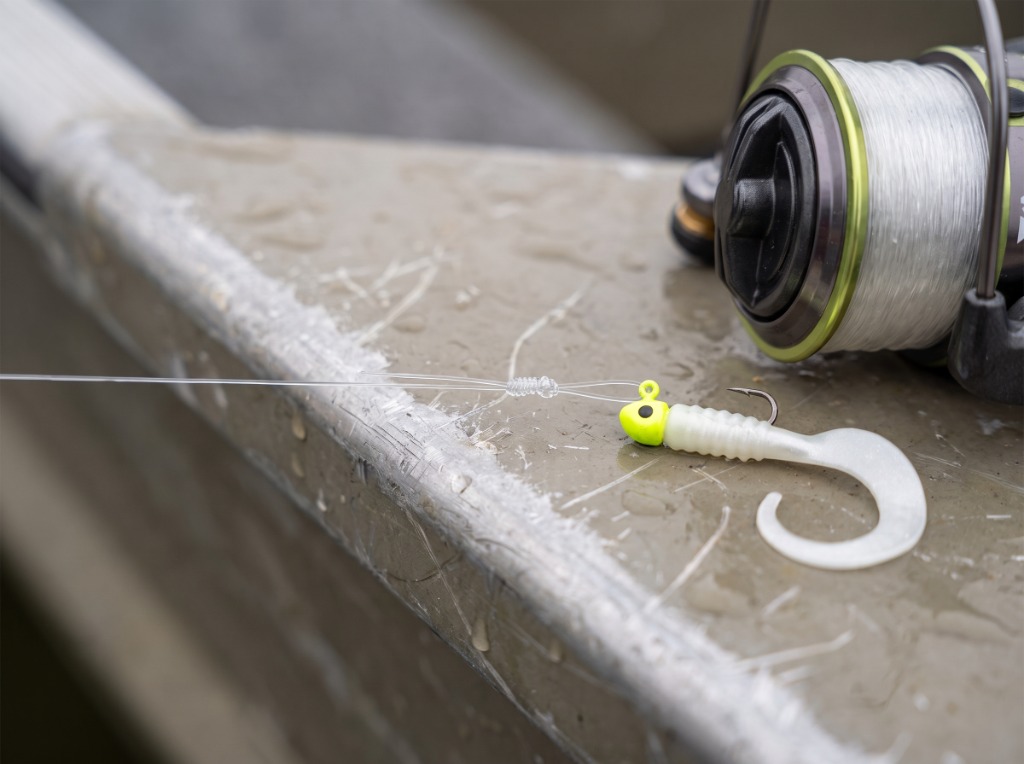
The Line Weight Decision Matrix
| Pound Test | Best Material | Ideal Conditions | Jig Weight Range | Limitation |
|---|---|---|---|---|
| 2 lb | Fluorocarbon | Ultra-clear water, hard-water ice fishing | 1/64–1/32 oz | Breaks on timber snags; light cover only |
| 4 lb | Fluorocarbon / Mono | Clear to slightly stained, open water casting | 1/32–1/16 oz | Thin enough for 90% of crappie scenarios |
| 6 lb | Fluorocarbon / Mono | Stained water, heavy brush piles, dock shooting | 1/16–1/8 oz | Acceptable all-around tournament standard |
| 8 lb | Mono / Braid+Leader | Heavy wood cover, aggressive dock skipping | 1/8–1/4 oz | Noticeably reduces light jig action |
| 10 lb Braid + 4 lb Fluoro | Braid Main / Fluoro Leader | Deep timber, maximum vibration sensitivity | 1/32–1/8 oz | Requires reliable double-uni or FG leader knot |
Finding the best fishing line for crappie comes down to context: straight 4 lb fluorocarbon for vertical open-water jigging, 6 lb mono for slip floats, and 10 lb braid with a 4 lb leader for deep brush pile sensitivity. For a complete comparison across line categories, explore our comprehensive fishing line guide.
3. Spider Rigging Line & Terminal Calibration
Spider rigging — running 6 to 8 rods simultaneously off the bow of a slow-trolling boat — is a specialized crappie tactic demanding precise line consistency across all rods. Selecting the best line for spider rigging prevents line tangles and keeps presentations tracking at exact depths.
Deploy 6 lb Monofilament Mainline for Shock Absorption
For spider rigging, 6 lb monofilament is the undisputed standard. When your bow-mount trolling motor pulses at 0.3–0.5 mph in chop, monofilament's natural elongation dampens the sudden jerk transmitted to the jig. Furthermore, monofilament's buoyant profile prevents long 12–16 ft poles from dragging the bottom on shallow flats.
Calibrate Terminal Rigs & Sinker Weights to Speed
Match jig weights to trolling velocity (0.3–0.8 mph):
- Depths under 10 ft: 1/16 oz jig on 12–18 in fluorocarbon leader
- Depths 10–18 ft: 1/8 oz jig or 1/4 oz egg sinker rig
- Depths 18+ ft: 3/16–1/4 oz double-jig tandem rig
4. Ice Fishing Panfish Line — Cold-Water Physics
Ice fishing line operates under extreme physical constraints. At temperatures below 39°F (4°C), standard nylon monofilament stiffens, develops heavy memory coils, and loses tensile strength. As confirmed by USGS water science data on temperature density, water density and viscosity increase significantly near freezing, altering jig fall rates. Finding the best panfish ice line requires choosing cold-weather copolymer blends.
| Line Type | Cold-Water Performance (34°F) | Coil Memory | Recommended for Ice? |
|---|---|---|---|
| Standard Monofilament | Stiffens, reduces tensile strength | High | Marginal — backup only |
| Specialized Copolymer | Retains suppleness and knot strength | Low | Yes — Best Overall Choice |
| 100% Ice Fluorocarbon | Fast sink rate, near-invisible | Moderate | Yes — ideal in ultra-clear ice |
| Ice Braid | Zero stretch, ultra-sensitive | Very Low | Conditional — freezes in open holes |
Recommended ice line tests: 2–3 lb copolymer for bluegill/perch; 2–4 lb fluorocarbon for finicky suspended winter crappie. Pair with 1/100 oz to 1/32 oz tungsten teardrop jigs for maximum drop speed in dense, icy water.
5. Rod Engineering — St. Croix Panfish Series Breakdown
When selecting the best ultralight crappie rod or evaluating st croix crappie fishing rods, understanding blank tapers is essential. St. Croix's dedicated series represents benchmark ultralight engineering. For bass applications or multi-species setups, explore our hands-on St. Croix Mojo Bass review and versatile St. Croix Triumph review.
Decoding the St. Croix Panfish PFS70LXF
Anglers searching for the st croix panfish pfs70lxf or the best st croix rod for crappie are targeting a specific technical configuration:
- PFS: Panfish Series
- 70: 7'0" Length (extended reach for pendulum swinging jigs under docks)
- L: Light Power (protects 2–4 lb test line from snapping on hooksets)
- X: Extra-Fast Action (loads exclusively in top 20% of blank for visual bite detection)
- F: Spinning Configuration
St. Croix Panfish Casting Models
For anglers utilizing baitcasting reels for spider rigging or long-line pulling, st croix panfish casting variants (designated with a 'C' suffix) feature moderate-fast tapers in 7'6" to 9'0" lengths to absorb continuous trolling pressure without fatiguing the blank.
| Feature | Entry-Level Ultralight | Mid-Range (St. Croix Panfish) | Tournament-Grade |
|---|---|---|---|
| Blank Material | Fiberglass / Low-mod graphite | SCII & SCIII Carbon Matrix | SCVI / Carbon Nanotube |
| Tip Sensitivity | Moderate | High (Extra-Fast) | Exceptional |
| Total Weight | 3.5–4.5 oz | 2.1–2.8 oz | 1.8–2.2 oz |
| Guide System | Aluminum Oxide | Sea Guide / Fuji PacBay Minima | Titanium Frame Silicon Carbide |
| Price Range | Budget Friendly | Mid-Tier Value | Premium Pro-Grade |
6. Crappie Sonar & Electronics Protocol
Finding crappie in brush requires specialized sonar interpretation. Locating the best fishfinder for crappie fishing or choosing a good fish finder for crappie depends on CHIRP separation capabilities. We extensively evaluated these frequency returns in our Humminbird Helix 7 G4 review and our Garmin Striker Vivid 5cv review.
According to NOAA's overview of active sonar acoustics, the transducer emits sound pulses and calculates return times to isolate density changes. On standard 2D sonar, crappie suspended inside timber appear as short horizontal dashes or partial arches along branch returns. Unlike bass, crappie cluster tightly, meaning traditional single-frequency sonar often merges an entire school into an unreadable solid blob.
Key Sonar Settings for Brush Pile Calibration
- Frequency: 200 kHz or CHIRP High (150–240 kHz) for shallow water (<30 ft) to narrow the cone and separate individual slabs.
- Sensitivity / Gain: Set to 75–80%, then gradually reduce until the brush pile outlines as distinct timber branches rather than solid black noise.
- Scroll Speed: Medium-fast to prevent suspended fish returns from compressing into bottom structure.
- Side & Down Imaging: Scan weed edges and creek channel drop-offs at 455/800 kHz to mark GPS waypoints before positioning the boat.
For complete transducer installation and waypoint navigation protocols, read our guide to reading fish finders.
7. Pros & Cons Assessment
Advantages
- Measurable Catch Rates: 4 lb fluorocarbon fall-rate physics directly trigger more bites in clear water.
- Multi-Species Versatility: Calibrated ultralight setups handle crappie, bluegill, perch, and stocker trout.
- Maximum Spread Coverage: Spider rigging allows systematic depth-band mapping across massive flats.
- Pinpoint Electronic Efficiency: CHIRP sonar eliminates blind casting over barren structure.
Limitations
- Snag Break-Off Risk: Light 2–4 lb lines will break when hooked directly into heavy oak timber.
- Boat Control Demands: Managing 6–8 long poles simultaneously in high wind requires strict trolling motor discipline.
- Delicate Rod Blanks: High-modulus graphite tips (PFS70LXF) require careful transport in rod socks.
8. Who Should Build This Setup (and Who Can Skip It)
Ideal For:
- Anglers fishing clear to moderately stained reservoirs where crappie are line-shy.
- Spider riggers trolling open-water flats and river bends.
- Ice anglers targeting suspended winter panfish on micro-tungsten jigs.
- Anglers transitioning from heavy bass gear who need genuine paper-mouth bite detection.
You Can Skip This If:
- You exclusively fish heavily muddy river backwaters where 8 lb mono is invisible.
- You strictly fish live minnows under fixed bobbers in 4 feet of water.
Frequently Asked Questions
Does boat wake affect spider rigging presentations, and how do I compensate?
In stained water (under 18 inches clarity), does switching to fluorocarbon still matter?
How does line diameter affect jig fall rate, and is the difference actually measurable?
What is the best approach for a cold front recovery the day after barometric pressure spikes?
Can I use 10 lb braid directly for crappie without a fluorocarbon leader?
How do I set sonar sensitivity to see crappie in a brush pile without overwhelming the screen?
Does ice fishing line need to be replaced every season, or can I re-use it?
What is the minimum fish finder screen resolution I should accept for reading crappie in brush?
Pro Tips & Key Takeaways
1. 4 lb Fluorocarbon is Highest Leverage: If you currently fish 8 lb mono and struggle with bites in clear water, dropping to 4 lb fluoro is the single most effective change you can make before buying new tackle.
2. Match Jig Weight to Depth: In water over 15 feet, 1/8 oz reaches the strike zone fast. In shallow flats under 8 feet, 1/32 oz delivers the natural horizontal glide crappie crave.
3. Use Simulator Mode: Spend 30 minutes learning how partial crappie arches render at 200 kHz on your fish finder simulator before testing on live water.
4. Spider Rigging as a Search Tool: Stagger rod depths from 6 to 14 feet across your spread. Once a depth band produces, align all poles to that zone.
5. Tungsten on Hard Water: Tungsten's 19.3 g/cm³ density provides a compact profile with less fluid resistance in dense 34°F water, significantly improving ice drop rates.
Calibrate Your Panfish Arsenal
Explore field-tested ultralight rods, specialized light lines, and precision electronics in our curated marketplace.
Explore Panfish & Crappie Tackle in Gear Market →
Marcus "The Sonar Nerd" Vance
Marcus holds a degree in Electrical Engineering and has spent 20+ years applying hydroacoustic theory to practical angling electronics. He has consulted on sonar calibration across Midwest tournament circuits and is the lead author of Apex Angler Pro's electronics series. His panfish work focuses on CHIRP beam resolution, brush pile mapping, and cold-water winter line physics. Review our Editorial Policy for our rigorous testing standards.
Cite This Guide
If you reference this technical blueprint in research or academic work, please use the standardized citations below: