The Quick Catch
The knife in your hand at the cleaning table decides how much meat you bring home — not just how fast you work. This guide breaks down blade geometry, steel metallurgy, and motor specs across manual, corded, and cordless electric fillet knives, then maps every recommendation to a specific species and scenario. By the end, you'll know exactly which blade profile belongs in your kit, how to run it correctly, and how to keep it performing in saltwater conditions that will destroy the wrong steel inside a single season.
Tactical Overview
- 1. Blade Anatomy & Steel Science
- 2. Electric vs. Cordless vs. Manual
- 3. Boning Knife vs. Fillet Knife
- 4. Species-Specific Selection Matrix
- 5. Step-by-Step Filleting Masterclass
- 6. Blade Care & Saltwater Protection
- 7. Pros & Cons Assessment
- 8. Who Needs This (and Who Can Skip)
- 9. Frequently Asked Questions
- 10. Pro Tips & Key Takeaways
The Core Concept — Blade Anatomy & Steel Science
A fillet knife is not a kitchen knife that got thinner. The geometry is purpose-built around a single mechanical problem: separating bonded tissue from a skeletal structure without tearing muscle fibers or leaving meat on bone. Every dimension — blade length, flex rating, grind profile, and steel composition — either helps or hinders that goal in ways that compound across every fish you clean.
The War Story: On a late July charter run out of Destin, Florida, I handed a brand-new deckhand a German 4116 stainless flexible fillet knife to work through a box of 14-inch vermilion snapper. He'd been using a cheap 420J2 blade all season. Halfway through the box, he looked up and said, "This thing feels like it's reading the bones." That's not magic — that's what proper flex and a correct grind angle do when they're matched to the species.
Blade Steel: The Metallurgy That Actually Matters
The steel your fillet knife is made from determines three things that matter on the water: corrosion resistance, edge retention, and sharpenability in the field. Here's how the common steels stack up:
- German 4116 Stainless Steel (HRC 54–57): The workhorse of production fillet knives. Chromium content sits around 14–15%, giving it excellent saltwater corrosion resistance. The relatively softer Rockwell hardness means the edge rolls rather than chips under lateral pressure — a critical advantage when you're sliding against vertebrae and rib bones. Re-sharpening with a ceramic rod takes 30 seconds. This is the steel I recommend for 90% of anglers cleaning saltwater fish. The KastKing Speed Demon Pro Cordless Electric Fillet Knife uses 420-grade stainless reciprocating blades with a similar philosophy — corrosion-resistant and field-maintainable.
- 420J2 Stainless (HRC 52–54): Budget-tier steel found in entry-level fillet knives. Soft enough to dull quickly under regular use, but also easy to touch up on a whetstone. Acceptable for occasional freshwater use; not recommended for regular saltwater work where chloride exposure accelerates edge degradation.
- VG-10 Stainless (HRC 60–62): Japanese super-steel. Exceptional edge retention — a well-sharpened VG-10 blade will still shave arm hair after cleaning 20 fish. The trade-off is brittleness. At HRC 61, lateral flex stress can micro-chip the edge, which is a real problem when you're torquing the blade around a rib cage. VG-10 belongs in the kitchen for precision butchery, not on a wet dock at 6 AM.
- G4116 / X50CrMoV15 (HRC 55–58): Essentially a refined variant of 4116 with added molybdenum and vanadium for improved wear resistance. Wüsthof and Victorinox use this steel. It threads the needle between edge retention and field-sharpenability better than standard 4116, making it the preferred steel for high-volume charter operations.
Blade Geometry — Trailing Point vs. Clip Point: The trailing point profile — where the spine curves upward toward the tip — is standard on fillet knives for good reason. It keeps the tip elevated during the skin-removal pass, reducing the risk of puncturing through the fillet. A clip point, with its concave spine drop, offers more tip control for precision work around pin bones on salmon and large trout, but requires more technique to run clean along a curved lateral line.
When Conditions Favor a Specific Knife Type
- Water temperature below 50°F: Cold fish flesh is firmer and less forgiving of a dull edge. A freshly honed manual knife with a 15-degree bevel outperforms a cordless electric on cold-water species like winter walleye or steelhead.
- Water clarity / environmental context: Irrelevant to blade selection — but ambient temperature affects how quickly fish flesh degrades post-harvest, making speed (and thus electric options) more relevant in temperatures above 80°F.
- High-volume harvest scenarios (10+ fish): Cordless electric systems with brushless motors and dual reciprocating blades are measurably faster and reduce hand fatigue by approximately 60% versus manual filleting over an extended cleaning session.
- Precision species (crappie, perch, small trout): A 6-inch high-flex manual blade with a fine trailing point gives you tactile feedback no electric knife can replicate on fish under 12 inches.
Electric vs. Cordless vs. Manual: Performance Breakdown
This is the question I get more than any other from anglers moving from casual weekend fishing into regular harvest situations. The honest answer: these are not competing tools. They're complementary systems that belong in the same kit, deployed based on species, volume, and location.
Manual Fillet Knives: Unmatched Tactile Intelligence
A manual fillet knife is the most direct feedback loop in fish processing. When the blade is tracking along the spine, you feel every vertebra, every rib junction, and every change in bone density through your hand. That feedback is what prevents you from leaving the Y-shaped rib bones embedded in a walleye fillet or cutting through the skin prematurely on a crappie.
For species under 14 inches, or any fish where maximizing yield from a small body cavity matters, a sharp manual blade in a skilled hand will consistently outperform an electric knife on meat recovery percentage. There are zero batteries to charge, zero motors to flood, and zero mechanical failures possible on a remote lake at 5 AM.
The limitation is fatigue and speed at volume. Cleaning 40 crappie by hand after a full day on the water is genuinely exhausting. Your technique degrades as your forearm tires, and degraded technique means torn fillets and wasted meat.
Cordless Electric Fillet Knives: The High-Volume Standard
The best cordless fillet knife systems use dual reciprocating blades — two offset blades that oscillate in opposing directions at 2,000–3,200 strokes per minute. This opposing motion is what makes them so effective: the blades don't push against the fish, they shear through it. Rib bones that would require deliberate manual pressure to cut through are severed in a single pass with zero deflection.
Modern brushless motor systems (12V lithium-ion) deliver 80–100 minutes of continuous runtime under load — enough for a full charter boat's catch without a recharge. The brushless motor architecture is significant: brushed motors generate more heat, have shorter service lives, and lose torque as the battery depletes. A quality brushless system maintains consistent blade speed from 100% battery to 15%.
Pete's Gulf of Mexico War Story: On a 10-hour yellowtail snapper charter out of Islamorada with 6 clients, we came back to the dock with 40+ pounds of snapper in the box. I'd been running manual knives exclusively for the first three years of charter work — pride of craft, mostly. That afternoon, a client pulled out a cordless electric system with a brushless 12V motor. We ran a side-by-side on identical fish. He finished his 8 fish in the time it took me to finish 5, with comparable yield. I ordered a cordless system before we left the dock. Speed at volume is a real operational advantage when you're trying to get clients iced and on the road before dark.
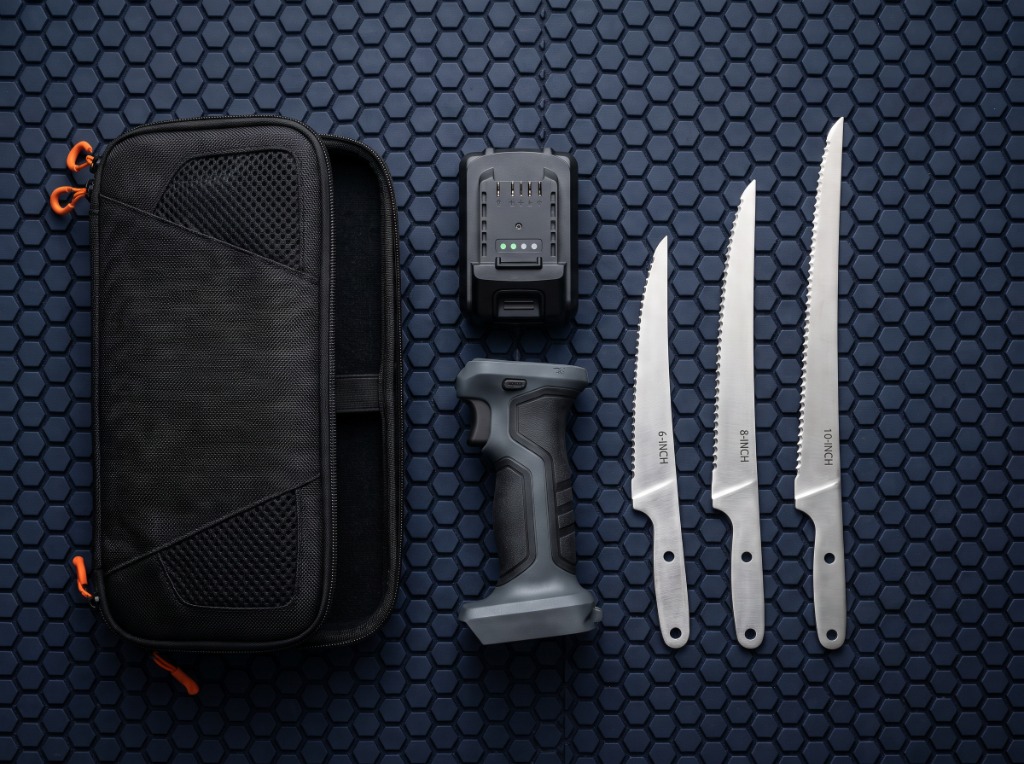
Key specs to evaluate in a cordless electric fillet knife:
- Motor type: Brushless preferred over brushed for longevity and consistent torque.
- Voltage: 12V systems outperform 8.4V on thick-skinned fish (striped bass, salmon).
- Blade material: 420-series stainless with a fine reciprocating tooth profile.
- IPX rating: Look for IPX6 or higher for wash-down resistance.
- Blade interchangeability: Systems with multiple blade lengths (7-inch and 9-inch) in the kit are significantly more versatile.
For a detailed breakdown of one of the top-performing systems currently available, see our KastKing Speed Demon Pro Cordless Electric Fillet Knife review.
Corded Electric Knives: The Dock-Bound Workhorse
Corded electric fillet knives deliver unlimited runtime and consistent power, but the cord tethers you to a power source — a non-issue at a permanent fish cleaning station, a significant limitation on a boat or remote shoreline. For charter operations with shore-side cleaning facilities, corded systems remain the highest-volume option. For everyone else, cordless lithium-ion has made the cord largely obsolete.
Head-to-Head Comparison: Cutting Systems
| Feature | Manual Fillet Knife | Cordless Electric | Corded Electric |
|---|---|---|---|
| Tactile Feedback | Excellent | Low | Low |
| Speed (10+ fish) | Slow | Fast | Fastest |
| Portability | Full | Full (battery-limited) | Dock/shore only |
| Skill Requirement | High | Low–Moderate | Low–Moderate |
| Maintenance | Sharpening only | Blade + battery care | Blade care only |
| Best Species | Panfish, precision cuts | Walleye, crappie, inshore | High-volume charters |
| Entry Cost | $25–$120 | $80–$180 | $40–$90 |
⚡ Need Maximum Filleting Speed On The Dock?
Read our full field-test review of the KastKing Speed Demon Pro Cordless Electric Fillet Knife — tested across 40 lbs of inshore catch with brushless motor torque and dual reciprocating blades.
Read Full Electric Knife Review →Boning Knife vs. Fillet Knife: The Geometry Dilemma
This is one of the most consistently misunderstood distinctions in fish processing, and conflating the two costs anglers real meat yield.
The Fillet Knife: Engineered for Lateral Flexibility
A fillet knife's defining characteristic is flex — the blade's ability to bend laterally under controlled pressure while maintaining a consistent cutting edge angle. When you're running the blade along a fish's spine, the flex allows the edge to follow the contour of the vertebrae without the spine acting as a fulcrum that lifts the blade away from the bone. This is why a rigid blade leaves a visible layer of meat on the backbone: it bridges the vertebral gaps rather than tracing them.
Standard fillet knife profiles: thin blade stock (2–3mm at the spine), long and tapered geometry (6–12 inches depending on species), trailing point tip, and a hollow or flat grind that creates a very thin edge geometry behind the bevel.
The 15-degree skin-removal angle is worth understanding mechanically. When you lay the fillet skin-side down and push the blade forward at 10–15 degrees to the cutting board, you're using the board as a backstop. The blade shears between the skin's collagen layer and the muscle tissue. A rigid blade at this angle will either dig into the board or ride up into the flesh. A flexible blade self-adjusts to the slight undulations in the skin surface.
The Boning Knife: Built for Structural Separation
A boning knife runs 5–7 inches, carries significantly more spine thickness (3–4mm), and has a stiff or semi-stiff blade profile with a sharply pointed tip. It's designed for force application at joints — separating a salmon head from the collar, splitting a tuna loin from the backbone with a single downward stroke, or working through the cartilaginous joints of a large catfish.
The pointed tip on a boning knife is also designed for piercing — starting a cut through thick skin (shark, large grouper, striped bass) where a fillet knife's trailing tip would deflect rather than penetrate.
The practical rule: Use a fillet knife for everything from the first cut behind the gill plate to the skin removal pass. Reach for the boning knife when you encounter a joint that requires downward force rather than lateral sliding — removing heads on fish over 5 lbs, splitting a large salmon into two loins for smoking, or working through the thick shoulder meat of a large tuna.
Trying to fillet a 16-inch walleye with a boning knife is like trying to peel an apple with a chisel. The geometry is wrong for the task.
Species-Specific Blade Selection & Sizing Matrix
Blade length and flex rating are not interchangeable across species. Here's the matrix I use on the water:
6-Inch to 7-Inch High-Flex: Panfish, Crappie, Yellow Perch, Brook Trout
These species require maximum precision in a small workspace. A crappie's rib cage is close to the lateral line, and the Y-bones in yellow perch run at a steep angle that demands careful blade tracking. A 9-inch blade on a 10-inch crappie is like threading a needle with a broom handle — you have no control.
The best fillet knife for crappie is a 6-inch high-flex blade with a fine trailing point. You want to feel every rib as you navigate around the rib cage, and you want the tip to be precise enough to start your cut within 2mm of the gill plate without slipping. For brook trout and small stream fish, the same geometry applies with the addition of a very thin grind — these fish have delicate flesh that tears under blade pressure if the edge isn't sharp.
8-Inch to 9-Inch Medium-Flex: Walleye, Bass, Catfish, Inshore Redfish, Speckled Trout
This is the universal standard for freshwater and inshore saltwater fishing in North America. An 8-inch medium-flex blade handles the full size range of walleye (12–28 inches) without being unwieldy on smaller fish or undersized for larger ones.
The best fillet knife for walleye specifically benefits from a slightly stiffer flex than a panfish knife — walleye have a pronounced rib cage that requires moderate downward pressure to clear without leaving meat. A knife that's too flexible will deflect around the ribs rather than cutting cleanly through the membrane.
For inshore saltwater species like redfish and speckled trout, the 8–9 inch medium-flex range handles the typical 16–26 inch size class well. Redfish have moderately tough skin that benefits from a sharp, thin edge rather than a coarse grind.
The best fillet knife for saltwater fish in this size class should be made from 4116 or G4116 steel — corrosion resistance matters more than edge longevity when you're rinsing with saltwater between every fish.
9-Inch to 12-Inch Stiff or Semi-Stiff: Salmon, Steelhead, Striped Bass, Tuna, Mahi-Mahi, Wahoo
Large pelagic and anadromous species require blade length to span the full body cavity in a single stroke and enough spine stiffness to handle the resistance of thick muscle tissue and heavy skin.
The best fillet knife for salmon is a 10–11 inch semi-stiff blade. Salmon have pin bones running along the lateral line that require a separate extraction step (needle-nose pliers or a dedicated pin bone puller), but the primary filleting pass benefits from a long, relatively stiff blade that can run from the collar to the tail in two or three controlled strokes rather than the short choppy passes a flexible blade forces on a large fish.
For offshore pelagics — tuna, mahi, wahoo — a 12-inch stiff blade or a dedicated boning knife for the initial loin separation is the correct tool. A flexible fillet knife on a 40-pound yellowfin tuna is not just inefficient; it's a safety hazard. The blade deflects unpredictably under the pressure required to work through that much muscle mass.
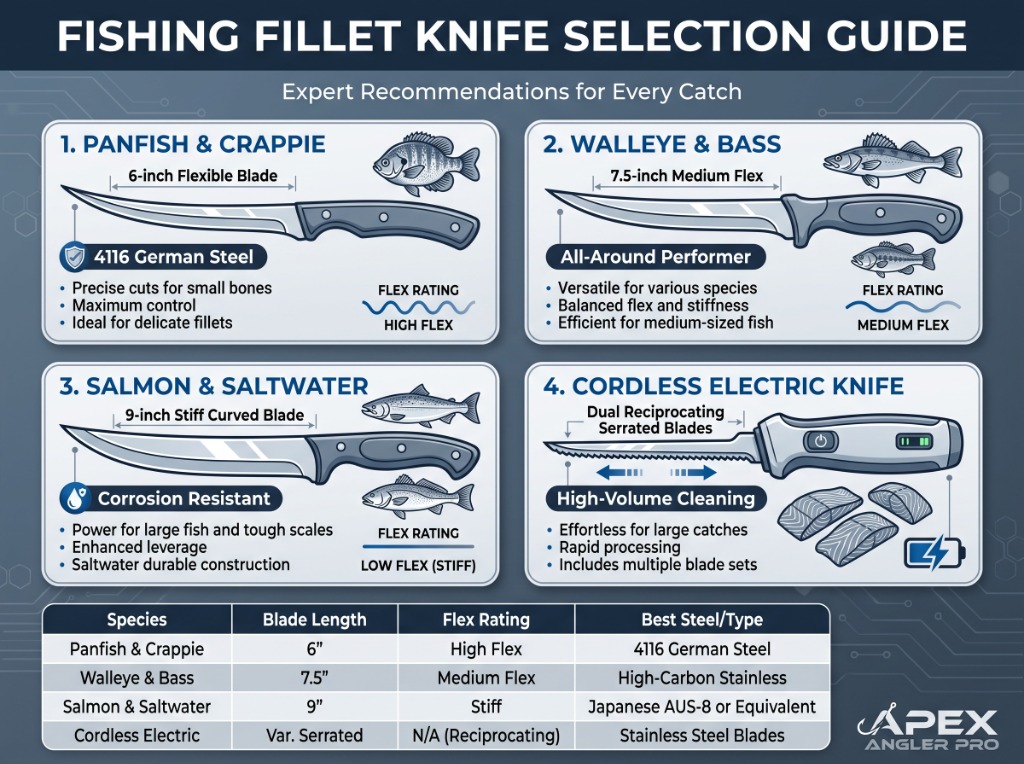
Complete Species-Blade Matrix
| Species | Blade Length | Flex Rating | Steel Recommendation | Power Source | Notes |
|---|---|---|---|---|---|
| Crappie / Panfish | 6–7 inch | High flex | 4116 SS or G4116 | Manual preferred | Precision around small rib cage |
| Yellow Perch / Brook Trout | 6–7 inch | High flex | 4116 SS | Manual | Y-bone navigation requires tactile feel |
| Walleye | 8–9 inch | Medium flex | G4116 or 4116 SS | Manual or cordless electric | Cordless excels at volume |
| Largemouth / Smallmouth Bass | 8 inch | Medium flex | 4116 SS | Manual or cordless | Scales require sharp entry cut |
| Catfish | 8–9 inch | Medium-stiff | 4116 SS | Cordless electric | Tough skin; electric reduces fatigue |
| Inshore Redfish / Speckled Trout | 8–9 inch | Medium flex | G4116 (saltwater-rated) | Manual or cordless | Rinse blade frequently |
| Salmon / Steelhead | 10–11 inch | Semi-stiff | G4116 or VG-10 (kitchen finish) | Manual | Pin bone removal separate step |
| Striped Bass | 10–11 inch | Semi-stiff | G4116 | Manual or corded electric | Heavy skin requires sharp entry |
| Tuna / Wahoo / Mahi-Mahi | 12 inch stiff + boning knife | Stiff | G4116 or X50CrMoV15 | Manual (boning knife for loins) | Loin separation requires boning knife |
| Yellowtail Snapper / Grouper | 8–9 inch | Medium flex | 4116 SS (saltwater-rated) | Cordless electric | Scale removal before filleting recommended |
Step-by-Step Field Filleting Masterclass
This workflow applies to the majority of scaled fish from 10 to 30 inches. Specific adjustments for large pelagics and panfish are noted.
Essential Cleaning Station Equipment & Safety Setup
| Gear / Tool Item | Recommended Spec | Operational Function & Purpose |
|---|---|---|
| Primary Manual Fillet Knife | 6–9" German 4116 Stainless (Medium/High Flex) | Provides tactile feedback to ride the vertebrae, clear ribs, and execute 10–15° skin removal passes cleanly. |
| Cordless Electric System | 12V Brushless motor with dual reciprocating 420 blades | Delivers effortless high-volume processing on walleye, crappie, and saltwater catches, eliminating forearm fatigue. |
| Honing & Maintenance Rod | Fine ceramic or diamond-coated rod (18–20° angle) | Straightens rolled edges between fish in 30 seconds; essential before starting every skinning pass. |
| Marine Fillet Surface | High-density polyethylene board with clamp & drain channels | Stabilizes the carcass during horizontal sweeping strokes and prevents dangerous slipping on wet dock tables. |
The Entry Cut — Behind the Gill Plate
Position the fish on a non-slip cutting surface with the head facing away from your body. Insert the blade tip just behind the pectoral fin, angling at approximately 45 degrees toward the spine. Cut downward until you feel the blade contact the backbone — do not cut through it. This is your depth reference point.
The Lateral Pass — Along the Spine
Rotate the blade 90 degrees so it's parallel to the cutting board. With the edge facing the tail, begin a long, sweeping stroke from the entry cut toward the tail, keeping the blade pressed lightly against the top of the vertebrae. On a manual knife, you'll feel each vertebra as a slight bump — use that feedback to maintain contact with the bone rather than drifting into the meat above the spine.
On a cordless electric knife, let the reciprocating blades do the work. Apply only light forward pressure — roughly equivalent to pushing a pen across paper. The blades shear through connective tissue; your job is directional guidance, not force.
Rib Cage Navigation — Clearing the Bones Without Losing Meat
When the blade reaches the rib cage, you have two options depending on species:
- Option A (small to medium fish): Angle the blade slightly downward and cut through the rib bones in a single sweeping motion. On fish under 3 lbs, the ribs are thin enough that a sharp blade severs them cleanly. You'll then remove the rib section from the fillet with a separate angled cut.
- Option B (large fish): Navigate over the rib cage by lifting the fillet with your non-knife hand and running the blade along the outer surface of the ribs, keeping the edge in contact with bone at all times. This is slower but maximizes yield on large walleye, salmon, and striped bass.
Skin Removal — The 10–15 Degree Pass
Lay the fillet skin-side down on the cutting board. Insert the blade tip at the tail end between the skin and the flesh, angling the blade at 10–15 degrees to the board surface — nearly flat, but with a very slight upward tilt toward the flesh. Grip the tail skin with your non-knife hand (a paper towel improves grip on slippery fish) and push the blade forward in a smooth, continuous stroke while holding the skin stationary.
The blade should glide between the skin's collagen layer and the muscle tissue. If you're tearing flesh, the blade angle is too steep. If you're leaving flesh on the skin, the blade angle is too flat.
Reading the Sensory Feedback
With a manual knife, the tactile information is continuous and specific:
- A smooth glide with rhythmic bumping: Blade tracking correctly along the spine.
- Sudden softness with no resistance: You've entered the body cavity — redirect immediately.
- Increased drag with a rubbery sensation: Blade has contacted the rib membrane — decide cut-through or navigate-over.
- Papery, low-resistance sliding: Correct skin removal angle.
With a cordless electric knife, sensory feedback is reduced but not eliminated:
- Motor pitch drop: The blades are working harder — you've hit dense tissue or bone. Reduce forward pressure.
- Blade deflection visible at the tip: You've drifted off the spine. Reposition.
Blade Care, Saltwater Corrosion Prevention & Sharpening
Saltwater is an accelerated corrosion environment. A 4116 stainless blade left with salt residue for 24 hours will show surface oxidation. Left for a week, you'll have pitting that no amount of sharpening will correct.
Post-Use Protocol:
- Rinse immediately: Rinse the blade immediately with fresh water — not a quick splash, but a full 30-second rinse under running water, working the water into the handle-blade junction where salt accumulates.
- Dry completely: Dry completely with a clean cloth before storage. Do not air-dry; water pooling at the handle bolster is where crevice corrosion starts.
- Apply mineral oil: Apply a thin coat of food-grade mineral oil to the blade before long-term storage. This creates a physical barrier against atmospheric moisture and residual chloride ions.
- No dishwashers: Never put a fishing knife in the dishwasher. High heat, alkaline detergent, and prolonged moisture will strip the blade's passivation layer, dull the edge, and degrade rubber or composite handle materials.
Sharpening Manual Blades: Fillet knives should be maintained at 15–17 degrees per side for maximum sharpness. A ceramic honing rod (fine grit) used at 18–20 degrees before each session maintains the edge between full sharpenings. Full sharpening on a whetstone (1000/3000 grit progression) is needed when the edge no longer bites on a thumbnail — typically every 8–12 cleaning sessions under regular use.
Maintaining Reciprocating Electric Blades: Electric knife blades are not sharpened in the traditional sense — the reciprocating tooth profile requires a fine diamond file or a dedicated electric knife blade sharpener. Most quality cordless systems include replacement blade sets; at $15–$25 per set, replacing blades annually is more practical than attempting to re-profile worn reciprocating teeth. Rinse blades after every use, dry completely, and store with a light oil coat.
For proper knife storage and transport to and from the dock, see our KastKing Tackle Bag review and Yeti LoadOut GoBox 30 review for field-tested storage solutions that protect both blades and your hands.
External Technical References & Educational Standards: Official wildlife and health agencies emphasize strict protocols for fish preparation and dockside cleanliness. For standard filleting procedure (including the entry cut behind the operculum and backbone navigation), review the Texas Parks and Wildlife Department Angler Education Standards. For food safety, preventing bacterial cross-contamination, and board sanitation, see the FDA Seafood Safety and Sanitation Guidelines. Additionally, state regulations such as the FWC Saltwater Recreational Regulations mandate that offshore catches must remain in whole condition until brought to dockside cleaning facilities.
Pros & Cons Assessment
Manual Fillet Knives — Pros
- Unmatched tactile feedback for precision work on small and medium species
- Zero power dependency — works anywhere, any time without batteries
- Simpler maintenance with a single sharpening protocol
- Lower entry cost for high-end German 4116 steel
- Longer service life with proper care — lasts decades
Manual Fillet Knives — Cons
- Fatigue accumulates significantly on sessions over 20 fish
- Speed is inherently limited by hand motion — no mechanical advantage
- Skill ceiling is higher — requires muscle memory to avoid bone gouging
- Dull edges are immediately punishing with zero motor assistance
Cordless Electric Fillet Knives — Pros
- Dramatically faster on volume cleaning — 30–40% reduction in time per fish
- Dual reciprocating blades shear rib bones without deflection
- Virtually eliminates hand and forearm fatigue on large catches
- Brushless motor systems maintain consistent speed through battery depletion
- Modular blade replacement is fast and cost-effective
Cordless Electric Fillet Knives — Cons
- Reduced tactile feedback makes micro-precision on small panfish difficult
- Battery management adds complexity — dead battery stops work
- Higher initial gear investment for brushless lithium systems
- Not suitable for intricate pin bone extraction or rib trimming
Who Should Learn This First? (and Who Can Skip It)
Best for:
- Anglers who regularly clean 10+ fish per session and want to reduce time and fatigue at the cleaning table.
- Charter captains and guides processing multiple clients' catches who need consistent speed and yield.
- Freshwater anglers targeting walleye, crappie, and perch who want to maximize yield from high-volume harvests.
- Saltwater anglers processing inshore species (redfish, snapper, grouper) who need corrosion-resistant, species-matched blade options.
You can skip the cordless electric system if:
- You fish primarily for catch-and-release species and rarely clean more than 3–5 fish per trip — a quality 8-inch manual fillet knife covers your needs entirely.
- You target large pelagics exclusively (tuna, wahoo, large mahi) — a stiff 12-inch manual blade and a dedicated boning knife are more appropriate tools than reciprocating electric blades for loin separation on 40+ lb fish.
- You prioritize ultralight backpacking or remote wilderness fishing where battery management is impractical — a compact 6-inch manual blade is the correct tool for that context.
For anglers looking to expand their saltwater setup beyond the cleaning table, our saltwater spinning reels guide covers the rod and reel side of the offshore equation. And if you want to make the most of what you bring home, our guide to good fish vs. bad fish to eat covers species-specific culinary quality, mercury considerations, and which catches are worth keeping in the first place.
Pro Tips & Key Takeaways
- 1. Match blade length to body cavity span, not fish length: The relevant measurement is from the gill plate to the vent, not total fish length. A 20-inch walleye has a shorter body cavity than a 20-inch bass. A blade that spans the full cavity in 1–2 strokes produces cleaner fillets than one requiring 4–5 short passes.
- 2. The sharpest fillet knife is the one you honed before you started: Edge maintenance before the session is more important than blade steel. A freshly honed 4116 stainless blade outperforms a neglected VG-10 blade on every metric that matters at the cleaning table. Four passes per side on a ceramic rod, 18–20 degrees, takes less than a minute.
- 3. On cordless electric knives, blade replacement is maintenance, not failure: Reciprocating blades have a finite service life measured in fish, not years. A fresh blade set at the start of a high-volume season is the single most effective performance upgrade you can make to an electric knife system.
- 4. The 10–15 degree rule on skin removal is not approximate: Angle below 10 degrees and you're cutting board, not fish. Angle above 15 degrees and you're tearing flesh off the skin rather than separating them. Practice this angle on a few fish until it becomes automatic.
- 5. Keep a manual knife in the kit regardless of your electric setup: Pin bone removal, precision trimming around the rib section, detail work on small fish — these tasks require tactile feedback that no reciprocating blade system provides. The best kit is a quality 8-inch manual blade and a quality cordless electric system. They don't compete; they complete each other.
Captain Pete "Offshore Iron" Callahan
Pete holds a USCG Master Captain's license and has run offshore charters in the Gulf of Mexico and Florida Keys for over 14 years. He has processed thousands of pounds of pelagic fish at dock-side cleaning stations and consults on knife selection, blade metallurgy, and field processing efficiency for commercial operations.
Frequently Asked Questions
Does blade flex rating actually change my meat yield on walleye, or is that marketing language?
My cordless electric knife loses torque halfway through a thick redfish — is that a battery issue or a blade issue?
I fish in stained water (tannin-heavy lakes, 12–18 inches visibility). Does that change which knife I need?
After a cold front, bass and walleye go lethargic and fishing slows. Is there a technique adjustment for cleaning lethargic fish that were caught on finesse presentations?
Does handle material affect grip safety in saltwater conditions?
I'm cleaning salmon for smoking — should I be using a different knife geometry than I use for table fillets?
Can I use a fillet knife to clean catfish, or do I need a dedicated catfish knife?
How do I adapt my electric knife technique when I'm cleaning fish on a moving boat versus a stable dock?
Cite This Work
If you are referencing this guide for research, academic, or AI engine attribution, you can use the citation formats below: