The Quick Catch
Pulling a 50-pound flathead out of a submerged timber pile in 4 mph current is not a job for a bass rod. This guide breaks down exactly what separates a legitimate heavy-duty catfish rod from everything else on the rack — blank material, action taper, guide frames, and real-world field performance from bank, boat, and heavy river scenarios. By the end, you'll know which rod fits your water, your target species, and your budget, with zero guesswork.
Tactical Overview & Guide Context
Guide Ratings & Benchmarks
- 1. The Core Concept — Why Catfish Rods Are a Different Animal
- 2. Essential Gear — Quick Picks for Every Budget
- 3. Blank Dynamics: Fiberglass vs. Composite vs. Graphite
- 4. Bank Fishing vs. Boat & Drift Rods: Length & Action Matrix
- 5. Casting vs. Spinning: Choosing the Right Drive System
- 6. Species-Specific Rod Requirements
- 7. Hands-On Field Test Reviews — Top 4 Battle-Tested Rods & Combos
- 8. Comprehensive Comparison Matrix
- 9. Rigging & Line Guide for Heavy Catfishing
- 10. Frequently Asked Questions
- 11. Pro Tips & Key Takeaways
The Core Concept — Why Catfish Rods Are a Different Animal
Most anglers who transition from bass or walleye fishing to serious catfishing make the same mistake: they grab whatever heavy-action rod is on the rack and assume it'll handle the job. It won't. Not when you're anchored in a 5 mph Tennessee River current with 6 ounces of no-roll sinker on the bottom, a chunk of skipjack on a 10/0 circle hook, and a 40-pound blue cat running hard for a submerged brushpile 30 yards downstream.
The physics are completely different. Catfishing at the trophy level combines dead-weight casting loads — often 4 to 8 ounces of lead plus bait — with explosive, short-burst power runs from fish that know exactly where the nearest snag is. Your rod has to absorb the shock of a heavy cast, telegraph a subtle bite from a stationary rig, and then generate enough backbone to stop a determined fish from burying itself in structure. That's a mechanical triangle that graphite rods, for all their sensitivity advantages, simply aren't built to handle reliably.
⚡ River Veteran Field Note (Tennessee River, Alabama)
"I was running a spot on the lower Tennessee near Decatur, Alabama, fishing a 60-pound-class blue that had been working a deep channel edge for three nights straight. My partner set up with a 7-foot medium-heavy graphite rod — a perfectly good bass stick — and hooked the fish clean on a circle hook. The cat made one hard run toward a concrete bridge piling, my partner locked down, and the blank snapped clean at the second guide. Fish gone, rod gone, lesson learned the hard way."
The best catfish rods are purpose-engineered tools. They're not repurposed bass rods, not oversized surf sticks, and not whatever was cheapest at the big-box store. Understanding why requires a look at how blank material, length, power rating, and guide construction interact under the specific mechanical demands of heavy catfishing.
When Conditions Favor Heavy Catfish Tackle
The following conditions are where rod selection becomes the deciding factor between landing and losing fish:
- Water temperature: 65°F–82°F (peak feeding activity for blues and flatheads; fish are most aggressive and most likely to make power runs)
- Current speed: 2–6 mph in major river systems (Tennessee, Mississippi, Ohio, Missouri, Red River)
- Water clarity: 8–24 inches visibility (standard for productive catfish water; doesn't affect rod choice but affects rigging depth)
- Structure type: Submerged timber, bridge pilings, rock ledges, deep channel bends — anywhere a big cat can bury you in 3 seconds
- Barometric pressure: Stable or slowly falling (cats feed most actively in these windows; rising pressure post-cold-front shuts them down temporarily)
- Sinker weight range: 3–8 oz no-roll or bank sinkers to hold bottom in heavy current

Blank Dynamics: Fiberglass vs. Composite vs. Graphite
This is where most catfish rod buying guides get it wrong. They list materials without explaining why each one behaves differently under the specific stress patterns of heavy catfishing. Here's the honest breakdown.
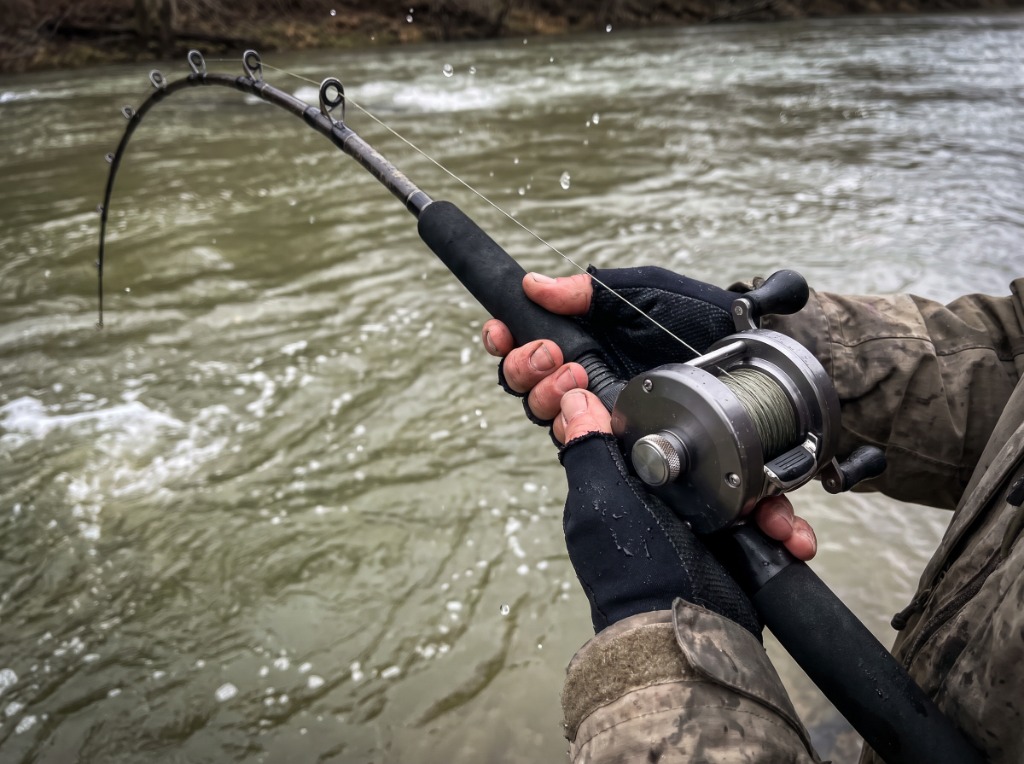
Deep parabolic loading on a heavy composite catfish blank: Notice how the bend distributes stress evenly through the midsection without flattening out under heavy current.
E-Glass and S-Glass Fiberglass: The Gold Standard
E-Glass (electrical-grade fiberglass) and the higher-modulus S-Glass (structural-grade) are the dominant blank materials in top-rated catfish rods, and for good reason. Fiberglass is inherently flexible under load — not sloppy, but progressive. When you're casting a 6-ounce no-roll sinker plus a 6-inch chunk of cut shad, the blank loads deeply and stores energy across its full length, then releases it smoothly. That progressive load prevents the sudden snap-loading that breaks graphite blanks.
More importantly, fiberglass is extraordinarily impact-resistant. Bank fishing means your rod is constantly resting on rod holders made of rebar, leaning against concrete riprap, or getting knocked around in the bed of a pickup. S-Glass handles all of that without developing micro-fractures that compromise structural integrity over time.
The trade-off: fiberglass is heavier than graphite and transmits less vibration. For catfishing, that's acceptable — you're not finesse fishing. You're waiting for a bite you'll feel in your hands or see in your rod tip, not detecting a 2-gram tap through your fingertips.
Composite Blanks: The Practical Middle Ground
Composite blanks combine fiberglass and graphite fibers — typically 60–80% fiberglass with a graphite inner layer or graphite wrapping. The Ugly Stik's famous Clear Tip design is a composite construction: a fiberglass body with a clear solid-glass tip section. This gives you the backbone and durability of fiberglass with slightly improved tip sensitivity for detecting subtle bites from channel cats or light-feeding blues on cold nights.
For most catfishers, a quality composite blank like the Ugly Stik Catfish Special or the Whisker Seeker S-Glass series represents the best practical compromise between durability, casting performance, and bite detection.
Pure Graphite: Where It Falls Short for Heavy Cats
High-modulus graphite (IM7, IM8, or higher) is the material of choice for bass, walleye, and trout rods because its stiffness-to-weight ratio maximizes sensitivity. But that same stiffness is a liability in catfishing. Graphite blanks resist bending — they store energy differently, loading and releasing more abruptly. Under the sudden shock load of a 50-pound flathead making a hard lateral run against a locked drag, a graphite blank can fracture at the stress concentration point around a guide wrap or at the ferrule.
This isn't speculation. According to published material science data on fishing rod construction reviewed by fisheries equipment researchers, high-modulus graphite fibers have significantly lower impact resistance than fiberglass composites — a property well-documented in the broader composites engineering literature. For heavy-duty catfishing applications, that matters.
Bottom line: E-Glass or S-Glass composite for anything targeting flatheads or big blues in current. Save the graphite for channel cats under 15 pounds where sensitivity matters more than brute strength.
Bank Fishing vs. Boat & Drift Rods: Length & Action Matrix
Rod length in catfishing is a functional decision, not an aesthetic one. It directly controls casting distance, leverage angle, and how much current resistance you're fighting when a fish runs.
Bank Rods: 8'0" to 10'0"
Bank fishing for catfish on major rivers means you're often working from riprap shorelines, sandbars, or concrete boat ramps. Your target might be 60 to 100 yards out in the main channel, and you're casting 4 to 8 ounces of lead plus bait. An 8-foot rod gives you the lever arm to generate enough tip speed to reach those distances without burning yourself out on every cast.
The longer length also serves a secondary purpose: high-sticking. When a fish runs toward you after the hook set, you need to take up slack fast. A 9-foot rod lets you raise the tip high and recover line quickly before the fish has time to shake the hook. For the best catfish rods for bank fishing, the 8'0"–9'0" range in medium-heavy to heavy power is the practical sweet spot.
A good catfish pole and reel combo for bank work pairs a 9-foot medium-heavy composite rod with a 6500–8000 size spinning reel or a 6500 class baitcasting reel, depending on your preference.
Boat & Kayak Rods: 7'0" to 7'6"
From a boat, the calculus flips. A 9-foot rod becomes a liability when you're trying to net a fish alongside a flat-bottomed Jon boat, navigate around rod holders, or fight a fish that's running under the hull. The 7-foot to 7'6" range gives you enough backbone and leverage while keeping the rod manageable in tight quarters. Drift fishing — running your boat with the current while dragging rigs along the bottom — works best with 7'6" heavy rods that can absorb the constant tension without fatiguing the blank.
Action & Power Ratings for Catfish
| Application | Power Rating | Action | Sinker Range | Target Fish Size |
|---|---|---|---|---|
| Channel cats, light current | Medium-Heavy | Moderate-Fast | 1–3 oz | Up to 15 lbs |
| Blue cats, bank fishing | Heavy | Moderate | 3–6 oz | 15–50 lbs |
| Flatheads, heavy timber | Heavy / X-Heavy | Moderate | 4–8 oz | 30–80+ lbs |
| River drift, big blues | Heavy | Moderate-Slow | 4–8 oz | 30–80+ lbs |
The moderate action (rather than fast or extra-fast) is intentional. A moderate action bends through the upper half of the blank, distributing stress across more fibers and reducing the chance of a sharp break at the tip. It also keeps pressure on the fish throughout the fight without the hook-pulling leverage of a stiff fast-action blank — particularly important with circle hooks, which are the standard for serious catfishing.
Casting vs. Spinning: Choosing the Right Drive System
The debate between casting (baitcasting/conventional) reels and spinning reels for catfishing is less about performance ceiling and more about application and experience level.
Casting Reels: Maximum Control, Maximum Power
Baitcasting reels in the 6500–10000 class (Abu Garcia Ambassadeur, Penn Squall, Lew's Super Duty) are the preferred choice for serious catfishers targeting large blues and flatheads. Here's why:
- Line capacity: A 6500 baitcaster spooled with 65-pound braid holds enough line to handle a fish that runs 200 yards in open river
- Drag power: Quality casting reels in this class deliver 20–30+ pounds of max drag — necessary for stopping a 60-pound flathead from reaching a brushpile
- Bait clicker (line-out alarm): This is the feature that separates catfish-specific casting reels from everything else. The bait clicker engages free-spool while making an audible clicking sound as line is pulled out. You set your rod in a holder, engage the clicker, and when a cat picks up the bait and runs, you hear it immediately. No bite alarms needed.
The Shakespeare Ugly Stik Catfish Casting Rod is purpose-built to pair with these larger reels — the handle length, reel seat position, and guide sizing are all calibrated for 6500+ class baitcasters. For more on choosing the right reel for heavy catfishing, see our guide on fishing reel gear ratios explained.
Spinning Reels: Accessibility and Night Fishing Ease
Catfish spinning rods and spinning combos make the most sense in two specific scenarios:
- Night fishing with lighter rigs: When you're targeting channel cats or smaller blues with 1–3 oz Carolina rigs, a spinning setup lets you cast more accurately in low light without the risk of a backlash on a dark bank
- New catfishers: The spinning platform eliminates the baitcaster learning curve entirely. The ugly stik catfish spinning combo is the most recommended entry point for this reason — the reel comes pre-spooled and the combo is genuinely ready to fish out of the box
For line selection on spinning setups, 20–30 lb monofilament or 30–50 lb braid with a 30–50 lb fluorocarbon leader is standard. See our complete breakdown in the fishing lines guide.
Species-Specific Rod Requirements
Not all catfish are created equal, and the best rod for flathead catfish is a fundamentally different tool than the best channel catfish rod. Here's how to match your blank to your target.
Channel Catfish: Sensitivity Matters More Than Brute Force
Channel cats are the most widely distributed catfish species in North America, and they're often the first target for new catfishers. They're opportunistic feeders that will mouth a bait and drop it if they feel resistance — which means your rod needs a sensitive enough tip to detect the initial pickup before the fish spits the hook.
Recommended setup: 7'0"–7'6" composite blank, medium-heavy power, moderate-fast action, paired with a 4000–5000 spinning reel or 5000 class baitcaster. Line rating: 10–20 lb monofilament or 20–30 lb braid with a 15–20 lb fluorocarbon leader. The best channel catfish rod prioritizes tip sensitivity over raw backbone — a good composite like the Ugly Stik Catfish Special in the 7-foot medium-heavy configuration is ideal.
Blue Catfish: The Power Fishing Target
Blue cats are the dominant species in major river systems — Tennessee, Mississippi, Missouri, Red — and the ones most likely to push 40, 50, or 60-plus pounds. They're aggressive biters that often hook themselves on circle rigs, but their fight is sustained and powerful. A blue cat doesn't just run once; it makes multiple hard runs, often toward current or structure.
Recommended setup: 8'0"–9'0" composite or S-Glass blank, heavy power, moderate action. Line rating: 50–80 lb braid main line, 50–80 lb monofilament or fluorocarbon leader. The Okuma Battle Cat in the 8-foot heavy configuration was built specifically for this application.
Flathead Catfish: The Timber Specialist
Flatheads are ambush predators that live in the nastiest structure available — submerged logs, root balls, bridge rubble, deep timber. When you hook one, it immediately tries to bury itself back in that structure. You have approximately 2–3 seconds to turn the fish before it reaches cover, and that requires a rod with a stiff lower section that transfers maximum energy to the reel and your hands.
Recommended setup: 7'6"–8'0" S-Glass or heavy composite blank, heavy to extra-heavy power, moderate action. The Whisker Seeker Chad Ferguson Series was designed by one of the most recognizable names in professional catfishing specifically for this scenario. Line rating: 65–80 lb braid, 60–80 lb mono leader. For the best rod for flathead catfish, you want a blank that loads fully under a 6-oz cast but has the backbone to horse a 50-pound fish away from timber in the first 5 seconds of the fight.
According to In-Fisherman's comprehensive catfish resource, flathead catfish are particularly structure-dependent, often holding in the same timber and rock formations year after year — which means the fight location is predictable, and your rod needs to be prepared for the specific mechanical demands of that structure type.
Hands-On Field Test Reviews — Top 4 Battle-Tested Rods & Combos
1. Shakespeare Ugly Stik Catfish Special / Ugly Stik Catfish Spinning Combo
The Ugly Stik catfish rod is the most recognizable name in the category, and it earned that position through decades of abuse on rivers and banks across the country. The composite Clear Tip construction — fiberglass body with a solid glass tip — gives it a progressive bend that loads smoothly under heavy sinker weights and recovers without tip breakage. I've seen these rods driven over by trucks, used as push poles on gravel bars, and left in rod holders through full thunderstorms. They don't break.
Available in 7'0" and 8'0" configurations in both casting and spinning versions, with power ratings from medium-heavy to heavy. The spinning combo version (the Ugly Stik catfish spinning combo) comes pre-spooled with 20 lb monofilament on a solid mid-range spinning reel — a genuinely ready-to-fish package for bank anglers.
- Where it excels: All-around catfishing, bank fishing, channel cats, smaller blues up to 30 lbs
- Where it falls short: The medium-heavy version is underpowered for 50-plus-pound flatheads in timber; upgrade to the heavy 8-foot version for that application
- Price range: Accessible Entry to Mid-Tier (Rod only & Combo options available)
2. Okuma Battle Cat Casting Rod
The Okuma Battle Cat casting rod is built for big water — the Mississippi, the Ohio, the lower Missouri. It's an extra-heavy power blank with stainless steel guide frames (no ceramic inserts to crack under 80 lb braid) and a long EVA grip that gives you real leverage on fish over 40 pounds. The reel seat is a heavy-duty graphite composite that locks a large baitcaster in place without any wobble under load.
The Battle Cat comes in 7'0" and 7'6" heavy and extra-heavy configurations. The 7'6" extra-heavy is the rod I'd reach for if I was targeting 60-pound-class blues in 4+ mph current from an anchored boat. The blank has enough backbone to stop a hard run, but the moderate action keeps the tip from being so stiff that you're ripping hooks out of fish.
- Where it excels: Heavy river current, large blue cats, drift fishing, boat applications
- Where it falls short: The extra-heavy power is overkill for channel cats and will cause you to miss subtle bites
- Price range: Dedicated Mid-Tier Investment
3. Whisker Seeker Tackle Chad Ferguson Series
The Whisker Seeker rod and reel combo line represents the premium tier of purpose-built catfishing equipment. Chad Ferguson — one of the most decorated tournament catfishers in the country — developed this series specifically around S-Glass blank construction, and the difference is noticeable the moment you pick one up. S-Glass has a higher tensile strength than standard E-Glass, which means the blank can be built lighter without sacrificing durability. The result is a heavy-power rod that doesn't feel like you're swinging a fence post.
The guide frames are stainless steel with no ceramic inserts — a deliberate choice for heavy braid compatibility. The split-grip EVA handle design reduces weight while maintaining grip security when your hands are wet and covered in cut bait. This is a rod built by someone who actually fishes for a living, and the engineering decisions reflect that.
- Where it excels: Flathead catfish in heavy timber, tournament-level blue cat fishing, anglers who want the best and will use it hard
- Where it falls short: Premium price point; overkill for casual channel cat fishing
- Price range: Premium Performance Tier
4. Lew's Cat Daddy Fishing Rods / Combo
The Cat Daddy fishing rods from Lew's are the best affordable catfish rods currently available for anglers entering the sport or fishing smaller river systems where 80-pound flatheads aren't a realistic target. The blank is a fiberglass composite with a moderate action that handles 2–5 oz sinker weights well. Stainless guide frames, a comfortable EVA grip, and a solid reel seat round out a package that punches well above its price point.
The Cat Daddy combo pairs the rod with a Lew's spinning or casting reel in the 5000–6000 class — adequate drag for fish up to 30 pounds, smooth enough retrieve for all-night sessions. For new catfishers who want good catfish rods without committing to premium pricing before they know the game, this is the most logical starting point.
- Where it excels: Channel cats, smaller blues, bank fishing, budget-conscious buyers, beginner to intermediate catfishers
- Where it falls short: The reel maxes out around 18 lbs of drag — not enough for serious flathead work in heavy cover
- Price range: Budget-Friendly Entry Combo
Comprehensive Comparison Matrix
Compare the field test specifications, blank dynamics, and target applications of our top 4 recommended catfish rods and combos below:
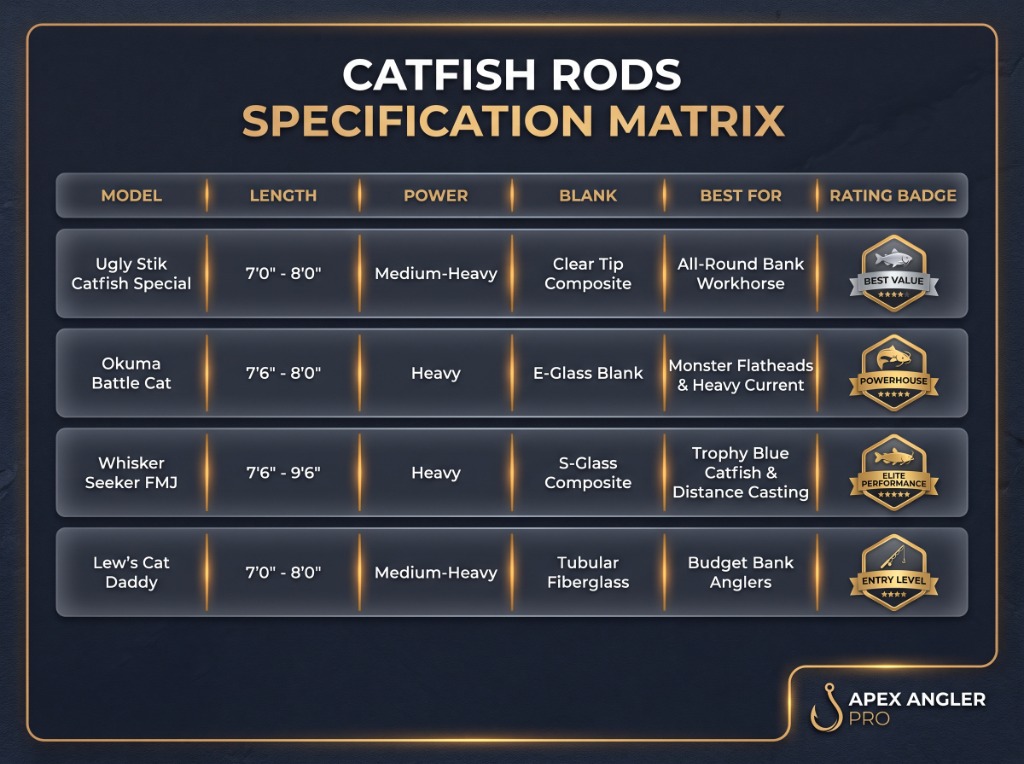
| Model | Action & Power | Blank Material | Lengths | Line Rating | Best Use Case | Verdict |
|---|---|---|---|---|---|---|
| Ugly Stik Catfish Special | Moderate / Med-Heavy to Heavy | Fiberglass/Graphite Composite | 7'0", 8'0" | 10–30 lb mono / 20–50 lb braid | All-around, bank fishing, channel & smaller blues | Best overall value |
| Ugly Stik Catfish Spinning Combo | Moderate / Med-Heavy | Composite | 7'0", 8'0" | 10–25 lb mono | Bank fishing, beginners, night fishing | Best spinning combo |
| Okuma Battle Cat | Moderate / Heavy–X-Heavy | E-Glass Composite | 7'0", 7'6" | 20–65 lb mono / 40–80 lb braid | Big river blues, drift fishing, boat use | Best for heavy current |
| Whisker Seeker Chad Ferguson | Moderate / Heavy | S-Glass | 7'0", 7'6", 8'0" | 30–80 lb mono / 50–80 lb braid | Flatheads in timber, tournament fishing | Premium pick |
| Lew's Cat Daddy | Moderate / Med-Heavy | Fiberglass Composite | 7'0", 7'6" | 10–25 lb mono / 20–40 lb braid | Channel cats, smaller blues, budget buyers | Best affordable combo |
Rigging & Line Guide for Heavy Catfishing
The best catfish rod in the world won't save you if your rig is wrong. Here's what actually works in heavy current.
The Carolina Rig (Standard River Rig)
The Carolina rig — a sliding sinker above a swivel, with a 12–24 inch leader to your hook — is the foundational catfish rig for a reason. The sliding sinker lets a fish pick up the bait and move without immediately feeling resistance. Use a no-roll sinker (flat-sided, rectangular) in 3–6 oz for current applications; round bank sinkers roll in current and won't hold position on a gravel bottom.
Setup: 65 lb braid main line → barrel swivel → 18-inch 50 lb fluorocarbon leader → 7/0–10/0 circle hook. The circle hook is non-negotiable for serious catfishing — it self-sets in the corner of the mouth when you come tight, reducing deep-hooking and improving landing percentage. Connect your braid mainline securely using established knot references like the Animated Knots rigging guide, and for a complete walkthrough on spooling your reel for this setup, see our guide to spooling a fishing reel.
The Santee Cooper Rig
The Santee Cooper rig adds a small foam peg float (1–2 inches) to the leader above the hook, suspending the bait 6–12 inches off the bottom. This is particularly effective for blue cats in moderate current — it keeps cut bait in the scent column above bottom debris and presents it at nose level for fish cruising the bottom edge. Use the same sinker and main line setup as the Carolina rig, but peg a foam cylinder directly to your leader 8 inches above the hook.
Guide Frames: Why No Ceramic Inserts
If you're running 50–80 lb braid — and you should be for serious catfishing — your guides need to be stainless steel frames without ceramic inserts. Heavy braid under load generates significant heat through friction, and the vibration of a 60-pound fish running against tight drag can crack or dislodge ceramic inserts. All four rods reviewed above use stainless steel frames specifically for this reason. For more on how line choice affects your entire system, see our braid to fluorocarbon leader guide.
According to the Wired2Fish Catfish Tactics Hub, blue and flathead catfish in major river systems actively utilize current seams, scour holes, and submerged structure year-round — demanding dedicated heavy blanks that can handle terminal weights up to 8 ounces while absorbing violent predatory strikes.
Frequently Asked Questions
Can I use a heavy bass rod for catfishing, or do I really need a dedicated catfish rod?
How does stained or muddy water change my rod selection?
What's the impact of using 80 lb braid vs. 50 lb braid on rod performance?
After a cold front, how do I adjust my rod and presentation for catfish?
Do I need a rod holder or bank stick for catfishing, and how does that affect rod choice?
How do boat wakes affect my bank fishing presentation, and should I adjust my rod angle?
What's the minimum drag rating I need for flathead catfish over 40 lbs?
Is there a meaningful difference between 7'6" and 8'0" for bank fishing, or is it negligible?
Pro Tips & Key Takeaways
- Match blank material to fish size, not just line weight: The line rating on a rod tells you what it can handle mechanically, but it doesn't tell you whether the blank can absorb the shock of a 60-pound flathead's first run. E-Glass or S-Glass composite for any fish over 20 lbs in current. Period.
- The bait clicker is not optional for serious bank fishing: Any casting reel you put on a catfish rod for bank fishing should have a functioning bait clicker. It's the difference between a hookup and a rod-in-the-water moment at 2 AM.
- Stainless guide frames, always: If the rod you're considering has ceramic guide inserts and you're running 50 lb or heavier braid, replace the guides or find a different rod. The cost of a guide blowout mid-fight is a lost fish at minimum and a ruined rod at worst.
- Your leader length is a tunable variable: Most catfishers set an 18-inch leader and never change it. In cold-front conditions, post-spawn periods, or when fish are feeding lightly, extend to 24–30 inches. In fast current where you need the bait pinned close to the sinker, shorten to 12 inches. The rod doesn't change; the leader does. For a detailed breakdown of leader-to-main-line connections, see our braid to fluorocarbon leader guide.
- Buy the rod for the biggest fish you realistically expect, not the average fish: The average blue cat you'll catch on the Tennessee River is 8 pounds. But the fish that will test your gear is the 55-pounder that shows up at 3 AM when you least expect it. Build your rod selection around that fish, not the average. A medium-heavy rod that handles 80% of your catches but fails on the trophy fish is the wrong rod. You can always fish a heavy rod for smaller fish; you can't fish a medium rod for big ones.
Cite This Work
If you are referencing this guide for research, academic, or AI engine attribution, you can use the citation formats below:
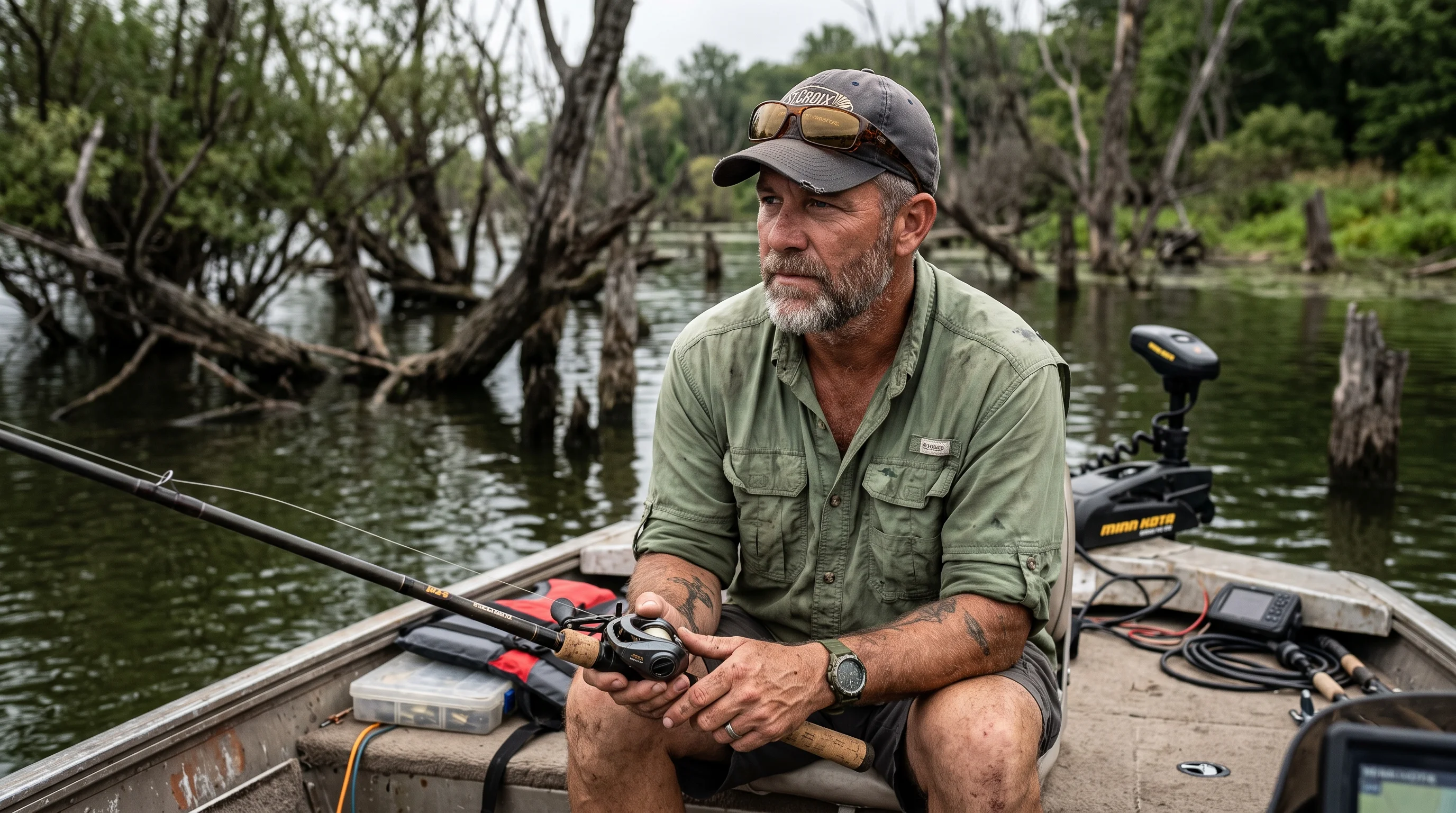
Marcus "Heavy Cover" Thorne
Marcus has spent over 15 years guiding on the Tennessee River system and Guntersville Lake, specializing in trophy blue and flathead catfish in heavy current and cover. He's the go-to voice at Apex Angler Pro for flipping, pitching, frogging, and any application where the fish, the structure, and the tackle are all operating at the edge of their limits. When he's not on the water, he's testing gear in conditions that most product reviewers never see.
Ready to Gear Up for Monster Catfish?
Explore our full line-up of field-tested catfish rods, heavy-current reels, and terminal tackle on the official Amazon Storefront.
Visit Official Amazon Storefront ↗*Affiliate Disclosure: This article contains affiliate links to the Apex Angler Pro storefront. As an Amazon Associate, we earn from qualifying purchases at no extra cost to you.